





![[FREE EBOOK] Strategic Vietnam IT Outsourcing: Optimizing Cost and Workforce Efficiency](https://vti.com.vn/wp-content/uploads/2026/06/ebook-it-outsourcing.png)


Did you know that organizations implementing comprehensive application security monitoring reduce breach costs by an average of $2.22 million? In today’s digital landscape, applications face constant threats from sophisticated attackers, making robust security monitoring not just important – but essential for business survival.
This guide breaks down everything you need to know about application security monitoring, from understanding core components like SAST, DAST, and IAST testing methods, to implementing AI-powered threat detection systems. Whether you’re a CxO looking to quantify security ROI or an IT leader navigating modern architecture challenges, you’ll discover practical strategies, proven frameworks, and actionable insights that transform your application security from a cost center into a competitive advantage.
5 Must-Adapt IT Operations Trend Before 2030 This ebook provides a clear, executive-level perspective on 5 forces redefining IT operations in the next 5 years. The strategic decisions leaders must act now to stay ahead.
What is application security monitoring?
Application security monitoring (ASM) is the process of systematically observing and evaluating software systems to uncover security weaknesses, spot potential threats, and prevent cyberattacks. ASM moves beyond point-in-time testing to ongoing surveillance of how applications function.
By continuously examining network activity and reviewing system records, security teams can detect unusual patterns or questionable behavior that may signal a compromise.
Recently, the demand for such security managed services from third parties has been increasing. Recent studies reveal that over two-thirds of CISOs (Chief Information Security Officers) find vulnerability management increasingly challenging. This is because software supply chains and cloud infrastructures are growing more complex. Additionally, nearly 75% of these security leaders struggle to reduce risks effectively, largely because collaborating with vendors to discover and fix security flaws proves difficult.
Application security relies on multiple layers of protection that work together throughout the software lifecycle. These components range from testing tools used during development to continuous monitoring systems that protect applications in production.
What are the key components of application security?
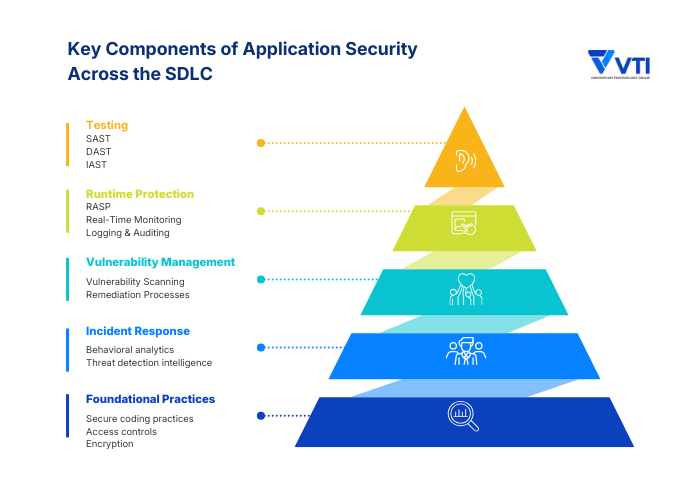
Application security relies on multiple layers of protection of your software throughout its entire development lifecycle (SDLC). These components range from testing tools used during development to continuous monitoring systems that protect applications in production.
Testing Components
Static Application Security Testing (SAST) analyzes source code during development to catch vulnerabilities before deployment. This method scans code without running it, finding injection flaws and insecure patterns early. SAST reduces remediation costs by 85% when implemented in development phases.
Dynamic Application Security Testing (DAST) evaluates running applications in real-time. It simulates external attacks to discover runtime vulnerabilities that static analysis misses. DAST operates from an attacker’s perspective to identify exploitable gaps during execution.
Interactive Application Security Testing (IAST) combines SAST and DAST strengths by monitoring applications during runtime. It instruments code to observe execution paths and provides real-time feedback. IAST reduces false positives by 70% compared to standalone approaches.
Runtime Protection & Monitoring
Runtime Application Self-Protection (RASP) embeds security controls within applications to block attacks in production. It detects and stops threats like injection attacks as they occur, providing immediate defense when vulnerabilities are exploited.
Real-Time Monitoring tracks the application’s infrastructure, network traffic, and user activities for any signs of intrusion or suspicious behavior. Deviations or anomalies from “normal” application behavior can indicate a valid security concern.
Logging and Auditing involve collecting and analyzing the application’s logs and audit trails. These logs provide valuable information about the application’s behavior and potential security incidents.
Vulnerability Management
Vulnerability Scanning uses automated tools to regularly scan applications and identify potential weaknesses. These tools detect known security vulnerabilities, misconfigurations, and outdated software components.
Remediation Processes track and address security flaws throughout the application lifecycle, ensuring vulnerabilities are prioritized and fixed systematically.
Incident Response
Incident Detection and Response establishes a well-defined process to investigate and mitigate security incidents. This involves behavioral analytics, real-time monitoring of network traffic, user activity, and system logs, combined with threat intelligence. Effective incident response goes through phases of isolating affected systems, analyzing the impact, identifying the root cause, and taking appropriate remedial actions.
Foundation Elements
Secure Coding Practices following OWASP Top 10 guidelines form the foundation of application security. Access controls and encryption protect data both in transit and at rest. These components work together within a secure development lifecycle (SDLC) framework to create comprehensive protection across all phases of application development and deployment.
How does ASM work across the SDLC and runtime?
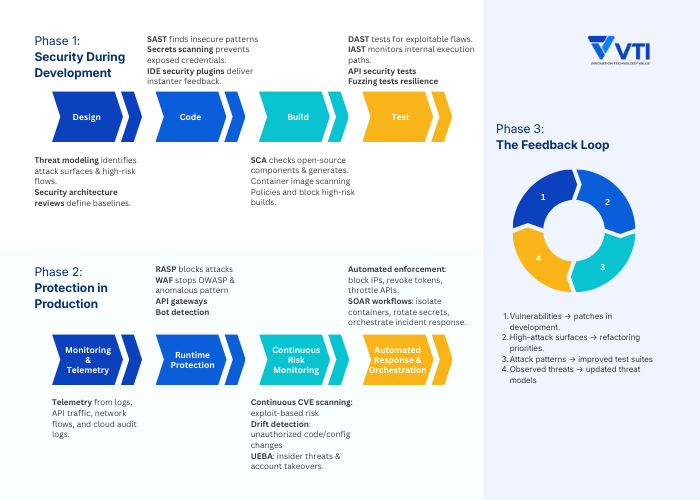
Let’s give you a simple understanding of how the aforementioned components work together. It starts during development and continues while your app runs in production.
Security During Development
Security begins at the design phase with threat modeling. Teams identify potential attack surfaces and high-risk flows before writing any code.
Security architecture reviews establish control baselines that guide development.
During coding:
- Static Application Security Testing (SAST) scans source code for vulnerabilities like SQL injection or insecure cryptography.
- Secrets scanning catches exposed API keys and credentials before they reach repositories.
- IDE-level security plugins give developers instant feedback, catching issues before code is even committed.
At the build stage:
- Software Composition Analysis (SCA) examines third-party libraries and generates a Software Bill of Materials (SBOM) to track dependencies and CVE (Common Vulnerabilities and Exposures) risks.
- Container image scanning checks base images for vulnerabilities and misconfigurations. Build pipelines can automatically block deployments if critical vulnerabilities exceed policy thresholds.
Testing includes:
- Dynamic Application Security Testing (DAST) probes running applications for exploitable flaws.
- Interactive Application Security Testing (IAST) monitors applications from the inside during test execution.
- API security tests validate authentication, authorization, and rate limits
- Fuzz testing checks how apps handle unexpected inputs.
Before deployment, Infrastructure as Code (IaC) scanning reviews Terraform, Helm, and CloudFormation templates. Configuration scans ensure Kubernetes and cloud environments meet security hardening standards.
Protection in Production
First of all, runtime monitoring ingests telemetry from application logs, API traffic, network flows, and cloud-native audit logs from Kubernetes, AWS, and GCP. This comprehensive observability detects threats that testing alone cannot catch.
Runtime Application Self-Protection blocks attacks like SQL injection in real-time.
Web Application Firewalls stop OWASP Top 10 attacks and detect anomalous request patterns.
API security gateways identify token misuse, shadow APIs, and abnormal client behavior.
Bot detection prevents credential stuffing and automated scraping attacks.
Continuous CVE scanning monitors production dependencies with real-time risk scoring based on exploit activity.
Drift detection catches unauthorized configuration or code changes.
User and Entity Behavior Analytics (UEBA) identifies account takeovers and insider threats by spotting unusual patterns. Advanced systems correlate signals across microservices to detect multi-step attacks, such as lateral movement and privilege escalation.
Automated policy enforcement can block suspicious IPs, revoke compromised tokens, or throttle abusive APIs.
SOAR integration orchestrates complex response workflows, such as isolating containers or rotating secrets.
The Feedback Loop
Runtime insights create a powerful feedback cycle, with 4 steps:
- Production vulnerabilities trigger upstream patches.
- Frequently attacked surfaces get prioritized for refactoring.
- Attack patterns inform test suite improvements
- Updates to the threat model.
This continuous improvement cycle strengthens security with every deployment.
Modern Architecture Monitoring Challenges and Solutions
Microservices Security Monitoring Across Distributed Environments
Modern architecture monitoring challenges arise from the distributed nature of microservices, which creates significant visibility gaps and complicates threat detection across numerous interconnected services.
In response, enterprises can consider using tools. For example, Istio service mesh and Jaeger for distributed tracing can help organizations achieve 95% visibility across microservice communications, while Prometheus provides real-time metrics collection with sub-second response times.
Additionally, role-based access control and automated scanning for vulnerable components have become critical for securing these environments without impacting deployment speed.
Also, integration of security monitoring within CI/CD pipelines using shift-left practices detects security flaws early, following NIST Cybersecurity Framework guidelines for continuous monitoring.
Serverless Application Protection and Visibility Gaps
Serverless architectures lack traditional host-level controls, creating significant visibility and protection gaps that complicate security monitoring efforts.
Your organization can consider AWS X-Ray and Azure Application Insights with dedicated serverless monitoring to cover 90% code for function tracing.
Tools like Datadog Serverless Monitoring are other options that offer real-time anomaly detection with a mean time to detection under 5 minutes.
These platforms provide function-level metrics, trace execution paths, and analyze API gateway interactions to detect potential abuse.
Implementing comprehensive observability tools helps bridge visibility gaps and protect serverless workloads from injection attacks, supporting SOC 2 compliance requirements.
Our ITIL v4 compliant framework, enhanced by AI-powered operations, AuraOps, delivers comprehensive, end-to-end outsourcing. We commit to stability and continuous evolution, backed by high SLAs for assured results.Elevate your business applications with VTI Managed Services
API Security Monitoring and Threat Detection Strategies
API security monitoring has become essential as APIs serve as gateways to critical services but face frequent exploitation attempts.
Kong Gateway and AWS API Gateway can provide built-in rate limiting and threat detection, reducing DDoS (Distributed Denial of Service) attacks by 85% through intelligent traffic analysis.
And SIEM (Security Information and Event Management) systems like Splunk integrate with API gateways for end-to-end threat detection and automated response capabilities. Monitoring focuses on authentication failures, unexpected parameter usage, and data leakage indicators, while threat intelligence integration updates detection mechanisms against emerging API-specific attack vectors.
Container and Kubernetes Security Implementation
Finally, your must-try solution is implementing Container and Kubernetes security, which focuses on protecting complex, dynamic runtime environments where workloads deploy and scale continuously.
Falco provides runtime security monitoring with 99.8% accuracy for detecting privilege escalations, while Aqua Security and Twistlock scan container images with average vulnerability detection rates of 92% before deployment.
Kubernetes Role-Based Access Control (RBAC) enforces least privilege principles, following CIS Kubernetes Benchmark guidelines.
Runtime security platforms integrate with Kubernetes to detect anomalies such as network policy violations, generating automated alerts within 30 seconds of suspicious activity detection.
Strategic Implementation Framework for CXOs and IT Leaders
Quantifying Application Security ROI for Executive Buy-In
A strategic implementation framework for application security monitoring requires executives to understand measurable returns on their security investments. It seems abstract, but application security ROI can be systematically calculated through proven methodologies.
The foundational ROI formula follows a simple structure:
| (Total Revenue – Total Costs) ÷ Total Costs × 100 |
The Return on Security Investment (ROSI) formula calculates:
| (Annual Cost of Security Incidents Avoided – Annual Security Investment) ÷ Annual Security Investment. |
For example, a $500K security investment preventing a $3M breach delivers 500% ROSI.
This approach transforms abstract security concepts into tangible business value that executives can evaluate against other investment opportunities.
Key Performance Indicators for Executive Dashboards
In addition to ROI, executive stakeholders require specific metrics aligned with board-level reporting requirements and compliance frameworks like SOX and PCI DSS.
Critical KPIs include Mean Time to Detect (MTTD) threats, Mean Time to Remediate (MTTR) vulnerabilities, and the percentage of defects identified early in development rather than post-deployment.
Industry benchmarks show top performers achieve MTTD under 24 hours and MTTR under 72 hours.
Gartner research indicates organizations tracking these metrics demonstrate a 40% better security posture compared to those without structured measurement. Successful implementation requires establishing baseline metrics before investment, tracking improvements continuously, and translating technical achievements into business value.
Implementation Strategy and Change Management
Effective implementation follows a phased approach:
- Phase 1 (months 1-3) focuses on pilot programs and quick wins,
- Phase 2 (months 4-9) expands to critical applications,
- Phase 3 (months 10-18) achieves full enterprise deployment.
Common challenges include resistance to process changes and integration complexity, which executives can address through clear communication and dedicated change management resources.
Leaders should elaborate on how application security monitoring creates a competitive advantage through reduced risk exposure and operational efficiency gains, positioning security as a business enabler rather than a cost center.
AI-Powered Application Security Monitoring

Machine Learning Algorithms for Automated Threat Detection
AI-powered application security monitoring transforms how organizations detect and respond to security threats.
The machine learning algorithms learn from historical data, then establish behavioral baselines and identify anomalies in real-time.
Furthermore, with the capability to adapt to new threat information, the AI-powered machine allows organizations to identify both known threats and previously unseen attacks through behavioral analysis.
This creates comprehensive protection for your application.
Major financial institutions report a 90% reduction in false positives and $2.8M average cost savings annually after implementing AI-powered detection systems within 6-month deployment timelines.
Real-Time Threat Response and Automated Incident Management
Automated threat detection specifically enhances incident response by enabling systems to take preventive actions without human intervention – such as isolating infected systems, blocking malicious traffic, or quarantining suspicious emails.
IBM QRadar and Splunk Phantom deliver automated responses that reduce mean time to response (MTTR) from 4 hours to 12 minutes, preventing attack spread across networks through proactive defense mechanisms operating 24/7.
Yet, hybrid approaches (or human-in-the-loop) combining AI automation with human expertise prove most effective, with security teams focusing on strategic threat hunting while AI handles routine incident triage. Organizations implementing this model achieve 75% improvement in threat detection accuracy while addressing compliance requirements for GDPR, SOX, and HIPAA through automated audit trails and response documentation.
AI Security Tool Selection and Implementation Strategy
Selecting the right AI-powered security monitoring tools requires evaluating machine learning capabilities, integration options, and scalability to match organizational security requirements.
Organizations should prioritize solutions offering explainable AI features, allowing security teams to understand alert generation logic and providing transparency in automated decision-making processes – critical for regulatory compliance and team trust.
AI threat detection systems must demonstrate their effectiveness through measurable improvements in detection accuracy and reduced false positive rates. The recommended benchmark for successful implementations is 80% or higher detection rate improvement compared to traditional approaches.
Final words
Application security monitoring isn’t just about protecting your systems – it’s about building a foundation for sustainable business growth. The strategies and tools we’ve covered, from traditional testing methods to AI-powered threat detection, work together to create comprehensive protection that adapts to your organization’s unique needs.
As cyber threats continue to evolve and business applications become more complex, the organizations that thrive will be those that view security monitoring as an investment in their future, not just a compliance requirement. Take time to assess where your current security posture stands, identify the gaps that matter most to your business, and remember that the best security strategy is one that grows with your organization while keeping your most valuable assets safe.