

As demand for IoT devices and other technologies increases in the manufacturing sector, digital twins in manufacturing are attracting attention as an excellent technology that can be integrated with IoT, improving productivity and quality while simultaneously reducing costs. A 2022 McKinsey research indicates that 70 percent of C-suite technology executives at large enterprises are already exploring and investing in digital twins.
What is a digital twin?
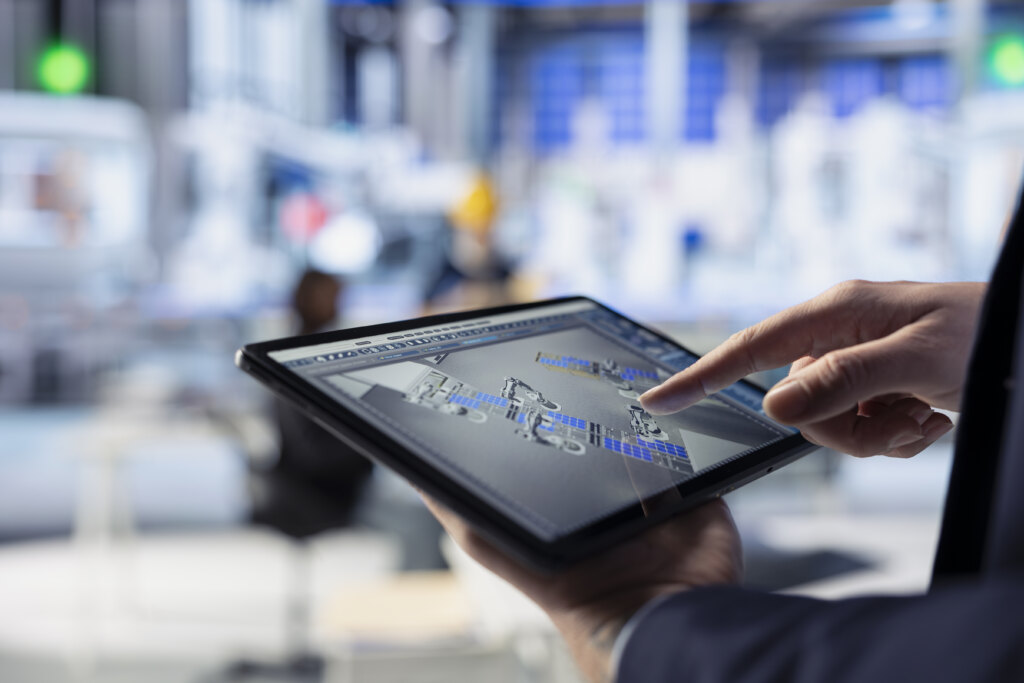
More than simply recreating a physical object in 3D, a digital twin connects real-world data with its virtual counterpart to monitor asset conditions, analyze performance, and run simulations. A digital twin refers to a replica of a physical machine or product that exists in a virtual space. Digital twins use virtual and augmented reality, along with 3D graphics and data modeling, to construct virtual models of processes, systems, services, products, or other physical objects. A digital twin can also serve as a design model for a product that never materializes, and it can be updated and maintained to reflect the completed state of the asset during the construction and operational phases of its lifecycle.
How does a digital twin work?
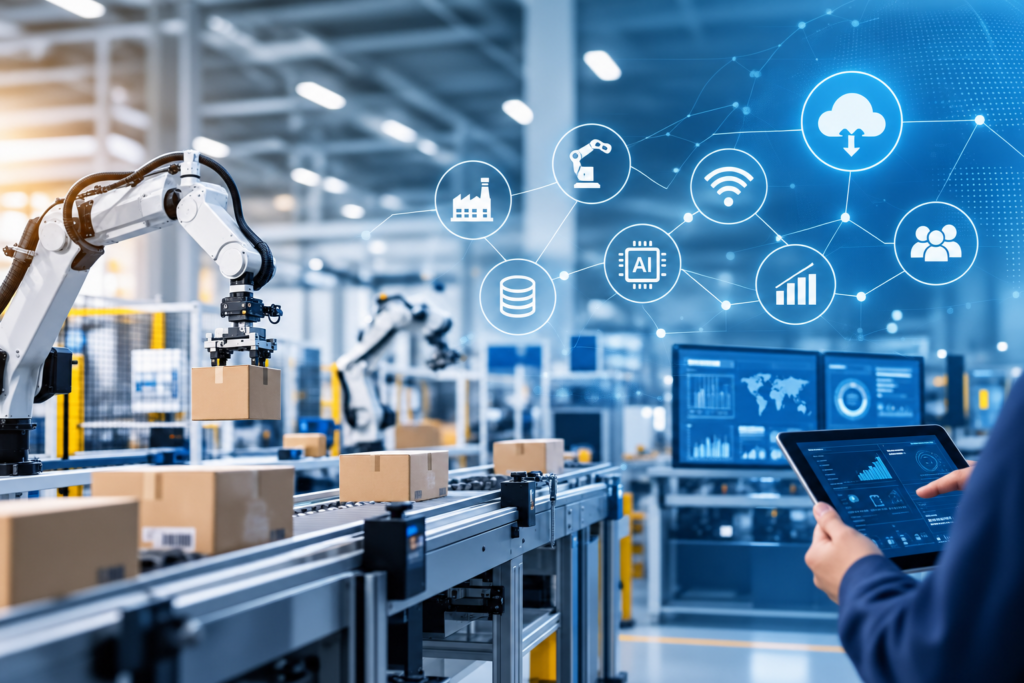
Digital twins in manufacturing work through a continuous flow of data between a physical manufacturing system and its digital counterpart. Sensors, IoT devices, and other data sources collect information about equipment, processes, products, and operating conditions. This data is transmitted to the digital twin, where it is integrated with digital models and analytical tools to create an up-to-date view of the physical system.
The digital twin then uses this data to monitor conditions, analyze performance, simulate scenarios, and predict potential outcomes. Manufacturers can evaluate different operational changes in the virtual environment and use the resulting insights to support decisions in the physical system. As new data is collected, the digital representation is updated, creating a continuous connection between the physical and digital environments. This enables manufacturers to identify changes, optimize processes, and respond more effectively to changing production conditions.
What elements make up a digital twin?
A digital twin consists of the following three main elements:
- Historical data: Includes historical performance data for individual machines, entire processes, and specific systems.
- Current data: includes real-time data from sensors, outputs from the manufacturing hierarchy and systems, outputs from systems across the entire distribution chain, and outputs from systems in other business units such as customer service and purchasing.
- Future data: Predictions generated by machine learning models and information provided by engineers for future simulations and adjustments.
What are digital twin types?
Digital twins can be classified based on the physical entity or manufacturing scope they represent. Four common types include:
- Component Twins: Represent individual components or parts within a larger asset. They provide detailed insights into the condition and performance of specific components.
- Asset Twins: Represent complete functional assets made up of multiple components, such as machines or production equipment. They help monitor how these components work together and perform in real time.
- System Twins: Represent multiple connected assets that form a larger system, such as a production line. They provide visibility into interactions between assets and help identify opportunities for system-level optimization.
- Process Twins: Represent broader processes or workflows across a manufacturing operation. They help manufacturers analyze how different systems work together and improve overall production efficiency.
What are digital twins in manufacturing?
Digital twins in manufacturing go beyond a virtual representation by maintaining synchronization with a physical manufacturing element, such as equipment, materials, production processes, products, or facilities. By integrating data from sensors, IoT devices, and other manufacturing systems, it enables manufacturers to monitor operations, analyze performance, and simulate different scenarios before making changes to physical assets or processes. This allows manufacturers to identify potential improvements, optimize operations, reduce costs, and make more informed decisions.
Benefits of Digital Twins in Manufacturing
Digital twins, with their superior simulation and monitoring capabilities, help optimize production operations, reduce costs and time, and improve product quality. In fact, digital twins are widely applied in many industries, from automotive and electronics manufacturing to F&B food and beverage production.
Manufacturers can leverage digital twins in all aspects of their business, including:
- Higher production efficiency: Identify bottlenecks and evaluate process improvements.
- Improved product quality: Analyze production conditions and investigate potential causes of defects.
- Reduced downtime: Monitor equipment conditions and support predictive maintenance.
- Better resource utilization: Evaluate equipment capacity, material availability, and production schedules.
- Lower testing costs: Simulate product designs and operational changes before physical implementation.
One of the key capabilities of digital twins is simulation, which allows manufacturers to test processes, designs, and operational changes in a virtual environment before applying them to physical systems.
Utilization of Digital Twins in Manufacturing
Product Design
Digital twins allow engineers to simulate product designs under different operating conditions and evaluate their performance before building physical prototypes. This can reduce the need for repeated physical testing, shorten development cycles, and help identify potential design issues earlier.
Process Optimization
Digital twins help improve existing manufacturing processes by performing advanced simulations based on real-world data provided by IoT sensors. When AI has sufficient historical and real-time data, it can simulate the entire process and identify areas for improvement. This leads to increased operational efficiency, minimized errors, and improved decision-making accuracy.
Quality control
By installing IoT sensors on lines and machinery, manufacturing companies can monitor ongoing production operations in real time. This makes it easy to manage production quality and adjust it as needed. Digital twins can simulate every stage of the manufacturing process and test various materials and solutions until something negatively impacts quality is found.
Supply Chain Management
Digital twins can help manufacturers improve supply chain visibility by modeling the movement of raw materials, components, and finished products across suppliers, warehouses, and production facilities. By integrating data on inventory levels, material availability, and production demand, manufacturers can evaluate supply scenarios, identify potential material shortages, and improve coordination between procurement, warehousing, and production. This helps reduce inventory inefficiencies and support more reliable production planning.
Predictive Maintenance
Digital twins support predictive maintenance by combining equipment data with models of asset behavior. Manufacturers can use these insights to identify signs of degradation, estimate potential failures, and plan maintenance before unexpected breakdowns lead to costly downtime.
Production Planning and Scheduling
Digital twins help manufacturers evaluate production schedules and resource allocation in a virtual environment before implementing changes on the factory floor. By modeling production capacity, equipment availability, material constraints, and workflow dependencies, manufacturers can compare different scheduling scenarios and identify potential bottlenecks. This supports more effective production planning, better resource utilization, and more responsive adjustments to changing production requirements.
VTI MES-X is an AI- and IoT-powered manufacturing execution system that connects production, warehouse, quality, and maintenance operations. Gain real-time visibility, streamline processes, and improve factory efficiency with a unified manufacturing platform.Ready to make your manufacturing operations smarter?
Digital Twin: Latest Trends in Manufacturing
Growing Adoption Across Manufacturing
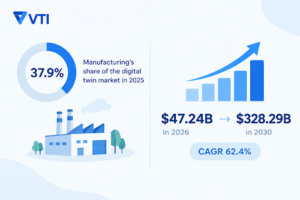
Manufacturing led with 37.9% of digital twin market share in 2025, reflecting growing adoption across automotive, electronics, and heavy industries. Around 29% of manufacturers worldwide have fully or partially adopted digital twin strategies, while more than 40% are still in the pilot phase, indicating continued opportunities for wider implementation.
IoT and IIoT Enable Real-Time Digital Twins
IoT and IIoT accounted for 29.6% of the digital twin market in 2025. These technologies provide real-time data from connected equipment and production systems, allowing digital twins to reflect physical operations and support more informed manufacturing decisions.
Rapid Market Growth and Investment
According to Research and Markets, the digital twin in the manufacturing market is valued at $47.24 billion in 2026 and is projected to reach $328.29 billion by 2030, representing a compound annual growth rate (CAGR) of 62.4%. This forecast highlights increasing investment in digital twin technologies for production optimization and operational improvement.
AI-Powered Predictive Maintenance
AI-enabled digital twins can analyze sensor data to identify equipment anomalies and predict potential failures, supporting proactive maintenance planning. A 2025 study published in the Journal of Electrical and Computer Engineering discusses the role of AI in enhancing digital twin capabilities, including monitoring and predictive analysis.
Virtual Factory Simulation and Optimization
According to NVIDIA, manufacturers can combine AI and digital twins to simulate factory operations, optimize production planning, and test robotic systems in virtual environments before deploying them on physical production lines. This approach helps evaluate potential changes and identify operational issues before implementation.
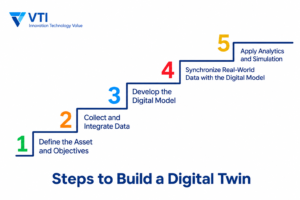
How can we build a digital twin in the manufacturing industry?
Step 1: Define the Asset and Objectives
Identify the specific equipment, machinery, or production processes to be represented by the digital twin. At this stage, businesses should also establish clear implementation objectives and determine the key performance indicators (KPIs) they aim to improve.
Step 2: Collect and Integrate Data
Gather relevant data from various sources, including IoT devices, PLCs, SCADA, MES, and other related systems. These data sources provide the necessary inputs for developing a digital representation of the physical asset and its operational environment.
Step 3: Develop the Digital Model
Build a digital representation of the selected physical asset by modeling its structure, current condition, and operational behavior, along with relevant factors that influence its performance. This model serves as the virtual counterpart of the physical equipment or production process.
Step 4: Synchronize Real-World Data with the Digital Model
Establish continuous data synchronization between the physical asset and its digital counterpart. Regularly update the digital model with real-time operational data to ensure it accurately reflects the actual condition and operating status of the physical asset.
Step 5: Apply Analytics and Simulation
Leverage the digital model to analyze operational data, conduct simulations, and support predictive analysis. These capabilities enable businesses to explore potential scenarios, identify opportunities for optimization, and make more informed, data-driven decisions.
Summary
Digital twins enable manufacturers to connect physical operations with virtual models, supporting real-time monitoring, simulation, predictive maintenance, and production optimization. As AI and IoT capabilities advance, digital twins can help manufacturers make better-informed decisions and improve operational efficiency. Successful implementation, however, depends on clear business objectives, reliable data, and integration with existing manufacturing systems.
With capabilities in IoT, AI, and smart manufacturing solutions, VTI supports businesses in connecting production data, integrating operational systems, and enhancing factory visibility. Through solutions such as MES-X, which connects production, warehouse, quality, and maintenance operations, VTI helps manufacturers establish a more integrated data foundation for monitoring and optimizing factory operations. These capabilities provide a practical foundation for advancing digital twin initiatives and building smarter, more efficient manufacturing environments.