






![[FREE EBOOK] Strategic Vietnam IT Outsourcing: Optimizing Cost and Workforce Efficiency](https://vti.com.vn/wp-content/uploads/2026/06/ebook-it-outsourcing.png)


When your technology team is stretched thin and critical projects are piling up, you face a common dilemma: how do you scale your capabilities without breaking the budget or losing control? The answer often comes down to choosing between staff augmentation vs managed services.
These are two fundamentally different approaches to solving your resource challenges.
This comprehensive guide breaks down the key distinctions, cost implications, and strategic considerations that will help you make the right decision for your organization. You’ll discover when each model works best, how to evaluate ROI, and why a hybrid approach might be your optimal solution.
What Are the Differences Between Staff Augmentation vs Managed Services?
Understanding the core differences between staff augmentation vs managed services is essential for making an informed sourcing decision. While both models address resource gaps, they differ fundamentally in team integration, control structures, accountability frameworks, and cost dynamics.
The following sections break down these distinctions across four critical dimensions: service models, control, accountability, and financial impact.
1. Service Model: How Teams Integrate
Staff augmentation integrates external professionals directly into your existing team structure. These specialists work under your management, follow your processes, and become temporary extensions of your internal workforce. You maintain complete control over daily operations, project direction, and the quality of deliverables.
Managed services operate as independent units, handling entire business functions. The service provider assumes end-to-end responsibility for specific operations, from strategy development, execution, and maintenance. Your team collaborates with the provider but doesn’t manage their day-to-day activities.
The fundamental distinction:
- Staff augmentation: external professionals become part of your team structure and work under your direction.
- Managed services: you work with an independent operation delivering outcomes and managing their own team, processes, and day-to-day execution.
2. Control: Who Directs Daily Work?
With Staff Augmentation: You Control Everything
You retain full authority over daily operations. Your team decides priorities, redirects resources as needs change, and makes immediate workflow adjustments without external approvals. Augmented staff reports directly to your leadership through your established communication processes. This direct control ensures strategic alignment but requires significant internal management capacity, including:
- Daily task assignment and prioritisation
- Regular check-ins and progress reviews
- Technical guidance and architectural decisions
- Performance management and quality oversight
- Integration support and cultural onboarding
Certainly, organisations without dedicated project managers often struggle with these.
With Managed Services: Provider Controls Operations
Meanwhile, managed services eliminate such an “essential” burden when the provider handles team management internally, while your leadership focuses on strategic objectives and outcome monitoring.
In other words, you define objectives and success metrics while the provider controls daily operations. You specify “what” (99.9% uptime, 2-hour response times), but the provider determines “how” using their processes and tools.
Yet, changes require coordination through formal channels – submitting requests to account managers and negotiating scope adjustments—which reduces your management burden but limits operational agility.
3. Accountability: Who Owns the Outcomes?
Staff Augmentation: You Own All Results
Under staff augmentation, project outcomes and delivery risks remain entirely with your organization. External professionals contribute their expertise, but your team bears ultimate responsibility for final results, quality assurance, and meeting business objectives.
If an augmented developer writes buggy code, your QA team must catch it. In case project deadlines slip, your organization explains to stakeholders. And if deliverables don’t meet requirements, your team owns the rework. The contractors execute work according to your direction, but you own the consequences.
This creates direct accountability within your organization but also exposes you to greater project failure risk. You control quality standards and remediation strategies, but you also absorb the full impact of poor performance or missed deadlines.
For organizations in regulated industries, risk distribution also extends to compliance responsibilities:
- Compliance training for contractors is your responsibility
- Background checks and security clearances remain your burden
- Audit trails and documentation are your obligation
- Regulatory violations trace back to your organization
- Contractor actions fall under your corporate policies
Managed Services: Provider Guarantees Performance
In contrast, managed services transfer accountability to the provider. From regulation-related tasks:
- Provider maintains required certifications (SOC 2, ISO 27001, HIPAA, PCI-DSS)
- Provider handles compliance training for their team
- Provider produces audit-ready documentation as part of the service
- SLAs specify compliance requirements and provider liability
- Provider’s compliance expertise reduces your regulatory risk
To maintain formal Service Level Agreements (SLAs). The MSP guarantees specific performance metrics – 99.9% uptime, 2-hour response times for critical incidents, 24-hour resolution for standard issues – and assumes responsibility for continuous service delivery.
If the provider misses SLA targets, they owe financial penalties (typically 5-10% of monthly fees per violation). Also, if a security incident occurs due to provider negligence, their professional liability insurance covers damages. Or, If service quality degrades, formal escalation procedures activate executive-level provider engagement to resolve issues.
4. Cost: How You Pay and What You Get
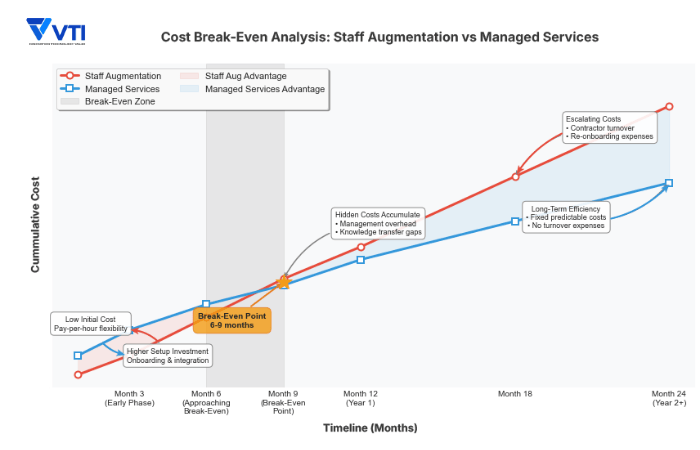
Staff augmentation operates on hourly or daily billing with rates typically ranging from $25-$199 based on skill level, technology specialization, and geographic location. You pay only for actual time worked, receiving itemized invoices showing hours per contractor per project.
Managed services use fixed monthly or annual fees tied to specific service level agreements. A typical managed services contract costs $5,000-$50,000 per month, depending on scope, with predictable, all-inclusive pricing that covers the entire service team, tools, infrastructure, and support coverage.
| Staff Augmentation | Managed Services | |
| Visible |
|
|
| Additional | (Increase total costs by 20-30%)
|
|
Note: Several variables influence when each model delivers better financial returns: Project duration, Management capacity, Skill rarity, Compliance requirements, Deployment speed, etc.
Staff Augmentation vs Managed Services: Which to Choose?
Best Scenarios for Staff Augmentation
Staff augmentation excels when organizations need specialized expertise for time-bound projects with clear endpoints. This approach works best for projects with the following characteristics:
- Defined project duration: 1-6 months
- Clear project scope and deliverables
- Specific technical skills needed temporarily
- The project has a definite endpoint (launch, migration completion, etc.).
About Timeline:
- Need resources deployed quickly (1-2 weeks)
- Urgent or time-sensitive initiatives
- Cannot wait for extended setup periods
About Budget:
- Variable budget with flexibility for hourly billing
- Project duration under 6 months (cost-effective zone)
- Can absorb 20-30% management overhead costs
Certainly, to ensure a smooth execution, there is a requirement for readiness from your organization:
- Established IT department with management capacity
- Dedicated project managers or technical leads available
- Existing processes and workflows to integrate contractors
- The internal team can provide daily direction and oversight
Usually, companies with established IT departments benefit most from this choice. Your existing management infrastructure can effectively integrate external professionals while maintaining project control and oversight responsibilities throughout the engagement.
Ideal scenarios include:
- Software development sprints requiring specialized skills (React, Python, cloud architecture)
- Seasonal workload spikes (e-commerce holiday season, tax season for financial services)
- Digital transformation initiatives with defined timelines
- Product launch preparations requiring temporary capacity
- Short-term skill gaps while recruiting permanent staff
Best Scenarios for Managed Services
Managed services become the strategic choice for organizations seeking hands-off operations with predictable cost structures. According to industry analysis, 67% of companies now leverage managed service providers for at least partial IT infrastructure coverage. As this model suits companies lacking sufficient in-house IT expertise or those where internal teams lack bandwidth for proactive infrastructure management.
Here are some key points indicating your project needs to hire a managed service provider:
Operational Characteristics:
- Ongoing operational needs: beyond 6-9 months
- Require 24/7 monitoring and support coverage
- Need continuous service delivery (no defined endpoint)
- Business-critical functions requiring high reliability
Organizational Incapabilities:
- Limited in-house IT expertise in specific domains
- Internal teams lack bandwidth for proactive management
- Need to reduce management overhead
- Seeking hands-off operations with outcome focus
Timeline Requirements:
- Can accommodate a 2-4 week setup and onboarding period
- Long-term perspective (12+ months commitment)
- Prioritize stability over immediate deployment
Budget Considerations:
- Need predictable, fixed monthly costs
- Can invest in upfront setup fees ($5K-$25K one-time)
- Prefer all-inclusive pricing over variable hourly billing
Compliance & Risk:
- Operating in regulated industries (healthcare, finance, government)
- Require specialized certifications (SOC 2, HIPAA, PCI-DSS, ISO 27001)
- Need formal SLA guarantees and accountability transfer
- Want financial protection through provider insurance
Ideal scenarios include:
- 24/7 infrastructure monitoring and maintenance
- Cybersecurity operations require constant threat monitoring
- Cloud infrastructure management (AWS, Azure, Google Cloud)
- Help desk and end-user support
- Compliance-heavy operations (HIPAA, SOC 2, PCI-DSS)
- Disaster recovery and business continuity planning
The Hybrid Approach
A holistic sourcing strategy integrates multiple models rather than forcing binary choices. Retain in-house teams for core competencies while augmenting capacity through vendor staff for specialized skills or temporary gaps. According to strategic sourcing research, 70% of companies use both models simultaneously, recognizing that different business functions have different optimal sourcing strategies. This approach allows:
- Managed services for commodity infrastructure (email, network, security monitoring)
- Staff augmentation for specific project needs (application development, migrations)
- Internal teams for core strategic capabilities (architecture, product strategy)
Hybrid approaches require strong governance frameworks to succeed:
- Clear service boundaries, preventing overlap or gaps
- Regular performance reviews (quarterly minimum)
- Defined escalation procedures for cross-team issues
- Unified reporting dashboard showing all sourcing models
- Strategic assessments ensuring continued alignment with business needs
Successfully managing hybrid models demands:
- Mature vendor management processes
- Clear communication protocols across internal and external teams
- Integration architecture supporting multiple service providers
- Strong contract management capabilities
- Executive sponsorship ensuring strategic alignment
5 Common Mistakes When Choosing Staff Augmentation or Managed Services
1. Choosing based on initial price alone
Many organizations select staff augmentation because hourly rates seem lower than managed service retainers. However, as mentioned, hidden costs – onboarding time, management overhead, and knowledge gaps – can increase total expenses by 20-30% for engagements exceeding 6 months.
2. Underestimating management capacity
Staff augmentation requires significant internal oversight. Organizations without dedicated project managers often struggle to integrate augmented staff effectively, leading to delays and misalignment.
3. Locking into rigid managed service contracts
Some businesses commit to 3-year managed service agreements without testing provider compatibility. Start with 12-month contracts that include quarterly performance reviews and clear exit clauses.
4. Mixing accountability models
Combining staff augmentation with managed services for the same function creates confusion about who owns outcomes. Keep accountability clean: one model per distinct business function.
5. Ignoring cultural fit
Technical skills matter, but cultural alignment determines long-term success. Whether augmenting staff or engaging managed services, evaluate communication styles, work ethics, and values alignment during vendor selection.
Frequently Asked Questions
Q: What is Staff Augmentation?
Staff augmentation integrates external professionals directly into your existing team structure. These specialists work under your management, follow your processes, and become temporary extensions of your internal workforce. You maintain complete control over daily operations, project direction, and the quality of deliverables.
Q: What is Managed Services?
Managed services operate as independent units that handle entire business functions. The service provider assumes end-to-end responsibility for specific operations, from strategy development to execution and maintenance. Your team collaborates with the provider but doesn’t manage their day-to-day activities.
Q: Which is more cost-effective: staff augmentation vs managed services?
Staff augmentation is typically more cost-effective for projects under 6 months, with hourly rates of $50-$199. Managed services become more economical for engagements lasting 12+ months, offering 15-25% savings through predictable monthly fees and eliminating recruitment costs.
Q: Can I switch from staff augmentation to managed services mid-project?
Yes, though transition requires 2-4 weeks for knowledge transfer and process alignment. Many organizations start with staff augmentation for proof-of-concept phases, then migrate to managed services once requirements stabilize and long-term support needs become clear.
Q: How quickly can I start with each model?
Staff augmentation offers immediate deployment, often within 1-2 weeks. Managed services require 2-4 weeks for initial setup, including SLA negotiations, infrastructure integration, and team onboarding.
Q: Which model is better for startups versus enterprises?
Startups with limited IT infrastructure often benefit from managed services, gaining enterprise-grade capabilities without building internal teams. Established enterprises with strong IT departments typically use staff augmentation to supplement existing teams for specialised projects.
Q: How do I ensure quality with either model?
For staff augmentation, implement rigorous screening processes, clear performance metrics, and regular check-ins.
For managed services, negotiate detailed SLAs with specific performance metrics, regular reporting requirements, and financial penalties for non-performance.
Q: Can I use both models simultaneously?
Absolutely. 70% of companies use hybrid approaches, applying managed services for ongoing operations (infrastructure, security) while utilising staff augmentation for specific projects (application development, migrations). The key is maintaining clear boundaries and holding each engagement accountable.
Conclusion
The choice between staff augmentation vs managed services isn’t just about immediate costs – it’s about aligning your sourcing strategy with your organisation’s goals, capabilities, and growth trajectory.
Take time to assess your current IT maturity, project timelines, and long-term objectives. Use the decision framework and criteria matrix provided in this guide to evaluate which model – or combination of models – best serves your specific situation.
The right sourcing strategy can transform how efficiently your technology initiatives deliver value to your business. Whether you choose staff augmentation, managed services, or a hybrid approach, ensure your decision aligns with both immediate project needs and strategic organisational goals.



![Top 10 AI use cases in retail [Latest Update]](https://vti.com.vn/wp-content/uploads/2024/11/AI-use-cases-in-retail.png)