





![[FREE EBOOK] Strategic Vietnam IT Outsourcing: Optimizing Cost and Workforce Efficiency](https://vti.com.vn/wp-content/uploads/2026/06/ebook-it-outsourcing.png)


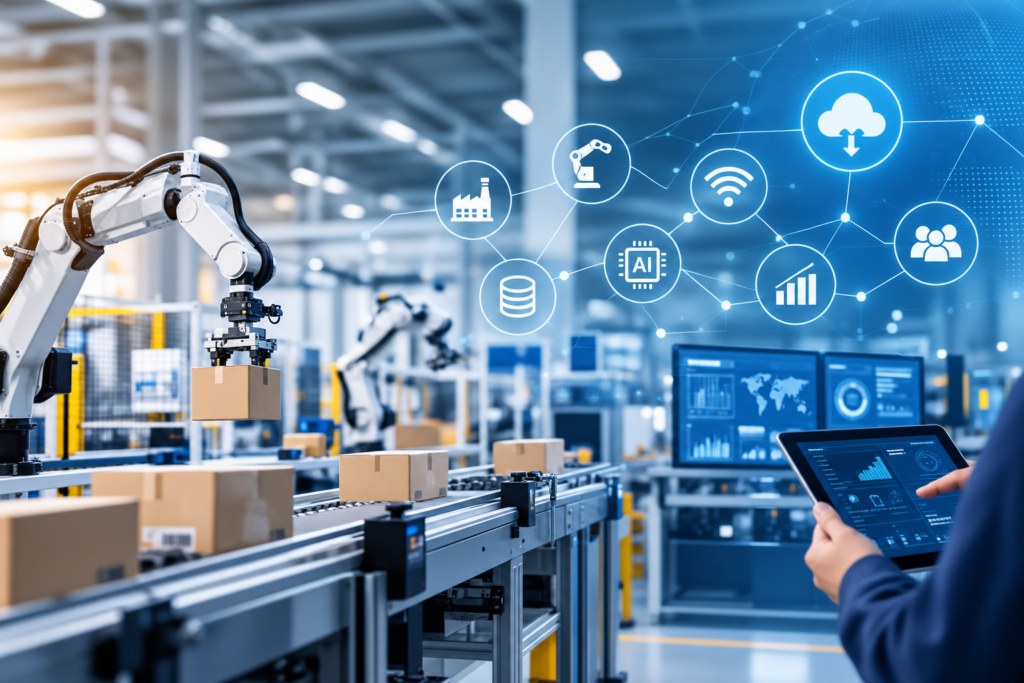
In APAC manufacturing, many factories have invested heavily in digital systems and automation, yet struggle to achieve expected improvements in OEE, downtime reduction, and operational efficiency.
The root cause is not a lack of technology, but a gap in how decisions are made on the shop floor. Most Smart Factories still rely on rule-based automation, where systems generate data but humans remain the primary decision-makers.
In contrast, an AI-Driven Factory introduces intelligent systems that can analyze data, generate insights, and increasingly support or automate operational decisions.
This shift from rule-based control to data-driven decision-making is not just a technology upgrade, but a strategic priority that directly impacts performance, consistency, and long-term competitiveness.
In this article, we examine:
- The performance gap between Smart Factory and AI-Driven Factory
- Why many digital transformation initiatives fail to deliver expected results
- A practical framework to assess your facility’s readiness for AI-driven operations
Smart Factory: Architecture, Capabilities, and Limitations
What Is a Smart Factory?
A Smart Factory is a highly connected, automated, and data-enabled manufacturing environment, where shop-floor operations are digitized and visible in near real time. It represents the operationalization of Industry 4.0 — turning machines, systems, and processes into a unified data-driven environment.
Core Architecture and Operational Capabilities
The foundation of a Smart Factory typically consists of three key components:
- Industrial IoT (IIoT): Sensors, edge devices, and connectivity infrastructure that continuously capture machine status, production parameters, and environmental data
- MES / ERP Integration: A Manufacturing Execution System that connects shop-floor execution with enterprise planning, enabling unified tracking of work orders, material consumption, labor, and quality data
- Automation Systems (PLC / SCADA): Control systems that execute predefined production logic with high reliability, consistency, and speed
When properly implemented, a Smart Factory enables:
- Real-time visibility into production performance
- End-to-end traceability across materials, processes, and outputs
- Standardized and consistent operational data across lines and shifts
These capabilities are essential for data-driven manufacturing, providing the visibility and control needed to manage complex production environments at scale.
Read more: MES (Manufacturing Execution System)
Where the Smart Factory Model Reaches Its Limit
Despite these advantages, the Smart Factory model has a structural limitation — how decisions are made on the shop floor.
Most Smart Factory systems operate based on predefined, rule-based logic. Engineers define thresholds in advance, and when conditions fall outside those thresholds, the system generates alerts. However, interpreting those alerts and deciding what action to take still depends on human operators.
This creates a decision bottleneck: Data is available in real time, but response speed and consistency are limited by human interpretation and intervention. This is the critical point where the difference between a Smart Factory and an AI-Driven Factory becomes clear.
What Is an AI-Driven Factory?
An AI-Driven Factory is a manufacturing environment where AI systems are embedded into operational decision-making — not just data collection. While a Smart Factory focuses on connectivity and real-time visibility, an AI-Driven Factory shifts the role of data from monitoring to action.
The core difference lies in decision architecture. Instead of collecting data and relying on human response, AI-driven systems analyze that data to generate, recommend, and in some cases execute decisions in real time — directly on the shop floor.
Built on a solid Smart Factory foundation, an AI-Driven Factory introduces decision intelligence through the following key technologies:
- Machine Learning (ML): Models trained on historical and real-time data to identify patterns, predict outcomes, and trigger or recommend actions
- Predictive Analytics: Systems that anticipate equipment failure, quality deviations, or supply disruptions based on actual operating patterns rather than fixed schedules
- Computer Vision: AI-powered inspection systems that detect defects and anomalies at production speed, applying consistent criteria across all units
- Autonomous Optimization: Scheduling and process control systems that continuously adjust parameters in response to real-time constraints, without waiting for manual planning cycles
How This Changes Day-to-Day Operations
What this means in practice is a shift from automation to adaptive decision-making.
While traditional automation executes predefined rules, AI systems continuously learn from data, adapt to changing conditions, and optimize decisions over time.
- AI systems improve with experience. For example, a predictive maintenance model becomes more accurate as it processes additional production cycles, unlike static rule-based alerts
- AI shortens the gap between detection and action. A model identifying early-stage bearing degradation can trigger maintenance planning and adjust production schedules automatically — without requiring manual interpretation or escalation
- AI-driven scheduling optimizes multiple variables simultaneously — machine availability, order priority, material constraints, setup time, and even energy cost windows — generating plans that are continuously updated as conditions change
The result is not just faster operations, but more consistent and scalable decision-making across lines, shifts, and facilities.
Read more: AI-Driven Factory: From Real-Time Visibility to Intelligent Manufacturing Operations
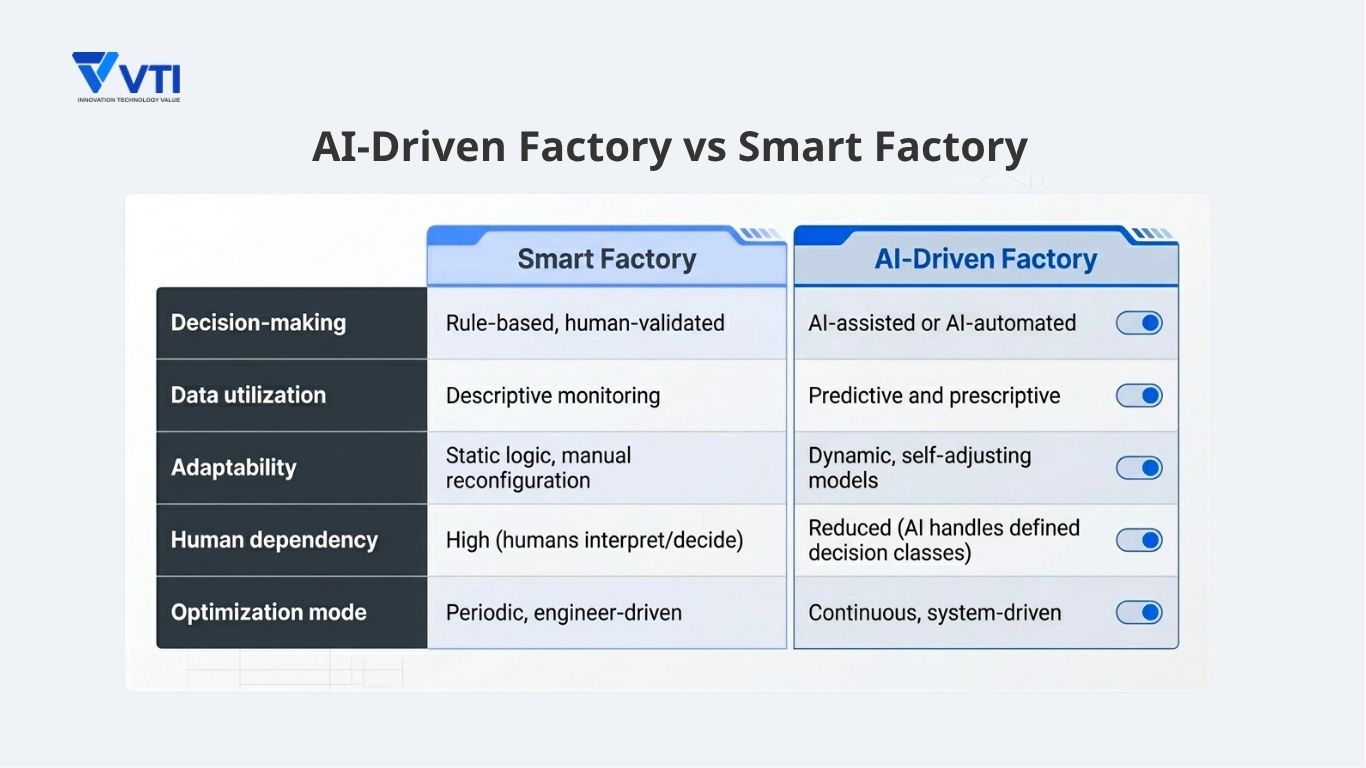
AI-Driven Factory vs Smart Factory: 5 Key Differences That Define Operational Maturity
The practical differences between a Smart Factory and an AI-Driven Factory become clearest when evaluated across key operational dimensions.
Here are the five fundamental differences:
Common Misconceptions in the Market
Three points are frequently misunderstood:
- An AI-Driven Factory evolves from a Smart Factory — it does not replace it. The IIoT infrastructure, MES integration, and data standardization built during the Smart Factory stage are essential prerequisites for successful AI deployment. Without this foundation, AI models often fail to produce reliable results due to inconsistent or poor-quality data.
- A Smart Factory is not the same as an intelligent factory. Connectivity and automation improve visibility and efficiency, but they do not create intelligence. True intelligence requires learning capability and the ability to make or support decisions autonomously.
- AI is not the same as automation. Automation executes fixed instructions, while AI generates and adapts instructions based on data inference. This distinction is critical when prioritizing investments and setting realistic expectations.
Understanding these differences is essential for developing a clear, long-term manufacturing strategy.
Manufacturing Maturity Model: From Smart Factory to AI-Driven Operations
Manufacturing Maturity Model
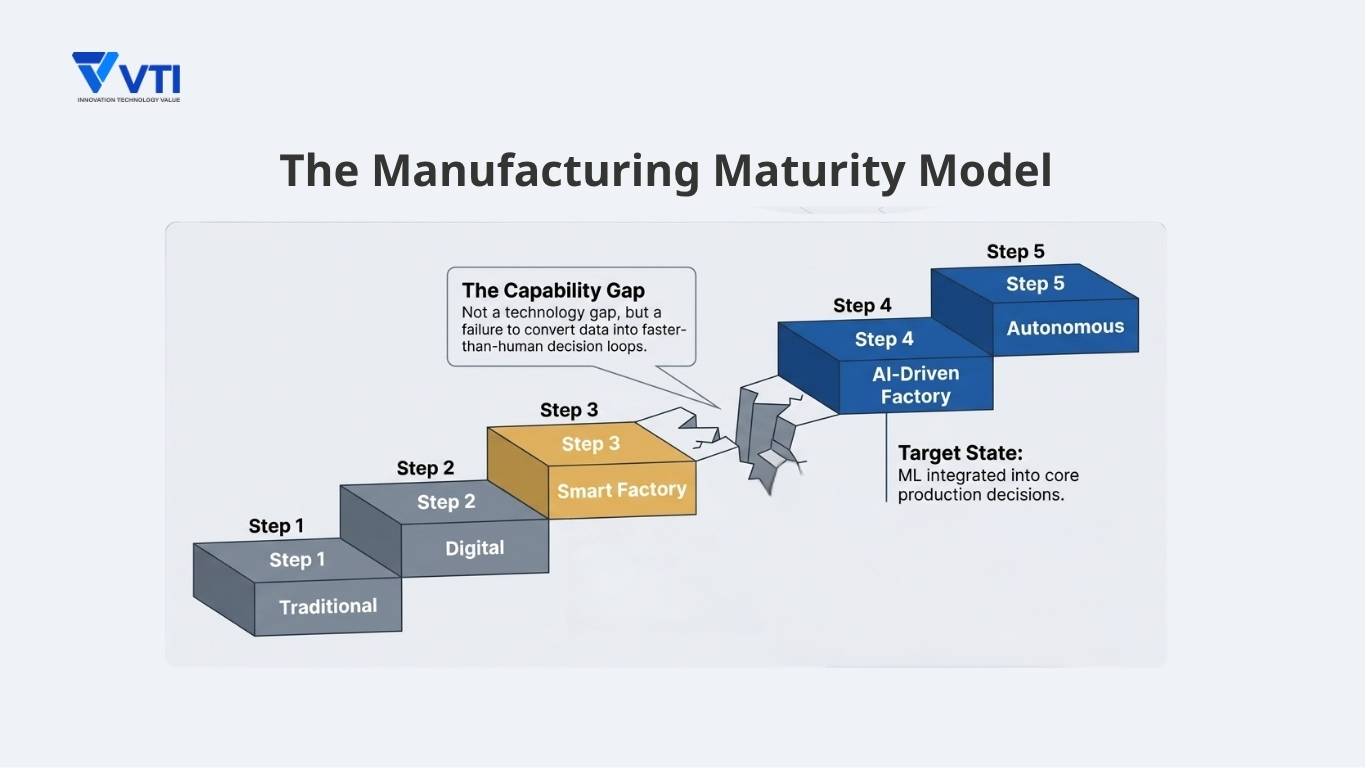
Factories typically progress through several maturity stages as they move from traditional operations toward more advanced capabilities. Understanding where your facility stands in the AI-Driven Factory vs Smart Factory journey is essential for making effective investment decisions.
The progression generally follows this path:
- Stage 1 – Traditional Manufacturing Operations are largely manual with siloed data. Performance improvements rely mainly on workforce experience and periodic process audits.
- Stage 2 – Digital Manufacturing ERP and MES systems are implemented along with basic automation. Data is captured but remains fragmented across systems and sites.
- Stage 3 – Smart Factory IIoT infrastructure is deployed, enabling real-time dashboards and production monitoring. Quality and process data are integrated, with rule-based automation and alerting systems in operation. This is currently the stage where most advanced manufacturing facilities in the APAC region operate in the AI-Driven Factory vs Smart Factory spectrum.
- Stage 4 – AI-Driven Factory Machine learning models are integrated into core production decisions. Predictive maintenance, AI quality inspection, and dynamic scheduling become operational. In the AI-Driven Factory vs Smart Factory comparison, this stage marks the shift where human decision-making moves from reactive responses to supervisory oversight.
- Stage 5 – Autonomous Factory AI systems handle the majority of routine operational decisions with minimal human intervention. Human roles focus on strategic oversight, model governance, and exception handling.
The Critical Gap Between Smart Factory and AI-Driven Factory
The biggest challenge in the AI-Driven Factory vs Smart Factory transition is not primarily a technology gap. Most facilities already have the necessary connectivity and data infrastructure from the Smart Factory stage.
What is often missing is the ability to turn that data into fast, reliable decision loops that outperform human judgment alone. This gap is mainly about data readiness — data that is captured but not properly standardized, labeled, or integrated for AI model training — and organizational readiness, where decision processes and habits are still built around human-initiated responses rather than AI-generated recommendations.
Closing this gap between Smart Factory and AI-Driven Factory is the real challenge of AI adoption — and the area where leading manufacturers create clear competitive differentiation.
Success Factors and Common Barriers in AI Adoption
In most cases, challenges in moving from a Smart Factory to an AI-Driven Factory stem from data quality and system architecture, not the AI algorithms. AI tends to deliver strong and consistent results in well-structured, high-volume environments such as electronics and automotive assembly. However, it often underperforms or fails in complex multi-line setups with fragmented data.
To avoid projects that never move beyond the pilot stage, manufacturers should address the following five common pitfalls when transitioning from Smart Factory to AI-Driven Factory:
- Building on Weak Data Foundations Deploying advanced AI models on inconsistent or unvalidated data quickly destroys operator trust. AI cannot fix poor data quality — it only makes underlying problems more visible.
- Adopting So-called “AI” Solutions Many vendors repackage rule-based automation as AI. True AI must be self-learning and demonstrate measurable improvements as it processes more production data.
- Treating Pilots as Isolated Experiments Many initiatives fail because they are treated as standalone tests. Successful implementations define the full pathway to production-scale deployment and integration from the very beginning.
- Underestimating the Human Factor Even technically strong models will underperform if operators and engineers do not understand or trust the recommendations. Proper change management and model explainability are essential to ensure AI is adopted rather than bypassed.
- Focusing on Misleading Metrics Model accuracy means little if it does not improve core business outcomes. Success should be measured by real operational KPIs such as OEE improvement, scrap reduction, and unplanned downtime, not just system uptime.
Ultimately, the key prerequisite for a successful transition from Smart Factory to AI-Driven Factory is not collecting more data, but building well-governed, high-quality, contextualized data that can reliably support intelligent decision-making.
High-Impact AI Use Cases in Manufacturing
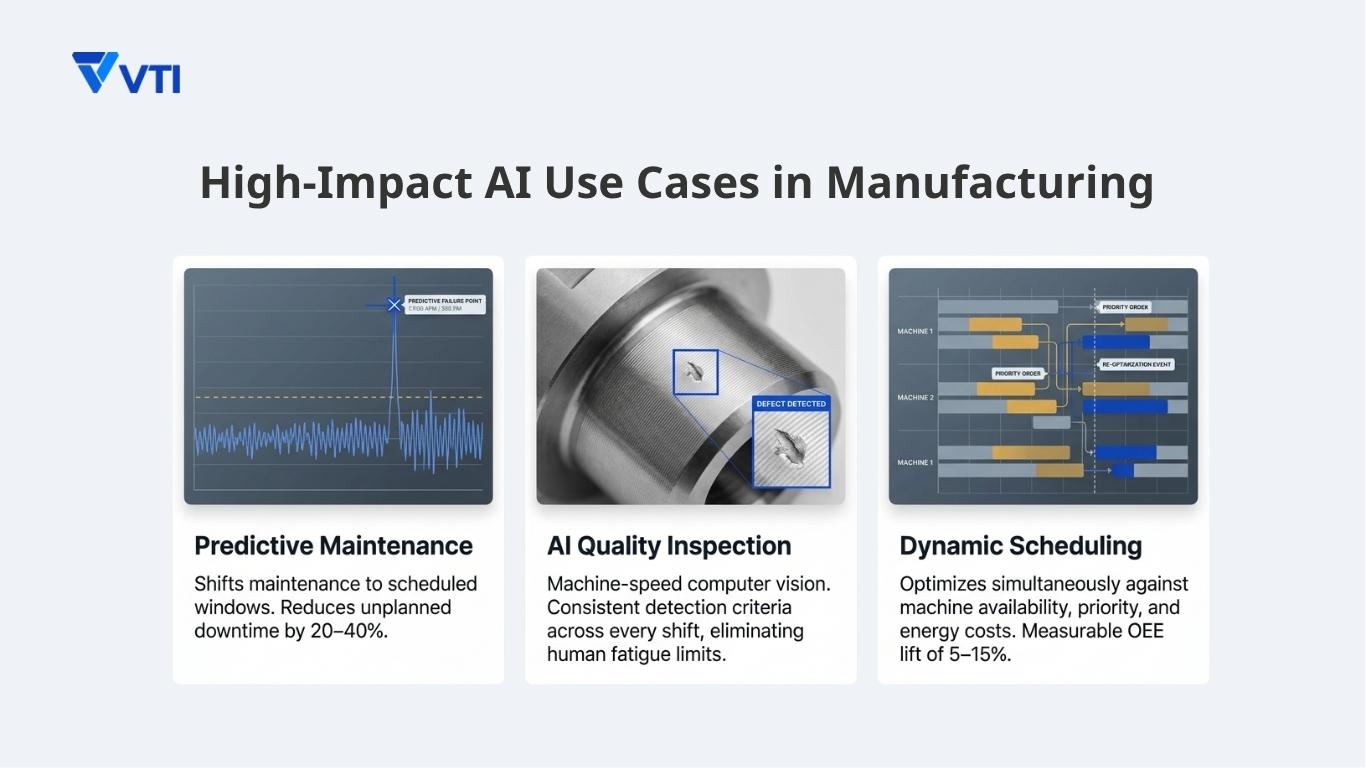
Not every AI application delivers the same level of value. The most effective use cases are those that address high-frequency, data-rich decisions currently limited by human capacity. Below are three areas where AI typically creates the strongest measurable impact when transitioning from a Smart Factory to an AI-Driven Factory.
Predictive Maintenance: Reducing Unplanned Downtime
In most Smart Factory environments, maintenance is still scheduled based on fixed time intervals or historical mean-time-between-failure data. This approach often results in two inefficiencies: performing maintenance too early on healthy equipment, or facing unexpected failures between scheduled services.
Predictive maintenance models, trained on real-time data such as vibration, temperature, current draw, and acoustic signals, can detect degradation patterns weeks in advance. This allows maintenance to be planned during scheduled downtime rather than as emergency line stoppages.
In high-utilization plants, the cost of unplanned downtime can reach tens or even hundreds of thousands of dollars per hour. For this reason, predictive maintenance remains one of the highest-ROI AI applications for most manufacturers.
AI Quality Inspection: Improving Yield and Consistency
Human visual inspection has well-known limitations, including operator fatigue, subjective judgment, and speed constraints. In precision industries such as electronics, automotive components, and medical devices, these limitations frequently lead to quality escapes and high rework costs.
AI-powered computer vision systems, trained on labeled defect data, can inspect parts at full production speed while applying consistent detection criteria across every unit, every shift, and every line. In high-volume, standardized environments, AI inspection accuracy often surpasses human performance.
Moreover, the data from AI inspection feeds back into process control, enabling upstream adjustments that help prevent defects rather than simply detecting them after they occur. This directly improves yield and quality consistency.
AI Production Scheduling: Handling Real-Time Constraints
Traditional MES scheduling typically generates shift or daily plans based on known demand and capacity constraints. When unexpected changes occur mid-shift — such as machine breakdowns, urgent orders, or material shortages — replanning is often manual and slow.
AI scheduling engines can optimize multiple variables simultaneously (machine availability, order priority, setup sequence, energy cost, and material lead times) and automatically re-optimize as conditions change. The results are usually visible in higher OEE, lower work-in-process inventory, and faster response to demand fluctuations.
From Assessment to Action: A 4-Phase Roadmap for AI Adoption
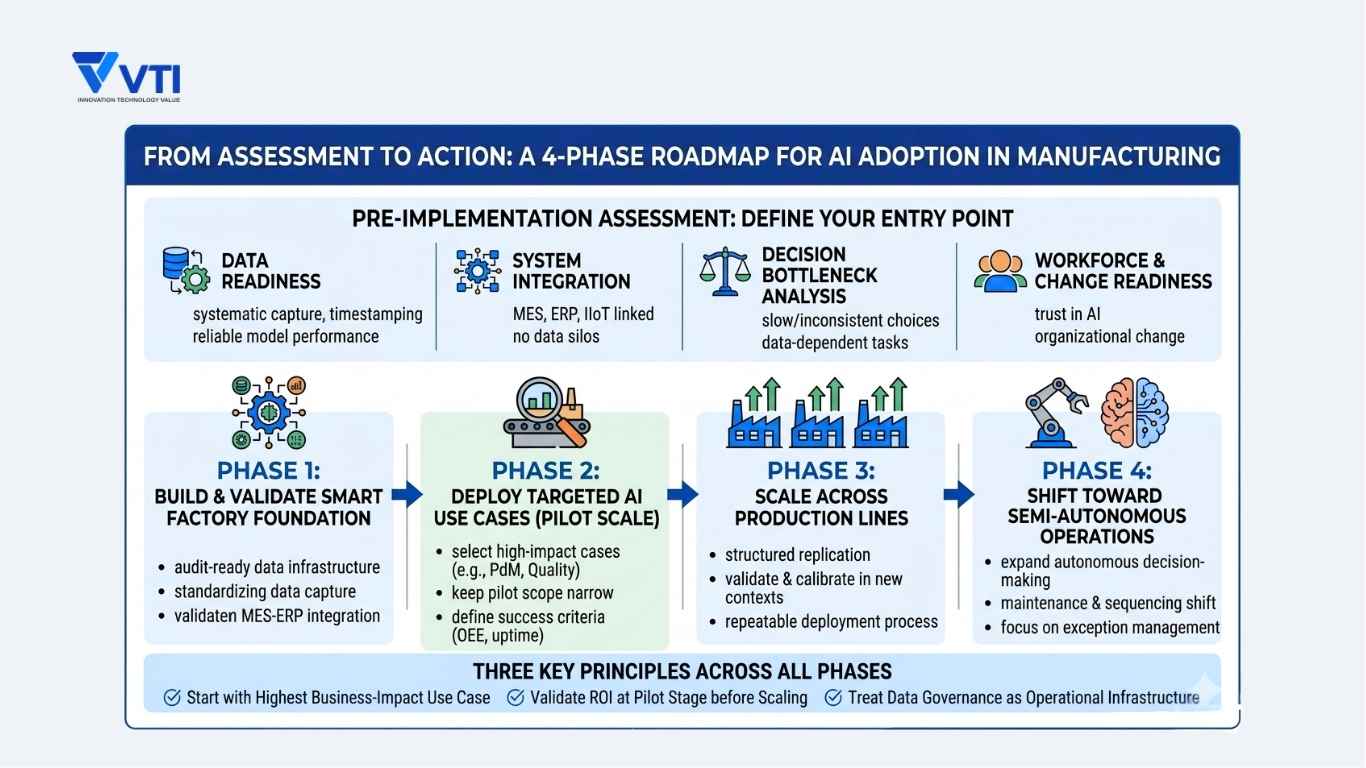
AI adoption does not happen overnight, it requires a structured, phased approach. The decision to move from one phase to the next should be based on an honest assessment of your facility’s current readiness — not vendor timelines or industry trends.
Before starting, evaluate your factory against these four key areas to determine the right entry point:
- Data Readiness: Is production data systematically captured, timestamped, and stored in accessible formats? Are quality results clearly linked to process parameters at the unit level? Without consistent, high-quality data, even the best AI models will deliver unreliable results.
- System Integration Maturity: Are your MES, ERP, and IIoT systems properly integrated, or do they remain as separate data silos? AI applications need seamless cross-system data flows. Fragmented architectures severely limit model performance.
- Decision Bottlenecks: Which decisions currently slow down or constrain production performance? If bottlenecks exist in quality disposition, maintenance scheduling, or production sequencing — and these decisions are repetitive and data-heavy — AI can deliver clear value. If your main need is still basic visibility and control, focus first on strengthening your Smart Factory foundation.
- Workforce and Change Readiness: Will operators and engineers trust and act on AI recommendations? Success depends less on technical capability and more on whether the organization is prepared to change how decisions are made on the shop floor.
Once the assessment is complete, follow these four phases in sequence when moving from Smart Factory to AI-Driven Factory:
Phase 1: Build and Validate the Smart Factory Foundation
Ensure your data infrastructure is solid and audit-ready. This includes standardizing data capture across all machines and lines, validating MES-ERP integration, establishing clear data governance, and confirming that historical data has sufficient volume and quality for AI training.
Skipping this phase is one of the most common reasons AI pilots show promising results in testing but fail to scale across the plant.
Phase 2: Deploy Targeted AI Use Cases at Pilot Scale
Select one or two high-impact use cases — typically predictive maintenance or AI quality inspection. These are popular starting points because they have proven model architectures and direct links to measurable outcomes.
Keep the pilot scope narrow (e.g., one production line or one machine type). This reduces risk, speeds up learning, and helps generate early ROI evidence to gain internal support.
Always define success criteria — such as OEE improvement, downtime reduction, or defect detection rate — before launching the pilot.
Phase 3: Scale Across Production Lines
After validating ROI and consistent performance in the pilot, begin systematic rollout to additional lines, cells, or plants.
Scaling is not simply copying the same model. Each new environment requires data validation, model recalibration, and operator training. Document the deployment process from Phase 2 to ensure replication remains efficient and cost-effective.
Phase 4: Move Toward Semi-Autonomous Operations
As AI systems build operational history and gain trust, expand the scope of AI-driven decisions. Maintenance scheduling, process parameter adjustments, and production sequencing can gradually shift from requiring human approval to AI execution, with humans focusing on exceptions and strategic oversight.
The objective is not full autonomy, but the right balance: AI handles high-frequency, data-driven decisions while humans retain control over complex judgment calls and exception management.
Three Guiding Principles for All Phases
- Start with the highest business-impact use case, not the most technically interesting one
- Validate ROI at the pilot stage before committing to full-scale rollout
- Treat data governance as core operational infrastructure, not just an IT initiative
Why This Shift Matters for Long-Term Manufacturing Performance
The transition from a “Smart Factory” to an AI-Driven Factory is often mischaracterized as a simple procurement task—buy the platform, link the MES, and watch the ROI roll in. In reality, the most successful manufacturers recognize that this isn’t just a tech upgrade; it is a fundamental shift in decision architecture.
The core evolution moves your facility along a clear trajectory:
- Reactive: Responding to events after the damage is done.
- Predictive: Anticipating issues before they impact the line.
- AI-Driven: Managing entire decision classes autonomously, without requiring a human to “click okay” at every turn.
Don’t start by choosing an AI use case. Start by auditing your data foundation. A capable algorithm on top of broken data is the most expensive mistake you can make. The real question for APAC manufacturing leaders is no longer “Can we connect our machines?” but “Is our data ready to make decisions for us?”
FAQs
What is the main difference between an AI-driven factory and a smart factory?
The difference is in decision-making. A smart factory provides real-time visibility and executes rule-based automation, but humans remain the primary decision-makers for quality, maintenance, and production adjustments. An AI-driven factory deploys machine learning and predictive systems that actively generate and, in defined contexts, execute operational decisions. The shift is from data visibility to decision intelligence.
Does a manufacturer need a smart factory before adopting AI?
In most cases, yes. The IIoT infrastructure, MES integration, and data standardization achieved at the smart factory stage are prerequisites for effective AI deployment. Machine learning models require consistent, high-quality historical data to produce reliable outputs. Factories that attempt AI deployment without this foundation typically produce models that cannot generalize across production conditions.
What ROI can AI realistically deliver in manufacturing?
Returns vary by use case and production environment. Documented outcomes include OEE improvements of 5–15 percentage points, unplanned downtime reductions of 20–40%, and scrap and rework rate reductions of 15–30%. ROI is highest in high-volume, standardized production environments with an established data infrastructure.
What are the biggest risks in AI adoption for manufacturing?
The most common failure modes are: insufficient data quality limiting model performance; operator and supervisor resistance to AI recommendations; pilot programs that never scale due to inadequate investment in change management; and technology selection driven by vendor positioning rather than operational fit.
Is an AI-driven factory part of Industry 4.0?
An AI-driven factory represents one of the more advanced stages within the Industry 4.0 framework — specifically the transition from connected, automated manufacturing toward intelligent, self-optimizing operations. Industry 4.0 covers the full spectrum from basic digitization through autonomous manufacturing. AI-driven operations sit at the higher maturity levels, where data-driven decision automation replaces or augments human judgment in core production domains.