





![[FREE EBOOK] Strategic Vietnam IT Outsourcing: Optimizing Cost and Workforce Efficiency](https://vti.com.vn/wp-content/uploads/2026/06/ebook-it-outsourcing.png)


VTI Japan engineer Tomobe Eiki (友部 瑛稀) has earned international recognition with the “Agents for Good” category at the AI Agents: Intensive Vibe Coding Capstone Project, organized by Google and Kaggle. His project, named CritiqAI, stood out among more than 6,000 submissions worldwide with an idea that turns a growing concern in the AI era into a practical solution: using AI to strengthen, rather than replace, human critical thinking.
CritiqAI: When AI Becomes a Critical Thinking Partner
Tomobe Eiki, Onsite Leader at VTI Japan, together with a collaborator, developed CritiqAI, an AI-powered debate coach designed to help learners develop independent and critical thinking skills.
The project was recognized in the “Agents for Good” category of the AI Agents: Intensive Vibe Coding Capstone Project, the capstone competition of Google and Kaggle’s five-day AI Agents Intensive course. The 2026 program attracted more than 353,000 registered participants, while the capstone received over 6,000 project submissions from more than 12,000 active participants worldwide.
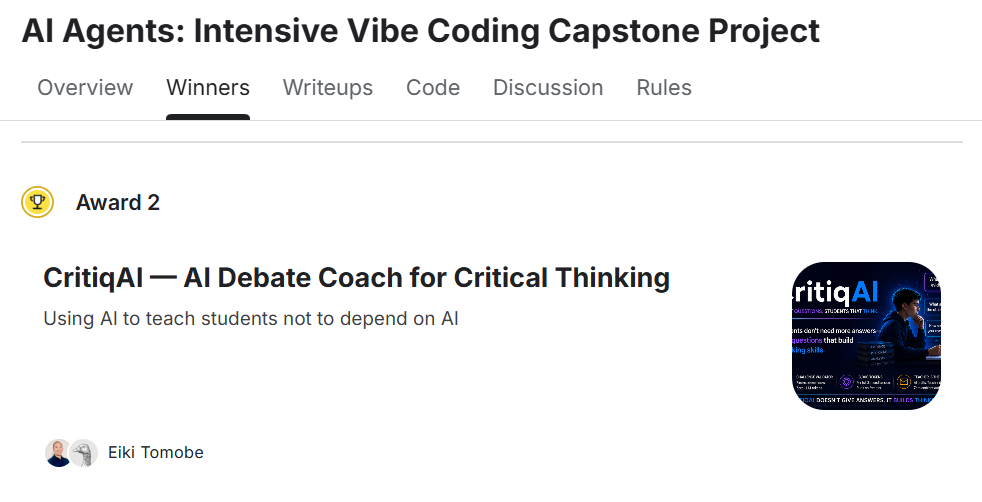
Unlike conventional AI assistants designed primarily to provide answers, CritiqAI takes a different approach, challenging users to develop their own. Acting as an AI debate coach, CritiqAI analyzes a learner’s argument and challenges it from multiple perspectives. Four debate personas are The Skeptic, The Devil’s Advocate, The Nitpicker, and The Expander, which question assumptions, introduce opposing viewpoints, identify gaps in reasoning, and encourage users to further develop their ideas. Through this process, learners are encouraged not simply to accept AI-generated information but to explain their reasoning, defend viewpoints, and critically evaluate different perspectives.
The idea for CritiqAI originated from Tomobe’s own experience using generative AI. “I realized I had started just copying and pasting AI’s answers,” he shared. “That was a wake-up call: if I kept going like that, I’d be no different from a copy machine. I had to change the way I use AI.”
CritiqAI therefore positions AI not as a substitute for human thinking, but as a tool for exercising and strengthening it.
From Curiosity to International Recognition
Behind the project was a learning journey that began with a simple personal habit. Whenever Tomobe encountered an AI concept he did not fully understand, whether during a meeting, on social media, or in everyday conversations, he would write it down in a personal note titled “What is?”.
On weekends, he would go through the list and research each topic until he understood it. His curiosity eventually led him to the AI Agents Intensive course offered by Google and Kaggle, where participants learned about the lifecycle of designing, securing, and deploying AI agents.
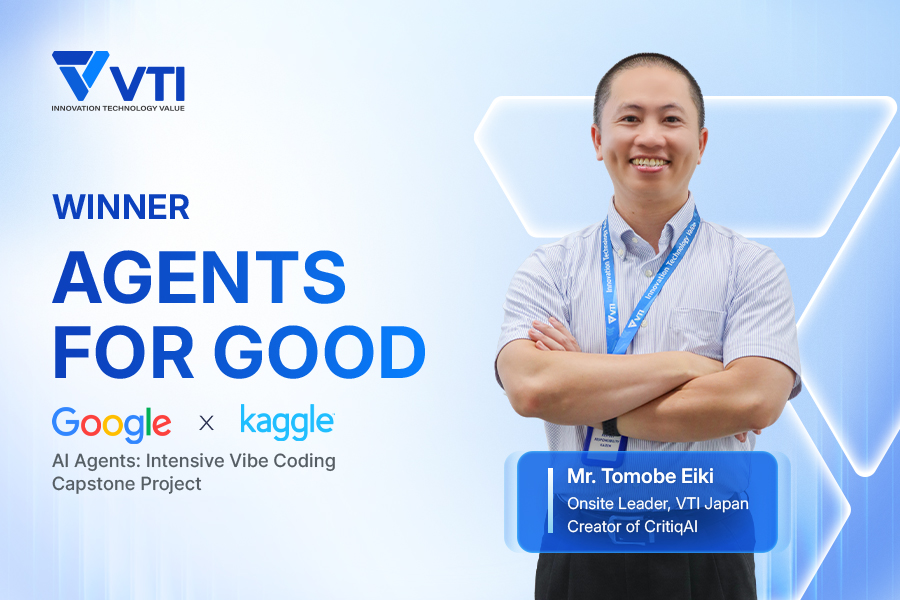
The capstone project gave Tomobe an opportunity to turn what he had learned into a practical application. The result was CritiqAI, an international recognition in the “Agents for Good” category, reflecting not only Tomobe’s technical capabilities, but also a culture of continuous learning and experimentation among VTI’s engineers as AI rapidly changes the way software is developed and used.
Empowering People Across VTI’s AI-Native Journey
Tomobe’s achievement comes as VTI marks several milestones in its broader journey toward becoming an AI-native enterprise, which reflects progress at the organizational, workforce, and individual levels.
At the organizational level, VTI was recently recognized with a Bronze Stevie® Award for AI Company of the Year, providing external recognition of the company’s efforts to embed AI across its operations and delivery capabilities. At the workforce level, more than 500 VTI engineers have completed the Claude Partner Network Learning Path, as the company continues to build practical AI capabilities at scale. Tomobe’s “Agents for Good” recognition adds an individual dimension to that progress, demonstrating how engineers are translating continuous learning into experimentation and practical innovation.
“AI is no longer the future; it is already reshaping how we work and create value today. Our ambition is to empower every VTI employee to embrace AI, master it, and turn it into meaningful innovation,” VTI’s representative emphasized.
These milestones, together, reflect VTI’s broader ambition to build an organization where AI is embedded not only in technology but also in how people learn, work, develop software, innovate, and create value. The company has been developing the systems and governance needed to make AI adoption more consistent and accountable across the organization, including AIWS (AI Work System), Generative AI Guidelines, and the AI Portal, a centralized hub for AI knowledge, resources, and best practices. Human oversight remains central to this approach, particularly where AI-generated outputs require contextual understanding, critical judgment, and final decision-making.
Tomobe is also bringing his experience back into VTI Japan as an active member of its AI Committee (AI推進委員会), which works to standardize and expand effective AI use in daily project work. One idea being explored is the use of independent AI agents that review project outputs from different perspectives such as those of a customer, end user, team leader, or Bridge System Engineer (BrSE).
The concept follows a similar principle to CritiqAI: AI does not simply generate an output, but introduces additional perspectives that help people examine their work more critically before making the final decision.
For Tomobe, the recognition marks another milestone in an ongoing learning journey. “There are so many developers out there fully immersed in figuring out how to apply AI to real life. I want to join that wave, at my own pace. And I’ll definitely be entering other hackathons.”
As VTI continues its AI-native transformation, achievements like CritiqAI demonstrate how that journey is being shaped not only by technology platforms and organizational initiatives, but also by engineers who continuously learn, experiment, and explore new ways to create value with AI.
The capstone project marked the conclusion of the 5-Day AI Agents: Intensive Vibe Coding Course with Google, which explored how production-grade AI agents are designed, secured, and deployed. The 2026 program attracted more than 353,000 registered participants, with over 12,000 active participants submitting more than 6,000 capstone projects worldwide. Learn more about CritiqAI: View the project on Kaggle |