






![[FREE EBOOK] Strategic Vietnam IT Outsourcing: Optimizing Cost and Workforce Efficiency](https://vti.com.vn/wp-content/uploads/2026/06/ebook-it-outsourcing.png)


Company Background
Company Overview
The client is a Vietnamese-Japanese joint venture specializing in the manufacturing of wire harnesses – components that function as the “nervous system” of a vehicle, transmitting electrical power and signals across various vehicle systems. Established in the late 1990s, the company currently employs nearly 10,000 people and operates multiple large-scale manufacturing facilities in Vietnam.
Despite advances in automation, wire harness manufacturing remains highly labor-intensive due to the complexity of the products. As a result, the company has continuously sought to automate and optimize processes where possible, particularly warehouse operations.
The company exports most of its products to overseas markets, primarily in East Asia and North America. This requires it not only to meet domestic quality standards but also to operate in line with the requirements of a global supply chain, where even a one-day delivery delay can potentially disrupt assembly operations across multiple countries.
Business Challenges
With its large-scale operations, the company handles hundreds of major export orders each month. As production volumes increase, however, so does the pressure on warehouse operations:
- Continuous inbound and outbound flows
- Increasingly limited storage capacity
- Heavy reliance on manual warehouse processes
- Longer picking and retrieval times
- Rising labor costs
The key questions were: How can the company scale its operations without expanding warehouse space? How can it increase order processing speed while maintaining a high level of accuracy?
Business Requirements
The company required an automated warehouse system capable of optimizing storage capacity, streamlining warehouse processes, reducing reliance on manual labor, and ensuring accurate inventory control to meet export requirements.
To address these requirements, the company partnered with VTI to develop a Smart Warehouse solution that comprehensively integrates both hardware and software.
Key Challenges
Before designing the solution, the VTI team surveyed the existing warehouse operations and identified four key challenges:
- High dependence on manual labor. Most material handling and warehouse movements were performed manually. This limited operational productivity and made it difficult to scale as production volumes increased.
- Limited real-time inventory visibility. Warehouse locations were not automatically tracked, resulting in longer search times, difficulties in inventory reconciliation, and limited traceability when information was required.
- Complex and error-prone order fulfillment processes. Inbound, outbound, and sorting activities involved multiple manual steps, increasing the risk of operational errors.
- Warehouse layout not optimized for automation. The existing racking system and material flow were designed around traditional warehouse processes and were not optimized for integrating modern automation equipment.
Proposed solution from VTI
Following the assessment, VTI proposed an integrated Smart Warehouse system with robotics, with the Warehouse Management System (WMS) serving as the central orchestration platform and connecting the hardware components into a unified system.
The system architecture consists of four key components working in synchronization:
CTU Robots Replace Manual Labor in Material Handling
A familiar scene in traditional warehouses was workers constantly moving around, pushing carts, and searching for boxes. With the new system, CTU robots automatically receive commands, navigate to designated locations, retrieve containers, and transport them to the required processing areas. They can also receive incoming goods and perform put-away operations. This reduces the need for operators to perform repetitive material-handling tasks, allowing them to focus on activities requiring human judgment, such as quality control and exception handling.
Conveyor Systems – The “Highway” Connecting Warehouse Zones
The conveyor system serves as the “backbone” connecting different warehouse zones, from inbound receiving and storage to outbound processing. By automating the movement of containers between workstations, the system improves material flow and reduces unnecessary manual transportation and waiting time.
Pick-to-Light – Improving Picking Accuracy
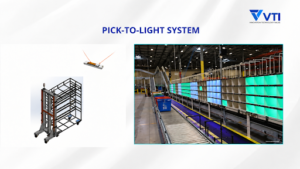
For complex sorting operations and piece picking, Pick-to-Light systems are installed at outbound workstations. When goods arrive at the station, indicator lights identify the required picking or sorting location, guiding operators through the process without requiring manual searches. This helps improve picking speed and accuracy without the need for manual lookups, significantly reducing picking errors.
WMSX: The Central Orchestration Platform
WMSX provides real-time visibility into robot status, container movements, and available storage locations. It also integrates directly with the company’s existing WMS to synchronize warehouse data in real time. At each workstation, operators receive detailed instructions through the system interface, including which goods to receive, where to pick them from, and where to place them. All warehouse activities are recorded and stored to support traceability, operational control, and continuous optimization.
System Operating Process
The system operates according to an Inbound → Storage → Outbound workflow, covering the entire material flow from receiving to dispatch.
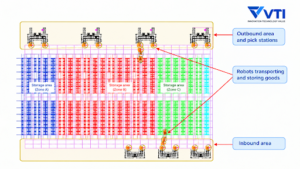
- Inbound: Pallets are delivered to the inbound stations, where operators scan the containers and place them onto the conveyor. The CTU robot then receives instructions from WMSX and automatically transports each container to its designated storage location within the central racking system.
- Outbound: When an outbound order is released, the CTU robot retrieves the required containers from the racking system and transfers them to the conveyor, which transports them to the outbound area. There, the Pick-to-Light system guides operators in sorting and placing goods into the designated positions on the vehicle according to the order requirements.
- Piece picking: For materials requiring extended picking time or individual counting and handling, the system prioritizes processing at the outbound area. Operators perform piece picking with Pick-to-Light support, after which the completed goods are placed in the dispatch staging area.
All three flows are monitored and coordinated by WMSX in real time, ensuring synchronized operation between robots, conveyors, and warehouse operators while minimizing conflicts and unnecessary waiting points.
Implementation Scope
The project was implemented through five key workstreams, covering the process from system setup to operational deployment:
- Item identification: Each container is assigned a unique identification code at the inbound stage, providing the foundation for inventory control and end-to-end traceability.
- CTU robot deployment: CTU robots are programmed to receive commands directly from WMSX via the Robotic Control System and automatically transport containers to their designated locations, eliminating manual intervention in the material movement process.
- Racking system redesign: The warehouse racking system is redesigned around the CTU robots’ picking and put-away operations while optimizing storage density in both horizontal and vertical dimensions.
- Conveyor system installation: Conveyors are installed along both inbound and outbound flows to support the receiving, transfer, and dispatch processes.
- Pick-to-Light deployment: Pick-to-Light systems are installed at outbound workstations to support accurate sorting, even under high workloads and time constraints.
Technology Platform – WMSX
WMSX (Warehouse Management System) serves as the central platform of the Smart Warehouse. Beyond coordinating the warehouse automation equipment, the system provides comprehensive warehouse management functions and integrates bidirectionally with the company’s existing WMS to maintain data synchronization.
Key functions include real-time warehouse layout and storage-location management, standardized inbound and outbound operations, and support for the full order fulfillment process from order entry, batch picking, sorting, piece counting, and packing to dispatch and inventory verification, maintaining order history and recording the transportation history of CTU robots.
The Operator Interface (OI) enables operators to perform manual inbound operations, enter orders, and handle exceptions outside the automated workflow. This allows the system to remain flexible when operational requirements fall outside standard automated processes.
Results
Following system deployment, the company achieved improvements across several areas:
- Reduced reliance on manual labor. CTU robots took over warehouse material movement, allowing operators to focus on activities requiring human judgment and operational handling. This improved operational efficiency while optimizing labor requirements.
- Improved inventory accuracy and visibility. Item identification and real-time tracking provide clear status information for each container and storage location in WMSX, which reduces inventory uncertainty and improves stock control.
- Optimized storage capacity. The redesigned racking system is optimized for CTU robot operations, enabling more efficient use of available warehouse space in both horizontal and vertical dimensions.
- Centralized and traceable warehouse data. Warehouse information – including item locations, inbound and outbound history, and order status – can be accessed quickly and accurately through a centralized platform.
The project demonstrates VTI ability to deliver end-to-end Smart Factory solutions, covering consulting and system design, hardware integration, software development, and deployment in a real manufacturing environment where operational accuracy is critical. This also marks a significant step in the enterprise’s long-term strategy for factory automation and digital transformation.