





![[FREE EBOOK] Strategic Vietnam IT Outsourcing: Optimizing Cost and Workforce Efficiency](https://vti.com.vn/wp-content/uploads/2026/06/ebook-it-outsourcing.png)


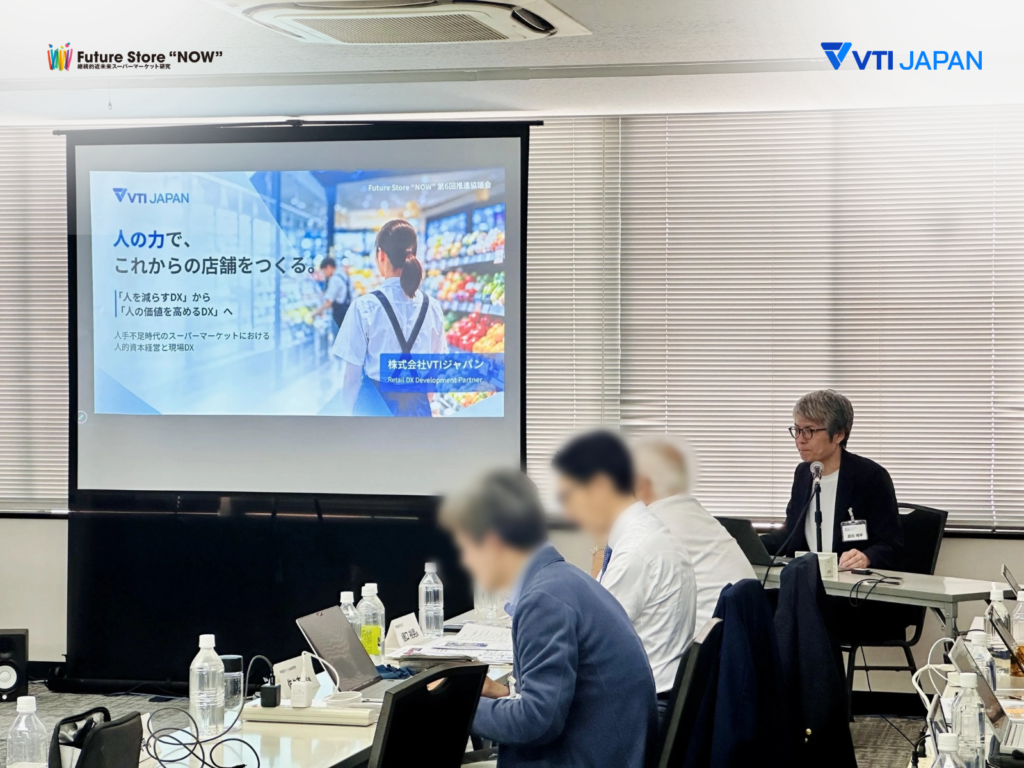
On September 17, 2026, VTI Japan participated in the 6th Future Store “NOW” Conference, hosted by the National Supermarket Association of Japan. Representing the company, Shuhei Yoshida, VTI Japan’s representative, shared perspectives on human capital management and frontline DX for supermarkets as the industry faces persistent labor shortages.
Reframing DX: From Reducing People to Elevating What They Can Do
Speaking under the theme “From DX that reduces headcount To DX that increases human value”, VTI Japan’s representative addressed a pattern common across the industry: as labor shortages deepen, DX investment tends to default toward headcount reduction. The talk proposed a different starting question — not “how many people do we have,” but “what can the people we already have accomplish.” Framed this way, DX becomes less about cutting roles and more about freeing up time and data so that existing staff can take on higher-value work such as customer service, floor improvement, and on-the-job coaching.
To explain why this value often goes untapped, the session outlined four structural gaps commonly found in frontline workforce management: skills and experience that go unrecorded and are lost when staff transfer or leave; training that produces attendance records but not measurable on-the-job capability; competencies that, even when known, are rarely reflected in shift assignments; and frontline feedback that surfaces but doesn’t reach the people who can act on it. According to the talk, these four gaps reinforce one another — invisibility blocks development, underdeveloped skills can’t be deployed, and unused capability rarely gets voiced upward.
To close these gaps, VTI introduced its RetaX approach: connecting workforce data — skills, availability, learning history — with store-level operational data such as demand, shift needs, and task volume, across an end-to-end retail stack spanning stores, inventory, ordering, and logistics. The goal is not simply to collect workforce data, but to make it usable in daily decisions — reassigning a trained employee to cover an unexpected shortfall, for instance, rather than leaving that knowledge sitting unused in a manager’s head.
Looking Ahead: VTI Japan’s Commitment to Human-Centered Retail DX
The talk was grounded in projects VTI Japan has delivered for Japanese retailers, including core-system modernization that cut operating costs by roughly 30% and annual maintenance costs by roughly 40%; inventory and ordering optimization built on unified, demand-forecast-driven data; multi-store shift management that consolidated scheduling and gave staff mobile access to their shifts; and data-driven decision-making built on a unified sales and inventory platform. These cases were used not as headline achievements but as illustrations of what a “people-first” DX approach looks like once implemented in an actual store environment.
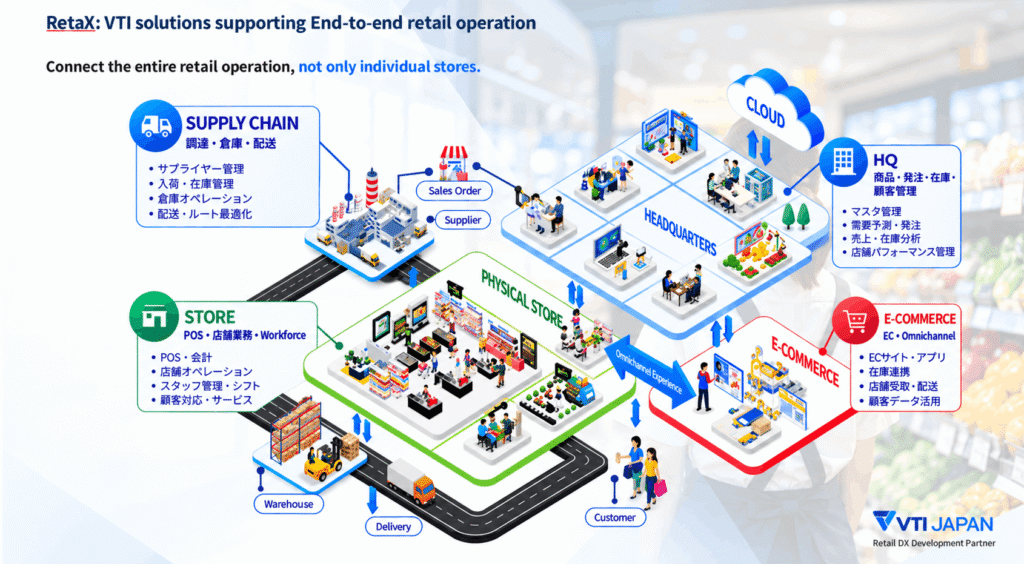
Going forward, VTI Japan continues to position itself as an execution partner for retail DX — supporting clients from problem definition and PoC through development, rollout, and ongoing improvement — with a particular focus on ensuring that workforce data, once connected, actually changes how frontline decisions get made.
About the Conference
Future Store “NOW” is a recurring research initiative on the future of the supermarket industry, hosted by the National Supermarket Association of Japan (NSAJ), founded in 1958. Its Promotion Council sessions are held roughly every two months in Tokyo; this event marked the sixth session held in 2026. VTI Japan became an associate member of NSAJ in 2026 and has since participated actively in the association’s activities.