





![[FREE EBOOK] Strategic Vietnam IT Outsourcing: Optimizing Cost and Workforce Efficiency](https://vti.com.vn/wp-content/uploads/2026/06/ebook-it-outsourcing.png)


Retail is evolving quickly, but not all changes happen at the same pace. From how customers pay to how inventory is managed and how stores operate, the shift toward digital is reshaping every layer of the industry. For many retailers, the challenge is no longer whether to transform, but how to connect these changes into a seamless whole.
To explore this, we spoke with Mr. Nguyen Huu Dang, General Manager and also Head of AI CoE at VTI, who leads system development projects for retail clients. Drawing from his experience, he shares how technologies like mPOS and AI are not just improving individual functions but redefining how retail operates end-to-end.
From Fixed Counters to Flexible Commerce with mPOS
Retailers today are rethinking one of the most familiar parts of the in-store experience: checkout. As Mr. Dang explains, the shift from traditional POS to mobile POS (mPOS) is driven by a need for greater flexibility.
With mPOS, transactions are no longer tied to a fixed register, payments can be processed anywhere on the shop floor.
This mobility allows retailers to redesign store layouts and reduce checkout congestion. It also makes scaling operations simpler, whether opening new stores, launching pop-ups, or expanding during seasonal periods.
Beyond flexibility, mPOS also improves scalability while reducing operational costs. Because it relies less on dedicated hardware, especially with web-based solutions, businesses can lower the total cost of ownership (TCO) & shorten training time. At the same time, it connects naturally with omnichannel strategies and digital platforms.
Looking ahead, Mr. Dang sees this as more than a system upgrade.
mPOS will become the new standard… enabling store operations and customer experience to be designed as one seamless whole.
From Experience-Based Decisions to Data-Driven Supply Chains
Inventory and logistics remain one of the most complex challenges in retail. Many organizations still rely on experience-based forecasting, which often leads to inefficiencies, from stock imbalances to unnecessary costs. AI is beginning to change that.
AI is not a decision maker, but a “forecast map.”
By analyzing factors such as sales history, seasonality, events, and even weather conditions, AI enables more accurate demand forecasting. This helps retailers reduce stockouts while avoiding excess inventory—both of which directly impact cost and customer satisfaction.
At the same time, AI works best when combined with other technologies. IoT and real-time tracking provide instant visibility into inventory, while predictive analytics help optimize allocation across locations. New approaches, such as simulation tools for store layouts, are also emerging.
Together, these capabilities allow retailers to move toward supply chains that are not only data-driven but also responsive and adaptable in real time.
From Operational Gaps to Smarter Store Experiences with AI
At the store level, another challenge continues to shape retail performance: workforce consistency.
Especially in markets like Japan, where part-time employment is high and staff turnover is frequent, maintaining consistent service quality can be difficult. Differences in employee experience often translate directly into differences in customer experience.
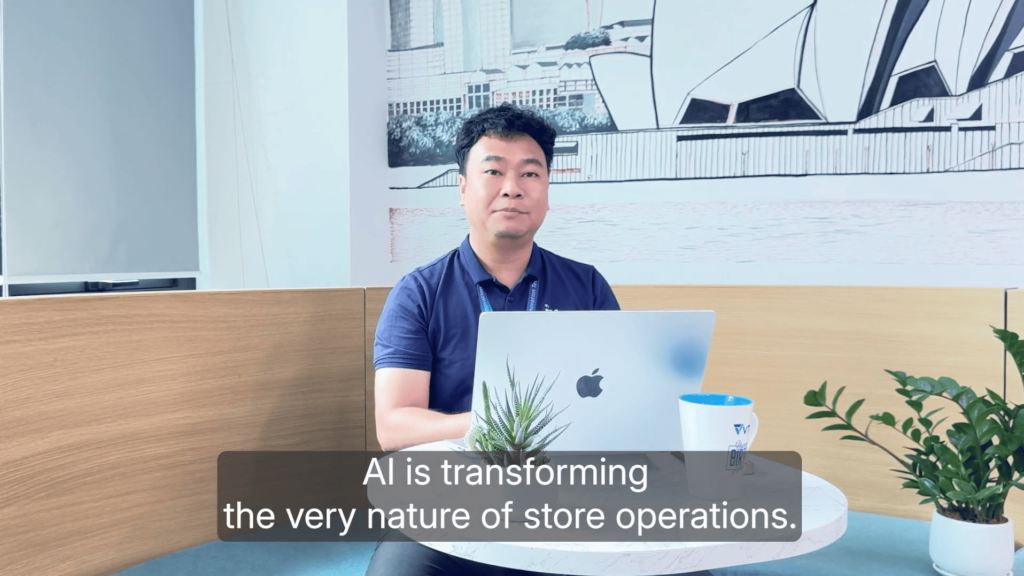
AI is starting to play a new role in addressing this gap.
AI turns each employee into an ‘on-the-spot expert,’ reducing training costs while elevating service quality.
With tools such as AI-powered assistants, employees can quickly access SOPs, resolve issues, and receive guidance tailored to real-time situations. This shortens onboarding time while improving day-to-day operations.
Looking ahead, AI is expected to go even further, connecting every stage of the customer journey: browsing, purchase, payment, or delivery. Systems will become more integrated, enabling retailers to deliver more personalized and consistent experiences.
As Mr. Dang notes, this level of integration will define the next generation of retail.
Connecting the Pieces of Modern Retail
What emerges from these shifts is a broader pattern. A single technology does not drive retail transformation, but rather how different capabilities come together: flexible checkout, intelligent supply chains, and smarter store operations. Each step builds on the next.
For retailers navigating this transition, the focus is shifting from isolated improvements to building systems that work seamlessly together. When that happens, transformation moves beyond incremental change and begins to reshape the entire customer experience.