





![[FREE EBOOK] Strategic Vietnam IT Outsourcing: Optimizing Cost and Workforce Efficiency](https://vti.com.vn/wp-content/uploads/2026/06/ebook-it-outsourcing.png)



ISA-95 has become an important indicator and standard for companies promoting DX (Digital Transformation) and aiming for automation and efficiency in manufacturing. Among these, many may have heard the concept of the “Automation Pyramid” when advancing business reforms in the field and office. However, not many people truly understand its structure and meaning. This article will provide a detailed explanation of the “Automation Pyramid,” which is widely used in the manufacturing industry.
What is Automation Pyramid
History of the Automation Pyramid
The Automation Pyramid was proposed in the late 1990s by ISA (the International Society of Automation) and is closely associated with ISA-95. Its development aimed to improve data transparency and integration between factory-floor and enterprise operations.
- From the 1970s to the 1980s, as computer technology advanced, manufacturing companies began computerizing production management and material requirements planning. CIM (Computer Integrated Manufacturing), in which host computers centrally managed data and integrated inventory management with process control, became increasingly popular. However, a fully integrated CIM model was difficult to achieve.
- The predecessor of the Automation Pyramid was the Purdue Reference Model, an Enterprise Architecture Model for CIM developed by Purdue University in collaboration with manufacturing companies in North America. It provided a blueprint for integrating enterprise information systems and manufacturing operations.
- During this period, Japanese companies mainly built enterprise information systems by customizing existing software packages. When new problems or functions arose, additional systems were often introduced, resulting in data silos.
- In the 1990s, ERP (Enterprise Resource Planning), which evolved from MRP-II (Manufacturing Resource Planning), supported a wide range of operations, including sales, marketing, procurement, logistics, and production. However, limited connectivity between functional modules and business applications remained a major challenge. Proprietary data and software across departments and factories created boundaries between manufacturing information systems and enterprise management systems, further contributing to data silos.
- Therefore, in the late 1990s, ISA proposed ISA-95 as a standard for integrating management systems with manufacturing systems and improving information exchange across the enterprise.
The Original Structure of the Automation Pyramid
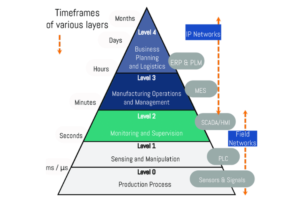
The first Automation Pyramid did not fully include the element of “automation” and only focused on centralized data management, but it laid the foundation for a “hierarchical model.” Consequently, the pyramid was composed of the following five levels:
- Level 0: Manages the physical process itself in real-time.
- Level 1: Manages activities related to sensing and operating the physical process in seconds/milliseconds.
- Level 2: Manages activities for monitoring and controlling the physical process in minutes/seconds/sub-seconds.
- Level 3: Manages activities related to the workflow for producing the requested product in days/shifts/hours/minutes/seconds.
- Level 4: Manages management-related activities necessary for managing the manufacturing department in months/weeks/days.
The current pyramid incorporates advanced technologies such as AI and IoT, and not only centralizes data for each department but also contributes to automating and improving the efficiency of manufacturing operations. In the following two sections, we will explain each level of the Automation Pyramid currently in use in detail.
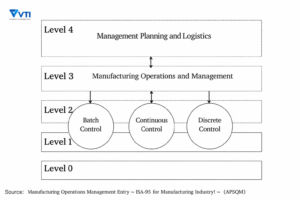
Hierarchical Structure of the Automation Pyramid Based on ISA-95
ISA-95 defines a model of manufacturing enterprises that distinguishes between software systems for management and production functions and the data exchanged between them. Beyond the “Automation Pyramid,” the standard provides a framework for modeling production lines and communication between levels. Levels 0–2 prioritize safety and typically use local industrial networks and fieldbus protocols, while Levels 3–4 rely more on internet-based communication and traditional IT systems.
- Level 0: “Production Process” – Raw materials are processed into products. Sensors and actuators automate physical processes, with data collected and processed in milliseconds or microseconds.
- Level 1: “Sensing and Manipulation” – Sensors and actuators connect to PLCs (Programmable Logic Controllers), which continuously read sensor signals and control actuators.
- Level 2: “Monitoring and Supervision” – SCADA (Supervisory Control and Data Acquisition) systems and HMI interfaces enable operators to monitor, supervise, and remotely control groups of machines.
- Level 3: “Manufacturing Operations Management” (MOM) – This level manages operations between the shop floor and enterprise systems. MES (Manufacturing Execution System) manages production from raw materials to finished products, digitizes documents, and tracks production data to support informed decision-making.
- Level 4: “Business Planning & Logistics” – This level manages enterprise operations through systems such as ERP (Enterprise Resource Planning) and PLM (Product Lifecycle Management). Shared data helps departments such as R&D analyze information for product improvement and development.
Beyond these five levels, some Automation Pyramid models include an “External Level” (Level E) covering external entities such as the Internet, suppliers, collaborators, and customers. In Manufacturing 4.0, connecting these elements can extend data sharing beyond the enterprise and support a broader data ecosystem.
How Emerging Technologies Are Transforming the Traditional Automation Pyramid
The traditional Automation Pyramid was designed around a clear hierarchy, with data flowing upward from physical devices and equipment on the factory floor to control systems, manufacturing management, and enterprise-level systems. However, the emergence of technologies such as AI, IoT, computer vision, cloud computing, and advanced data analytics is changing how these levels interact. Instead of operating as relatively isolated layers, modern manufacturing environments are increasingly connecting data, systems, and decision-making across the pyramid.
Factory Floor Automation Becomes More Intelligent
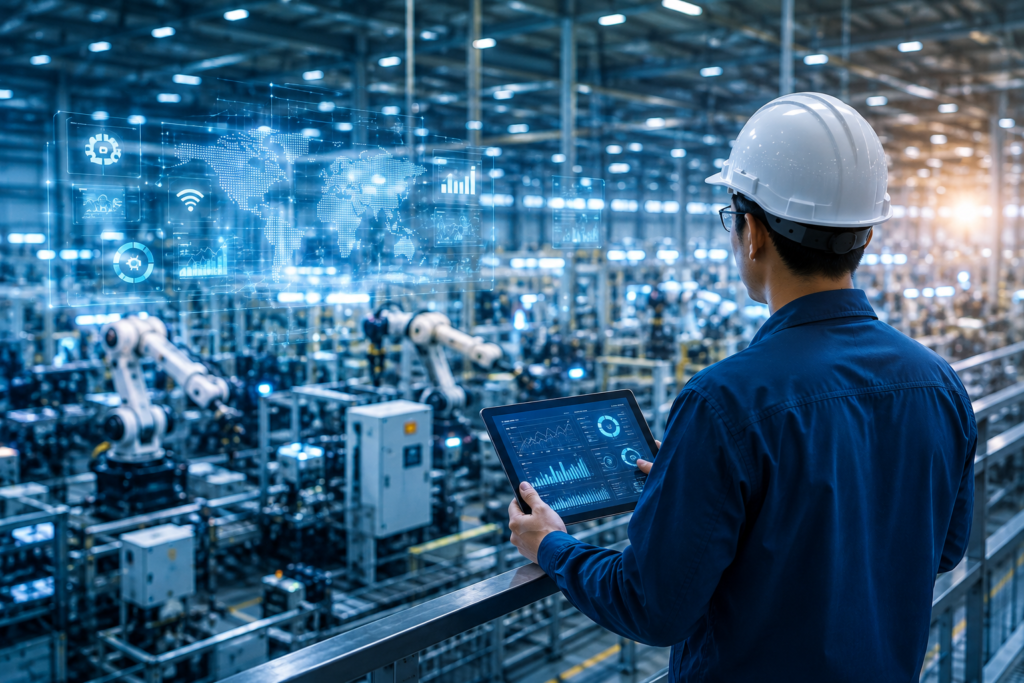
In the past, tasks from receiving and manufacturing to packaging and inspection often relied on manual work. Today, a factory floor model based on the automation pyramid uses cameras, sensors, robotic arms, and computer vision to automate and optimize these tasks. For example, computer vision can scan QR codes or RFID tags to capture product information such as shelf location, supplier, and expiration date, enabling automated robots or drones to replenish stock. Cameras with computer vision also support quality control and entry/exit management.
The devices at Levels 0-2 have also taken on a new role. They not only support factory-floor operations but also collect real-time product data, which allows managers at higher levels to quickly identify problems. By continuously collecting data and applying AI for analysis and prediction, manufacturers can anticipate demand and hidden risks, supporting predictive maintenance. According to McKinsey, Industry 4.0 applications can reduce machine downtime by 30-50% and increase throughput by 10-30% . McKinsey also reports that they can improve labor productivity by 15-30% and forecasting accuracy by up to 85% . Greater adoption of AI, sensors, and connected equipment at lower levels can therefore help manufacturers turn production data into predictive insights and operational improvements.
Digitizing Operations Beyond the Factory Floor
Beyond the factory floor, many tasks are handled by other departments. When you think of an office or accounting department, you probably picture piles of documents, right?
Before technological advancement, employees had to input data manually and keep paper documents year after year, and the sheer volume of paperwork made mistakes easy, mistakes that could even cost a company its customers. That has changed. By introducing smart systems at the business planning and enterprise levels (Levels 3 and 4), most operations, especially those involving extensive paperwork, are now digitized. With OCR (Optical Character Recognition), for instance, documents can be scanned, converted into digital versions, and uploaded to the cloud automatically, replacing manual input that used to take 2-3 hours. Searching for data then takes just one click. As a result, employees no longer need to spend so much time on repetitive, simple tasks and can dedicate themselves to work that only humans can do.
This shift is already widespread. Deloitte’s 2025 Smart Manufacturing Survey found that 57% of manufacturers were using cloud computing and another 57% were leveraging data analytics at the facility or network level, while 46% were using industrial IoT (IIoT) solutions.
Connecting Data Across Automation Levels
Centralized data management was already emphasized in the original automation pyramid, and new technologies make it far more effective. By utilizing advanced management systems at each level, data is not only collected in real time but also processed, analyzed, and stored. ERP systems and the like at higher levels (Levels 3 and 4) analyze data collected by devices at Levels 0-2 to extract valuable insights. Centralized data management also helps prevent data loss over the years and supports departments that research data, such as R&D, marketing, and management.
Better data integration is becoming increasingly important. Deloitte’s survey found that 54% of manufacturers were using a data standard based on a unified data model, while 45% were leveraging an architecture standard to support scaled deployments and governance. However, data silos remain a challenge: a Manufacturing Leadership Council survey found that only 41% of respondents reported routinely sharing data across all functions, while 68% shared data only between some functions.
Extending Automation to Business Performance
Together, these changes lead to measurable business results. Systems equipped with AI optimize and streamline departmental operations, while centralized data management helps reduce operating costs and increase sales at the same time. According to one survey, ERP systems integrated with AI alone were reported to reduce operating costs by 35% and increase sales by 10%.
MES Level in the Automation Pyramid
Of all five levels in the Automation Pyramid, Level 3 tends to raise the most questions — largely because MES, the software that defines it, is often talked about without ever being clearly explained.
MES is the system that sits between the physical shop floor (Levels 0–2) and the business-planning world of ERP (Level 4). It doesn’t sense or control machines directly the way a PLC or SCADA system does, and it doesn’t handle finance, sales, or long-term planning the way ERP does — instead, it occupies the middle ground, turning raw, real-time signals into structured, usable production data.
MES and AI-Powered Quality Control
There are no two factories running the same equipment, product mix, or quality process, a generic MES rarely fits out of the box. This is why most manufacturers work with a manufacturing software development service to configure or build an MES around their specific workflow, rather than reshaping their operations to match a rigid, pre-built package.
One area where this customization pays off is quality control. Rather than relying purely on manual visual checks, some MES deployments now fold in AI-powered inspection modules that use computer vision to automatically classify parts and flag defects a human eye might miss cutting inspection time while improving consistency.
VTI Group
VTI provides a one-stop solution for software development aimed at digital transformation and business growth, by leveraging advanced technologies such as AI and manufacturing expertise. We develop an ecosystem of products that are used in conjunction with our core MES-X production management system, offering them as a one-stop solution.
VTI MES-X is an AI- and IoT-powered manufacturing execution system that connects production, warehouse, quality, and maintenance operations. Gain real-time visibility, streamline processes, and improve factory efficiency with a unified manufacturing platform.Ready to make your manufacturing operations smarter?
The MES-X Integrated Production Management System is comprised of six main modules: MEScore (Manufacturing Execution System), WMS-X (Warehouse Management System), QMS-X (Quality Management System), MMS-X (Equipment Management, Maintenance, and Inspection System), TMS-X (Traceability System), and PMS-X (Procurement Management System). It aims to improve productivity and synchronize all entities involved in the production process.
Along with the MES-X system, we offer our proprietary AI & IoT products such as BusEye, ParkingX, FaceX, LogX, Smart ENE, and Smart Monitoring System, aiming to contribute to the acceleration of DX in our clients’ factories.
- MEScore, the Manufacturing Execution System: Comprehensively manages the entire production process, from planning to real-time monitoring and reporting.
- WMS-X, the Warehouse Management System: Smartly manages raw materials, products, and inventory in real-time using QR codes, reducing manual work.
- QMS-X, the Quality Management System: Manages quality from raw material arrival through manufacturing to product shipment, improving production processes and reducing defects.
- MMS-X, the Equipment Management, Maintenance, and Inspection System: Creates management and maintenance plans for machinery and equipment, predicts and warns of malfunctions, and analyzes return on investment.
- TMS-X, the Traceability System: Tracks the status of products in real-time from manufacturing to sales.
- PMS-X, the Procurement Management System: Manages the procurement of raw materials and other items with high accuracy.
If you would like to learn more about our MES-X system and proprietary AI & IoT products, please do not hesitate to contact us.
Summary
As discussed above, we will introduce the Automation Pyramid. If you have any questions regarding AI, please do not hesitate to contact us.
Also, if you wish to update your information and knowledge on cutting-edge technology, please enter your email address for registration.