






![[FREE EBOOK] Strategic Vietnam IT Outsourcing: Optimizing Cost and Workforce Efficiency](https://vti.com.vn/wp-content/uploads/2026/06/ebook-it-outsourcing.png)



As DX accelerates, manufacturing companies seem to be making their factories or headquarters smarter and more efficient by utilizing new technologies to realize DX transformation. Among these, MES and SCADA are attracting the attention of many managers as tools that help improve the efficiency of both machines and operators. But how should you implement MES, SCADA, or both? This article will solve that question.
Overview of MES and SCADA
What is MES?
MES manages and tracks manufacturing operations in real time. In the automation pyramid, it operates at Level 3, bridging Level 4 business systems such as ERP and Levels 1–2 systems such as SCADA and PLCs.
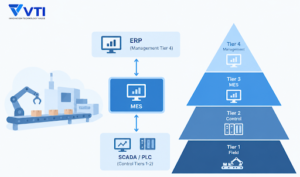
Benefits of MES
The potential impact of digital manufacturing can be significant. McKinsey reports that manufacturers have achieved 10–30% increases in throughput and 15–30% improvements in labor productivity through digital manufacturing initiatives .
In the Deloitte Survey, manufacturers reported an average 10–20% improvement in production output, 7–20% improvement in employee productivity, and 10–15% in unlocked capacity following smart manufacturing initiatives.
- Improving Production Efficiency: MES helps improve production efficiency and overall equipment effectiveness (OEE) by providing transparency and real-time analysis. Process large amounts of data to analyze performance, availability, and quality factors.
- Better quality: Improve quality by leveraging real-time quality data acquisition and processing.
- Inventory reduction: By connecting production data with ERP, MES improves visibility into production progress and material needs, helping manufacturers control work-in-progress and reduce production, transportation, and storage costs.
- Making your factory paperless: By digitizing factory data or acquiring data using scanning technology, documents can be easily managed without manual entry.
- Helps with tracking: MES provides product information (point of order, serial number, etc.). Combine this with factory-related data (such as machine status) to create a digital product lifecycle that supports tracking.
Key Features
VDI Guidelines 5600 describes ten core features of MES that provide the foundation for operating almost any type of system.
- Order management: Manages production orders and ensures the required information is available for execution.
- Detailed scheduling and process control: Creates detailed production schedules and coordinates order execution based on available resources.
- Equipment management: Monitors and manages the availability and condition of production equipment.
- Materials management: Ensures the timely supply of materials and tracks work-in-progress throughout production.
- Human resources management: Assigns personnel to production activities based on availability, qualifications, and requirements.
- Data acquisition: Collects and processes data from production processes, machines, and operations.
- Performance analysis: Analyzes production data to evaluate performance and identify areas for improvement.
- Quality management: Supports quality control by monitoring production processes and quality-related data.
- Information management: Organizes and provides production information to support operational and management decisions.
- Energy management: Monitors and manages energy consumption within manufacturing processes.
What is SCADA?
Supervisory Control And Data Acquisition (SCADA) systems are used to control, monitor, and analyze industrial devices and processes. The system consists of both software and hardware components and can collect data from industrial equipment remotely and on-site. This way, administrators can access and control data without being on site.
How does a SCADA system work?
A SCADA system consists of three main component systems which are: Field Devices, PLC/RTU and HMI/SCADA Interface. By combining these, data is transmitted from sensors, motors, etc. (devices that need to be monitored and controlled) to interfaces (where data is analyzed and reported).
The link between the components of the SCADA architecture is the Programmable Logic Controller (PLC) or Remote Terminal Unit (RTU). These are microcomputers that interact both with equipment (also called field devices) on the one hand and with human-machine interfaces, or HMIs, on the other hand.
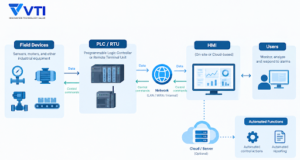
As shown in the diagram, the PLC and RTU send data to a remote or on-site HMI for conversion and send control commands back to field devices.
Human operators access data through HMIs that are cloud-based or based on their own servers. The software interprets the data and presents it in an easy-to-understand manner. It allows operators to quickly and easily analyze and respond to alarms.
Some SCADA systems also include options for automated control actions and automated reporting engines that allow easy report generation.
Advantages of SCADA
SCADA systems help manufacturers improve production control, operational efficiency, and compliance. By providing a centralized platform for industrial operations, SCADA supports more consistent and reliable production.
There are also several other benefits of SCADA worth mentioning:
- Transparency: Transform operational data into actionable insights, providing real-time visibility for faster decision-making, while helping identify productivity opportunities and optimize resource utilization.
- Availability: Support reliable operations through continuous monitoring, integrated diagnostics, and redundant architectures, helping minimize downtime and improve response times.
- Flexibility: Adapt to changing operational requirements with flexible and open SCADA systems that support applications ranging from simple setups to complex distributed and specialized environments.
- Integration: Connect OT and IT systems through open interfaces, making operational data more accessible for analytics and broader manufacturing applications.
MES vs SCADA: key differences
| Aspect | MES | SCADA |
| Primary focus | Production management and execution | Real-time monitoring and control |
| Automation pyramid level | Level 3 | Levels 1–2 |
| Main role | Uses production data to manage and coordinate manufacturing operations | Collects and visualizes equipment and process data |
| Control scope | Coordinates production activities and workflows | Controls and monitors machines and industrial processes |
| Data | Production, quality, materials, traceability, and operational data | Real-time equipment and process data |
| Decision-making | Supports higher-level production decisions | Supports real-time operational decisions |
| Typical users | Production managers, planners, quality teams, and supervisors | Operators, control engineers, and maintenance teams |
| Relationship | Can use SCADA data to manage and optimize production | Provides real-time shop-floor data |
MES vs SCADA: Which One Do You Need?
When to Use SCADA
SCADA may be suitable when the primary requirements are:
- Real-time monitoring of machines and industrial processes
- Centralized visualization of equipment status
- Alarm monitoring and response
- Supervisory control of industrial equipment
- Collection of machine and process data
- Improving visibility into shop-floor operations
When to Use MES
MES may be suitable when a manufacturer needs to:
- Manage and execute production operations
- Track production orders and progress
- Improve production traceability
- Manage production-related quality data
- Coordinate materials and production resources
- Connect production operations with ERP or other enterprise systems
- Analyze production performance and OEE
In equipment manufacturing, MES can work with IoT systems to collect machine status and production data in real time. This information can then be used to monitor production performance, identify downtime, and support maintenance and operational decisions.
How MES and SCADA work together
MES and SCADA operate at different levels of the automation pyramid and can work together to connect shop-floor operations with higher-level production management. SCADA focuses on real-time monitoring and control, while MES uses production data to manage and coordinate manufacturing operations.
Data Flow Between MES and SCADA
The integration creates a two-way flow of information between the shop floor and production management. SCADA sends real-time machine and process data to MES, including equipment status, production counts, alarms, and process values. In return, MES can provide production orders, schedules, and instructions to connected shop-floor systems for execution.
This connection allows real-time data collected from machines and processes to be combined with production information and used in broader manufacturing operations management.
How MES and SCADA Support Each Other
The two systems have complementary roles. SCADA monitors and controls equipment and processes in real time, while MES adds production context to shop-floor data and manages activities such as production tracking, quality, and traceability.
For example, when SCADA detects an alarm on a filling line, the event can be sent to MES. MES can associate the event with the relevant production order and lot, helping manufacturers identify the affected production and take appropriate action, such as holding the lot for quality inspection.
MES and SCADA in Multi-Line Manufacturing
The benefits become more apparent in manufacturing environments with multiple production lines. Each line may use its own SCADA system to monitor machines and processes, while MES can collect and consolidate data from these systems into a centralized view of production.
This helps manufacturers synchronize production information across lines, improve traceability, and monitor overall production performance. By connecting real-time shop-floor data from SCADA systems to production management via MES, manufacturers can create a more consistent flow of information throughout the manufacturing process.
VTI’s MES-X production management system
VTI offers an integrated software development solution that supports digital transformation and business growth, combining advanced technologies such as AI with manufacturing expertise. Its product ecosystem works alongside the core MES-X production management system to provide manufacturers with a comprehensive, one-stop solution.
Ready to make your manufacturing operations smarter?
VTI MES-X is an AI- and IoT-powered manufacturing execution system that connects production, warehouse, quality, and maintenance operations. Gain real-time visibility, streamline processes, and improve factory efficiency with a unified manufacturing platform.
Summary
MES and SCADA play complementary roles in smart manufacturing. While SCADA focuses on real-time monitoring and control at the shop-floor level, MES manages and coordinates production at a higher level. Understanding their differences and how they work together can help manufacturers choose the right system or integrate both to improve visibility, traceability, and production efficiency.