






![[FREE EBOOK] Strategic Vietnam IT Outsourcing: Optimizing Cost and Workforce Efficiency](https://vti.com.vn/wp-content/uploads/2026/06/ebook-it-outsourcing.png)



COBOL was born in 1959, which makes it more than 65 years old (67 as of 2026). Even so, this decades-old language that runs on mainframes has proven its staying power, surviving the pandemic and the arrival of every generation of newer programming languages, and it is still used by many developers today. That track record is the reason why so many IT leaders are asking about the COBOL future: will it keep running the world’s core systems, or is it finally on its way out?
Leon Kappelman, a professor of information systems at the University of North Texas, said COBOL was still “alive and well,” and that the same went for its mainframe colleagues. One reason, he explained, is that “there is no business case for replacing them.” Yet few people can say for certain whether demand for COBOL will stay high, or whether it will become a “dead language,” as rumor has predicted for years. This article looks at where COBOL stands today, why it persists, what might replace it, and how companies are managing the transition, so you can form your own view of the COBOL future.
A Brief History & Current State of COBOL
COBOL (Common Business-Oriented Language) was created to make programming more accessible for business applications. At the time, languages such as FORTRAN were difficult to understand and often tied to specific hardware, limiting portability between different computer systems. COBOL was designed to address these limitations by supporting portability across multiple computers and using more English-like syntax.
Although COBOL remained difficult to write and did not become widely adopted by businesspeople as originally intended, its readable structure made it well suited to business data processing. It was increasingly used on mainframes in industries that handled large volumes of transactions and data, particularly banking and government.
As programming shifted toward object-oriented languages such as Java, COBOL became less common in university courses and appeared to be heading toward obsolescence. However, it never disappeared. Today, COBOL continues to support core transaction systems across banking, insurance, airlines, retail, and government.
As a result, the key issue is no longer simply COBOL’s age, but how organizations can maintain, modernize, and support the legacy systems that still depend on it.
The Growing COBOL Talent Shortage
An Aging Workforce & Retirement Wave
Many programmers are retiring, creating a shortage of skilled COBOL personnel. The Society for Information Management’s 2020 IT Trends report found that respondents expected 7% of IT employees to retire over the following five years, compared with 7.1% in 2019 and 6.9% in 2018. In Japan, a 2019 COBOL fact-finding survey by Nikkei xTECH highlighted ongoing challenges in maintaining COBOL skills. Among 1,348 respondents, 665 said it had become difficult to secure COBOL engineers, indicating a significant talent shortage as organizations continued to rely on legacy systems.
More recent data shows the same trend:
- A 2025 survey reported by BizTech Magazine found that 91% of IT leaders consider expanding their mainframes a moderate or critical priority, yet 71% said their mainframe teams are understaffed and 54% said they are underfunded.
- Industry estimates put the average age of COBOL programmers is 58, and roughly 10% are retiring each year .
- In Japan, the Ministry of Economy, Trade and Industry (METI) warned in its 2018 DX Report of the “2025 cliff,” projecting economic losses of up to 12 trillion yen a year after 2025 if aging core systems were not renewed. Having a shortage of expert personnel available to maintain a critical system creates significant risk to an agency’s mission.
As experienced COBOL programmers retire, maintaining these systems becomes harder. Although COBOL systems are easy to maintain, COBOL itself is not easy to learn, and bringing new engineers up to speed is commonly said to take one to two years. Many developers prefer modern languages such as Python. Meanwhile, as digital transformation (DX) advances and companies such as Fujitsu move away from mainframe offerings, uncertainty remains over how long COBOL system and talent providers will continue to offer support. What should companies do?
Career Outlook: Is Learning COBOL Worth It for Developers?
For an individual developer, the answer depends on what kind of career you want, and on your own read of the COBOL future.
- The case for learning COBOL: competition is low, demand is steady because the systems cannot simply be switched off, and the work tends to be stable. In the US, salaries for COBOL and mainframe roles are commonly reported in the range of roughly $67,158 to $115,845, with modernization specialists at the upper end. Because so few people learn COBOL, skilled engineers are hard to replace.
- The case against: the applicability is narrow. COBOL work is concentrated in large banks, insurers, governments, and retailers, and it is rarely found at startups or in consumer product companies. It usually comes bundled with a wider mainframe toolset (such as JCL, CICS, and DB2) that also has to be learned, and AI-assisted modernization tools may change what the work looks like over time.
A practical path for many developers is to combine COBOL fundamentals with modern skills such as Java, APIs, and cloud, and to work on the modernization side of the field rather than pure maintenance.
Why COBOL Demand & Usage Remain High
Where COBOL still runs today
COBOL was created for transaction processing, and that is still where it earns its keep. COBOL applications run ATM and banking transactions, payroll, government pension funds, hotel bookings, and airline ticketing, among many other things. According to IBM, COBOL serves as the foundation for more than 40% of all online banking systems, supports 80% of in-person credit card transactions, and handles 95% of all ATM transactions and powers systems that generate more than USD 3 billion of commerce each day.
How much code is there?
For years, the commonly cited estimate was 200 to 230 billion lines of COBOL worldwide . A more recent industry benchmark suggests the true scale is far larger. A 2022 survey conducted by Vanson Bourne for Micro Focus (now part of OpenText, with its COBOL business today under Rocket Software) put the amount of COBOL in daily production use at roughly 775-850 billion lines. In that survey, 92% of respondents said their COBOL applications were strategic, and nearly half expected the amount of COBOL in use at their organization to grow over the following 12 months.
In Japan, the picture is similar. In the IPA’s “Software Development Analysis Data Collection 2022” which covers projects from 2016 to 2021, COBOL was the second most common main development language at 16.3% of projects, behind Java at 42.4%. The IPA data reflects that COBOL is used largely to maintain and modify existing assets rather than for new development.
Why is COBOL still used so widely?
Over the years, COBOL has been known for its high stability and its ability to process large volumes of data at once. COBOL systems are also highly structured and are considered fairly easy to maintain. That is probably why industries that need stable systems capable of processing large numbers of transactions efficiently and quickly (banks, securities firms, insurance companies, government agencies, and so on) favor systems built on COBOL. Although many programming languages such as C++ and Java have emerged over the years, the fact that COBOL systems continue to run smoothly shows that COBOL’s effectiveness is still high.
The age of a COBOL application does not, by itself, determine whether it remains useful. What matters more is whether its underlying business logic still supports current business requirements and whether the system can be maintained securely and reliably.
COBOL systems are used mainly by financial services organizations and the federal government, but they are also used quite a lot in the retail industry. Early findings from a survey by the COBOL Working Group found that many retailers use COBOL to process POS credit card transactions “We know that Walmart uses it, and that Target and Home Depot use mainframes,” the majority of those use COBOL.
Why Is It Too Expensive and Risky to Rewrite COBOL Systems?
“The cost of rewriting 220 billion lines of code would probably be between $4 trillion and $8 trillion today, maybe more,” said Leon Kappelman. If the higher line-count estimates above are closer to the truth, the bill would be proportionally larger.
Money is only part of the problem. There are three reasons why replacing COBOL systems is so hard:
- Ripple effects. Core COBOL systems are rarely standalone. They are connected to batch jobs, databases, downstream reporting, and partner systems, many of them built up over decades. A change in one program can have consequences several steps away, and those consequences are often discovered in production.
- The cost of downtime. These systems process payments, payroll, claims, and public services. Even a short outage can mean financial losses, regulatory exposure, and damage to customer trust, so the tolerance for mistakes during a migration is very low.
- Incomplete documentation. Complex systems written many years ago are extremely stable, but their business rules are often embedded in the code itself and only partly documented. Rewriting requires first extracting those rules from a codebase that has been modified for years, and the people who understood them are retiring.
As a result, enhancing these systems is very expensive and can shape how organizations approach the COBOL future, while a full replacement can risk breaking critical programs. Even though technology continues to evolve across banking and many other industries, the reason COBOL systems remain so heavily used is not only their strengths, but also that the cost and risk of replacing them are so high that organizations hold back. This is also why the industry has increasingly favored modernizing COBOL over a full “rip and replace,” as the Micro Focus survey found.
COBOL Modernization: Replacement Options & Transition Strategies
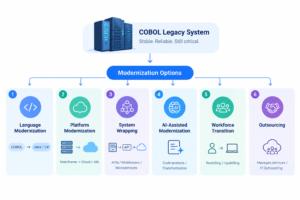
Few organizations are looking for a single technology to replace COBOL. In practice, modernizing a COBOL environment can involve several approaches, from rewriting applications in modern languages to keeping the existing COBOL logic while changing the underlying platform or connecting it to newer systems. AI is also becoming part of this process by helping organizations understand legacy code, document business rules, and support code transformation.
The right approach depends on factors such as the role of the COBOL system, its business logic, technical constraints, available skills, and the organization’s modernization goals. In many cases, companies combine multiple approaches rather than choosing one replacement strategy.
Language Modernization: Refactoring COBOL to Java or C#
One approach is to convert COBOL applications into modern languages such as Java or C#/.NET. Automated modernization tools can analyze legacy code and generate equivalent code in a modern programming language, giving organizations access to larger developer talent pools and making applications easier to deploy on cloud and open platforms.
Examples include IBM watsonx Code Assistant for Z and AWS Mainframe Modernization with Blu Age, which supports automated application transformation.
However, automated translation does not necessarily produce idiomatic modern code. The resulting application may retain structures and dependencies from the original COBOL system, which can make it difficult for developers to maintain. Extensive testing is also required to verify that the modernized application preserves the behavior of the original system.
Platform Modernization: Re-hosting COBOL Applications
Organizations do not always need to rewrite COBOL applications to modernize them. Re-hosting moves COBOL workloads from traditional mainframe infrastructure to cloud platforms such as AWS or Azure, or to open x86/Linux environments, while keeping much of the existing application code.
Technologies such as Micro Focus, now part of Rocket Software, support this approach. By changing the underlying infrastructure rather than immediately rewriting the application, organizations can address infrastructure constraints while retaining existing business logic and creating more time for longer-term modernization.
System Wrapping: APIs, Middleware & Microservices
Another approach is to keep the COBOL application as the core system while exposing its data and business logic through modern interfaces. RESTful APIs, middleware, and microservices can allow web, mobile, and cloud applications to interact with existing COBOL systems without requiring a complete rewrite.
In this model, the mainframe or COBOL application remains the system of record, while new customer-facing or digital services are built around it. This creates a form of coexistence between legacy and modern technologies rather than replacing COBOL outright.
AI-Assisted Modernization & Knowledge Capture
Generative AI is increasingly being used across different stages of COBOL modernization. IBM watsonx Code Assistant for Z, for example, can analyze and document mainframe applications, explain COBOL code in natural language, transform COBOL into Java, and generate tests to validate the resulting Java code.
Other tools focus more specifically on understanding legacy systems. Swimm can map dependencies, extract business rules, explain business logic in natural language, and help teams understand COBOL applications.
General-purpose AI coding tools are also entering this area. In early 2026, Anthropic highlighted Claude Code as a tool that can support complex legacy modernization workflows, including COBOL-to-cloud migration.
AI can therefore help address one of the major challenges of legacy modernization: understanding systems whose original developers and maintainers may no longer be available. However, AI-generated or AI-transformed code still requires human validation. IBM researchers have noted that LLM-translated code should be validated rather than assumed to be correct, making testing an important part of AI-assisted modernization.
Migration Services
VTI provides end-to-end migration services to help businesses modernize legacy systems, cloud platforms, and data infrastructure. With tailored migration strategies and technical expertise, VTI supports organizations in transitioning to modern environments while minimizing disruption to business operations.

Workforce Transition: Reskilling Internal Teams
Modernization does not always mean removing COBOL from the technology stack. Organizations can also retrain Java/C# developers or computer science graduates in COBOL fundamentals and mainframe technologies.
Internal employees already understand the company’s business domain, regulatory requirements, and data flows, which can help preserve institutional knowledge during the transition. However, developing sufficient COBOL and mainframe expertise takes time, so organizations may need an overlap period between experienced engineers and newly trained staff.
Strategic Support & Outsourcing
Companies can also work with specialized technology partners to maintain COBOL systems, address skills gaps, or support phased modernization projects. This approach can provide access to legacy technology expertise without requiring the organization to build every capability internally.
Offshore development is one possible model, particularly when companies need additional development or maintenance capacity. Japanese companies, for example, have increasingly used offshore development services for software development and related technical work, including partnerships with firms in Vietnam.
Potential benefits include:
- Access to specialized legacy technology skills
- Additional development and maintenance capacity
- Potential cost efficiencies
- Support across different time zones
Potential challenges include:
- Dependence on external providers
- Time required to transfer business and system knowledge
- Difficulty finding providers with both COBOL expertise and relevant industry knowledge
IT Outsourcing Services
VTI provides IT outsourcing services, helping businesses access skilled technology teams, optimize costs, and scale development flexibly. With expertise across AI, cloud, software development, and other technologies, VTI supports projects from development to long-term operations.
Choosing a COBOL Modernization Path
These approaches are not mutually exclusive. An organization might re-host a COBOL application on cloud infrastructure, expose its core functions through APIs, use AI to document and analyze the codebase, and gradually retrain its internal workforce at the same time.
The resulting COBOL future is therefore unlikely to be defined by a single replacement technology. For some systems, full language replacement may make sense; for others, continued COBOL operation combined with modern infrastructure, APIs, AI-assisted maintenance, and new development practices may be more appropriate. The key consideration is not simply how to remove COBOL, but how to modernize the systems and business logic that organizations still depend on.
COBOL Modernization Solutions by VTI Group
End-to-End Maintenance and Migration Capabilities
VTI Group is an outsourcing company with long experience providing solutions to customers in Vietnam, Japan, and Korea. In particular, it offers COBOL development services covering everything from COBOL system operation to maintenance and migration.
Why Partner with VTI Group?
- 50+ dedicated COBOL engineers: We have abundant talent well-versed in COBOL. Through continuous training, we ensure a continuous pipeline of COBOL talent and legacy expertise.
- Deep industry domain knowledge: Thanks to our accumulated experience and know-how, we understand the operations of many industries, and we provide seamless support for core banking and enterprise operations, delivering the optimal service on a one-stop basis.
- Expertise in cutting-edge technologies such as AI and cloud: By leveraging AI, IoT, and cloud, we help modernize COBOL systems and improve their scalability and flexibility.
Conclusion: What Is the COBOL Future?
COBOL does have a future, but not in the form that either the “COBOL is dead” or the “COBOL forever” camp imagines. The best way to describe the COBOL future is managed longevity.
COBOL will not disappear overnight. Hundreds of billions of lines of code are still in production; they support critical financial and public services, and the cost and risk of replacing them are enormous. At the same time, the workforce that built and understands these systems is retiring, so leaving them untouched is not a strategy either.
What is emerging instead is coexistence. COBOL will keep running core logic while it is surrounded by APIs, moved to the cloud and open platforms, gradually refactored where it makes sense, and documented and translated with the help of AI.
For companies, the priority is to decide now how to capture knowledge, build talent, and choose partners, rather than waiting until the last experts are gone, because the COBOL future will be shaped by the decisions made in the next few years, not by the language itself.