





![[FREE Whitepaper] Smart Factory isn’t delivering. Is AI-Driven the answer?](https://vti.com.vn/wp-content/uploads/2026/10/angle-3.-whitepaper-ai-driven-factory-1.png)



In today’s fast-evolving manufacturing landscape, many factories across the globe have invested significantly in automation, IoT sensors, and basic connectivity. Production lines run smoother, robots handle repetitive tasks, and dashboards display real-time machine status. Yet, despite all this technology, operational intelligence remains elusive. The solution lies in transitioning to an AI-driven factory architecture — a comprehensive operational framework that turns raw data into contextualized intelligence and executable decisions.
This article explores the core architecture required for true AI-driven operations. Rather than treating this as a pure IT infrastructure project, we position it as a fundamental evolution in how manufacturing organizations orchestrate production, quality, maintenance, and logistics. By examining practical layers, data flows, and integration strategies, manufacturing leaders can build a foundation for closed-loop manufacturing that delivers measurable business impact.
What Defines an AI-Driven Factory Architecture?
The journey toward intelligent manufacturing begins with understanding how architecture must evolve beyond traditional models.
From Automation Architecture to Intelligence Architecture
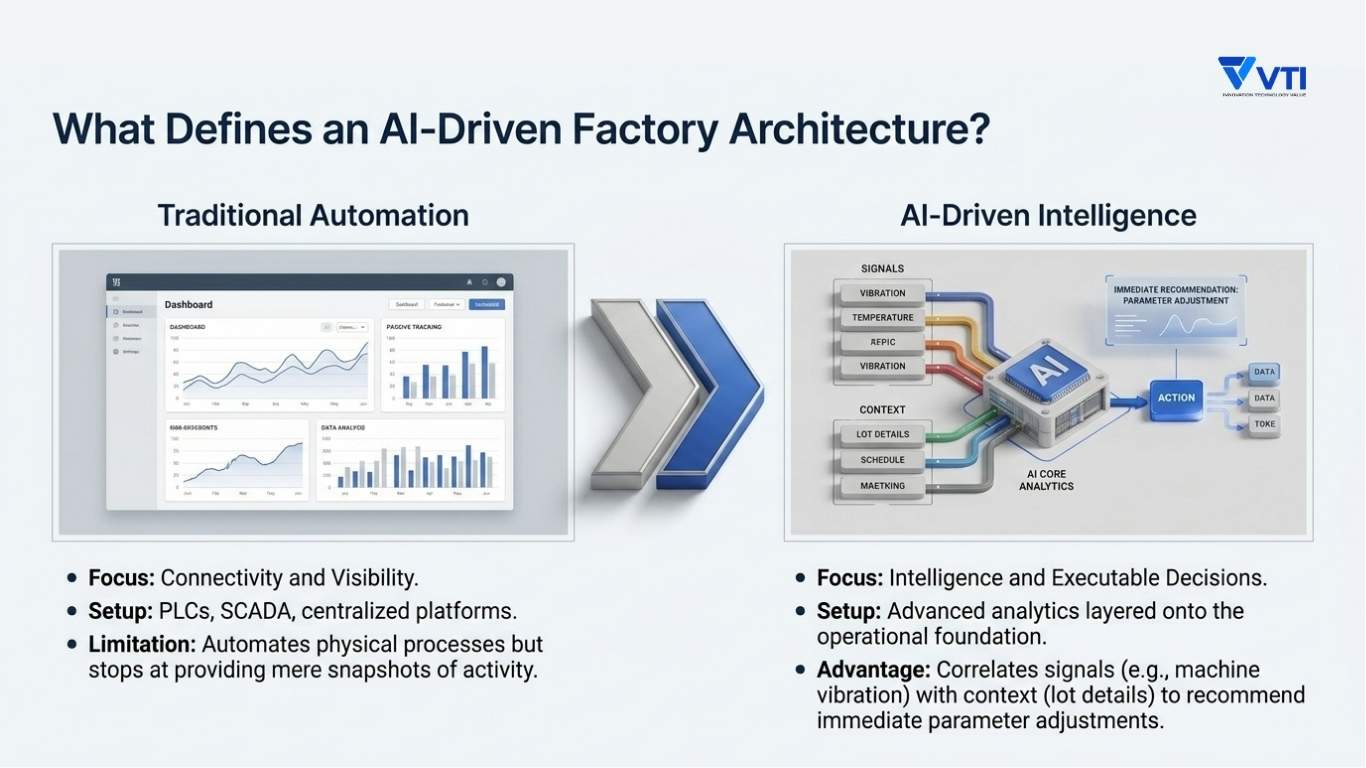
Traditional smart factory architecture primarily emphasizes connectivity and visibility. Machines connect through PLCs and SCADA systems, sensors feed data into centralized platforms, and operators gain better oversight via dashboards. This setup excels at automating physical processes and providing snapshots of shop-floor activity. However, it stops short of transforming data into actionable operational intelligence.
In contrast, an AI-driven factory architecture shifts the focus toward intelligence and executable decisions. It layers advanced analytics and AI capabilities onto the existing foundation, enabling systems not only to monitor but also to predict, recommend, and optimize in real time.
For example, instead of simply alerting a supervisor when a machine’s vibration increases, the architecture can correlate this signal with production lot details, material properties, and historical quality data to recommend immediate parameter adjustments or maintenance scheduling.
This intelligence architecture prioritizes operational outcomes over mere technology deployment. It ensures that every layer works in harmony to support faster, more accurate decisions that directly influence key performance indicators like cycle time, defect rates, and resource utilization.
Why Operational Orchestration Becomes Critical
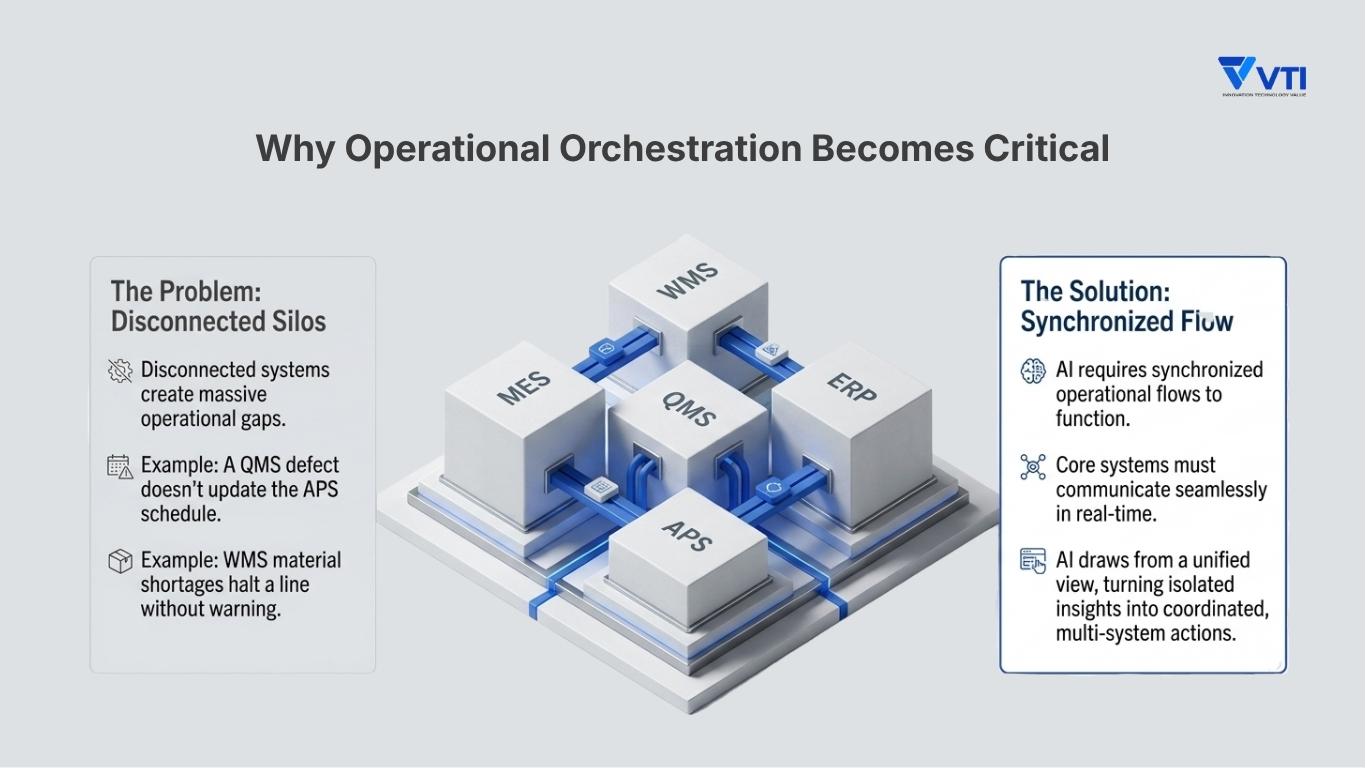
Disconnected systems create significant operational gaps in modern manufacturing. A quality issue detected in the QMS might not automatically update production schedules in the APS, or material shortages in the WMS could go unnoticed until they halt a line. These silos lead to delayed responses and suboptimal decisions.
AI requires synchronized operational flows to function effectively. The architecture must orchestrate interactions across core systems such as MES (Manufacturing Execution System), WMS (Warehouse Management System), QMS (Quality Management System), APS (Advanced Planning and Scheduling), and ERP. When these systems communicate seamlessly, AI can draw from a unified view of operations, turning isolated insights into coordinated actions that enhance overall factory performance.
Why AI-Driven Factory Architecture Differs from Traditional Smart Factory Architecture
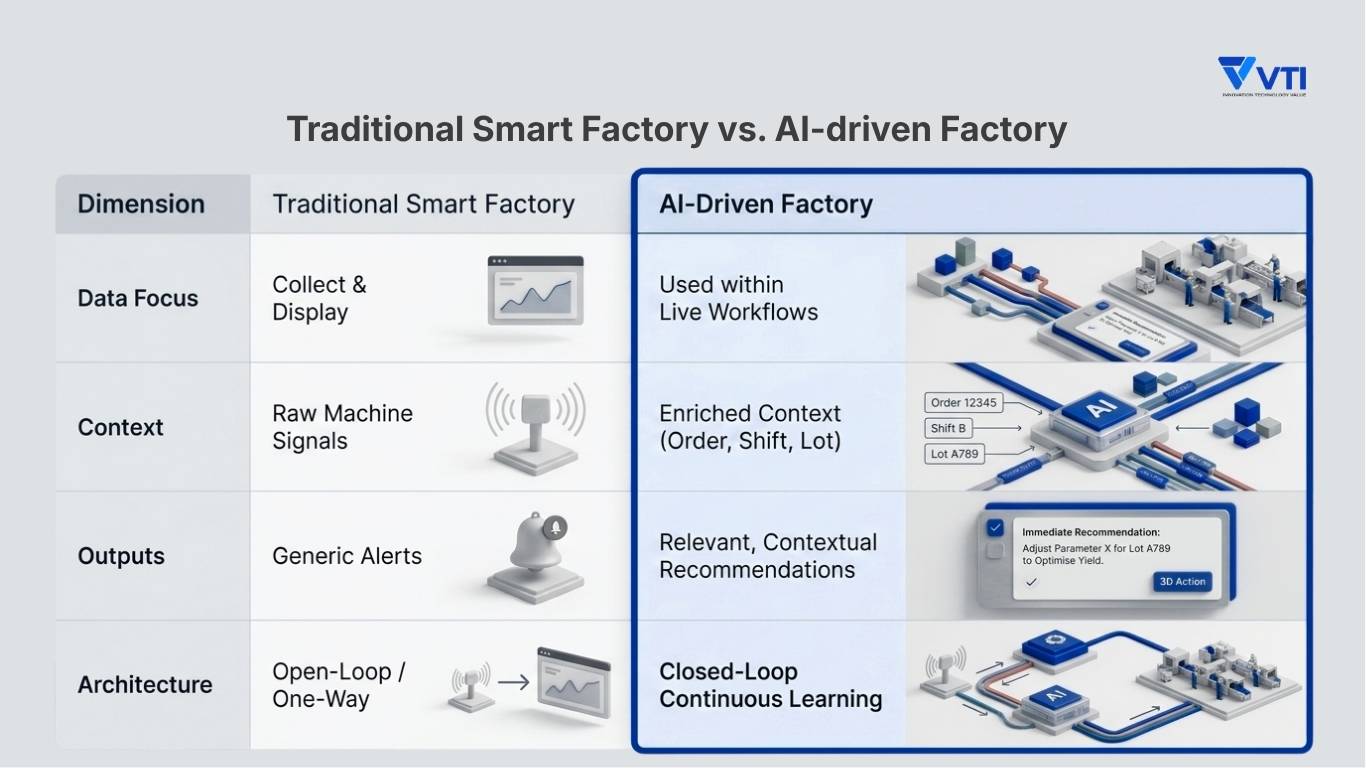
The key distinctions appear in operational flow, execution integration, contextualized manufacturing data, and closed-loop operations. Traditional architectures focus on collecting and displaying data, while AI-driven ones emphasize using that data within live workflows. Contextualized data — enriched with details like production order, shift, lot, and quality status — allows AI models to deliver relevant recommendations rather than generic alerts. Closed-loop operations further differentiate by feeding execution outcomes back into the system for continuous learning and improvement.
The Role of Closed-Loop Manufacturing Operations
At the heart of this architecture lies the closed-loop model: Detect → Analyze → Recommend → Execute → Learn. This cycle represents the operational endpoint where AI truly drives value. Detection identifies anomalies through real-time monitoring. Analysis correlates data across sources to understand root causes. Recommendations propose optimal responses. Execution translates these into actions via integrated systems, and learning refines models based on actual results. This loop ensures that the factory becomes increasingly self-optimizing over time, reducing reliance on manual intervention while improving consistency.
What Are the Core Layers of an AI-Driven Factory Architecture?
This section forms the foundation of any successful transition. Understanding each layer and its interconnections helps leaders design systems that deliver real operational impact.
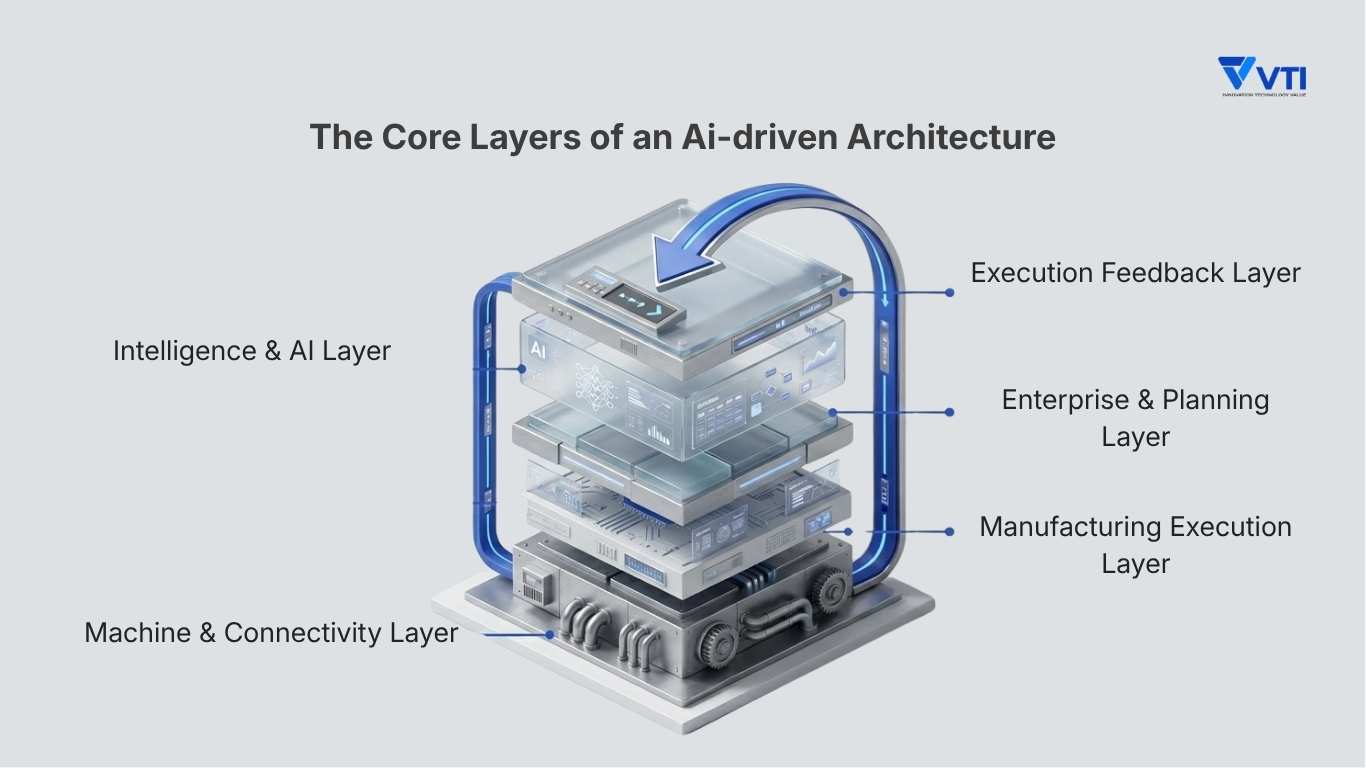
Machine & Connectivity Layer
The base layer consists of PLCs, SCADA systems, IIoT sensors, robots, and various machine controllers. This is where operational signals originate — vibration readings, temperature fluctuations, production speeds, and equipment status updates flow continuously.
However, raw machine data alone has limited operational value. A temperature spike on a molding machine might indicate a problem, but without additional context, it is difficult to determine whether it stems from material variation, operator settings, or environmental factors. The connectivity layer’s role is to reliably capture and transmit these signals upward, but its true potential unlocks only when higher layers add meaning and context. In a typical Korean electronics assembly line, thousands of sensor readings occur every minute, yet only those properly contextualized contribute to meaningful AI insights.
Manufacturing Execution Layer — The Strategic Core
The manufacturing execution layer, centered around MES, serves as the operational heart of the AI-driven architecture. This layer includes MES, WMS, QMS, MMS, and APS, which together provide contextualized operational data and orchestrate activities across production, quality, maintenance, and warehouse functions.
Why is this layer so critical? AI cannot operate effectively on isolated sensor data. Raw inputs must be enriched with production context — including the specific order, line, shift, lot number, machine ID, material batch, operator details, process stage, and current quality status. For instance, in semiconductor manufacturing, the same defect pattern on a vision inspection system might be tolerable in one material lot but critical in another due to upstream process variations. The MES layer supplies this essential context, transforming raw signals into actionable operational intelligence.
This layer also enables operational orchestration and execution coordination. When a quality drift appears in the QMS, the MES can automatically adjust scheduling in the APS, trigger material replenishment in the WMS, and update maintenance priorities. Synchronization prevents cascading issues and maintains smooth flow. Many plant managers in precision manufacturing environments report that without a robust execution layer, even sophisticated AI models produce recommendations that remain unused because they lack integration with daily workflows.
Enterprise & Planning Layer
Sitting above execution, the enterprise and planning layer includes ERP, supply chain systems, and broader planning platforms. Its primary role involves synchronizing high-level business objectives with shop-floor realities. Demand forecasts from ERP must align with actual production capacity and material availability visible in the MES and WMS.
This alignment enhances operational responsiveness. When customer orders change suddenly — a common occurrence in electronics and automotive supply chains — the architecture allows rapid re-planning without disrupting ongoing production. Inventory synchronization ensures just-in-time delivery while minimizing holding costs, directly addressing C-level concerns around working capital and supply chain resilience.
Intelligence & AI Layer
The intelligence layer hosts specialized AI capabilities such as AI Vision for defect detection, predictive maintenance models, anomaly detection, demand forecasting, production optimization, and scheduling algorithms. Crucially, this layer consumes contextualized operational data from the execution layer rather than isolated raw sensor signals.
By operating on enriched datasets, AI models deliver higher accuracy and relevance. In practice, a predictive maintenance model in an automotive parts plant might analyze vibration data alongside lot information, operator shifts, and recent process changes to forecast failures more precisely, reducing false positives that plague systems relying solely on machine signals.
Execution Feedback Layer
This final layer closes the operational loop by converting AI recommendations into tangible actions. Maintenance workflows receive prioritized schedules, scheduling adjustments update production orders in real time, quality control actions hold or release lots automatically, warehouse operations synchronize material movements, and production execution updates reflect changes instantly.
It is here that the architecture becomes true closed-loop manufacturing. Feedback from executed actions flows back to refine models, creating a virtuous cycle of improvement. A quality prediction system, for example, might recommend parameter tweaks on a soldering line; once implemented via the MES, the system observes the outcome and adjusts its future predictions accordingly. This layer transforms AI from a passive analytics tool into an active operational partner.
Why Does MES Become the Operational Orchestration Core?
The MES sits at the center of operational data flow for compelling reasons that go beyond simple production tracking.
Why MES Sits at the Center of Operational Data Flow
MES connects machines, operators, production workflows, quality processes, warehouse operations, and enterprise systems into a unified operational fabric. It collects real-time data from the shop floor while providing the context necessary for higher-level intelligence. In integrated environments, MES acts as the single source of truth for what is actually happening on the production lines at any moment.
Why AI Requires Execution Context
AI becomes operationally useful only when machine data connects with production context, quality context, maintenance context, and planning context. Without the MES providing this bridge, AI models operate in a vacuum, leading to recommendations that feel disconnected from reality. For example, an anomaly detection algorithm might flag unusual energy consumption, but only the MES can link this to a specific batch, recipe, or operator shift to enable meaningful intervention.
Why MES Enables Closed-Loop Execution
In advanced implementations, MES evolves from a tracking tool into an execution coordination layer, orchestration engine, and operational context engine. It not only records events but actively coordinates responses across systems. This capability allows manufacturers to move from reactive firefighting to proactive, intelligent operations that continuously adapt to changing conditions.
Ready to Move Beyond the Smart Factory with MES
A successful AI-driven factory starts with execution visibility, traceability, and contextualized operational data. As the execution backbone of modern manufacturing, MES connects production, quality, inventory, and machine data into a single source of truth that enables intelligent decision-making and continuous optimization. VTI Solutions helps manufacturers build this foundation and accelerate their journey toward AI-driven operations. Explore our MES & Smart Manufacturing Solutions today.
How Does Operational Data Flow Across an AI-Driven Factory?
Understanding data flow clarifies how architecture components interact to create intelligence.
From Machine Signals to Operational Context
Raw signals from the connectivity layer travel to the MES, where they gain context through association with orders, lots, and workflows. This transformation turns isolated data points into meaningful operational records.
From Operational Context to AI Analysis
Enriched data then feeds the intelligence layer. AI models analyze patterns using full production context, quality status, maintenance history, and scheduling conditions, producing insights far more accurate than those based on raw inputs alone.
From AI Recommendations to Execution Actions
Recommendations flow back through the MES to trigger actions in QMS, PMS, APS, or WMS. This ensures that insights result in tangible changes, such as automatic schedule adjustments or quality holds.
From Execution Actions to Continuous Operational Learning
Outcomes of these actions feed back into the system, allowing models to learn and improve. This creates a continuous optimization loop that enhances performance over time.
Why Do Many AI Initiatives Fail at the Architecture Layer?
Despite promising pilots, many AI projects fail to scale due to foundational architectural weaknesses rather than shortcomings in the AI models themselves.
- Fragmented Operational Systems: When systems operate in silos, data remains inconsistent and incomplete.
- Weak MES Integration: Without a strong execution core, AI lacks the context needed for reliable performance.
- Lack of Contextualized Manufacturing Data: Models trained on raw signals produce noisy or irrelevant outputs.
- AI Disconnected from Execution Systems: Recommendations that cannot trigger workflows remain theoretical.
- Siloed Operational Workflows: Disconnected processes prevent the closed-loop cycle from functioning effectively.
The real barrier is usually weak operational architecture maturity, not a lack of advanced algorithms.
What Does a Closed-Loop Manufacturing Architecture Look Like?
A practical closed-loop architecture operates through five interconnected stages grounded in real manufacturing workflows.
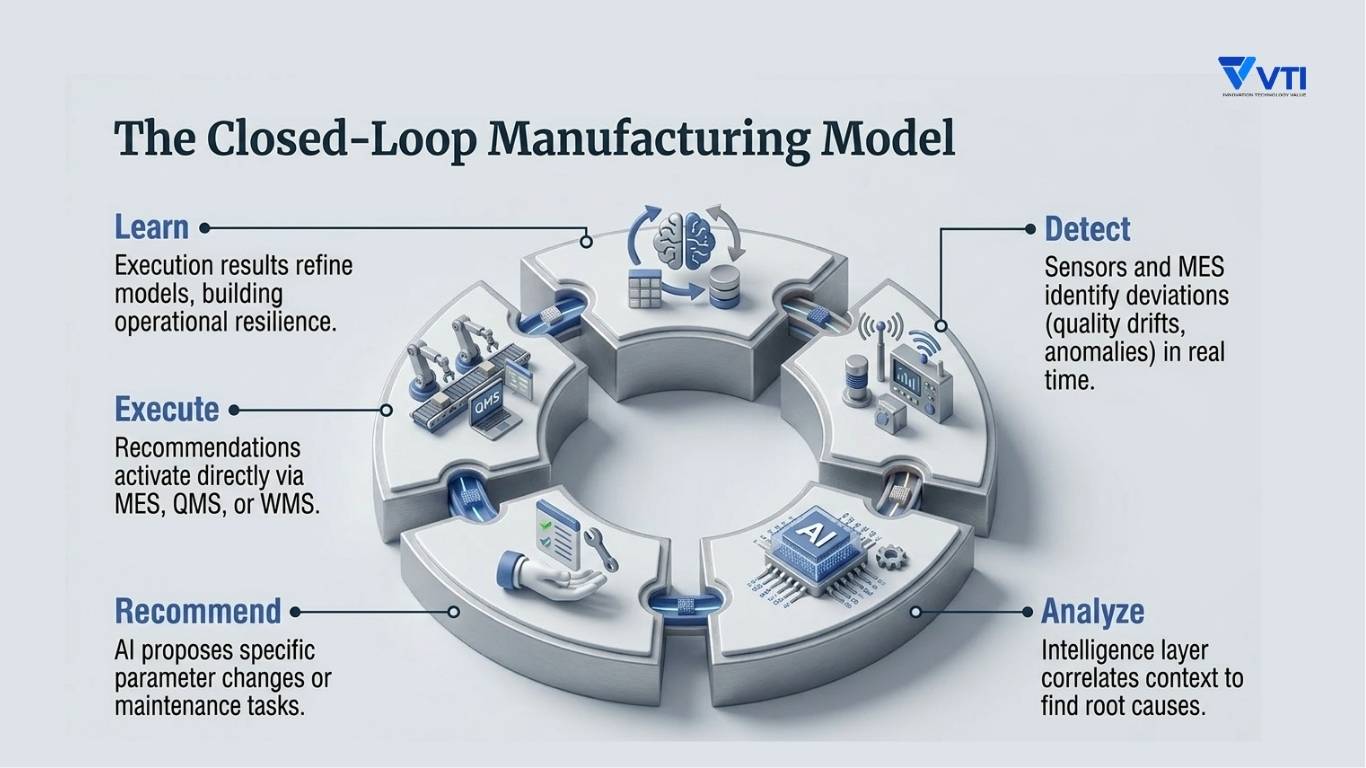
Detect: Sensors and MES identify deviations in real time, such as quality drifts or equipment anomalies.
Analyze: The intelligence layer correlates contextual data to understand root causes.
Recommend: AI proposes specific actions, like parameter changes or maintenance tasks.
Execute: Recommendations activate through MES, QMS, or WMS to implement changes directly on the shop floor.
Learn: Execution results refine models, improving future performance and creating operational resilience.
How Should Manufacturers Evolve Toward an AI-Driven Factory Architecture?
The transition should follow a practical, phased approach tailored to operational realities.
- Standardize operational data across lines and plants to ensure consistency.
- Connect execution systems to eliminate silos and enable orchestration.
- Build real-time operational visibility as a stepping stone to deeper intelligence.
- Contextualize manufacturing data to unlock AI potential.
- Deploy AI-assisted operational workflows starting with high-impact areas like quality and maintenance.
- Finally, move toward closed-loop manufacturing by strengthening feedback mechanisms.
This roadmap emphasizes incremental gains while maintaining focus on shop-floor execution and measurable ROI, avoiding unrealistic hype around full autonomy.
Conclusion
Building an AI-driven factory architecture represents an operational evolution rather than an isolated technology project. By thoughtfully designing layers that prioritize contextual data, seamless integration, and closed-loop execution, manufacturers can move beyond visibility toward truly intelligent, adaptive operations. Those who invest in this foundation will gain significant advantages in efficiency, quality, and competitiveness in the years ahead.
Ready to assess your current architecture and build a practical roadmap? VTI’s team specializes in tailoring these solutions to real manufacturing environments.