






![[FREE EBOOK] Strategic Vietnam IT Outsourcing: Optimizing Cost and Workforce Efficiency](https://vti.com.vn/wp-content/uploads/2026/06/ebook-it-outsourcing.png)


Most AI initiatives never make it past the pilot stage. According to recent industry research, over 80% of enterprise AI projects fail – not due to technical limitations, but mainly because of AI implementation gaps, such as misidentifying the core business problem and lacking proper data infrastructure.
If you’re a CXO, CTO, or digital transformation leader, you’ve likely experienced this firsthand: promising demos that stall during deployment, misaligned teams, unclear ROI, or data challenges that weren’t visible at the start. This guide cuts through the noise to show you exactly how successful AI implementation works.
You’ll learn the essential phases from planning through deployment, understand the real costs and realistic ROI timelines, discover how to structure teams and address talent gaps, and get industry-specific roadmap guidance for retail and manufacturing.
Whether you’re launching your first AI project or scaling across business units, this framework will help you navigate the common pitfalls and build a sustainable AI transformation program.
What Are the 5 Main Steps in AI Implementation?
Successful AI implementation follows a gated lifecycle with distinct phases from planning through deployment. Each phase includes decision gates to ensure readiness before advancing, reducing risk and improving outcomes in enterprise environments:
- Planning
- Preparing
- Model Developing
- Piloting
- Deploying and Monitoring
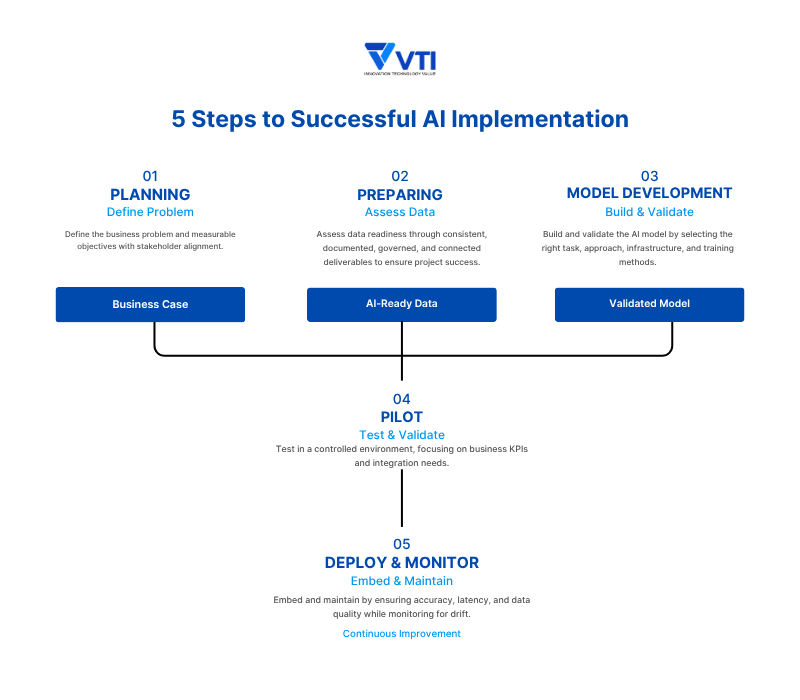
Planning Phase: Define the Problem
AI implementation starts with clarity, not technology. Before evaluating any tools, leadership needs to pin down the specific problem or opportunity AI can realistically address. A few questions help sharpen this:
- Which inefficiencies need solving?
- How could GenAI improve the customer experience?
- Are there decision-making processes that automation could strengthen?
- What have comparable organizations achieved with similar use cases?
Once the problem is clear, it needs to become a concrete, measurable objective – not just an aspiration. Common examples include:
- Improving operational efficiency by a defined percentage
- Cutting customer service response times
- Increasing the accuracy of sales forecasts
Tying each objective to a success metric – accuracy, speed, cost reduction, or customer satisfaction – gives teams a clear target and helps prevent scope creep as the initiative moves forward. This precision is ultimately what determines the use case’s value, and whether AI is the right approach at all.
A critical decision gate follows this stage. Before committing to development work, leadership must confirm executive sponsorship and align stakeholders across IT, risk, and business teams. In enterprise environments across Asian countries, like Japan, Korea, Singapore, or Malaysia, transformation initiatives often fail when cross-functional accountability remains unclear.
Preparation Phase: Assess Data Readiness
Once the business case is validated, assess whether your data is actually ready for AI, not just clean enough for reporting. AI-ready data looks different from data built for human analysts:
- Consistent – the same concept means the same thing across every system
- Documented – each dataset carries clear context on its origin and meaning
- Governed – ownership and access rules are defined at the source
- Connected – data from different systems can be joined without conflicts
- Deliverable – data moves through automated pipelines without manual cleanup
Raw enterprise data typically falls short on one or more of these fronts – carrying labeling gaps, privacy issues, or governance challenges that must be resolved before modeling begins. This AI adoption phase determines whether your organization can reliably support the proposed solution.
Require a formal AI-ready data foundation check as your second decision gate. Poor data quality increases rework and undermines pilot results, so completing data audits and compliance reviews upfront is mandatory for an effective AI implementation roadmap.
Model Development Phase: Build and Validate
Before training begins, teams must align the AI approach with the specific task – selecting the wrong framework early undermines every step downstream.
Common task-to-technology mappings include:
- Supervised learning: Best for tasks with labeled data, such as classification, regression, or forecasting.
- Unsupervised learning: Ideal for discovering patterns in unlabeled data, such as clustering or anomaly detection.
- Computer vision (e.g., CNNs): Suited for spatial visual data like images, video processing, and object detection.
- Language models (e.g., Transformers): Designed for natural language processing, text generation, and semantic understanding.
Also, infrastructure choices matter just as much as the algorithm. For example, cloud platforms provide scalable compute and storage for teams without on-premises resources. Or choosing open-source libraries – such as Scikit-Learn for classical ML and PyTorch or Keras for deep learning – can accelerate development using prebuilt components.
Once the framework and infrastructure are in place, teams train models on prepared data and validate performance against both technical benchmarks and business requirements prior to pilot testing. This dual validation ensures the solution yields real-world outcomes, rather than just strong standalone metrics.
Pilot Phase: Test in a Controlled Environment
Deploy the validated model into a bounded, real-world use case before committing to enterprise-wide rollout. Pilot testing should focus on performance against business KPIs, not just the development metrics from the previous phase – a model that scores well offline can still struggle against live conditions.
The two risks that matter most here are poor generalization to new data and data drift, where incoming data gradually shifts away from what the model was trained on, degrading accuracy over time.
Approve scale only if pilot metrics, security audits, and integration tests all pass. This decision gate exists to prevent unproven models from reaching core operations.
Deployment and Monitoring: Embed and Maintain
Once validated, the AI system is integrated into production APIs, microservices, and enterprise workflows to generate operational value.
Yet, long-term production stability relies on continuous monitoring that tracks predictive accuracy, inference latency, and data quality – catching both data drift (when incoming data shifts from what the model was trained on) and concept drift (when the underlying relationship the model learned no longer holds) as real-world conditions evolve past launch.
Also, because user trust determines the ROI of your AI project, change management and user enablement are as crucial as the technical deployment. So, establishing clear feedback loops and user training ensures seamless adoption across operational teams.
Governance, privacy, and MLOps rigor – the operational discipline of running and maintaining AI models reliably in production – must be treated as core priorities across the entire AI lifecycle, particularly within regulated, cross-border data environments common across the APAC region.
Best Practices for AI Implementation Across Business
Lead with Business Value, Not Technology
Successful AI implementation starts by tying each use case to measurable business outcomes and KPIs rather than chasing technical capabilities. Run controlled pilots that validate both business value and technical feasibility before committing to enterprise rollout. Document success metrics and lessons learned to build the evidence base leadership needs for scaling decisions.
Prioritize Use Cases with a Three-Dimensional Framework
Score potential AI projects on business impact, technical feasibility, and organizational readiness. Start with high-value processes where AI can relieve operational pain points or unlock significant productivity gains. Remember that most value comes from process redesign and operating-model change, not model building alone-a principle especially relevant for organizations managing complex multi-market operations.
Deploy AI Through Cross-Functional Integration
Bring finance, operations, customer service, supply chain, IT, and HR into a unified task force with clear collaboration boundaries and shared data governance. This cross-functional approach prevents siloed tools and inconsistent controls while enabling AI to move across departments effectively. Establish unified data access and explicit governance frameworks from the start.
Redesign Workflows, Don’t Just Automate
The strongest deployments integrate AI into existing decision and service processes rather than building standalone automation. For operations, finance, customer service, and supply chain functions, focus on workflow redesigns that work with current systems and data pipelines. This gradual integration approach avoids disruption while improving productivity across business units.
Build Sustainable Adoption Through Governance and Change Management
As aforementioned, provide AI literacy training for all employees and advanced training for technical teams. Establish regular review cycles that monitor performance, compliance, fairness, and security-critical factors when operating across markets with varying privacy and regulatory requirements. Make change management and governance core components of your AI implementation strategy, not afterthoughts.
What Challenges Do Organizations Face When Implementing AI?
Data Quality, Legacy Systems, and Infrastructure Gaps
AI initiatives fail most often at the foundation: data quality, legacy integration, and infrastructure scale.
AI models require clean, accessible data and compute power that can scale on demand. Fragmented or siloed data reduces model accuracy and delays deployment. It also weakens governance, which is a major issue for enterprises still running on legacy architectures.
Also, integration friction shows up when AI tools are integrated into older ERP or CRM systems without a modern connection layer between them. Without scalable storage, networking, and processing power, projects stall at the prototype stage and can’t support real-time enterprise demands.
Possible Solution
- Audit before building: Run a full data quality and lineage review before writing any model code
- Bridge legacy systems properly: Use APIs and modern integration layers to connect AI tools to older core systems, rather than forcing a direct retrofit
- Modernize for scale: Adopt cloud-native or hybrid infrastructure so compute and storage can scale independently as demand grows
- Sequence the work: Treat data pipeline readiness as a prerequisite for pilots, not something to fix in parallel
Talent Shortages, Cultural Resistance, and Misalignment
Beyond technology, organizational readiness is a second major obstacle to AI transformation.
A shortage of in-house AI expertise slows execution and increases dependence on external vendors. At the same time, cultural resistance – distrust of AI outputs, preference for existing processes, or fear of job disruption – limits adoption even when the technology works well.
Misalignment between business and technical teams shows up as unclear objectives and weak ROI definitions. Pilots end up disconnected from real business outcomes, which fuels stakeholder skepticism and stalls funding.
Possible Solution
- Partner to build capability, not dependency: Bring in system integrators or specialist consultancies under a model where they deliver the first build while training internal teams to take over
- Involve end users early: Co-design pilots with the operational teams who’ll actually use them, to build trust and fit real workflows
- Share ownership from day one: Make business and technical leads jointly accountable for both metrics and outcomes
- Set governance and ROI upfront: Define clear KPIs and risk protocols before funding a pilot, not after it’s already running
How Much Does AI Implementation Cost and What Is the ROI?
Understanding Total Cost of Ownership
Enterprise AI should be evaluated on a multi-year total-cost-of-ownership basis rather than against the initial pilot budget alone. A complete cost model accounts for:
- Data preparation and integration
- Cloud infrastructure and model or API usage
- Monitoring, security, and governance
- Retraining and ongoing support
- Internal talent
Both major cloud providers reinforce this lifecycle view. Microsoft’s Cloud Adoption Framework calls for continuous cost monitoring, automated budget alerts, and retraining scheduled around performance metrics, treating cost management as an ongoing discipline rather than a one-time estimate.
AWS’s Well-Architected Machine Learning Lens takes a similar position, with a dedicated cost-optimization pillar and guidance on continuous monitoring to detect accuracy and performance issues – often requiring model retraining with refined datasets – alongside version control and traceability practices that support model governance and audit standards.
For early budgeting, organizations may use an annual operating-cost assumption of approximately 20–40% of the initial build cost, but this should be treated as a planning range rather than a universal industry benchmark. Actual TCO varies substantially with usage volume, model architecture, data quality, regulatory requirements, integration complexity, and the level of human oversight required.
Calculating ROI and Key Performance Indicators
AI ROI should be measured against total cost of ownership over a defined period – typically 24 to 36 months for a strategic program. Comparing against development spend alone understates the real cost and overstates early returns.
The benefit model should track:
- Direct cost savings
- Productivity gains
- Revenue uplift
- Quality improvements
- Risk reduction
Each benefit needs a clear baseline and an accountable business owner, or it becomes difficult to prove impact later.
Useful KPIs include:
- Cycle-time reduction and cost per transaction
- Automation rate and analyst hours redeployed
- Revenue per customer and conversion rate
- Error rate and adoption
- Model quality and cost per inference
Financial KPIs alone aren’t enough – they need to be paired with operational and control metrics, so reported value reflects both business impact and production reliability.
Timeline Expectations for Returns
Time to value depends on use-case scope, data readiness, integration complexity, process standardization, governance, and organizational adoption. Focused workflow automations may show initial value within weeks or months.
A multi-process implementation typically needs 8 to 16 weeks for initial delivery. Complex enterprise deployments can take 16 to 24 weeks, or longer, before benefits become stable and measurable. These are planning ranges, not universal industry averages – organizations with cleaner data and stronger process standardization tend to reach ROI faster than those in fragmented or highly regulated environments.
Industry-Specific AI Roadmap Considerations for Retail and Manufacturing
Retail AI Implementation Planning
Retail AI implementation should prioritize customer analytics, demand sensing, and omnichannel execution, with sequencing that reflects local market maturity and peak-season operations.
Start with customer analytics and demand sensing, then inventory optimization. Inventory optimization should be treated as a core operating capability that links customer demand signals to replenishment, markdowns, and store-level execution. Prioritize this after foundational data analytics are operational, with data integration across channels as a prerequisite. Expect 6-12 month implementation timelines.
Then, you can move to omnichannel AI agent capabilities in year 2+. Omnichannel experience enhancement increasingly depends on making digital commerce systems readable by AI agents. Deploy API-first architecture and structured data to enable agent-driven discovery and purchase journeys.
Manufacturing AI Roadmap Priorities
Manufacturing AI roadmaps should begin with predictive maintenance and quality control automation because these use cases connect quickly to uptime, scrap reduction, and yield improvement.
Predictive maintenance pilots typically deliver results in 2-4 months, while full smart factory integration spans 18-36 months. Identify high-impact opportunities first, then establish data foundations from machine telemetry, operational systems, and enterprise data before piloting and scaling AI across plants. AI value depends on trustworthy sensor data, consistent asset hierarchies, and integration with existing MES, ERP, and maintenance workflows.
Smart factory integration should be sequenced after first use cases prove value, with governance, observability, and human-in-the-loop controls built in before broad automation. Scale from pilot to enterprise only after standardizing infrastructure, repeatable deployment processes, and cross-functional collaboration.
Final words
Successful AI implementation requires disciplined execution across planning, data readiness, model development, piloting, and deployment. Winning organizations treat AI as a staged transformation – prioritizing data governance, workflow redesign, and change management over chasing technology. While implementation requires multi-year commitments, tracking business-focused KPIs ensures measurable ROI. By aligning leadership, fixing data foundations, and proving value before scaling, your enterprise can ensure AI investments deliver lasting transformation rather than stalled initiatives.
Connect with our experts to build a tailored AI roadmap that accelerates enterprise AI implementation and drives measurable business value.