




![[FREE Whitepaper] Smart Factory isn’t delivering. Is AI-Driven the answer?](https://vti.com.vn/wp-content/uploads/2026/10/angle-3.-whitepaper-ai-driven-factory-1.png)



According to the survey, AI tools are now deployed at 73% of organizations, but only 7% have reached governance that enforces security and policy in real time, and that gap continues to widen as adoption accelerates faster than the controls meant to manage it. Closing it is less a matter of adopting better tools than of rethinking how the work between people and AI is structured in the first place.
The Gap Between Using AI and Building on It
Enterprise AI adoption has moved well past the experimentation stage, with budgets expanding and pilot projects multiplying across departments. Underneath that visible momentum, the way AI actually gets used still varies widely from one person to the next, because most organizations have never settled on a consistent working model for how humans and AI should collaborate.
That inconsistency tends to make members & teams try to adapt on their own, through :
- Standalone prompts: Individuals write a fresh prompt for each task, producing results shaped as much by how well someone phrases a request as by what the task actually requires.
- Prompt templates: Teams bring in templates for consistency, but still find themselves editing constantly, since few tasks share identical requirements or constraints.
- Reference documents: Others build out documentation and expect AI to search through it independently, an approach that holds up while the material stays small and grows less reliable as it expands.
None of these methods were designed to remain consistent across an entire project, let alone across an organization running many projects at once.
Another survey found that over half of businesses, 54%, now admit they adopted AI technology too quickly and are struggling to scale it back or implement it more responsibly. That points to something more specific than a lack of caution: most organizations are running into a gap not in AI capability, but in the absence of a framework that can carry consistent standards across every team and task where AI is involved.
Why Human-AI Collaboration Needs Structure
AI performance depends heavily on the quality of the context, instructions, and knowledge surrounding a task, far more than most organizations account for when they roll AI tools out across a team. A capable model working without structured input behaves like a skilled new hire on their first day without an onboarding document or a defined scope: technically able but working blind.
This is the gap that our AI Committee at VTI Japan set out to close in building the AI Work System, known internally as AIWS.
AI Committee (AI推進委員会) is a dedicated body for AI strategy and adoption, which works to standardize and expand effective AI use in daily project work.
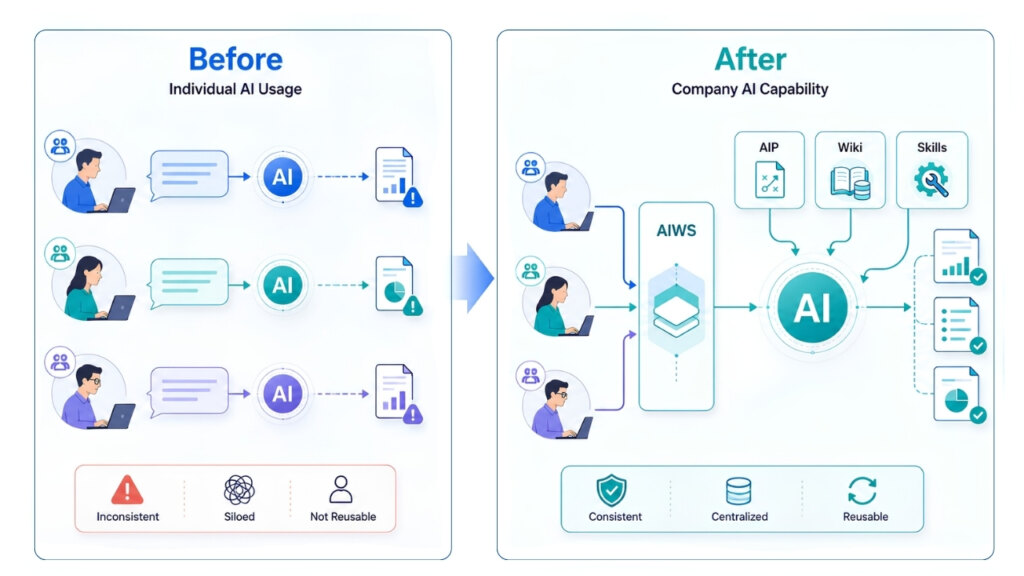
AIWS is the Committee’s framework for how people and AI collaborate on a project, not a proprietary AI model and not a replacement for human judgment. Its purpose is to keep direction, execution, and organizational knowledge connected throughout a task, so that context does not need to be reassembled from scratch every time someone opens a new AI conversation.
Framed that way, the real design question is not which AI tool to adopt. It is how to build a consistent environment in which people can direct AI effectively, AI can execute within clearly defined boundaries, and the organization’s accumulated knowledge stays available throughout the work. That question is what the architecture behind AIWS was built to answer.
How AIWS Connects People, AI, and Knowledge
AIWS is built around four key elements that work together rather than in isolation:
- Human: Sets direction and makes the decisions that matter, defining what a task requires and confirming it at the important steps or gates AIWS lets you set for human review.
- AI: Acts as the primary executor, carrying out the work itself once that direction has been set and staying accountable to it throughout.
- AIP (AI Implementation Plan): Gives the AI a structured scope and set of boundaries drawn from the human’s direction, so execution stays targeted rather than open-ended.
- Wiki (Knowledge Hub): Supplies the project knowledge the AI draws on to work within that scope accurately, rather than guessing at context it was never given.
Each element depends on the others to function. Direction only holds if the AIP translates it into a working scope, and that scope only produces useful results if the Wiki helps the AI understand the project’s specific context, resulting in output that is better tailored to the project.
That interdependence is what keeps a project’s knowledge, standards, and scoping discipline consistent from one task to the next, rather than resetting every time someone opens a new conversation. It is also what lets a client experience the same quality and reliability regardless of which individual on the team happens to be handling their work.
From Individual AI Use to Organizational Capability
The value AIWS creates compounds as it moves from a single person’s workflow to the way an entire company operates. And at every level, the ambition is the same: work that clients can rely on regardless of who is doing it.
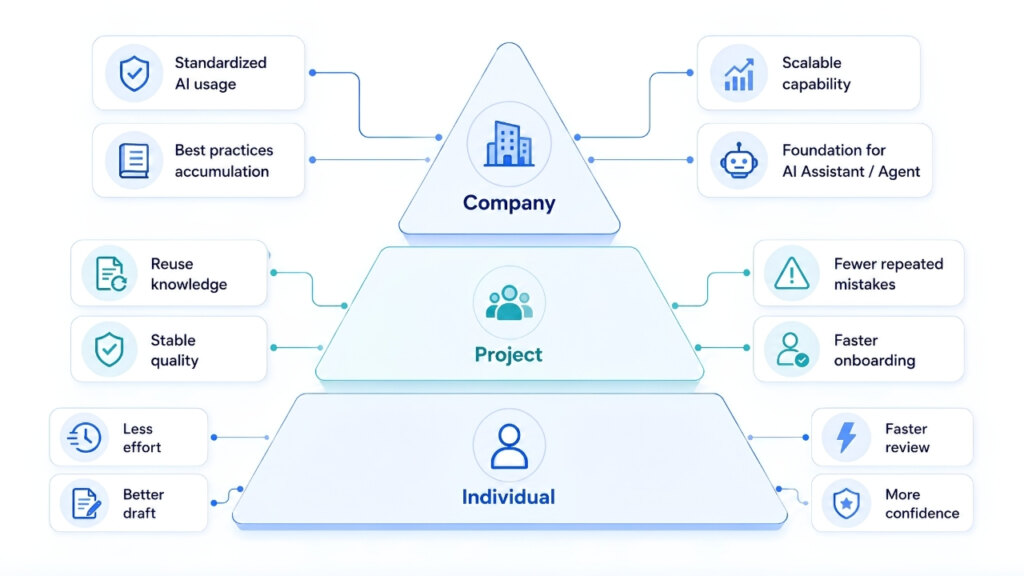
- At the individual level, that means faster turnaround on day-to-day requests, since less time goes into reconstructing context before work can start.
- At the project level, it means more stable delivery quality and fewer errors reaching the client, because knowledge carries over instead of resetting with each new task or team change.
- And at the company level, it means consistent service quality and security posture across every engagement, not just the ones staffed by a few strong AI users.
That progression also shows up in performance, not just in workflow.
On an internal benchmark task, our team applied AIWS to reconstruct a call-tree structure in a legacy COBOL codebase, and the gap showed up immediately and measurably:
- Roughly 1/2 the tokens used to complete the same task.
- About a 1/4 of the tool calls needed to get there.
- Roughly 3x faster completion, start to finish.
It also caught meaningfully more of the actual structure, missing far fewer relevant items than the unstructured comparison did.
These numbers describe one measured task, not company-wide validation, but they point to the underlying principle: structured context produces work that is both faster and more complete, and that is the pattern the individual-to-company progression above is built on.
What This Means for Enterprise AI
AI maturity will ultimately depend on more than how skilled individual employees become at using AI. It will depend on whether an organization can make effective AI-assisted work consistent, repeatable, and scalable.
AIWS is one part of how VTI is working toward that goal. It works alongside the Generative AI Guidelines, which establish how AI should be used, and the AI Portal, which brings together the knowledge and practices needed to apply those principles in daily work. Together, they create a foundation for more consistent AI adoption across the organization.
People remain at the center of that system. AI can support analysis and execution, but decisions involving business judgment, risk, or context still require human oversight.
The AI Committee is also exploring how multiple AI agents could review the same work from different perspectives within AIWS, helping teams identify issues that a single reviewer might miss. Once available, it will be another step toward a broader goal: building an organization that continuously learns how to work with AI more effectively.
AI capability improves as the organization learns how to work with it.
That is the principle behind AIWS and the standard VTI is working to build.