





![[FREE EBOOK] Strategic Vietnam IT Outsourcing: Optimizing Cost and Workforce Efficiency](https://vti.com.vn/wp-content/uploads/2026/06/ebook-it-outsourcing.png)


Have you ever wished that there would be a day when your enterprise systems could think, adapt, and make intelligent decisions autonomously without moving a finger? Luckily, we no longer have to wait for the day. The AI agent represents the next evolution in business automation, combining artificial intelligence with autonomous decision-making to transform how organizations operate.
Yet, not all of us are AI experts to comprehend the power of such advanced technology. Therefore, together, let’s go through this comprehensive guide to see the AI agent definition, how they function, and AI agent examples across customer service, supply chain management, IT operations, and financial services. Moreover, you’ll discover implementation frameworks, real-world case studies from leading Asian enterprises, and actionable insights for calculating ROI and managing enterprise-wide deployments.
What are AI agents?
AI agents are intelligent, autonomous systems that can perceive their environment, make decisions, and take actions without constant human oversight. This represents a fundamental shift from traditional automation.
While conventional software simply executes preset commands, an AI agent operates through a sophisticated cycle of observation, analysis, and adjusts their approach based on changing conditions and accumulated experience. To sum up, what distinguishes AI agents from traditional tools is their capacity for goal-oriented behavior and adaptive decision-making.
This intelligence enables them to handle complex enterprise scenarios, from optimizing supply chain operations in real-time to providing personalized customer support that improves with each interaction.
How AI Agents Process and Decide? The Components of AI Agents
At their core, AI agents function through 04 interconnected components that work together seamlessly: perception, reasoning, action, and the learning & adaptation mechanism.
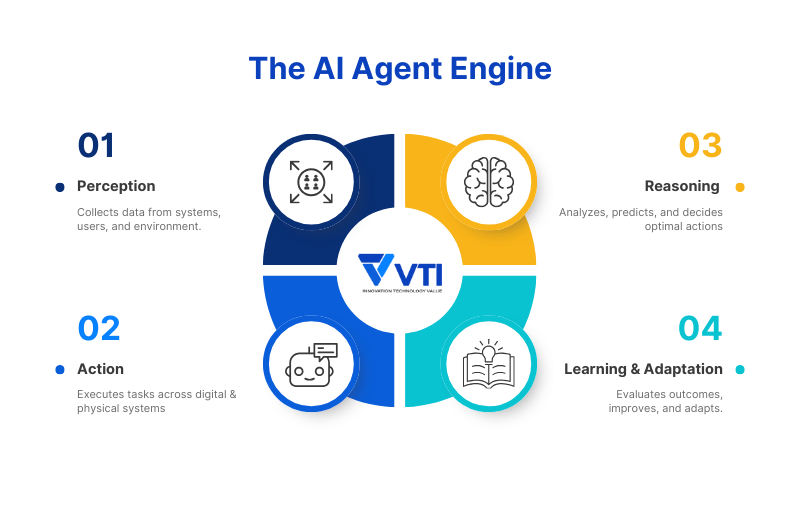
- Perception: Serves as the system’s sensory layer, gathering data from various sources such as digital interfaces, sensors, or enterprise system APIs. This component enables the agent to understand its current operational context, from network traffic patterns to customer service interactions or financial transactions.
- Reasoning: Forms the intelligent heart of any AI agent, where raw data transforms into actionable insights. This component employs sophisticated techniques, including machine learning algorithms, neural networks, and advanced reasoning frameworks like Chain-of-Thought processing to analyze information and make informed decisions. Modern AI agents can evaluate multiple scenarios simultaneously, weighing various factors such as business objectives, resource constraints, and risk parameters to determine optimal actions.
- Action: Completes the agent’s operational cycle by executing decisions through physical or digital interfaces. Whether adjusting server configurations, routing customer inquiries, or triggering automated workflows, these systems can operate across multiple enterprise platforms simultaneously, creating seamless integration opportunities for organizations across Asia seeking to modernize their operational infrastructure.
- Learning and Adaptation: Enables the agent to improve its performance over time. Through a feedback loop, the agent evaluates the outcome of its actions and adjusts its internal models and decision-making processes. It learns from its experiences, allowing it to become more effective and adaptable in dynamic environments without constant human reprogramming.
What are the differences between an AI Agent and an AI Chatbot?
It is common for people to misunderstand these 2 AI entities.
Of course, both AI agents and chatbots use natural language processing and machine learning to interact with users. They can understand context, generate relevant responses, and learn from interactions to improve performance over time.
Yet, there are a few key distinctions that make them different from each other:
| AI Chatbots | AI Agents | |
| Purpose | Conversational tools for dialogue and information exchange | Autonomous systems for task execution and goal achievement |
| Function | Respond to user queries, provide information, and maintain conversations | Perceive environment, make independent decisions, execute complex tasks |
| Scope | Communication-focused, reactive to user inputs | Action-oriented, proactive in pursuing objectives |
| Use Cases | Customer service, FAQ assistance, general conversation | Scheduling systems, transaction processing, smart home control, workflow automation |
To sum up, the fundamental difference lies in their operational approach: chatbots excel at communication and information retrieval, while agents focus on independent action and task completion to achieve specific goals.
Types of AI Agents and Enterprise Applications
Reactive Agents: Real-Time Monitoring and Alert Systems
Reactive agents represent the foundational tier of AI agent architecture, operating through immediate stimulus-response patterns that make them ideal for enterprise monitoring and alert systems. These AI agents continuously scan their environment for specific conditions and trigger predetermined responses without maintaining historical context or complex reasoning capabilities.
The strength of reactive agents lies in their speed and reliability for well-defined scenarios:
- Process incoming data streams in real-time, comparing current conditions against established thresholds
- Generate alerts, escalate issues, or execute immediate corrective actions
- Operate continuously without human intervention – essential first-line defense for IT managers overseeing critical infrastructure
Example: Network security monitoring – instantly detecting abnormal traffic patterns and initiating automated containment protocols
Model-Based Agents: Predictive Analytics and Strategic Planning
Model-based agents advance beyond simple reaction patterns by maintaining internal representations of their operational environment, enabling sophisticated predictive analytics and forward-looking decision support. These software AI agents build and continuously update models of their environment, allowing them to anticipate future states and optimize actions based on projected outcomes rather than just current conditions.
In enterprise applications, this forward-looking capability shows up as:
- Analysis of historical data, current market conditions, and operational constraints
- Actionable insights that support executive decision-making — used throughout Japan, Korea, and Singapore’s dynamic business environments
Example: Supply chain optimization, financial forecasting, and capacity planning scenarios where understanding trends and patterns drives strategic value
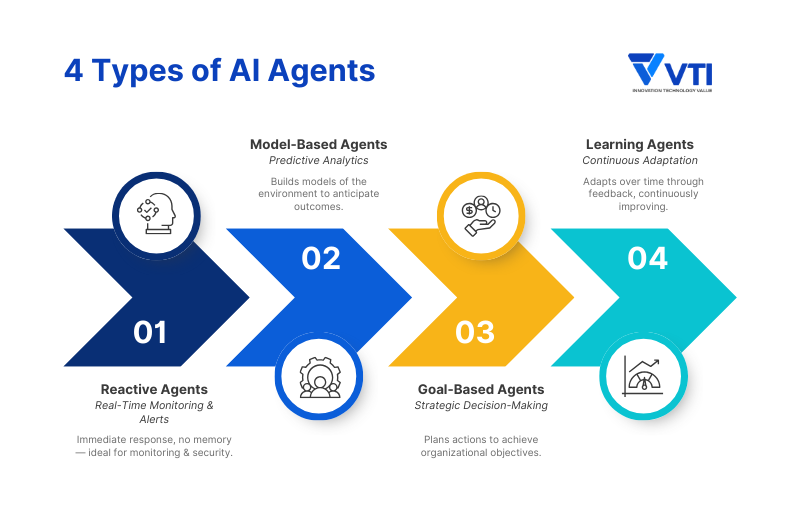
Goal-Based Agents: Strategic Decision Making and Process Optimization
Goal-based agents are advanced artificial intelligence applications that operate with explicit objectives and can evaluate multiple pathways to achieve desired outcomes.
Unlike reactive systems that respond to immediate stimuli, these AI agents demonstrate autonomous planning capabilities that align actions with long-term organizational goals while adapting strategies based on changing circumstances.
In practice, this means goal-based agents can:
- Evaluate trade-offs between competing objectives
- Prioritize actions based on business impact and continuously adjust their approach to maximize goal achievement
- Operate within established constraints or compliance requirements
These agents excel in complex enterprise scenarios requiring strategic thinking, such as resource allocation optimization, project management automation, and customer experience orchestration.
Learning Agents: Continuous Process Optimization and Adaptation
Learning agents represent the most sophisticated category of AI agents, incorporating machine learning mechanisms that enable continuous improvement and adaptation based on experience and feedback. These systems combine the capabilities of goal-based reasoning with the ability to refine their performance over time, making them particularly valuable for complex enterprise applications where optimal strategies emerge through iterative refinement.
In practice, learning agents transform routine business processes by:
- Identifying optimization opportunities that human operators might overlook
- Adapting to changing business conditions automatically
- Developing increasingly effective strategies for achieving organizational objectives over time
How AI Agents Transform Business Operations by Industry – Enterprise AI Agent Examples
The value of an AI agent is easiest to see once you leave the abstract and look at a specific industry, where “perceive, reason, act, learn” turns into a concrete workflow – a forecast that adjusts itself, a defect that gets flagged before it reaches a customer, a transaction that gets frozen before it clears. Below are the domains where enterprise AI agents are delivering the clearest results today, starting with the two where VTI has the deepest hands-on experience: retail and manufacturing.
Retail & Ecommerce: From Personalized Storefronts to Real-Time Inventory Decisions
Retail is one of the most agent-friendly domains because the data is abundant and the decisions – what to stock, what to recommend, who to route a support ticket to – repeat thousands of times a day. AI agents are taking over three layers of retail operations at once:
- Demand forecasting and replenishment: Instead of static reorder rules, agents continuously read historical sales, seasonality, and live signals to recommend SKU-level stock levels. An AI-driven forecasting model can improve prediction accuracy to the point that the retailer can see a 7–10% sales increase within three months, alongside lower costs from better-optimized order volumes.
- In-store and customer-facing intelligence: Computer-vision agents reading in-store heatmaps helped one retail chain keep sales resilient through the pandemic by showing managers where shoppers actually spent time, while AI-integrated digital signage let another client deliver targeted content and capture real-time customer insight instead of running the same static ads to everyone.
- Conversational commerce and support: Retail is also where the customer-service side of agentic AI shows up most visibly – agents that don’t just answer FAQs but process returns, update loyalty accounts, and hand off to a human only when a case genuinely needs one.
Manufacturing: Predictive Maintenance, Quality Control, and Smart Factories
Manufacturing pairs well with AI agents because the environment is instrumented – sensors, SCADA systems, MES platforms – and the cost of a missed defect or unplanned downtime is high and easy to quantify. Three use cases stand out:
- Automated quality inspection: Manual defect classification is slow and error-prone, especially at scale – human inspectors fatigue, miss subtle defects, and can’t keep pace with high-volume production lines. Computer-vision agents solve this by continuously scanning products against learned defect patterns, flagging anomalies with consistent accuracy shift after shift. It’s the kind of task where an agent’s advantage isn’t creativity; it’s tirelessness.
- Smart factory integration: Manufacturing plants often run SCADA systems and MES platforms as disconnected data silos, forcing managers to piece together production data manually before they can spot a problem. Connecting the two into a single operational view lets AI agents monitor production in near real time, flagging anomalies and supporting decisions as they happen rather than after a shift-end report.
- Warehouse and spare-parts synchronization: When a manufacturer runs multiple factory sites, spare-parts inventory tends to drift out of sync – each location tracks stock separately, and reconciling it becomes manual, error-prone work for plant managers. AI agents built into warehouse management systems can synchronize inventory data across sites automatically, catching discrepancies before they cause downtime.
Financial Services (BFSI): Fraud Detection and Compliance Monitoring
Financial services remains one of the most AI-mature verticals: 58% of APAC banks and payment firms already use AI for fraud detection and anti-money-laundering monitoring. And across the industry, banking and insurance firms (47%) are more than twice as likely as healthcare providers (18%) to have agents running in production.
AI agents here flag anomalies instantly, generate audit trails automatically, and adapt as regulations change – though full compliance-automation adoption is still comparatively early.
Healthcare: From Clinical Documentation to Care Coordination
Healthcare is moving more cautiously, for good reason – compliance, patient safety, and data governance requirements raise the bar for autonomous decision-making. Still, adoption is accelerating.
In HIMSS’s 2026 APAC healthcare survey, 81% of respondents reported using generative AI, and industry researchers describe 2026 as the year the field shifts from single-purpose chatbots toward agentic systems that can handle clinical documentation, prior-authorization workflows, and patient-routing tasks end-to-end, rather than just answering questions.
What to consider when implementing an AI Agent?
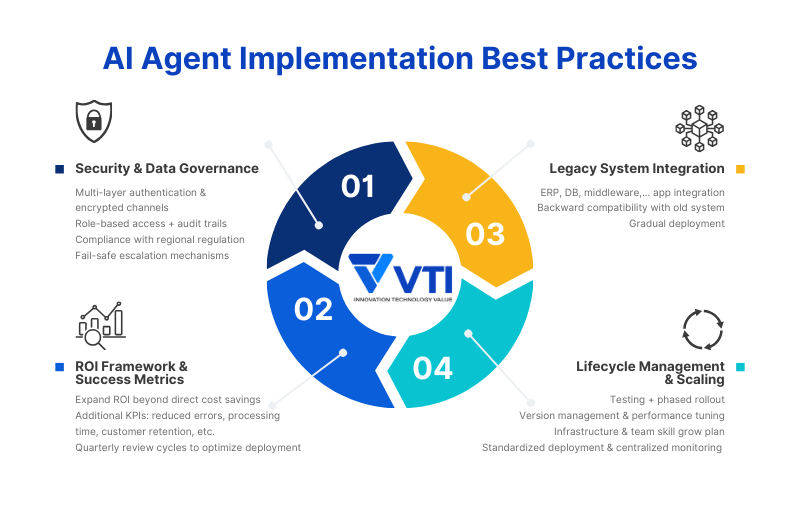
Enterprise-Grade Security and Data Governance Requirements
Implementing AI agents in enterprise environments demands comprehensive security frameworks that address the unique challenges of autonomous decision-making systems. AI agents require dynamic security protocols that can adapt to their evolving behavior patterns while maintaining strict data governance standards. Particularly, data governance becomes critical when AI agents access sensitive enterprise information across multiple systems and databases.
Therefore, it is a must that enterprise security architectures incorporate multi-layered authentication, encrypted communication channels, and continuous monitoring capabilities to ensure AI agents operate within authorized boundaries.
Also, organizations must establish clear data lineage tracking, implement role-based access controls that evolve with agent capabilities, and maintain audit trails that demonstrate compliance with regional regulations, such as Japan’s Personal Information Protection Act, Korea’s Personal Information Protection Act, and Singapore’s Personal Data Protection Act.
Furthermore, enterprises must design fail-safe mechanisms that prevent AI agents from accessing or modifying critical data without proper authorization escalation.
Legacy System Integration Strategies and Best Practices
Successful AI agent deployment requires sophisticated integration strategies that bridge modern artificial intelligence capabilities with existing enterprise infrastructure. Especially crucial in the case of many organizations across the Asia-Pacific, which are operating hybrid environments combining cloud services with on-premises legacy systems.
Modern AI agents need to interface with ERP systems, databases, middleware platforms, and custom applications through standardized APIs while maintaining backward compatibility with older protocols. Integration best practices emphasize gradual deployment approaches that minimize operational disruption while maximizing value realization.
Organizations should prioritize AI agent implementation in non-critical processes initially, allowing teams to build expertise and confidence before expanding to mission-critical operations. This phased approach enables IT teams to identify integration bottlenecks, optimize performance parameters, and develop robust monitoring frameworks that ensure seamless operation across diverse technology stacks.
ROI Calculation Frameworks and Success Metrics
Calculating return on investment for AI agent implementations requires comprehensive frameworks that capture both quantitative benefits and qualitative improvements across enterprise operations.
This is because enterprise AI applications deliver value through multiple channels, from process automation, predictive analytics, to intelligent resource optimization that compound over time. In other words, hard-to-measure processes. Meanwhile, traditional ROI calculations focus solely on measurable metrics, direct cost, for example; therefore, they barely reflect strategic advantages such as improved decision quality or increased operational agility.
Accordingly, it is suggested that AI-era ROI frameworks should be updated and incorporate more parameters to better capture performance, implementation costs, operational expenses, and projected benefit streams over multi-year periods. For instance, key performance indicators (KPI) must reflect both immediate operational improvements, such as reduced processing times, error rates, as well as strategic benefits, including improved customer retention, competitive positioning, or innovation index.
At the same time, it is necessary to establish quarterly review cycles that track actual performance against projected outcomes, enabling continuous optimization of AI agent configurations and deployment strategies.
Lifecycle Management: From Deployment to Scaling
Effective AI agent lifecycle management encompasses the complete journey from initial deployment through enterprise-wide scaling, requiring sophisticated orchestration capabilities that maintain performance standards while accommodating growth demands. Deployment phases must include comprehensive testing protocols, gradual rollout strategies, and real-time monitoring systems that detect performance anomalies before they impact business operations. Organizations need established protocols for agent version management, configuration updates, and performance tuning that ensure consistent service delivery as systems evolve.
As with any IT project, scaling strategies for enterprise AI Agent should also address both technical and organizational dimensions, including infrastructure capacity planning, team skill development, and governance framework expansion. When growing from pilot projects to enterprise-wide implementations, organizations must develop standardized deployment processes, automated monitoring capabilities, and centralized management platforms that maintain operational excellence across diverse business functions and geographic locations throughout the Asia-Pacific region.
Final words
AI agents represent a fundamental shift from traditional automation to intelligent, adaptive systems that can transform enterprise operations across every business function. From predictive maintenance to fraud detection in banking and supply chain optimization, these autonomous systems deliver measurable results through continuous learning and intelligent decision-making. As your organization evaluates AI agent implementation, focus on security frameworks, integration strategies, and phased deployment approaches to minimize risk and maximize value. The enterprises already deploying AI agents are gaining competitive advantages that will be difficult to match.