






![[FREE EBOOK] Strategic Vietnam IT Outsourcing: Optimizing Cost and Workforce Efficiency](https://vti.com.vn/wp-content/uploads/2026/06/ebook-it-outsourcing.png)


Ask five leaders in the same enterprise for last quarter’s customer count and you’ll likely get five different numbers. Multiply that gap across every business unit, region, and system, and it becomes clear why enterprise data governance is no longer optional, and why so many AI and analytics initiatives stall without it.
Enterprise data governance exists to close that gap. This guide breaks down exactly how to structure it, staff it, and roll it out. Let’s dive in!
What is enterprise data governance?
Enterprise data governance is an organization-wide framework of policies, roles, standards, and technology. It ensures an enterprise’s data remains accurate, secure, and trustworthy at scale. Most importantly, it establishes clear individual accountability across every business unit, system, and region.
At enterprise scale, governance is significantly harder than it is for a single team or business unit. Key decisions have to work seamlessly across dozens of legacy and cloud systems, comply with multiple regulatory jurisdictions, and align business units that often do not agree on what fundamental terms like “customer,” “active user,” or “order” actually mean. That broad complexity and distributed accountability is precisely what separates enterprise data governance from localized data governance.
To build a solid operational framework, it helps to separate three terms that are frequently conflated in executive discussions:
| Term | What It Covers | Primary Focus |
| Data governance | The rules, policies, and accountability structure — defining who decides what is correct, secure, and usable. | Strategy, compliance, ownership, access rules |
| Data management | The day-to-day technical execution and infrastructure — building pipelines, storage, integration, and performance. | Execution, architecture, ETL/ELT pipelines, storage |
| Master data management (MDM) | The specialized technical discipline of maintaining one single, trusted “golden record” for core business entities. | Entity resolution, customer/product record unification |
In practice, data governance sets the rules; data management and MDM are how those rules get enforced and executed within technical systems.
Why enterprise data governance matters
Enterprise data governance matters because ungoverned data slows decision-making, exponentially increases regulatory compliance risk, and quietly undermines AI initiatives that depend on clean, trustworthy inputs.
AI and GenAI readiness
Without a modern data foundation, advanced analytics and generative AI models risk operating on inconsistent, ungoverned data.
Every large language model (LLM), Retrieval-Augmented Generation (RAG) system, or predictive analytics pipeline is only as reliable as the data feeding it. Without rigorous governance, global enterprises risk feeding models inconsistent training data, inadvertently exposing personal identifiable information (PII) through prompts, and generating AI outputs that cannot be audited or traced back to an authoritative source — severely eroding executive trust in AI adoption.
The hidden cost of bad data
The financial impact of poor data hygiene is neither subtle nor theoretical. Gartner estimates that poor data quality costs the average enterprise roughly $12.9 million per year. Furthermore, according to SODA’s research on data engineering teams, 61% of surveyed data engineers said more than 50% of their time is wasted wrestling with data quality issues rather than building high-value features. Enterprise data governance is explicitly designed to reclaim those lost hours and operational costs.
Global compliance and data sovereignty
Enterprises operating globally must satisfy overlapping, and occasionally conflicting, regional mandates: GDPR in Europe, CCPA in the US, PDPA across APAC markets, and HIPAA/HL7 in healthcare. Enterprise governance establishes clear lineage, allowing compliance officers to prove, on demand, where sensitive data resides, who holds permission to view it, and how it crosses international borders.
Measuring governance success (KPI matrix)
Governance should never be treated as a static compliance checkbox. Instead, measure ongoing progress by tracking these operational KPIs:
| Model | How It Works | Best For | Trade-Off |
| Centralized | One central team defines all policies, manages metadata, and approves all access requests. | Highly regulated industries (e.g., banking, healthcare) needing tight control | Creates operational bottlenecks; can slow down business units needing fast data access |
| Federated | A central body sets enterprise-wide standards, while business-unit teams handle local enforcement. | Large, multi-region enterprises balancing compliance with speed | Requires strong cross-departmental coordination to maintain consistency |
| Data mesh | Fully decentralized; domain teams own their data end-to-end and treat data as a product. | Digitally mature enterprises with highly autonomous engineering teams | Demands significant initial investment in platform infrastructure and data literacy |
The 5 core pillars of enterprise governance framework
A modern enterprise data governance framework rests on five core pillars: data quality, security and access control, metadata and lineage, stewardship, and compliance. Together, these pillars transform raw corporate data into an enterprise-grade asset.
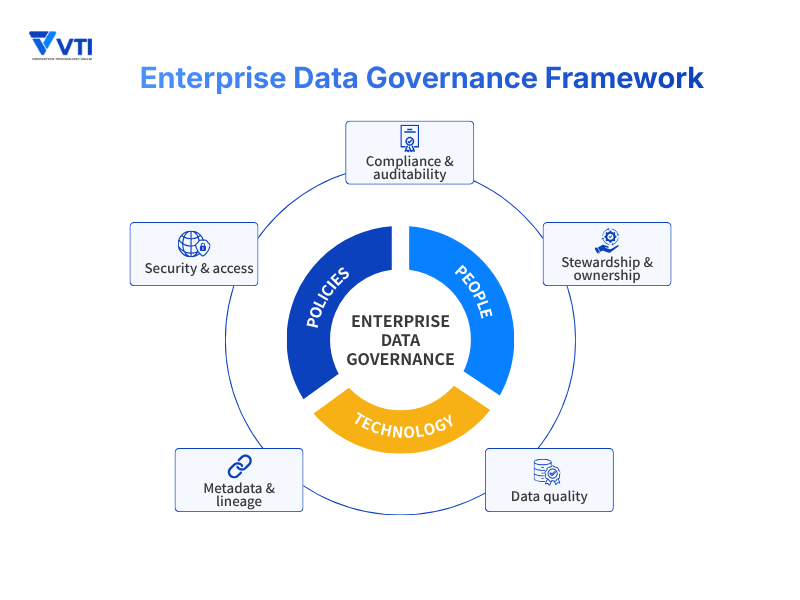
– Data quality management: Ensuring data is accurate, consistent, and complete enough to be trusted for decision-making.
– Data security, privacy & access control: Enforcing who can see and use what, typically through role-based (RBAC) or attribute-based (ABAC) access controls, encryption, and PII protection.
– Metadata management & lineage: Maintaining a searchable data catalog and tracking where data originates and how it changes as it moves through systems.
– Stewardship & ownership: Assigning clear, named accountability for each data domain, rather than leaving ownership implicit.
– Compliance & auditability: Keeping policies, access logs, and reporting audit-ready at all times, not just before a scheduled review.
Key roles & the RACI matrix
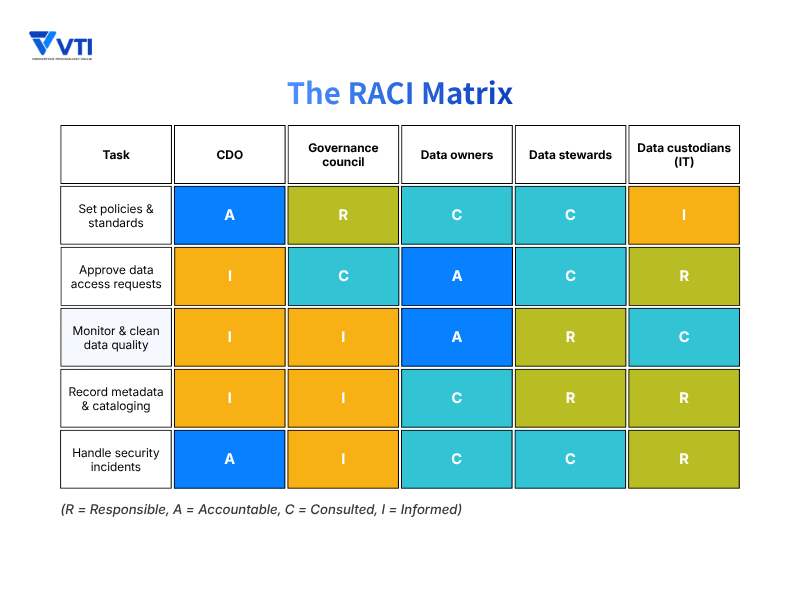
Enterprise data governance distributes accountability across five key role types: a Chief Data Officer (CDO), a governance council, data owners, data stewards, and data custodians. Each role fulfills distinct responsibilities across policy, quality, and technical execution.
To eliminate ambiguity, enterprises use a RACI matrix to define clear responsibilities for key governance tasks:
Core role responsibilities
– Chief Data Officer (CDO): Sets strategic direction, secures executive budget, and holds ultimate executive accountability for enterprise data outcomes.
– Governance council: A cross-functional leadership group (spanning IT, legal, security, and business units) that resolves policy disputes and aligns cross-departmental standards.
– Data owners: Executive or senior business leaders accountable for a specific domain (e.g., Customer Data, Financial Records, Supply Chain Data).
– Data stewards: Domain experts responsible for day-to-day data hygiene, defining business terms, maintaining metadata, and enforcing data quality rules.
– Data custodians (IT): Technical specialists who manage database infrastructure, execute pipelines, and enforce technical security controls (such as RBAC/ABAC and encryption).
Operating models: Centralized vs. Federated vs. Data mesh
Enterprises generally adopt one of three governance operating models — centralized, federated, or data mesh. The optimal choice depends on the organization’s scale, industry regulatory pressures, and technical architecture maturity.
| Model | How It Works | Best For | Trade-Off |
| Centralized | One central team defines all policies, manages metadata, and approves all access requests. | Highly regulated industries (e.g., banking, healthcare) needing tight control | Creates operational bottlenecks; can slow down business units needing fast data access |
| Federated | A central body sets enterprise-wide standards, while business-unit teams handle local enforcement. | Large, multi-region enterprises balancing compliance with speed | Requires strong cross-departmental coordination to maintain consistency |
| Data mesh | Fully decentralized; domain teams own their data end-to-end and treat data as a product. | Digitally mature enterprises with highly autonomous engineering teams | Demands significant initial investment in platform infrastructure and data literacy |
Most global enterprises settle on a federated operating model. It strikes the ideal balance between top-down regulatory compliance and bottom-up business agility, allowing local business units to execute quickly without violating enterprise security guardrails.
Step-by-step implementation roadmap
A successful enterprise data governance rollout moves through four structured phases over 9 to 12+ months: strategy alignment, discovery and pilot, policy integration, and enterprise-wide scaling.
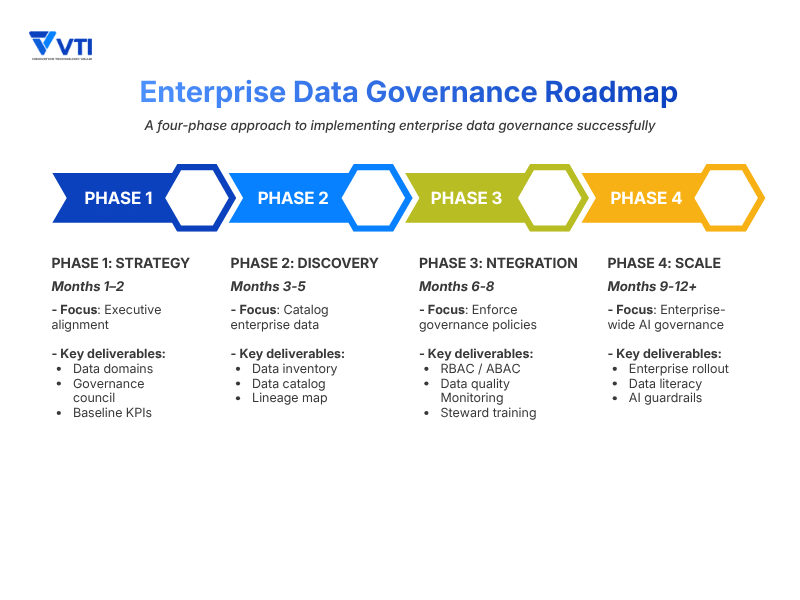
Phase 1: Strategy, vision & business value mapping (months 1–2)
Establish executive alignment before investing in complex tooling. Governance must solve tangible business problems to earn executive support.
Key deliverables:
– Prioritized list of initial data domains (e.g., Customer Data, Supply Chain).
– Chartered Governance Council with named executive sponsors.
– Signed-off baseline KPIs (data accuracy rates, audit readiness benchmarks).
Recommended tooling:
– Executive dashboards, collaboration platforms (Jira/Confluence, MS Teams).
Phase 2: Data discovery & cataloging pilot (months 3–5)
Inventory existing data assets across hybrid cloud and legacy environments. Prove the model on a single, high-impact data domain before scaling.
Key deliverables:
– Completed asset inventory for the target pilot domain
– Searchable data catalog populated with business terms and lineage maps
– Pilot outcome report demonstrating measurable quality improvements.
Recommended tooling:
– Data cataloging platforms such as Microsoft Purview, Snowflake Horizon, Collibra, or Alation
Phase 3: Policy rollout & tooling integration (months 6–8)
Shift from pilot phase to automated enforcement. Integrate governance guardrails directly into existing ETL/ELT pipelines and cloud storage layers.
Key deliverables:
– Role-Based (RBAC) and Attribute-Based (ABAC) access controls configured in production
– Automated data quality monitoring and alert workflows
– Role-tailored training materials for data stewards and data owners.
Recommended tooling:
– Cloud-native control services (AWS Glue Data Catalog & Lake Formation, Microsoft Purview), quality tools (Soda, Great Expectations).
Phase 4: Enterprise scaling & AI guardrails (months 9–12+)
Expand governance across all remaining business units and extend guardrails to cover generative AI, machine learning, and advanced analytics.
Key deliverables:
– Governance framework expanded to all secondary core business domains
– Enterprise-wide data literacy certification program
– Formal AI/GenAI guardrails covering PII masking, prompt filtering, and model training source verification
Recommended tooling:
– AI governance frameworks, automated PII masking engines, enterprise lineage tracking platforms.
Common challenges and how to address them
The primary obstacles to enterprise data governance are organizational data silos, cross-border regulatory friction, cultural adoption barriers, and difficulty proving clear financial ROI to leadership.
Persistent data silos
Business units frequently resist sharing data or adopting uniform standards.
-> The solution: Implement a federated operating model. Grant business units local autonomy over their domain execution while enforcing a shared baseline of central compliance policies.
Cross-border regulatory friction
Global enterprises face a complex web of regional privacy laws (GDPR, CCPA, PDPA, HIPAA).
-> The solution: Build modular governance policies. Design a core enterprise framework that can easily adapt to region-specific privacy rules without duplicating the entire data infrastructure per country.
Cultural resistance & low adoption
Teams often view governance as a restrictive compliance tax rather than a business enabler.
– > The solution: Secure early wins in a visible pilot project. Focus initial efforts on resolving a painful business bottleneck (e.g., accelerating customer analytics) to demonstrate immediate value before mandating broad compliance.
Difficulty proving ROI
Governance initiatives risk losing executive support if they cannot quantify their impact.
-> The solution: Anchor governance to clear operational KPIs from say 1. Track metrics like reduced data engineering maintenance hours, faster time-to-insight, and eliminated audit penalties.
Data governance across industries
While core governance principles apply universally, operational priorities vary significantly by industry domain, requiring tailored technical execution.
– Retail & E-commerce: Priorities center on unifying omnichannel customer data, harmonizing real-time POS data, and securing customer PII across loyalty platforms and digital storefronts.
– Manufacturing: Focuses heavily on IT/OT convergence—bringing legacy ERP records, supply chain logistics, and IoT sensor streams under unified quality and security standards.
– Healthcare: Governance revolves around patient privacy and compliance with strict interoperability standards (such as HIPAA, HL7, and FHIR) to ensure secure data sharing without regulatory exposure.
Building in-house vs. Partnering with an IT solutions provider
Enterprises can build governance capabilities entirely in-house or accelerate rollout by partnering with a managed IT solutions provider. The optimal approach depends on implementation urgency, budget flexibility, and internal engineering expertise.
Building in-house offers complete long-term control and deep institutional knowledge. However, it requires hiring, onboarding, and retaining scarce data talent in a highly competitive market. Partnering with an IT solutions provider brings proven execution frameworks, pre-built accelerators, and cross-industry experience from day 1.
| Dimension | In-house governance team | Partnering with a managed IT provider |
| Time-to-value | Slower: Hiring, onboarding, and tool learning curves typically add months before the first pilot goes live | Faster: Proven implementation playbooks and pre-built accelerators shorten the path to a working pilot |
| Upfront & operational cost | High fixed cost: Dedicated headcount and licenses regardless of workload | Flexible: Cost scales with project scope and can shift from capex to opex |
| Access to specialized expertise | Limited to what you can hire and retain locally | Broad access to consultants who’ve implemented governance across multiple industries and technology stacks |
| Long-term tooling/maintenance burden | Fully owned by your team, including upgrades and platform changes | Shared or fully managed, depending on engagement model |
For organizations seeking to compress their governance timeline, an experienced implementation partner provides critical momentum.
VTI brings over 9 years of digital transformation experience across 1,200+ successful projects, backed by ISO 27001/2022 and CMMI level 3 certifications. As a certified partner of AWS, Microsoft, Salesforce, IBM, and ServiceNow VTI deploys a global talent pool of 1,800+ software engineers and data architects to help enterprises design, build, and scale custom data governance frameworks across cloud and legacy environments.
Conclusion
Enterprise data governance isn’t a project you finish. It’s an operating capability that has to evolve as your data, regulations, and AI ambitions grow. Enterprises that treat it that way build the foundation for faster decisions, lower compliance risk, and AI systems people can actually trust.
If you’re evaluating how to build or scale a data governance program for your organization, VTI’s data and AI team can help you assess where you stand and design a roadmap suited to your industry and scale.