





![[FREE EBOOK] Strategic Vietnam IT Outsourcing: Optimizing Cost and Workforce Efficiency](https://vti.com.vn/wp-content/uploads/2023/08/cover-mockup_ebook-it-outsourcing-20230331111004-ynxdn-1.png)


Digital Transformation (DX) is often discussed as a race toward innovation: new services, new business models, and new technologies. But for many Japanese companies, the reality looks very different.
Many organizations have been “starting” their DX journeys for years, yet meaningful progress remains limited. So if the effort is there, what is holding them back?
To explore why, we invited Mr. Isami Kawabata, Senior Advisor at VTI Japan, to our exclusive interview series.
With over 35 years of experience spanning from the mainframe era to modern systems, Mr. Isami has led and advised large-scale transformation initiatives. In this conversation, he shares a clear perspective: successful DX does not begin with technology; it begins with strategy, particularly in the upstream phase.
The Reality Behind Japan’s “Digital Cliff”
One of the biggest barriers to DX in Japan is what the Ministry of Economy, Trade and Industry (METI) calls the “2025 Digital Cliff.”
As Mr. Isami explains:
Many Japanese companies are struggling to use digital technologies for business innovation; their systems are old, complex, and opaque.
In many cases, legacy systems have been in place for decades, with limited documentation and depend heavily on a few individuals, making them difficult to maintain and transform.
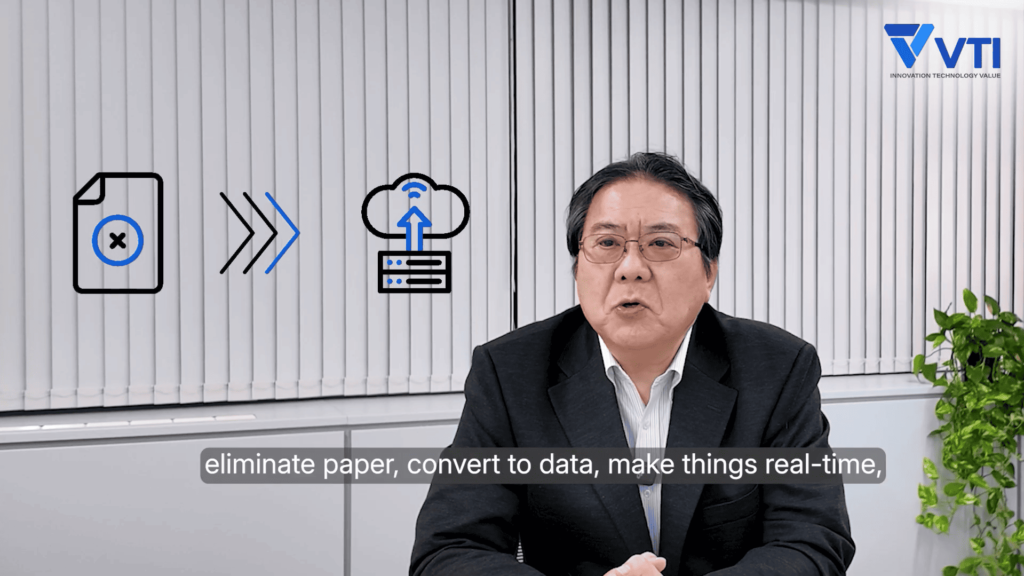
Mr. Isami recalls encountering this firsthand at a company in Osaka. Core systems had been running for over 20 years, while many business processes remained paper-based—leaving no usable data to support digital initiatives.
In situations like this, innovation efforts tend to stall, not because of a lack of intent, but because the foundation is not ready to support them.
>> Read more: What Is The 2025 Cliff? Why Japanese Business Owners Can’t Ignore It Anymore
A Practical Framework for Moving DX Forward
To make progress, Mr. Kawabata suggests looking at DX in two stages: Defensive DX and Offensive DX.
Defensive DX focuses on stabilizing and modernizing the core: updating legacy systems, digitizing processes, and making data usable across the organization. It creates the conditions needed for more advanced initiatives.
Offensive DX builds on that foundation, using data and digital tools to improve business performance, enhance customer engagement, and explore new opportunities.
The relationship between the two is simple but often overlooked.
You can’t start with offense; you need to build defense first. Like baseball: if you can’t field, you can’t win.
This is where many DX efforts lose momentum. When organizations move too quickly toward innovation without addressing underlying constraints, progress becomes difficult to sustain.
What It Really Takes to Drive DX Forward?
Even with the right foundation in place, moving forward is not always straightforward. In one case, Mr. Isami successfully modernized core systems and digitized operations, but the next phase proved more difficult.
During my time there, I couldn’t advance to Offensive DX. There was strong resistance from upper management, who believed sales should be done in person and rejected digital tools.
Shifts like this are rarely driven from within alone. As Mr. Isami notes, external pressure—whether through consulting support or increased competition is often needed to move things forward.
To bridge this gap, he highlights the role of “Yatagarasu talent”. A multi-skilled professional who can connect business, technology, and leadership. With the ability to navigate both strategy and execution, they help organizations move past internal resistance and turn direction into action.
>> Read more: Benefit of Outsourcing Software Development – 5 Key Advantages for Enterprises
VTI’s Role in Supporting Upstream DX in Japan
Japanese companies today face a structural talent shortage, with most IT professionals working for vendors rather than in-house teams. An aging workforce adds further pressure to long-term transformation efforts.
This is where VTI excels. With a young, growing engineering workforce and strong Japanese-language capability and cultural understanding, VTI enables effective cross-border collaboration.
Beyond delivery, VTI aims to enhance upstream consulting by formalizing methodologies, creating structured processes, and transferring knowledge to better support clients in both strategy and execution.
Starting the Journey Toward Innovation
The path from legacy systems to innovation takes time. It moves step by step, because in the end, progress depends on a few fundamentals: a solid foundation to support innovation, alignment at the leadership level to carry it forward, and the right people to sustain it over time.
For organizations navigating DX, the early decisions often shape everything that follows. Getting those first steps right makes it easier to turn ambition into real, lasting progress.