






![[FREE EBOOK] Strategic Vietnam IT Outsourcing: Optimizing Cost and Workforce Efficiency](https://vti.com.vn/wp-content/uploads/2023/08/cover-mockup_ebook-it-outsourcing-20230331111004-ynxdn-1.png)


If you’ve spent any time managing a manufacturing facility in the APAC region, you’ve probably lived through this scenario: your ERP system says production is on track, your planning team confirmed the schedule last night, and yet this morning the line supervisor is telling you there’s a two-hour delay due to a machine issue nobody flagged, and three customer orders are now at risk. That gap between what the plan says and what’s actually happening on your shop floor is not a people problem. It’s a systems problem. And it’s precisely the problem a Manufacturing Execution System (MES) is built to solve.
This guide breaks down what MES is, how it fits into your broader manufacturing architecture alongside ERP and Advanced Planning & Scheduling (APS), and why it has become a non-negotiable foundation for manufacturers across APAC whether you’re running a single-country operation or managing a multi-site regional network.
The Growing Pressure on Manufacturing Operations in APAC
APAC remains one of the world’s most dynamic manufacturing regions. FDI from Japan, Korea, Singapore, Europe, and rising intra-regional capital continues to drive expansion in Thailand, Vietnam, Malaysia, Indonesia, and other key hubs. Automotive, electronics, food processing, and medical devices sectors are growing strongly.
However, the operating environment has become significantly tougher. Rising labor and energy costs are eroding margins. Competition for skilled technicians is intense, and wage inflation in mature industrial zones has turned operational efficiency into a strategic necessity.
Manufacturers must meet exacting Japanese quality standards, Korean speed-to-market expectations, and strict global OEM and regulatory requirements, all while dealing with frequent shop-floor disruptions.
Multi-site operations across several APAC countries add further complexity. Coordinating standardized KPIs, consistent quality records, and complete traceability is essential for supplying Japanese, Korean, and EU customers, yet manual systems and delayed reporting cannot deliver at this scale.
Demand volatility compounds the challenge: lead times have shrunk to days, customers demand instant order visibility, and any disruption—supplier delay, quality issue, or machine breakdown—can quickly threaten relationships. Speed of response now determines whether you retain trust or lose business.
In this high-pressure setting, managing by walking the floor or depending on end-of-shift paper reports is no longer viable. Real-time production visibility has become a core requirement for competitive, responsive operations across APAC.
What Is a Manufacturing Execution System (MES)?
A Manufacturing Execution System (MES) is a software solution that monitors, controls, and records manufacturing operations in real time, from raw material input to finished goods release. It provides manufacturers with full visibility into what is happening on the shop floor at any given moment.
In a typical manufacturing IT architecture, the MES system sits between ERP and machine-level automation systems such as PLCs and SCADA. While ERP focuses on production planning, procurement, and financial management, MES focuses on execution. It ensures that production orders are carried out correctly, tracks actual performance against plan, and continuously updates production data across the organization.
This distinction is important. An ERP system works with planned and scheduled data. A Manufacturing Execution System works with live production data, including which work order is running, machine status, actual cycle time, operator activity, and quality results.
MES is also not simply a reporting or BI tool. Although it generates KPIs and production reports, its primary role is operational control. It captures, validates, and synchronizes real-time data to keep manufacturing aligned with business objectives.
From an industry standards perspective, the role of MES is clearly defined in the ISA-95 framework. Under ISA-95, MES operates at Level 3, known as Manufacturing Operations Management. It connects Level 4 business systems such as ERP with Levels 0 to 2, where physical machines, sensors, and control systems operate.
By acting as this intelligence layer, a Manufacturing Execution System helps close the gap between strategic production planning and actual factory execution, improving visibility, traceability, and operational performance.
How MES Bridges the Gap Between Planning and Execution
Understanding the value of MES requires understanding the full architecture of a modern manufacturing operation. The critical roles below are played by three distinct but interconnected systems: ERP, APS, and MES.
The Disconnect Between ERP Plans and Shop Floor Reality
Your ERP system is excellent at what it does: managing customer orders, calculating material requirements, handling procurement, controlling finance, and generating production plans. But ERP operates on scheduled, static data. A production order in ERP reflects what should happen based on standard lead times and theoretical capacities.
The moment that order reaches the shop floor, reality diverges. A machine runs slower than standard. A quality hold delays a batch. An operator is absent. Materials arrive slightly out-of-spec. ERP has no visibility into any of this until a human manually updates it — often hours or days later.
This is the execution gap. And in a high-precision manufacturing environment — where a supplier might be shipping directly into a tightly sequenced automotive or electronics assembly line — that gap is simply not acceptable.
Where Advanced Planning & Scheduling (APS) Fits
Advanced Planning and Scheduling (APS) systems address a different but related challenge: how to build production schedules that actually reflect your real capacity constraints. Unlike ERP’s rough-cut planning logic, APS uses finite capacity scheduling — it accounts for machine availability, tooling changeovers, operator skills, and material readiness to generate an optimized, constraint-aware production sequence.
APS answers the question: given everything we know about our resources and constraints, what is the smartest sequence and timing for our production orders?
It is a powerful optimization tool. But APS-generated schedules are only as good as the execution data feeding them. If APS doesn’t know that a production line lost two hours to an unplanned breakdown this morning, the next schedule it generates will carry the same error forward.
For a deeper look at Advanced Planning & Scheduling (APS) and its role in production optimization, explore our detailed guide here.
MES as the Execution Control Layer
This is exactly where MES becomes the critical connector. MES tracks what is actually happening — in real time, on every line, for every work order. When a deviation occurs, MES captures it immediately: downtime is logged, quality holds are flagged, actual quantities are recorded against plan.
This real-time execution data then feeds back into both ERP and APS, closing the loop. ERP gets accurate inventory and production completion data. APS gets accurate constraint and performance data for the next planning cycle. The result is what is called closed-loop manufacturing — a continuous cycle where planning informs execution, and execution informs planning.
The strategic positioning is simple: ERP plans. APS optimizes. MES executes and validates.
For manufacturers operating across multiple APAC sites, this architecture means regional leadership and headquarters see the same real-time production data that the on-the-ground plant manager sees — with no manual reporting lag and no data quality risk.
Core Capabilities of an MES System
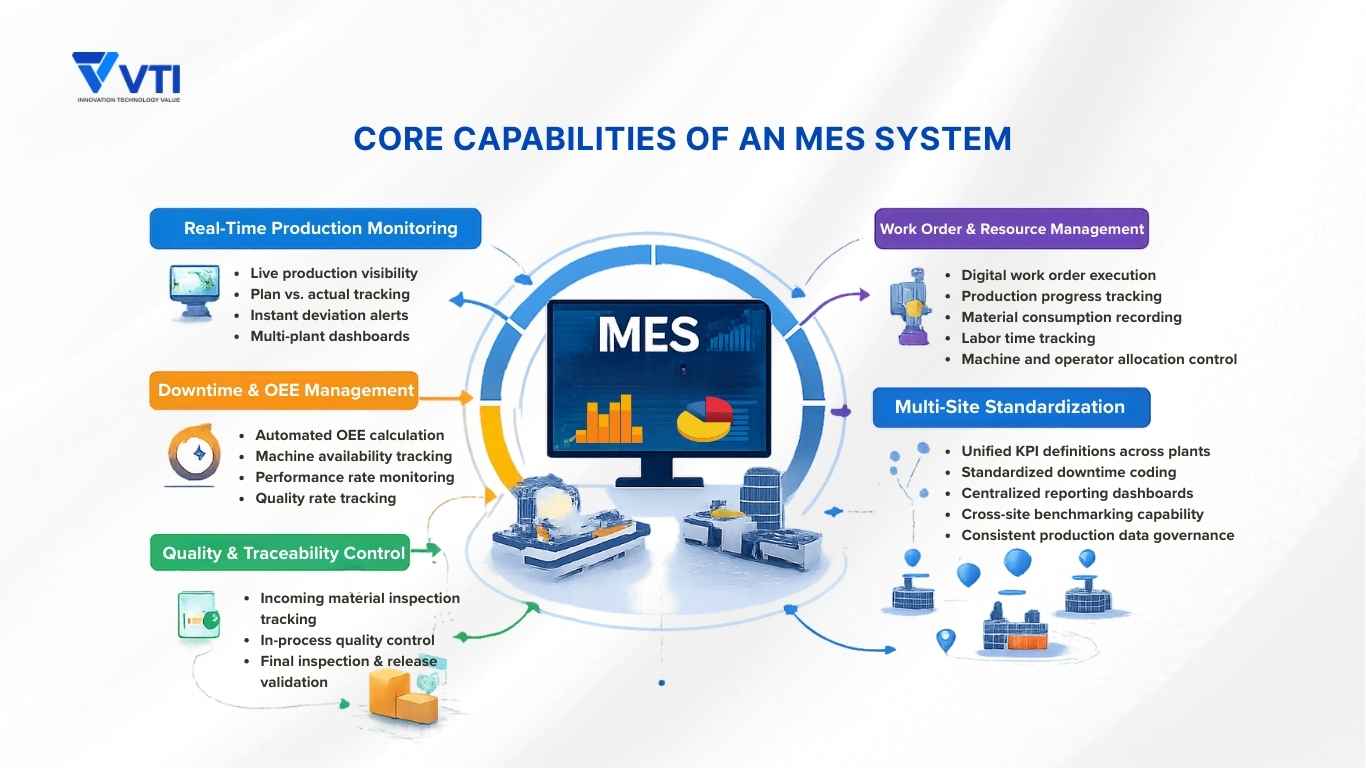
Real-Time Production Monitoring
The most fundamental capability of MES is live visibility into production status. Every work order, every production line, every machine — MES tracks actual progress against plan in real time. Shop floor supervisors see deviations as they happen. Plant managers can view live production dashboards without waiting for a shift report. Regional operations managers can compare performance across multiple plants simultaneously.
For facilities that previously relied on hourly manual reporting or end-of-shift data collection, this shift to real-time visibility alone can transform decision-making speed. When a line falls behind schedule, MES surfaces the issue within minutes — not hours.
Downtime & OEE Management
Overall Equipment Effectiveness (OEE) is the gold standard metric for manufacturing efficiency, combining availability, performance, and quality into a single number. MES automates OEE tracking by capturing machine uptime, cycle times, and quality rates directly from the production floor — eliminating the manual calculation burden and, more importantly, eliminating the data distortion that inevitably occurs when operators fill in paper-based OEE reports.
Downtime events are logged with reason codes, timestamps, and responsible parties. This transforms downtime from an invisible cost into actionable data: which machines lose the most production time, to which failure categories, and on which shifts. For manufacturers who take continuous improvement seriously — whether that’s kaizen, Six Sigma, or any structured improvement methodology — this level of granularity is essential. You cannot systematically improve what you cannot accurately measure.
Quality & Traceability Control
MES captures quality data at every step of the production process — incoming material inspection, in-process quality checks, final inspection, and release to shipment. Every product unit or batch is linked to the exact materials used, machines that processed it, operators who worked on it, and quality measurements recorded at each stage.
This end-to-end production traceability is a contractual and regulatory requirement for manufacturers supplying into automotive OEM networks, electronics assemblers, or regulated industries like medical devices and food processing. MES makes traceability automatic rather than manual — and makes it instantly retrievable when a customer audit or quality incident demands it.
Work Order & Resource Management
MES manages the execution of production work orders on the shop floor: issuing work orders to specific lines and operators, tracking completion progress, managing material consumption, and recording labor time. Resource availability — machines, tooling, qualified operators — is continuously tracked against demand.
When integrated with Advanced Planning & Scheduling systems, MES ensures that optimized schedules are executed precisely on the shop floor, and any deviations from the optimized sequence are immediately visible to planners for rescheduling decisions.
Multi-Site Standardization
For manufacturers operating across multiple plants in APAC, one of MES’s most strategically valuable capabilities is standardizing how production data is collected, defined, and reported across every facility.
Without MES, each plant tends to develop its own reporting templates, its own downtime reason code definitions, its own quality measurement practices. When regional management tries to compare OEE across plants in different countries, they’re often comparing apples and oranges. Benchmarking becomes meaningless. Best practice transfer becomes impossible.
With MES deployed consistently across sites, every plant speaks the same operational language. Regional performance benchmarking becomes genuine. Leadership at the group or headquarters level gets standardized KPI dashboards that reflect actual production reality — not manually curated slide decks assembled the night before a management review.
The Business Impact of MES: Beyond Operational Efficiency
Manufacturers who have deployed MES consistently report impact across two distinct dimensions.
- At the operational level, the most immediate gains come from speed — faster problem detection, faster response. When deviations surface in real time rather than at end-of-shift, recovery is quicker: line stoppages are shorter, quality escapes are caught earlier, and schedule adherence improves. Better in-process quality control naturally drives down scrap and rework, while greater production flow visibility helps reduce WIP inventory buildup.
- At the strategic level, MES enables the kind of cross-site standardization that makes regional benchmarking and best practice transfer genuinely actionable — shifting management focus from daily firefighting toward structured, data-driven improvement.
Looking further ahead, MES also lays the data foundation that more advanced capabilities depend on. Meaningful APS optimization, predictive analytics, and AI-assisted scheduling all require clean, continuous, real-time execution data as inputs. Without that foundation in place, higher-level optimization remains theoretical. MES is what makes it operational.
For C-level leaders accountable to headquarters or regional stakeholders, MES delivers something equally important: credible, real-time operational transparency. When leadership asks for a status update on a critical production order, the answer shouldn’t require three phone calls and two email chains. It should come from a live dashboard.
MES in the Context of Industry 4.0 and Smart Manufacturing
MES is not a new concept but the category has existed since the 1990s. But its role in the modern manufacturing technology stack has expanded significantly as Industry 4.0 technologies have matured.
In a smart factory architecture, MES serves as the data backbone. IoT sensors on machines feed real-time performance data directly into MES without manual data entry. Automated guided vehicles (AGVs) and conveyor systems report material movements. Vision inspection systems push quality data. The result is a comprehensive, continuous digital record of everything happening on the production floor.
Cloud-based MES platforms have accelerated deployment and reduced the infrastructure burden – particularly relevant for companies deploying MES across multiple plants in different countries, where maintaining on-premise server infrastructure at each site is costly and operationally complex. Cloud MES enables centralized management, consistent version control, and real-time multi-site visibility without the overhead of distributed IT infrastructure.
From Reactive Execution to Predictive Optimization
The evolution of MES is moving beyond execution tracking toward predictive capability. When MES has accumulated months or years of production data – actual cycle times, machine failure patterns, quality correlations, material consumption variances – that data becomes the raw material for AI-assisted analytics.
Predictive maintenance models built on MES data can flag machines at risk of failure before they stop the line. Quality prediction models can identify in-process conditions that correlate with defects before they occur. And critically, APS systems become dramatically more effective when they can draw on accurate, structured MES execution history to refine their capacity models and scheduling logic.
In the most mature implementations, MES and APS operate together as a closed-loop optimization system: APS generates optimized schedules, MES executes and tracks them in real time, deviations flow back to APS for immediate replanning, and the cycle continues throughout the production day.
Common Challenges in MES Implementation
Understanding the value of MES is one thing. Successfully deploying it is another. Manufacturers who approach MES implementation without realistic expectations about the challenges typically encounter some predictable difficulties.
Lack of Process Standardization
MES is a system that enforces process discipline. If your production processes are not standardized — if different shifts handle work orders differently, if quality check steps vary by operator, if downtime coding is inconsistent — MES will surface these inconsistencies immediately. Some organizations are not ready for this level of transparency, and the implementation becomes an opportunity (sometimes a painful one) to standardize processes that should have been standardized years ago.
Manufacturers with a strong continuous improvement culture — where SOPs are documented, followed, and regularly reviewed — tend to have a smoother MES deployment experience. Those without that foundation will find that MES implementation is as much an organizational change program as it is a technology project.
Data Integration Complexity
MES doesn’t exist in isolation. It needs to receive production orders from ERP, and send completion confirmations, quality data, and inventory movements back. In environments where ERP systems are older, heavily customized, or running on platforms with limited API capabilities, integration can be technically complex and time-consuming. A clear integration architecture and dedicated technical resources are essential, not optional.
Change Resistance on the Shop Floor
The operators and technicians who work on your production floor will be the daily users of MES. If they perceive MES as surveillance technology designed to catch mistakes rather than a tool that makes their work easier, resistance is predictable. Successful MES implementations invest heavily in change management — explaining the why, involving floor-level staff in configuration decisions, and demonstrating early wins that make operators’ daily work easier rather than harder.
Scaling Across Multiple Sites
Deploying MES at one pilot plant and then scaling to additional plants across APAC requires a disciplined rollout approach. Template configurations need to be built at the pilot stage with reusability in mind. Governance structures for managing configuration changes across sites need to be established early. Organizations that treat each site deployment as a fresh project typically find that costs and timelines multiply in ways that erode the business case.
It’s also worth noting: deploying APS without stable execution data from MES often leads to unstable, unreliable schedules. If your production planning team is considering APS implementation, establishing MES first — or at minimum concurrently — creates the data foundation that makes APS scheduling reliable rather than theoretical.
How to Evaluate the Right MES System for Your Manufacturing Environment
With a growing number of MES vendors in the market, the selection process requires a structured approach.
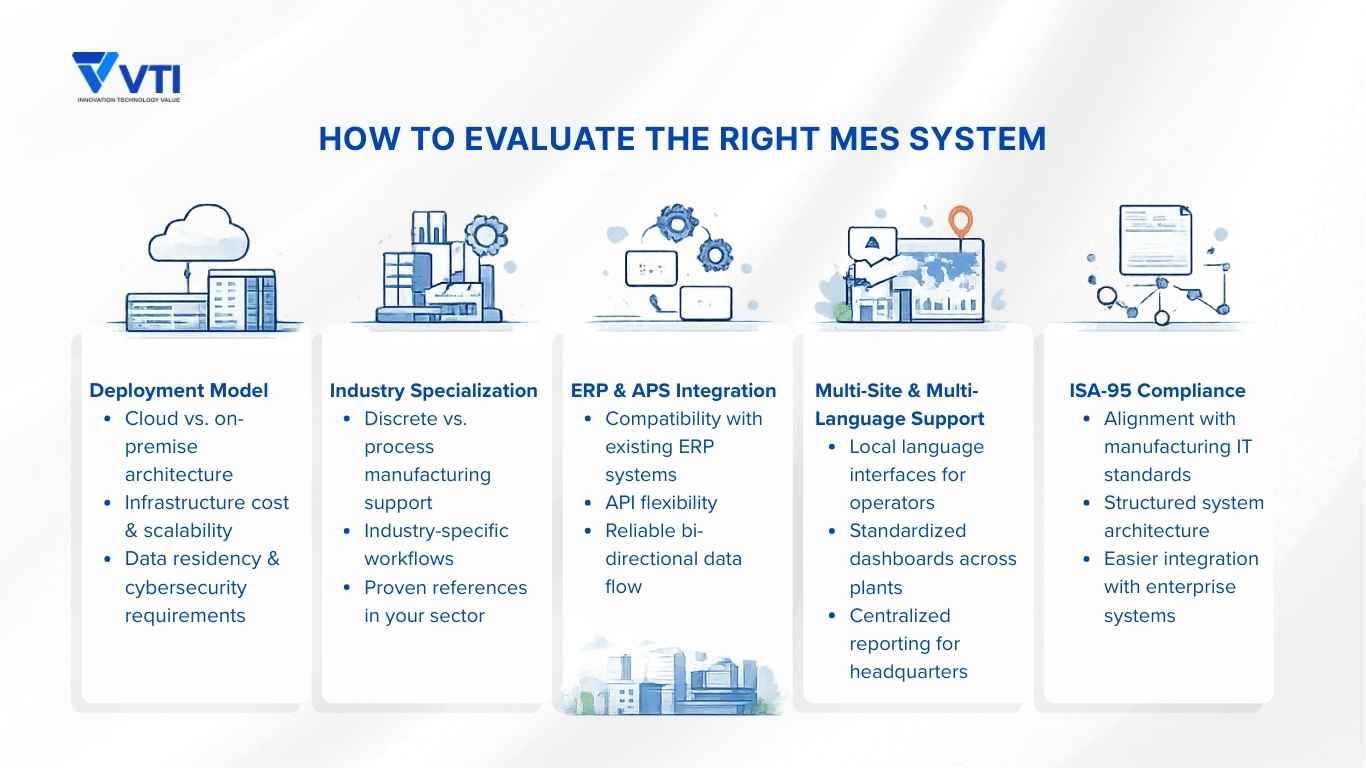
- Deployment model is often the first decision: cloud-based MES offers faster deployment, lower infrastructure cost, and easier multi-site scaling, while on-premise solutions may be preferred in environments with strict data sovereignty requirements or limited internet connectivity. Cybersecurity and data residency requirements from headquarters — wherever that headquarters may be — often drive this decision as much as technical considerations.
- Industry specialization matters significantly in MES. A platform built for discrete automotive manufacturing will handle BOMs, work order routing, and traceability differently than one built for process manufacturing in food or chemicals. Verify that the vendor has genuine reference customers in your specific industry and in your region, not just generic manufacturing credentials.
- ERP and APS integration capability should be evaluated rigorously. Request evidence of existing integration with your specific ERP platform — whether that’s SAP, Oracle, or another system. Ask specifically about API flexibility and the ease of configuring bi-directional data flows.
- Multi-language and multi-site capability is non-negotiable for regional manufacturers. Local operators need interfaces in their native language. Regional dashboards need to consolidate data across sites in a standardized format. Headquarters teams need reporting visibility in their preferred language and format. Verify all of this before signing a contract.
- ISA-95 compliance ensures the platform aligns with the international standard for manufacturing system architecture and serves as a useful baseline quality indicator, particularly when you plan to integrate with other enterprise systems.
Finally, evaluate the vendor’s implementation roadmap and local support capability. A technically capable MES platform with no local-language implementation team and no regional support infrastructure will create dependency and risk throughout your deployment — and long after go-live.
The Future of MES in APAC Manufacturing
The trajectory is clear: MES is evolving from a system that records execution data into one that actively drives decisions. Predictive analytics embedded in modern MES platforms now enable proactive maintenance, in-process quality trend detection, and yield optimization — without requiring manufacturers to build separate data science teams. AI-assisted decision support is moving from pilot stage into live production deployments across the region’s most digitally mature facilities.
Digital maturity across APAC remains uneven, varying by country, industry, and organizational culture. But manufacturers furthest ahead in MES adoption tend to share a common profile:
- strong process discipline
- a data-driven management culture
- clear KPI accountability
- leadership that treats digital transformation as a business priority rather than an IT initiative
The manufacturers who will lead in the next decade are those converging MES, APS, ERP, and analytics into a unified manufacturing control tower — giving leadership real-time visibility and response capability across every plant, every line, and every product. MES is the foundation that makes that possible.
FAQs About MES Systems
What is the difference between MES and ERP?
ERP manages enterprise-level processes such as planning, procurement, finance, and production orders. It works with planned and scheduled data. An MES system manages real-time shop floor execution. It tracks what is actually happening in production and sends accurate data back to ERP. In simple terms, ERP plans the business. MES ensures production runs according to plan.
What is the difference between MES and APS?
APS focuses on advanced planning and scheduling. It calculates the most efficient production sequence based on machine capacity, materials, and constraints. MES executes those schedules on the shop floor and captures real-time performance data. APS builds the optimal plan. MES makes sure the plan is carried out and provides feedback for continuous improvement.
How long does MES implementation take?
Implementation time depends on scope and production complexity.
- For a single plant with clear processes and ERP integration, an MES implementation typically takes three to six months.
- Multi-site or regional rollouts can take twelve to twenty-four months, especially when process standardization is required.
Can MES improve OEE?
Yes. Improving OEE is one of the strongest business cases for MES.
By automatically capturing machine availability, performance, and quality data, MES provides an accurate OEE baseline and highlights real production losses. Most manufacturers discover their true OEE is lower than expected, which creates clear opportunities for measurable productivity gains.
Is cloud MES secure?
Can MES integrate with APS software?
Yes. Integrating MES and APS creates a closed-loop planning and execution environment. MES sends real-time production data to APS, allowing planners to adjust schedules based on actual performance. APS then sends optimized updates back to MES for execution. This integration helps manufacturers respond quickly to disruptions and maintain schedule reliability.