






![[FREE EBOOK] Strategic Vietnam IT Outsourcing: Optimizing Cost and Workforce Efficiency](https://vti.com.vn/wp-content/uploads/2023/08/cover-mockup_ebook-it-outsourcing-20230331111004-ynxdn-1.png)


Across APAC manufacturing operations, production complexity is rising faster than planning capability. High-mix product portfolios, tighter OEM lead times, labor constraints, and multi-plant coordination pressure are exposing the structural limits of ERP-based MRP and spreadsheet scheduling. An advanced planning and scheduling (APS) addresses this gap by embedding finite capacity planning and multi-constraint optimization into the production planning process.
For Factory Directors and Plant Managers, APS delivers measurable operational outcomes:
- 15–25% improvement in bottleneck utilization
- 20–40% reduction in setup time
- 10–20% reduction in WIP and safety stock
- 20–30% improvement in lead time stability
- 15–30% overtime reduction
More importantly, an advanced planning system transforms production planning from reactive firefighting into structured operational discipline.
What Is Advanced Planning and Scheduling (APS)?
Advanced Planning and Scheduling (APS) is a production scheduling system designed to generate realistic, optimized, and executable production plans under real-world constraints. Unlike traditional manufacturing planning software embedded in ERP systems, APS does not assume unlimited capacity. Instead, it applies finite capacity planning and constraint-based scheduling to ensure that what is planned can actually be produced on the shop floor.
To understand advanced planning and scheduling clearly, it is important to distinguish between planning and scheduling.
- Planning focuses on what to produce, how much, and by when. It aligns demand forecasts, sales orders, and inventory targets with overall production requirements. This function is typically handled by ERP-based MRP logic and broader supply chain planning processes.
- Scheduling addresses a different question: how exactly will production be executed? It determines which machine runs which job, in what sequence, under which labor, material, tooling, and setup constraints. This is where complexity accelerates — especially in high-mix, multi-process environments common across APAC manufacturing operations.
Traditional MRP systems have well-documented limitations. They calculate material requirements effectively but rely on infinite capacity assumptions. As a result, ERP-generated plans frequently overload bottlenecks, ignore setup dependencies, or fail to reflect real shift patterns.
APS goes beyond MRP by embedding a real-time scheduling engine capable of recalculating production sequences whenever conditions change — machine breakdowns, urgent orders, material delays, or capacity adjustments. Instead of static planning, APS enables dynamic, scenario-based decision making.
For executive leadership, APS is a structural upgrade to how demand, capacity, and execution are synchronized, transforming production planning from theoretical alignment into operational feasibility.
Key takeaways: APS ≠ faster MRP. It solves a different problem — feasibility under constraints, not just material sequencing. The distinction between planning (what/when) and scheduling (how/where) is where APS delivers its core value.
Why Traditional Production Planning Fails
Many FDI manufacturers across APAC still rely on ERP built-in planning modules or spreadsheets for scheduling. These approaches work in stable, low-variety environments but struggle under today’s conditions.
ERP planning typically uses infinite capacity logic — it assumes resources are always available and lead times are static. In a plant with shared CNC lines, injection molding, or heat treatment ovens serving multiple product families, this creates capacity overloads that are not visible until production starts. Planners then resort to manual overrides, leading to schedule volatility.
Spreadsheet-based planning compounds the issue. Spreadsheets lack real-time updates, cannot handle complex constraints like setup sequences or labor shifts, and become error-prone as product mix grows. A single change — an urgent customer pull-in, for example — ripples through hundreds of rows, and data consistency deteriorates as product variety increases.
Without visibility into true bottlenecks, teams default to reactive production management — responding to shortages, expediting parts, or running unplanned overtime to catch up. This drives up costs: excess inventory to buffer uncertainty, premium freight, and elevated labor expenses from chronic schedule recovery.
In high-mix, low-volume environments, planning inaccuracy worsens further. Frequent engineering changes, quality holds, or supplier delays make static plans obsolete quickly. The result: eroded margins and sustained pressure from parent companies on OTIF and cost control.
Industry research from manufacturing benchmarking studies consistently shows:
- 20–35% of working capital tied up in inventory buffers
- 5–10% revenue impact from service-level variability
- 10–20% hidden productivity loss due to planning inefficiency
While exact figures vary by industry and region, independent supply chain benchmarks consistently confirm that schedule volatility directly correlates with margin erosion.
Key takeaways: The failure mode is structural, not operational. ERP and spreadsheets are not designed for constraint-based scheduling — using them for that purpose creates compounding inefficiency that grows with product complexity.
How APS Works: The Core Optimization Principles
Advanced Planning and Scheduling does not simply schedule faster. It schedules differently, using a set of principles that standard planning tools do not apply.
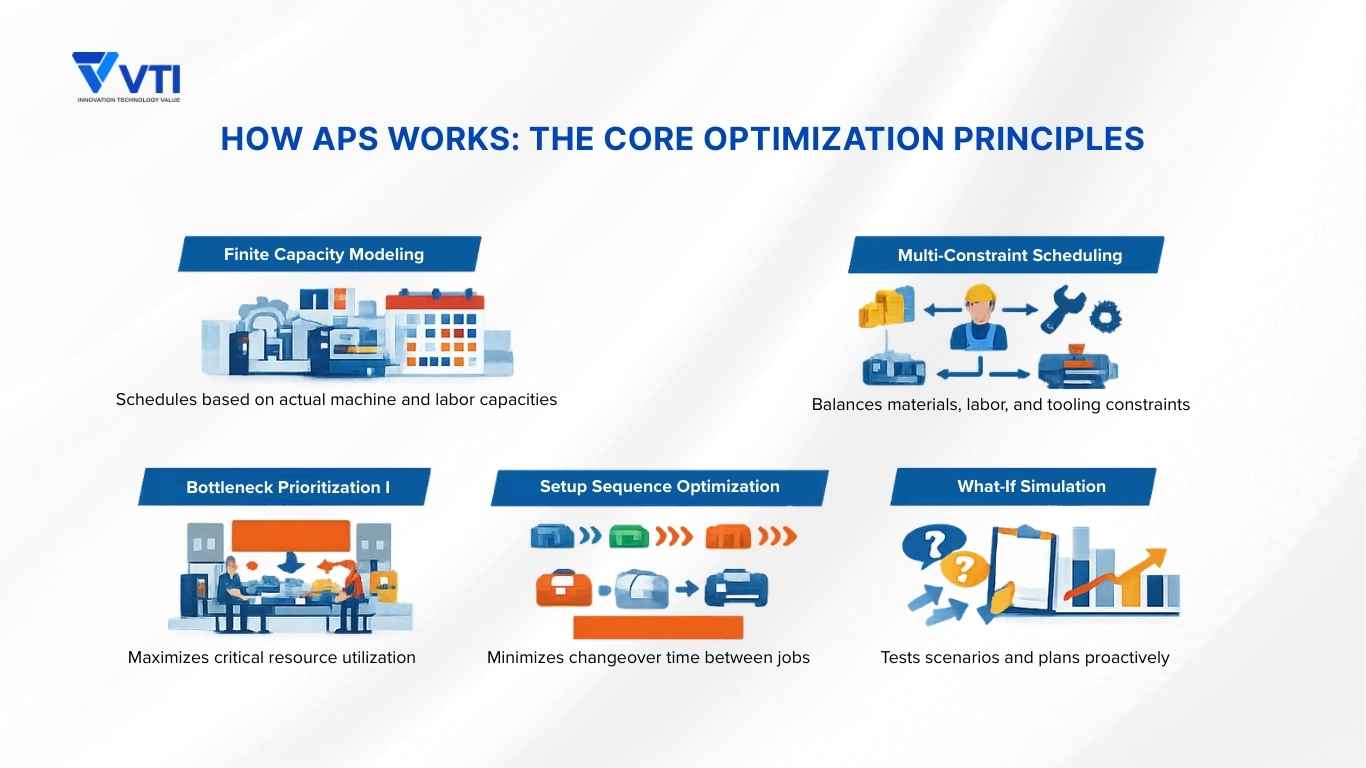
Finite Capacity Scheduling
Every machine, workstation, and labor group has defined availability — shift hours, planned maintenance windows, parallel capacity options, and alternative routing paths. APS uses this information to build schedules that respect physical limits from the outset, preventing capacity overloads before they appear on the shop floor.
Multi-Constraint Scheduling
Standard scheduling tools typically optimize for one constraint at a time. APS evaluates material availability, labor shifts, tooling requirements, setup dependencies, and inter-operation sequencing rules simultaneously. The result is a schedule that is feasible across all resource dimensions — not just one.
Bottleneck Prioritization
In any production system, one or two shared resources determine the throughput of everything else. APS identifies these bottlenecks and builds the master scheduling logic to protect and maximize their utilization first, rather than optimizing individual machines in isolation. This shift from local efficiency to system throughput is one of the most significant practical differences APS introduces.
Setup Sequence Optimization
Changeover time is one of the most significant hidden capacity losses in high-mix production. APS groups compatible jobs, optimizes sequencing across color families and product variants, and minimizes tool changes. Even modest reductions in average setup time — 20 or 30 minutes per changeover — add up to substantial recovered capacity across a weekly schedule.
What-If Simulation
Before committing to a decision, planners can model the consequences in advance. What happens to existing delivery commitments if a rush order is accepted? Instead of finding out after the fact, planners evaluate scenarios quickly and make informed decisions — shifting the planning function from reactive to genuinely proactive.
Key takeaways: APS works by optimizing the system, not individual resources. Bottleneck protection, multi-constraint feasibility, and scenario simulation are capabilities that ERP and MES do not replicate.
Comparing Production Planning Tools: ERP, MES, APS, and Excel
One of the most common points of confusion is how APS relates to the systems a manufacturer already has in place. Each addresses a different problem and delivers the most value when integrated.
| System | Primary Role | Key Strength | Key Limitation |
| ERP | Transactional backbone | Orders, inventory, finance, procurement | No optimization logic |
| APS | Optimization layer | Finite capacity, constraint-based scheduling | Requires accurate master data |
| MES | Execution visibility | Real-time shop floor data and tracking | No scheduling optimization |
| Excel | Manual workaround | Flexible, no license cost | Not scalable, error-prone, no real-time sync |
ERP tells you what to produce and manages the transaction records. MES shows you what is actually happening on the floor. APS connects the two — taking demand signals from ERP, receiving real-time feedback from MES, and generating schedules that are both optimized and executable.
In practice, however, many plants operate without a clean integration layer between ERP and MES. Demand signals arrive late or in inconsistent formats. Execution data from the shop floor is manually reconciled. Spreadsheets fill the gaps. The result is a planning process that is perpetually out of sync with operational reality — a structural condition that generates planning instability regardless of planner capability.
A robust digital manufacturing architecture requires all four layers working together: ERP for transactional integrity, APS for optimization, MES for execution visibility, and WMS for clean inventory data feeding the entire planning cycle. Without APS as the connecting optimization layer, the gap between ERP’s theoretical plan and MES’s operational reality persists — and that gap has a measurable cost.
Key takeaways: APS is not a replacement for ERP or MES — it is the optimization layer that makes both useful for production scheduling. The absence of APS is often why ERP-MES integration alone does not resolve schedule instability.
The Business Impact of Planning Instability
Planning instability is rarely recognized for what it actually is: a financial problem, not just an operational one.
When schedules change daily, OTIF (On-Time In-Full) becomes unpredictable. For FDI manufacturers supplying Tier 1 or OEM customers across APAC — where delivery reliability is a baseline requirement, not a differentiator — OTIF volatility has direct consequences on customer relationships and contract renewals.
To compensate for unreliable scheduling, companies accumulate safety stock. This protects service levels in the short term but inflates working capital, increases storage costs, and raises obsolescence risk — particularly acute in high-mix environments where product variants change frequently.
Unstable schedules also drive chronic overtime. What begins as an exception becomes embedded in the cost structure. Premium freight and emergency procurement become regular line items. Each is a symptom of the same underlying issue: a production planning system generating commitments it cannot keep.
The cumulative result is margin erosion that compounds over time. When analyzed carefully, the cost of planning instability — in overtime, expediting, excess inventory, and customer penalties — typically far exceeds the investment required to address it.
Key financial impacts include:
- OTIF volatility — Delivery commitments missed; penalties from OEM customers and parent company governance reviews
- Inventory imbalance — Excess stock ties up working capital; shortages trigger expediting costs
- Overtime cost — Unplanned schedule recovery inflates labor expenses
- Expediting cost — Rush procurement and premium freight erode margins
- Working capital impact — Higher inventory and receivables strain operational cash flow
- Margin erosion — All of the above compound over time
Advanced planning and scheduling stabilizes schedules, typically reducing lead time variability by 20–30% and improving OTIF consistency across customer accounts.
Key takeaways: Planning instability is a P&L issue. The cost accumulates across overtime, inventory, freight, and customer penalties simultaneously — and is often invisible until analyzed as a system.
Factory Case: Managing a Shared Bottleneck
Consider a typical auto-parts supplier in an industrial zone with high-mix production, a shared CNC machining center, and a heat treatment oven operating as bottlenecks — a configuration common across manufacturing clusters in Southeast and East Asia.
Before APS: Planners use ERP and spreadsheets, sequencing by due date. A sequence change for an urgent order disrupts setups, causing 2–3 extra hours per day in changeovers. Bottleneck utilization drops to 65%, overtime spikes, and downstream assembly waits.
After APS: The production scheduling software models setup dependencies — grouping similar alloys and process families — prioritizes the bottleneck, and suggests optimal sequences. What-if simulations show whether adding a night shift or outsourcing one product family actually frees capacity, before the decision is made.
Results seen in comparable APAC implementations:
- Bottleneck utilization improved 15–25%
- Changeover time reduced 20–40%
- Overall throughput increased on the same asset base
- Overtime reduced approximately 30%
- Cycle time adherence improved measurably
The improvement was structural — same asset base, higher throughput, with schedule stability driven by constraint visibility rather than planner effort.
Key takeaways: Advanced Planning and Scheduling converts bottleneck constraints from a daily operational problem into a managed variable. The same physical resources produce more, with less schedule volatility, when sequencing logic is constraint-aware.
APS in Multi-Plant and Regional Manufacturing Environments
For manufacturers operating across multiple sites — or managing production coordination with regional supply chain partners — APS delivers an additional layer of value beyond single-plant optimization.
From Optimization to Stability and Governance
Single-plant APS implementations typically focus on throughput and OTIF improvement. At the multi-plant level, the strategic value shifts: APS becomes the infrastructure for planning discipline and operational governance.
Plants that rely on individual planner expertise — local rules, tacit knowledge, improvised responses to disruptions — cannot scale predictably. What works in one facility depends on people, not systems. APS replaces this with systemized scheduling logic: consistent rules, documented constraints, and repeatable decision processes that hold across shifts, headcount changes, and organizational growth.
For regional or parent company leadership, this governance dimension is significant. Planning decisions become auditable. Schedule changes are traceable. Commitment reliability improves not because planners work harder, but because the underlying logic is stable.
Standardizing Planning Logic Across Plants
In multi-plant environments, inconsistent scheduling practices across facilities create hidden inefficiencies: capacity is allocated unevenly, demand signals are interpreted differently, and KPI reporting reflects local optimization rather than system-level performance.
APS enables a common scheduling rule set across plants — shared constraint modeling, harmonized KPIs, and a central visibility layer that allows regional management to understand real capacity availability across the network. This is particularly relevant for manufacturers coordinating production across two or more facilities serving the same OEM customer base.
Eliminating Planner Dependency Risk
In many facilities, scheduling knowledge is concentrated in one or two experienced planners. When those individuals are unavailable — or when the team turns over — schedule quality degrades. This is a structural risk that grows with operational complexity.
APS transfers scheduling logic from individuals to systems. Improvised local rules become documented constraint parameters. Tacit sequencing knowledge becomes explicit optimization criteria. The result is planning capability that is reproducible, transferable, and scalable — independent of any single person’s experience.
Reducing Variability in Production Commitments
Lead time volatility is one of the most damaging symptoms of planning instability for customer-facing operations. When committed lead times vary week to week, customers cannot plan reliably — and that unreliability eventually affects contract terms and order allocation.
Advanced Planning and Scheduling reduces schedule churn by generating plans that are feasible from the moment they are created, rather than plans that require manual correction before execution can begin. The practical result is more consistent lead time commitments, lower variance in delivery windows, and a stronger foundation for customer reliability metrics.
Key takeaways: In multi-plant environments, APS value extends beyond efficiency — it becomes governance infrastructure. Standardized scheduling logic, reduced planner dependency, and consistent commitment reliability are organizational capabilities, not just operational metrics.
ROI Framework: Quantifying the Business Case for Advanced Planning and Scheduling (APS)
For C-level decision makers, APS investment requires a structured financial justification. The table below illustrates the quantification approach using a representative mid-size manufacturing plant (~500 employees).
| Cost Category | Annual Baseline | Conservative Saving (%) | Annual Saving |
| Unplanned overtime | $750,000 | 20% | $150,000 |
| Expediting and premium freight | $300,000 | 25% | $75,000 |
| Excess safety stock carrying cost | $400,000 | 15% | $60,000 |
| OTIF penalties and concessions | $200,000 | 30% | $60,000 |
| Total addressable cost | $1,650,000 | $345,000/yr |
Typical APS investment range (software + implementation + first-year support): $150,000–$350,000 depending on scope and vendor.
Indicative payback period: 12–24 months at conservative assumptions. Plants with higher overtime or expediting exposure typically recover the investment in under 12 months.
These figures are illustrative. A structured pre-implementation assessment should quantify site-specific savings before vendor selection.
Key takeaways: The ROI case is strongest where overtime, expediting, and inventory carrying costs are already significant. In most high-mix environments, the addressable cost exceeds the system investment within the first operating year.
Vendor Selection: Decision Framework
Selecting the right production scheduling software requires evaluating fit across five dimensions.
| Evaluation Dimension | Key Questions |
| Functional fit | Does the system model your specific constraints — setup sequences, shared resources, alternate routings? |
| Integration capability | What is the native ERP integration depth? How does bidirectional MES data exchange work in practice? |
| Implementation track record | Does the vendor have reference sites in your industry and region? |
| Scalability | Can the system support multi-plant coordination and centralized governance? |
| Total cost of ownership | All-in cost: license, implementation, integration, training, and annual support. |
Due diligence before committing:
- Require a proof-of-concept using your own master data — not vendor demo data
- Validate integration against your specific ERP version
- Confirm master data audit is scoped into the implementation plan
- Assess regional support model (local team vs. remote-only)
Key takeaways: Vendor selection failure most often stems from evaluating system capability without assessing data readiness and integration depth. A system that performs well in demos but cannot integrate cleanly with your ERP delivers limited value in production.
Production Planning Maturity Model
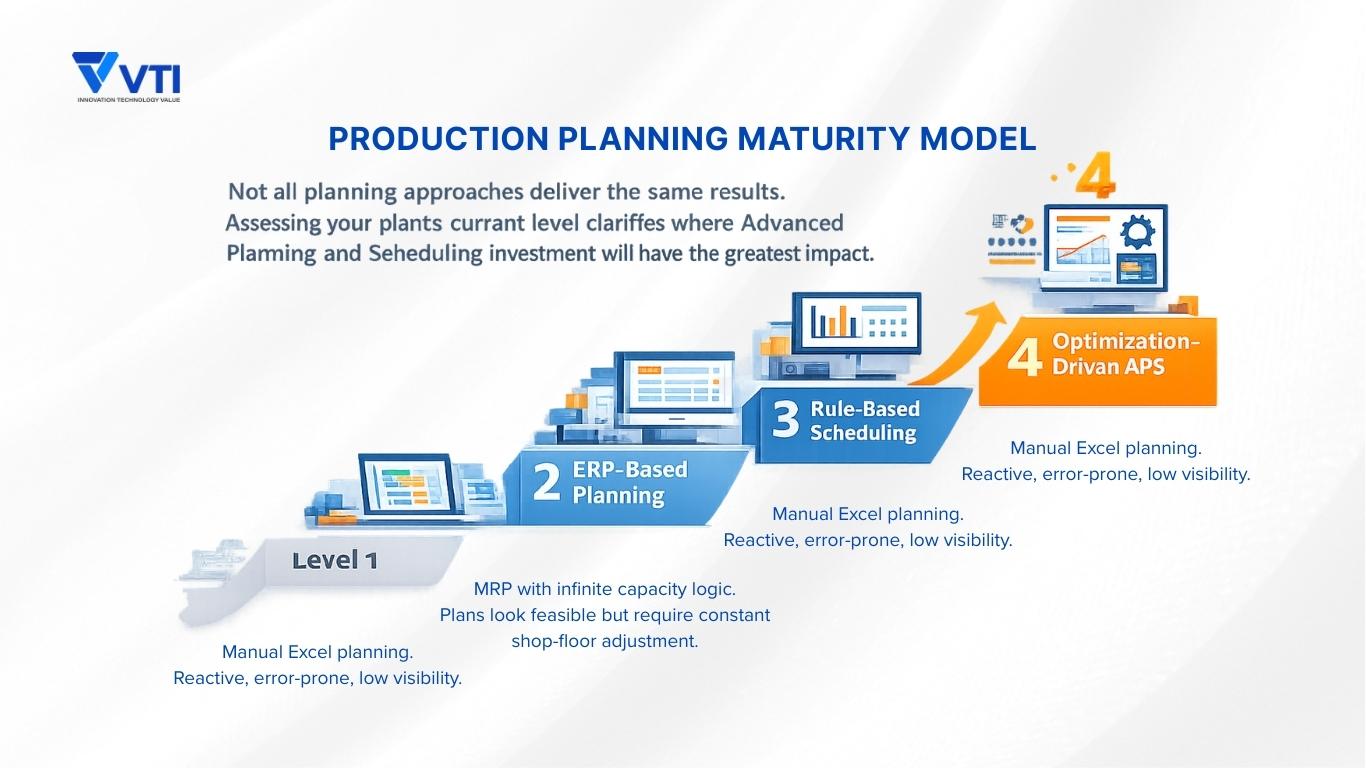
Not all planning approaches deliver the same results. Assessing your plant’s current level clarifies where Advanced Planning and Scheduling investment will have the greatest impact.
Level 1 — Spreadsheet-driven: Planning happens in Excel. Manual, error-prone, and largely reactive. Changes are constant, visibility is limited.
Level 2 — ERP-based planning: MRP runs regularly, but infinite capacity assumptions mean plans rarely reflect operational reality. What looks good on paper requires constant adjustment on the shop floor.
Level 3 — Rule-based scheduling: Basic finite scheduling rules are in place — either within ERP or through add-on tools. Improvement is visible, but optimization remains limited.
Level 4 — Optimization-driven APS: Full constraint modeling is in effect. The system accounts for machine availability, shift patterns, setups, and materials simultaneously. Real-time rescheduling and what-if simulation are standard capabilities. This level aligns with digital transformation objectives and Industry 4.0 readiness.
Self-assessment checklist — consider APS evaluation if three or more apply:
- Production schedules change more than three times per week
- Bottleneck visibility is poor or inconsistent
- ERP-generated plans match actual execution less than 70% of the time
- Overtime and expediting are recurring budget line items
- Inventory write-offs occur with regularity
When Should a Manufacturer Consider Advanced Planning and Scheduling (APS)?
Not every manufacturing operation requires APS. But there are clear signals that the current production planning approach has become a structural constraint on performance:
- Production schedules require constant manual correction
- Chronic bottlenecks restrict output despite nominally available installed capacity
- ERP-generated plans consistently cannot be executed as written
- Overtime has become a structural cost rather than an occasional exception
- Production complexity continues to increase through new products or variant growth
- OTIF performance fluctuates even during periods of relatively stable demand
- Capacity planning limitations are slowing the ability to accept new business
When production complexity grows faster than planning capability, the gap between what is planned and what gets executed widens. APS is specifically designed to close that gap.
Key Considerations Before Implementing Advanced Planning and Scheduling
Advanced Planning and Scheduling implementation success depends heavily on preparation. The most common failure mode is not selecting the wrong system — it is implementing a capable advanced planning system on top of unreliable master data.
- Master data quality. APS is only as accurate as the data it works with. Bills of materials must be accurate. Routing data must reflect actual production sequences and cycle times. Capacity parameters must match real shift patterns and equipment availability. Setup time records must be granular enough to drive meaningful sequencing. This requires a structured audit before go-live.
- ERP and MES integration. APS needs clean demand signals from ERP and real-time execution feedback from MES. Without both, optimization degrades as the gap between planned and actual state grows. The quality of integration — how reliably data flows, how frequently it updates — directly determines how much value APS can deliver.
- Organizational readiness. APS changes the planning role. Planners shift from manually rebuilding schedules after disruptions to evaluating scenarios and managing exceptions. This transition requires structured change management: training, clear process ownership, and consistent leadership support. Plants that treat APS as a pure technology implementation consistently underperform those that invest equally in people and process.
Most full implementations take between four and nine months. A phased approach — starting with a pilot on a single production line or product family — reduces risk and builds internal confidence before broader rollout.
The Future of Advanced Planning and Scheduling: AI, Simulation, and Digital Twin
The capabilities of APS platforms continue to evolve toward closer real-time integration with the shop floor and progressively more autonomous scheduling decisions.
AI-enhanced scheduling is beginning to appear in commercial production planning systems. Rather than relying solely on constraint-based optimization of known parameters, these systems can identify demand patterns, flag likely disruptions before they occur, and suggest proactive schedule adjustments. Predictive scheduling based on machine health data — fed through IoT sensors — allows the system to account for anticipated capacity reductions before a breakdown occurs.
Digital twin capabilities extend scenario simulation further, enabling planners to model operational changes with high fidelity in a virtual environment before implementing them on the production floor.
For FDI manufacturers across APAC navigating broader smart manufacturing or digital transformation programs, APS represents one of the highest-ROI investments within the production operations stack. It delivers measurable improvements in the near term while building the data infrastructure and process discipline that more advanced capabilities — predictive maintenance, AI-driven optimization, closed-loop MES-ERP integration — will require as the organization matures.
FAQs
What is the difference between APS and MRP? MRP calculates material requirements based on demand and lead times, assuming infinite capacity. APS performs finite capacity scheduling across multiple constraints simultaneously — answering not just what materials are needed, but whether the production system can actually execute the plan as required.
Is APS only for large manufacturers? No. The relevant threshold is production complexity, not company size. A mid-sized plant running high-mix, low-volume production with shared bottleneck resources often achieves stronger APS ROI than a larger plant running simple, repetitive flows.
How long does APS implementation take? Most implementations fall in the four-to-nine-month range. The primary variable is master data readiness — specifically routing accuracy, capacity parameters, and setup time records.
Can APS integrate with SAP or other ERP systems? Yes. Most commercial APS platforms support integration with SAP, Oracle, and other major ERP systems. Integration depth and update frequency should be a key evaluation criterion during vendor selection.
Does APS help reduce inventory? Indirectly, yes. When production scheduling becomes more stable, organizations can reduce safety stock previously held to buffer planning variability. Most implementations report meaningful reductions in both WIP and finished goods buffers, with corresponding working capital improvement.