






![[FREE EBOOK] Strategic Vietnam IT Outsourcing: Optimizing Cost and Workforce Efficiency](https://vti.com.vn/wp-content/uploads/2026/06/ebook-it-outsourcing.png)



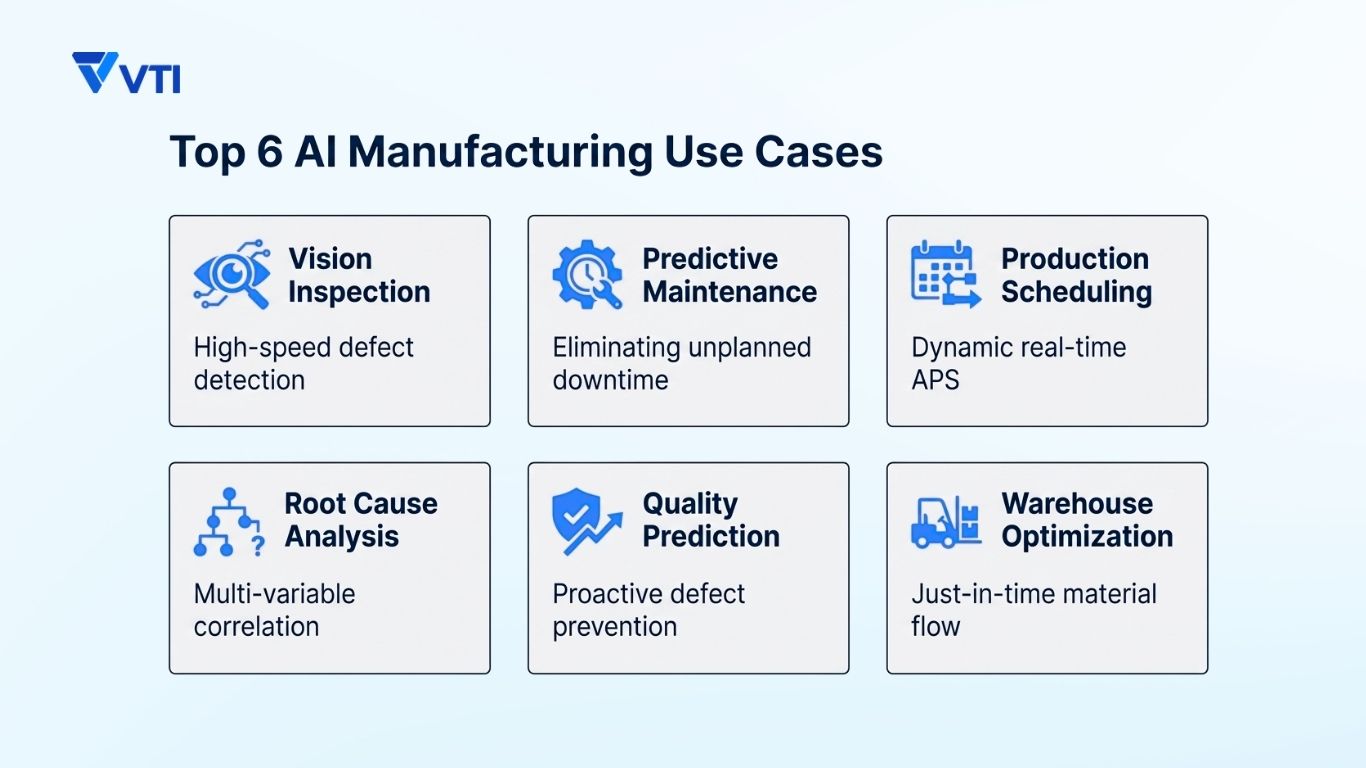
Across Asia, manufacturing hubs are moving beyond traditional automation and real-time visibility, especially in high-precision sectors. They are shifting toward AI-driven operations to accelerate shop-floor decision-making and maintain a competitive edge. This article explores why factories across major industrial markets are adopting AI-driven models, outlines how to prioritize deployment, and highlights six high-impact AI use cases transforming Asian manufacturing:
- AI Vision Inspection: Detecting micro-defects at full line speeds to boost first-pass yield.
- Predictive Maintenance: Forecasting equipment failure to eliminate unplanned downtime.
- AI Production Scheduling: Dynamically adjusting shift schedules to prevent line bottlenecks.
- AI Root Cause Analysis: Correlating multi-system logs to resolve recurring quality issues fast.
- AI Quality Prediction: Catching process drift early to prevent defects before they happen.
- AI Warehouse Optimization: Synchronizing raw material flows with live shop-floor demand.
Why Manufacturing Is Moving Beyond the Traditional Smart Factory
Asian Manufacturers Under Pressure to Optimize Operations Further
Several industry-specific pressures are pushing manufacturers across the region to go further:
1. Precision and yield requirements in semiconductors and electronics.
A single microscopic defect in a wafer, display panel, or bonding joint can scrap an entire batch worth a significant sum, whether that batch is produced in a Korean fab, a Japanese components plant, or a Malaysian back-end packaging facility.
Traceability requirements under ISO 9001‑based quality systems, or sector‑specific standards such as IATF 16949 for automotive products, or stringent customer audit programs, now demand full lot‑level genealogy and rapid, structured root‑cause analysis.
In high‑reliability segments, OEMs routinely push PPM targets into triple-digit, double‑digit or even single‑digit ranges, while audit rules (e.g., IATF’s 15‑day response window for major nonconformities) and more intensive on‑site/remote customer audits tighten oversight.
The cost of a quality escape at the customer level is much higher than catching defects in‑house, reinforcing the business case for tighter in‑process control and faster investigation.
2. Rising operational complexity.
Multi-product lines with frequent changeovers, just-in-time supply chains, and volatile global demand create constant production variability. This is especially acute in Vietnam and Thailand, where rapid capacity expansion often outpaces the maturity of planning systems.
Managing this complexity manually, or through static dashboards, introduces latency and inconsistency that directly impacts OEE (Overall Equipment Effectiveness) and on-time delivery KPIs.
3. Labor and cost pressure.
In Asia, there are 2 situations. Korea and Japan face an aging manufacturing workforce and high-skilled labor costs in established industrial centers. Meanwhile, rising manufacturing hubs like Vietnam, Malaysia, and Thailand – long positioned as lower-cost alternatives – are themselves seeing wages rise as demand for skilled operators and engineers outstrips supply.
Reducing dependency on manual oversight – particularly in inspection, data entry, and shift-based decision-making – is now a strategic priority across the region, not just in its most mature markets.
4. The need for faster operational decisions.
Customer lead times are shrinking while zero-defect expectations remain firm. Market windows that once allowed days for corrective action now require responses within a single shift, whether that shift is running in Ulsan, Osaka, Penang, Rayong, or Bac Ninh.
5. Regulatory and sustainability requirements.
Stricter environmental standards and energy efficiency targets – increasingly aligned with the expectations of multinational customers headquartered in Europe, the US, and Japan – add further constraints to production planning and operational management across all five markets.
Automation and Dashboards No Longer Sufficient
Real-time monitoring provides visibility but not operational intelligence. Dashboards show what has happened or is currently happening. They rarely predict what will happen next, and they rarely recommend the best course of action.
A production manager reviewing 40 to 50 monitoring screens during a night shift still needs to interpret anomalies manually, often under time pressure, with incomplete context. Alarm fatigue is a well-documented problem in highly automated environments. This human bottleneck limits responsiveness, introduces variability between shifts, and scales poorly as production complexity increases.
The fundamental gap is the difference between visibility and intelligence: one informs, the other acts.
What Makes an AI-Driven Factory Different from a Traditional Smart Factory?
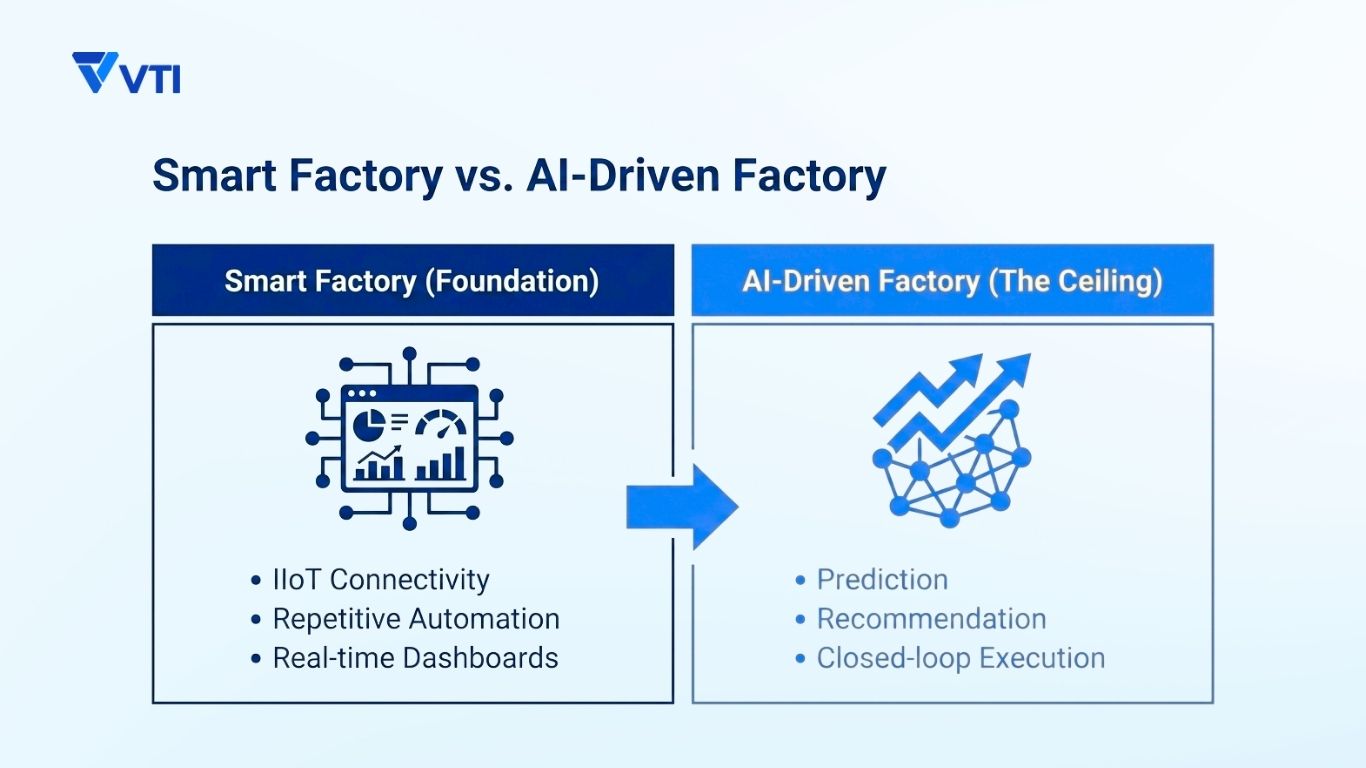
A traditional smart factory excels in three areas: connectivity through IIoT infrastructure, automation of repetitive physical tasks, and real-time visibility through dashboards and alerts. These remain valuable – but they represent the foundation, not the ceiling.
An AI-driven factory extends these capabilities across four additional dimensions:
- Prediction: Forecasting equipment failures, quality drifts, or production bottlenecks before they occur, giving operations teams time to intervene.
- Recommendation: Suggesting optimal maintenance windows, scheduling sequences, or process parameter adjustments based on live operational data.
- Optimization: Continuously balancing trade-offs across multiple competing constraints – capacity, cost, delivery, quality – in a way that no human team can sustain at scale.
- Closed-loop execution: Automatically triggering actions in MES, QMS, or WMS, and learning from operational outcomes to improve future recommendations.
This transition from smart factory to AI-driven factory represents the next competitive frontier for Asian manufacturers aiming to maintain leadership in high-value, precision production.
What Makes Manufacturing AI Different from Generic AI?
Before exploring specific use cases, it is important to understand why off-the-shelf or generic AI solutions frequently fail in factory environments – and what distinguishes effective manufacturing AI from the rest.
Manufacturing AI Requires Contextualized Operational Data
Machine sensor data – temperature readings, vibration signals, motor current – is the starting point, not the solution. Effective manufacturing AI requires rich production context layered on top of that raw data:
- Which production line and which station generated the reading?
- Which lot or batch was being processed, and from which material supplier?
- Which shift and operator was active at the time?
- What were the upstream and downstream quality statuses for that production run?
- What process recipe or parameter set was in effect?
Without this context, AI models produce noisy, unreliable outputs. A vibration pattern that is normal during one material lot may signal impending bearing failure during another – because substrate hardness, tooling wear, and environmental conditions interact in complex, non-obvious ways. Context is what makes the difference between a generic anomaly alert and an actionable operational insight.
AI Must Connect to Manufacturing Execution Systems
An AI system cannot operate in isolation from the systems that run the factory. Effective manufacturing AI must integrate with:
- MES (Manufacturing Execution System) – for production execution, lot traceability, and work order status
- QMS (Quality Management System) – for quality records, inspection results, and compliance data
- WMS (Warehouse Management System) – for material availability and inventory status
- APS (Advanced Planning and Scheduling) – for capacity planning and order prioritization
- SCADA/PLC/IIoT – for real-time equipment control and sensor data
Without these integrations, AI remains an isolated analytics layer. Recommendations are generated but never acted on. Models never improve because operational feedback never flows back. The system becomes another dashboard – one more screen to ignore.
Why Disconnected AI Pilots Rarely Deliver Operational Value
Many Asian manufacturers have run AI pilots – anomaly detection tools, image classification systems, data science dashboards – that never scaled beyond proof-of-concept. The most common reason is not algorithmic performance. It is the absence of execution linkage.
When AI outputs cannot trigger actions in MES or QMS – automatically placing a suspect lot on hold, rescheduling a work order, or generating a maintenance work request – the value stays theoretical. Without a feedback loop, models also cannot learn from real operational outcomes, so accuracy stagnates. True operational value requires AI to be embedded in workflows, not bolted onto them.
Top AI Use Cases in Manufacturing for Asian Factories
The following use cases are grounded in operational scenarios common across Korean semiconductor, electronics, automotive, and industrial manufacturing environments.
1. AI Vision Inspection for Semiconductor and Electronics Manufacturing
In high-speed semiconductor packaging lines, OLED display manufacturing, and PCB assembly, traditional manual inspection and rule-based machine vision systems struggle to keep pace with production volumes and product complexity. Subtle defects – micro-scratches, foreign particle contamination, bonding irregularities, solder bridging – require detection capabilities that go beyond fixed threshold-based algorithms.
Key capabilities of AI Vision inspection:
- High-accuracy defect detection and classification at full production speed
- Adaptive learning to handle product variants, lighting variations, and new defect types
- Consistent inspection performance across all shifts, eliminating the variability introduced by operator fatigue or experience gaps
Required data and system integration: AI Vision combines high-resolution image streams with MES lot data, process parameter records, and historical QMS inspection results. Inspection outputs feed directly into QMS for automatic lot disposition – placing suspect lots on hold without manual intervention – and into traceability records for downstream audit compliance.
2. Predictive Maintenance for Equipment-Intensive Factories
Factories operating expensive, high-precision equipment – CNC machining centers, injection molding machines, semiconductor etching systems, robotic assembly cells – cannot absorb unplanned downtime. A single unexpected equipment failure on a bottleneck machine can cascade hours of lost production, directly impacting OEE and customer delivery commitments.
Key capabilities:
- Early degradation detection through multi-sensor fusion: vibration, temperature, motor current, acoustic emission
- Remaining Useful Life (RUL) prediction, enabling proactive maintenance scheduling
- Integration with production plans to schedule maintenance during changeovers or low-volume windows rather than during peak production
Required data and integration: Predictive maintenance models draw on continuous sensor streams, historical maintenance records from CMMS (Computerized Maintenance Management System), alarm logs from SCADA and PLC systems, and production runtime data from MES.
Operational impact: Higher OEE, extended asset lifecycle, reduced emergency spare parts inventory, and more predictable maintenance labor planning.
3. AI Production Planning and Scheduling
Dynamic manufacturing environments – frequent customer order changes, machine capacity constraints, material delays, multi-product lines – push traditional APS (Advanced Planning and Scheduling) systems to their limits. Static scheduling rules and manual adjustments cannot respond quickly enough to real-time shop-floor changes.
Key capabilities:
- Real-time rescheduling based on live shop-floor status from MES
- Multi-objective optimization balancing delivery performance, production cost, and setup time minimization
- What-if scenario simulation to evaluate the impact of order changes or machine downtime before committing to a new schedule
Required data and integration: AI scheduling models require order demand data from ERP, real-time machine availability from MES, material availability from WMS, and line capacity constraints from APS.
4. AI-Powered Root Cause Analysis
When defects occur in high-mix production environments, rapid identification of the root cause is critical to preventing recurrence. Manual root cause analysis – reviewing machine logs, production records, and quality inspection data – is time-consuming and frequently misses subtle multi-variable interactions.
How AI root cause analysis works: The system correlates thousands of parameters simultaneously – machine event logs, process parameter trends, operator inputs, material batch characteristics, environmental conditions, inspection results – to surface probable causes ranked by statistical confidence.
Operational data required: Defect history from QMS, machine alarm logs from SCADA, process parameter records from MES, lot traceability data, and historical inspection records from AI Vision systems.
5. AI Quality Prediction Before Defects Occur
Rather than detecting defects after they have been produced, AI quality prediction models identify process conditions that are likely to generate quality failures – enabling intervention before defective output is created.
How it works: The model continuously monitors process parameter trends – solder paste viscosity, placement accuracy, oven temperature profiles, coating thickness – and flags gradual drift patterns that historical data associates with downstream quality failures. When risk thresholds are crossed, the system recommends parameter adjustments or triggers material verification checks.
Required data and integration: Process condition data from SCADA and PLC systems, combined with historical quality inspection records from QMS and production lot data from MES, provides the training foundation for predictive quality models.
Operational impact: Proactive quality management reduces rework and scrap rates, lowers the cost per quality incident, and reduces the risk of quality escapes reaching customers. This shifts quality control from a reactive audit function to a preventive operational capability.
6. AI Warehouse Optimization and Material Flow Management
Synchronizing warehouse operations with production schedules is a persistent challenge in large manufacturing facilities. Material shortages that halt production lines – even briefly – have compounding impacts on schedule adherence and OEE. At the same time, excessive safety stock inflates inventory holding costs and consumes working capital.
Key capabilities:
- Dynamic picking sequence optimization based on real-time production priorities
- Just-in-time replenishment triggered by MES production status rather than static reorder points
- Warehouse-production synchronization to reduce line-side material waiting time and search time in large warehouse environments
Required data and integration: Inventory status from WMS, production plans and consumption rates from MES, order data from ERP, and movement data from warehouse automation systems.
Operational impact: Fewer material-induced line stoppages, improved inventory accuracy, more efficient warehouse labor utilization, and smoother overall production flow.
Other Emerging AI Use Cases That Manufacturers Are Exploring
Beyond the established use cases above, manufacturers across Asia are actively piloting a second wave of AI applications:
- AI anomaly detection across entire process chains, identifying abnormal patterns that span multiple systems and production stages
- AI energy optimization, supporting sustainability targets by dynamically managing energy consumption based on production load
- AI automatic reading and recording, eliminating manual gauge readings and paper-based data entry through computer vision
- AI demand forecasting integrated with supply chain planning systems to improve material procurement accuracy
- AI behavior recognition and safety monitoring, detecting unsafe worker behaviors or unauthorized zone access in real time
| Use Case | Key Data Required | Main Integrated Systems | Primary Operational Impact |
| AI Vision Inspection | Images, lot data, process parameters | MES, QMS, AI Vision | Higher yield, lower customer PPM |
| Predictive Maintenance | Sensor data, maintenance history | CMMS, MES, SCADA | Reduced downtime, improved OEE |
| AI Production Scheduling | Orders, real-time shop-floor status | APS, MES, ERP | Better delivery, fewer bottlenecks |
| AI Root Cause Analysis | Multi-source logs, defect history | MES, QMS | Faster corrective action |
| AI Quality Prediction | Process trends, quality history | MES, QMS, SCADA | Preventive defect reduction |
| AI Warehouse Optimization | Inventory, production plans | WMS, MES, ERP | Fewer shortages, better flow |
Why Many Manufacturing AI Projects Fail to Scale
Understanding the common failure modes is as important as understanding the use cases themselves.
Raw Machine Data Is Not Enough for AI
Without production context – lot identity, shift assignment, process recipe, material batch – AI models produce outputs that are statistically noisy or operationally misleading. A temperature spike means something different depending on which product is running, which operator is active, and where that machine sits in the production sequence. Stripping that context from the data strips the intelligence from the model.
Isolated AI Systems Create Limited Operational Impact
When AI outputs cannot connect to execution workflows, the results sit in a dashboard. Quality engineers read alerts but must manually initiate holds in QMS. Maintenance planners see failure predictions but must manually create work requests in CMMS. Schedulers see optimization recommendations but must manually re-enter them into APS. Each manual step introduces latency, inconsistency, and the risk that the recommendation is simply not acted upon.
Closed-Loop Operations Are Critical for Sustained AI Value
The most effective framework for AI-driven manufacturing operations follows a closed-loop model:
| Detect → Analyze → Recommend → Execute → Learn |
AI value becomes operational and sustained only when recommendations connect directly to execution systems.
When MES automatically places a flagged lot on hold, when APS automatically adjusts a schedule in response to a machine alert, when CMMS automatically generates a maintenance work order based on an RUL prediction – only then does AI transition from a monitoring tool to an operational capability.
And only through the feedback loop of real execution outcomes does the model continue to improve.
How Manufacturers Should Prioritize AI Adoption?
Not all AI use cases offer the same return on investment or implementation feasibility at a given point in a factory’s data and integration maturity. Effective prioritization balances four factors:
- Current operational bottlenecks: Where are quality escapes, downtime events, scheduling failures, or material shortages causing the most damage to OEE and delivery KPIs?
- Available data: Does the factory already collect the data needed – sensor streams, inspection records, lot traceability, maintenance history – in a structured, accessible format?
- Measurable ROI: Can the impact of the use case be quantified in terms of yield improvement, downtime reduction, labor savings, or inventory reduction?
- Execution integration readiness: Are the MES, QMS, WMS, and CMMS systems in place and capable of receiving and acting on AI outputs?
Why start with Execution-Connected Use Cases?
The highest-ROI starting points are use cases where AI outputs can connect directly to existing execution workflows with relatively low integration complexity. Quality, maintenance, and planning typically offer the clearest immediate returns:
- AI Vision + QMS integration for immediate quality yield improvements and reduction in customer PPM incidents
- Predictive maintenance on bottleneck equipment to protect OEE on the machines where downtime is most costly
- AI-assisted scheduling to improve responsiveness to order changes and reduce setup waste
These use cases also build organizational confidence in AI – which is essential for securing the internal alignment needed to scale.
How Manufacturers Can Scale from AI Pilot to Plant-Wide Operations
The transition from a successful AI pilot to plant-wide deployment requires four foundational steps:
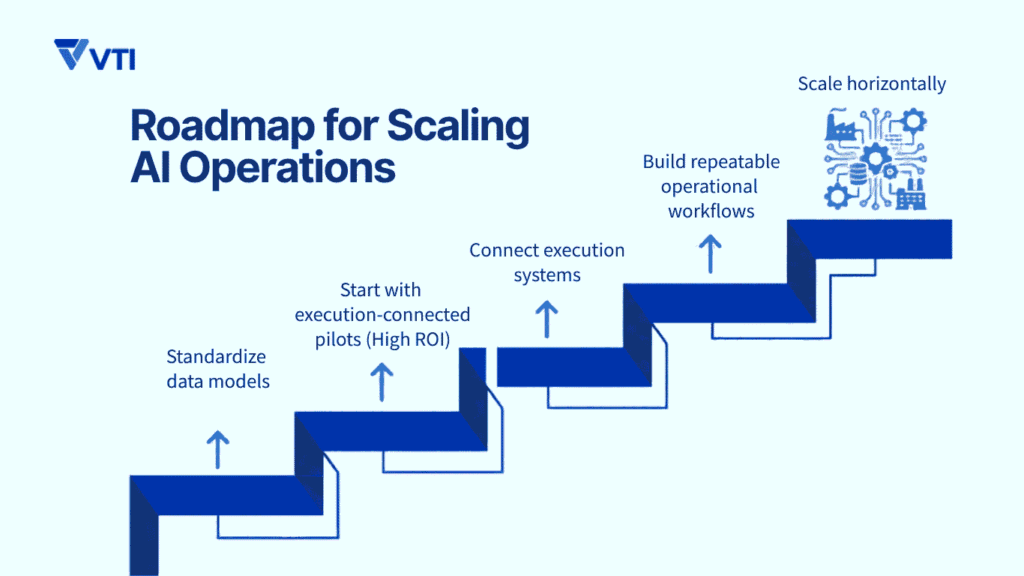
- Standardize data models across production lines so that AI models trained on one line can be applied to others without extensive rework.
- Start with execution-connected pilots in high-ROI areas (e.g., AI Vision, Predictive Maintenance) to prove immediate value in daily operator workflows.
- Connect execution systems – ensuring that MES, QMS, WMS, and CMMS are integrated with the AI layer and capable of bi-directional data exchange.
- Build repeatable operational workflows that define how AI recommendations are reviewed, approved, and executed – including escalation paths for edge cases.
- Scale horizontally across lines and facilities while maintaining the local production context that makes AI outputs operationally relevant.
A prioritization matrix plotting operational impact against data readiness provides leadership teams with a practical tool for sequencing investment decisions and building a credible AI adoption roadmap.
Conclusion
Manufacturing stands at a pivotal transition point. The move from highly automated smart factories to truly AI-driven operations will define the next decade of competitive positioning in semiconductors, electronics, automotive, and precision manufacturing.
Manufacturers that successfully build closed-loop AI-driven operations, grounded in contextual production data and tightly integrated with MES, QMS, WMS, and APS systems, will be better positioned to achieve higher agility, superior quality consistency, improved efficiency, and greater resilience against supply chain and market volatility.
Ready to transform your smart factory into an AI-driven operation? Contact our manufacturing-specified engineering team today to start building your closed-loop strategy.