






![[FREE EBOOK] Strategic Vietnam IT Outsourcing: Optimizing Cost and Workforce Efficiency](https://vti.com.vn/wp-content/uploads/2026/06/ebook-it-outsourcing.png)


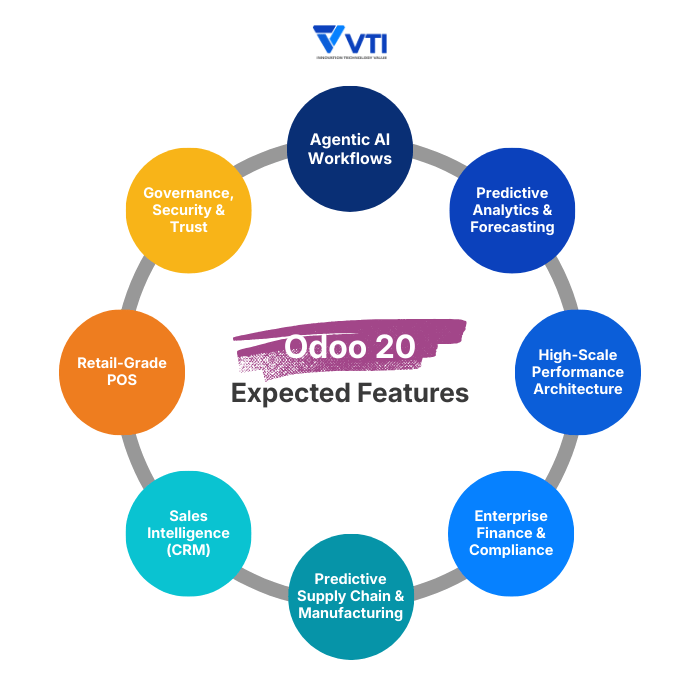
Odoo 20 is expected to launch in September 2026, and this could be the most noteworthy release yet. As an official partner, we’ve followed Odoo closely and realized the recent years of development patterns to see what’s coming. Here are our Top 4 Odoo 20 Predictions:
- Agentic AI: Autonomous multi-step workflow execution (not just chatbot responses)
- Read-Replica Database: Breaking the 10,000 concurrent user ceiling
- AI Financial Forecasting: Strategic decision-making beyond basic reporting
- Predictive Supply Chain: Dynamic demand forecasting and smart replenishment
If the improvements we outline materialize, version 20 could be transformative for mid-market companies wanting enterprise capabilities without enterprise complexity.
In this article, we’ll walk you through these, explain who benefits most, and help you think through your upgrade and necessary preparation.
What’s Driving Odoo 20: The Evolution from Version 17 to 19
Odoo is an open-source ERP platform designed for growing businesses that need enterprise capabilities without SAP-level complexity or cost.
Annually, in September, Odoo unveils its major version at the Odoo Experience conference in Brussels (Belgium). This year, we are looking forward to version 20, expected in September 2026.
Looking at how the platform has evolved over the past three years could help us understand what Odoo 20 will likely deliver.
From versions 17 through 19, Odoo has followed a clear and consistent strategy: depth over breadth. Rather than flooding the marketplace with quantity (apps), Odoo has radically deepened its quality through core modules with smarter defaults and sophisticated automation.
AI Integration
The clearest pattern? Odoo’s AI capabilities have evolved dramatically with each release:
- Version 17: Focused on Content Generation (marketing copy and website text).
- Version 18: Shifted to Practical Utility (enhanced OCR, automated invoice processing, and data cleaning).
- Version 19: Established an AI Infrastructure Layer (introducing AI Agents, ‘Ask Odoo’ natural language search, and voice-to-action transcripts).”
The logical next step is moving from reactive AI (responds to commands) to autonomous AI (plans and executes independently). This isn’t speculation but the natural progression of a three-year roadmap.
Performance Improvement
With each release, Odoo has significantly increased its ability to handle concurrent users & high-volume data processing:
- Version 17: 2,000–3,000 concurrent users
- Version 18: 5,000 users (core engine optimizations)
- Version 19/19.1: Framework-level support for scaling beyond 5,000
It will not be surprising if Odoo 20 targets such a barrier to enterprise adoption.
Odoo 20 Predictions: Game-Changing Features We’re Forecasting
Based on development patterns, user feedback from our client implementations, and competitive pressures in the ERP market, we’ve identified high-probability features for Odoo 20. Each prediction below addresses a specific gap that currently drives companies toward enterprise ERPs.
Disclaimer: These remain informed forecasts until Odoo’s official announcement in September 2026.
Agentic AI: From Reactive Chatbots to Autonomous Workflows
Odoo 19 introduced AI agents and natural language search, but they still function primarily as chatbots. You ask, they respond. Looking at Odoo’s pattern, we expect version 20 to make the leap from reactive to proactive AI.
The evidence is already visible in version 19.1, which introduced:
- AI agents that can analyze specific files (not just answer general questions)
- Context-aware filtering (AI understands time periods, departments, and data relationships)
- Multi-step task chaining (early foundation for workflow execution)
These aren’t finished features – they’re building blocks for what comes next.
What we hope to see
The difference between Odoo 19’s AI and predicted Odoo 20 agentic AI is like the difference between an intern who needs constant direction and an experienced employee who understands the job:
| Current AI (v19) | v20 Prediction: Agentic AI |
| You ask AI a question, and it answers | AI monitors processes and alerts you proactively |
| You tell AI to do one task | AI completes multi-step workflows, start to finish |
| You guide AI through each step | AI plans the approach and executes it |
| AI works within one module | AI connects information across departments (inventory, finance, manufacturing…) |
Who would benefit most?
This advancement would be especially valuable for:
- Operations managers currently spend 10+ hours/week chasing status updates across departments
- Sales teams are losing 30-40% of their time to CRM data entry instead of customer conversations
- Finance leaders need cross-functional insights but lack dedicated analyst resources
- Growing companies (50-500 employees) where coordination overhead is scaling faster than revenue
If Odoo 20 delivers on agentic AI, it could eliminate entire categories of manual coordination work – not just speed up individual tasks, but fundamentally change how mid-market companies operate.
Read-Replica Architecture: Breaking the 10,000-User Ceiling
Large retailers and manufacturers tell us they can’t adopt Odoo because “it doesn’t scale beyond 5,000 users.” This single limitation drives enterprise buyers toward SAP or NetSuite despite Odoo’s advantages in cost and implementation speed.
Odoo 19 thought about this with added framework-level support for read-replica databases, a system where:
- One database handles all writes (creating orders, updating inventory)
- Multiple replica databases handle reads (reports, dashboards, queries)
This prevents reporting queries from slowing down transactional performance. However, this feature remains incomplete and not production-ready for enterprise deployments. Version 20 can deliver full production-ready read-replica support, enabling 10,000+ concurrent users without performance degradation.
Who would benefit most?
- Multi-location retail chains (50+ stores) needing stable performance during Black Friday, holiday peaks, and flash sales
- High-traffic ecommerce platforms experiencing 5-10x seasonal traffic spikes
- Manufacturing companies (500+ employees) running concurrent operations across sales, production, and warehouse management
- Global organizations operating 24/7 across multiple time zones with no maintenance windows
- Fast-growing mid-market companies approaching 3,000+ concurrent users and planning for scale
If Odoo 20 delivers full read-replica support, it removes the single biggest technical barrier preventing enterprise adoption – making Odoo a genuine alternative to traditional enterprise ERPs at a fraction of the cost.
Module Upgrade Predictions: Closing Enterprise Gaps
Beyond agentic AI and read-replica architecture, Odoo 20 will likely deepen five core modules that currently fall short of enterprise requirements:
- Accounting & Finance
- Inventory & Manufacturing
- CRM & Sales
- POS & Retail
- Governance & Security
1. Accounting & Finance: From Record-Keeping to Strategy
AI-assisted bank reconciliation:
Transforming accounting’s most time-consuming daily tasks: auto-match transactions based on learned patterns, flag anomalies requiring human review (duplicate payments, unusual amounts), and suggest classifications for unclear items.
Financial forecasting:
We expect Odoo 20 to predict future cash flow, revenue, and expenses based on historical trends combined with AI analysis. Dynamic scenario modeling (“What if we delay this capital expense?” or “What if Q4 sales drop 15%?”) gives CFOs forward-looking tools instead of just historical reporting.
Enhanced multi-entity consolidation & accounting compliance:
Odoo 19 only records entries when an invoice is issued – rather than upon physical receipt, which risks violating GAAP/IFRS (legal “rulebooks” that dictate when and how money must be recorded). Odoo 20 may aim to fix this by:
- Automated accrual entries triggered by delivery confirmations, service completion, or contract milestones
- Configurable recognition rules by product type, revenue stream, or contract terms
- Audit trail showing when revenue was earned vs. when invoiced
2. Inventory & Manufacturing: Predictive Supply Chain
AI demand forecasting:
By analyzing historical sales data, seasonality patterns, and market trends, the module may allow us to predict future inventory needs by product and location. This replaces the manual spreadsheet forecasting and gut-feel ordering most companies currently rely on.
Dynamic replenishment rules:
Instead of relying solely on fixed rules, AI may continuously adjust reorder points based on lead time variability (tracking actual supplier performance), seasonal demand patterns, and sales velocity changes.
Advanced capacity planning:
A system that automatically recalculates entire schedules for production when one order is delayed. It can identify bottlenecks, suggest mitigation strategies, and optimize equipment utilization.
Enhanced IoT integration:
Real-time progress tracking from the shop floor via smartwatches or mobile devices would bring Industry 4.0 concepts to companies that can’t afford SAP’s manufacturing suite. Workers update job status on the floor, and managers see progress in real-time.
3. CRM & Sales: Intelligence Without Complexity
Odoo 19 introduced AI-powered CRM features (lead scoring, email suggestions), but they’re still basic compared to Salesforce Einstein’s capabilities (e.g., predictive analytics, deal risk scoring, automated pipeline intelligence). Therefore, we can expect some updates to close this gap.
AI Sales Copilot:
This will deliver AI-driven pipeline insights, including deal risk scoring, close date predictions, and next-best-action suggestions based on deal stage and customer history. Automated email drafting with context awareness becomes standard. This may address companies wanting Einstein-level intelligence without the respective cost and complexity.
Enhanced forecasting:
Forecast at the territory level with win probability scoring based on historical close rates. This gives sales teams the predictive analytics they need instead of just static pipeline reports.
4. Odoo POS & Retail: Stability and Speed
Stabilized offline mode:
This is to address the reliability complaints we’ve heard from version 19 early adopters. Enhanced front-end caching and smarter sync protocols when connectivity is restored will be critical for multi-location retail deployments in areas with unreliable internet.
Faster UI for high-volume operations:
We can also see a system built for simultaneous checkouts, 10+ terminals per location, and that enables real-time inventory sync without performance degradation.
5. Governance & Security: Meeting Enterprise Standards
AI Action Audit Trails:
Detailed audit trails of what autonomous AI agents do – which data they accessed, what decisions they made, and which workflows they triggered. This addresses regulated industries like finance and healthcare that require complete logs.
Granular Access Controls:
Odoo 19 restricts access at the module and record level, but cannot hide specific fields within records. This forces expensive custom development when companies need scenarios like managers accessing employee records without viewing salaries. Odoo 20 should introduce field-level permissions with role-based visibility rules and conditional access.
Automated Compliance Reporting
Enterprise compliance audits currently require 40-80 hours of manual documentation – exporting logs, compiling access records, and building evidence packages for GDPR, ISO 27001, or SOC 2 frameworks. It is good if Odoo 20 can introduce one-click compliance report generation that produces auditor-ready documentation in minutes instead of weeks. This would be critical for pre-IPO companies, regulated industries (healthcare, finance), and any organization pursuing enterprise certifications.
6 Steps to Prepare Before Odoo Upgrade
Based on our experience managing Odoo upgrades, here are six critical preparation steps to start today – regardless of your final upgrade timing:
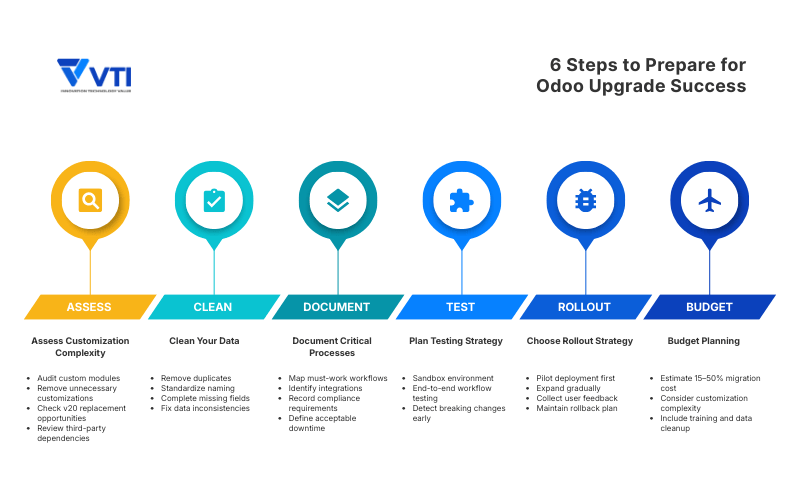
1. Assess your customization complexity
- Inventory all custom modules and modifications
- Identify which ones are truly necessary vs. “nice to have”
- Evaluate whether predicted v20 features might replace custom code
- Document dependencies on third-party modules
2. Clean your data
- Merge duplicate records (customers, products, vendors)
- Standardize naming conventions
- Complete incomplete records
- Fix data quality issues now rather than migrating problems forward
If Agentic AI becomes reality, clean data becomes even more critical because AI learns from your data patterns.
3. Document your critical processes
- List out critical workflows that absolutely must work on day one
- Identify integration points with external systems
- Note customizations that support compliance or audit requirements
- Understand which processes can tolerate brief disruption vs. which cannot
4. Plan your testing approach
When version 20 launches and features are confirmed, here is a standard process you might want to follow up:
- Set up a sandbox environment with production data
- Test critical workflows end-to-end (accounting close, order-to-cash, inventory cycles)
- Identify breaking changes before they impact operations
5. Consider a phased rollout strategy
Whether you roll out by location (pilot site first, then expand) or by module (low-risk apps first, Accounting last), avoid “big bang” deployments. Phased approaches let you:
- Catch issues in a limited scope before organization-wide impact
- Gather user feedback and adjust
- Build confidence before fully committing
- Maintain rollback options if problems emerge
6. Budget appropriately
Expect migration costs of 15-50% of the original implementation cost, depending on:
- Custom code complexity
- Data volume and cleanup needs
- User count and training requirements
- Timeline urgency
Conclusion
Version 20 remains speculative until September 2026. Make upgrade decisions based on your current situation and strategic direction, not solely on predicted features.
Our key advice is to always be ready to process quickly once official announcements arrive. And that preparation starts now, regardless of when you ultimately upgrade.
Need Help Navigating This?
Version 20 upgrades will be complex projects, not weekend tasks. If your team doesn’t have bandwidth for this level of preparation, or if you’re uncertain about assessing customization complexity and migration risks, working with an experienced Odoo partner makes sense.
As an official partner of Odoo in Asia for years, VTI has guided dozens of companies through major version upgrades and knows the common pitfalls: which customizations typically break, how data quality issues multiply during migration, and where testing shortcuts create production problems. We can help your organizations evaluate upgrade readiness, identify risk areas, and build migration roadmaps.
If you would like to discuss your Odoo project further, please don’t hesitate to contact us now.