






![[FREE EBOOK] Strategic Vietnam IT Outsourcing: Optimizing Cost and Workforce Efficiency](https://vti.com.vn/wp-content/uploads/2026/06/ebook-it-outsourcing.png)



In recent years, the convenience store industry has seen a rapid shift toward unmanned operations and self-checkout systems, with major chains such as 7-Eleven and Lawson accelerating adoption. However, this transition has led to a sharp increase in self-checkout shoplifting and sophisticated cash register fraud methods. As a result, convenience store shoplifting prevention measures have become a critical priority for maintaining profitability and reducing inventory loss.
This article explains the fundamentals of convenience store shoplifting prevention measures, including common methods, high-risk situations, practical countermeasures, and advanced solutions like AI security cameras to help you protect your business effectively.
Current situation and impact of shoplifting in convenience stores
Shoplifting has evolved from a minor security concern into a critical business issue in Asian retail. According to National Risk Assessment-Follow-up Report, annual losses due to shoplifting in Japan reach approximately 400 billion yen. In a typical convenience store, the loss rate from shoplifting is estimated at around 0.5% to 1.0% of total sales.
While this may appear manageable, it has a direct impact on profitability. Retail net margins are typically only 2–5%, meaning that the loss of a single 1,000-yen item requires an additional 20,000 to 50,000 yen, which means 20 – 50 sales to recover.
Furthermore, recent data from the National Police Agency confirms a troubling trend: after years of decline, theft cases are surging again. In 2024, there were 98,292 reported cases and 66,983 arrests, indicating an upward trend over the past two years. This trend is also influenced by an aging population in markets like Japan or Korea, where an increasing number of shoplifting cases involve elderly individuals, creating additional challenges for store operations.
In addition, the industry-wide shift toward self-checkout systems has introduced a high-tech loophole. According to the Japan Franchise Association (JFA), intentional scanning omissions and unpaid items at self-checkouts now account for nearly 40% of total losses. These calculated cash register fraud methods render traditional CCTV cameras almost obsolete, making detection extremely difficult and creating a significant hidden drain on revenue.
Characteristics of stores prone to shoplifting
When analyzing shoplifting in convenience stores, it is important to recognize that incidents are not random. Shoplifting tends to occur more frequently under specific store conditions related to layout and operations. The following factors increase the risk of shoplifting.
Blind spots in store layout
Stores with high shelves, complex layouts, or areas not visible from the counter tend to have a higher risk of shoplifting. Any area where staff members cannot see a customer’s hands is a potential crime scene. If your store has L-shaped corners or back aisles hidden from the counter, you are essentially providing a private space for shoplifting to happen.
Labor shortages and limited monitoring
Staff shortages can significantly reduce in-store visibility. When employees are occupied with checkout operations or backroom tasks, overall monitoring decreases. This weakens the deterrent effect of store security measures.
Disorganized displays and operational gaps
Poorly maintained shelves can make it more difficult to identify missing items or irregularities. In such environments, scanning omissions or item removal may go unnoticed. This risk becomes more pronounced in stores that have implemented self-checkout systems, where monitoring relies more heavily on operational discipline.
Ineffective use of technology
The presence of security cameras alone does not guarantee prevention. If cameras are not properly positioned or actively utilized, their deterrent effect may be limited. In particular, failure to capture high-risk shoplifting methods can reduce their effectiveness.
Convenience store shoplifting methods and patterns
To implement effective convenience store shoplifting prevention measures, it is essential to understand how shoplifting actually occurs in practice. Modern shoplifting methods are not limited to simple theft, but include a range of behaviors that take advantage of store operations, layout, and technology.
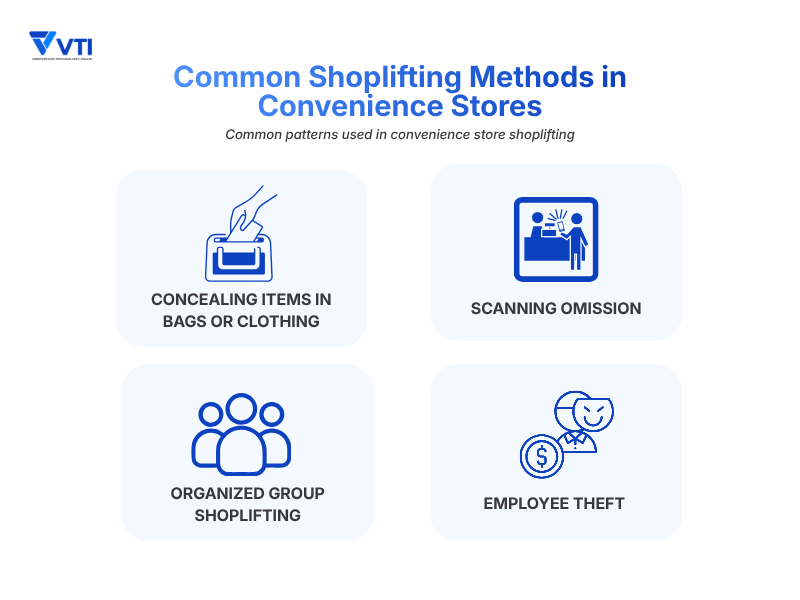
Individual shoplifting methods
Individual offenders often rely on subtle techniques that blend into normal shopping behavior. Common tactics include concealing items in bags or clothing or deliberately operating within the store’s blind spots.
In many cases, these actions appear so natural that staff find it nearly impossible to distinguish between a legitimate customer and a suspect. This is particularly true in busy environments where monitoring is limited.
Checkout fraud methods (including self-checkout)
The rapid expansion of self-checkout systems has fundamentally shifted the nature of retail theft. The most prevalent pattern is scanning omission, where a customer pays for a few low-cost items while leaving high-value products unscanned.
These calculated cash register fraud methods are designed to bypass standard monitoring. Consequently, self-checkout shoplifting has become a primary driver of inventory loss in stores with limited supervision.
Organized group shoplifting
In some cases, shoplifting at a convenience store is carried out by coordinated groups. These incidents involve clear role distribution: one individual distracts the clerk with a complex inquiry while accomplices target high-resale-value products. These organized hits are often repeated across multiple locations, significantly increasing the scale of total losses.
Employee theft
A critical yet often overlooked factor in store losses is internal theft. This involves the unauthorized removal of goods or the manipulation of POS data by employees. Because these activities occur within daily operations, they are exceptionally difficult to detect without integrated monitoring systems that link video footage to transaction data.
How to prevent shoplifting in a Convenience store: Practical strategies
Effective convenience store shoplifting prevention measures cannot rely on a single approach. Not all stores require the same level of shoplifting prevention. The appropriate measures depend on store size, staffing levels, customer volume, and the type of risk faced in daily operations.
In practice, many stores combine operational controls with system-based monitoring to improve consistency and reduce reliance on manual observation.
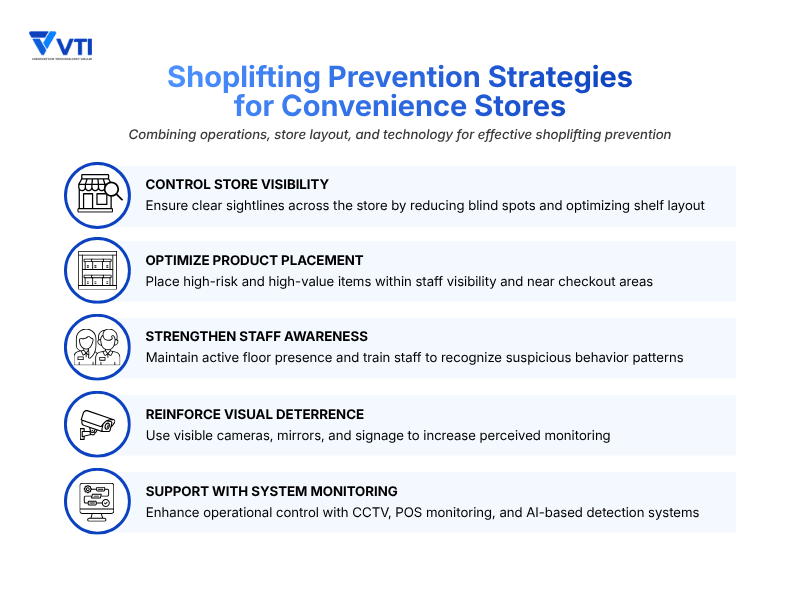
Store environment control
The store environment has a direct impact on shoplifting risk. Incidents are more likely to occur in areas with limited visibility or insufficient staff coverage, particularly in stores with high customer flow or self-checkout systems.
Reduce blind spots
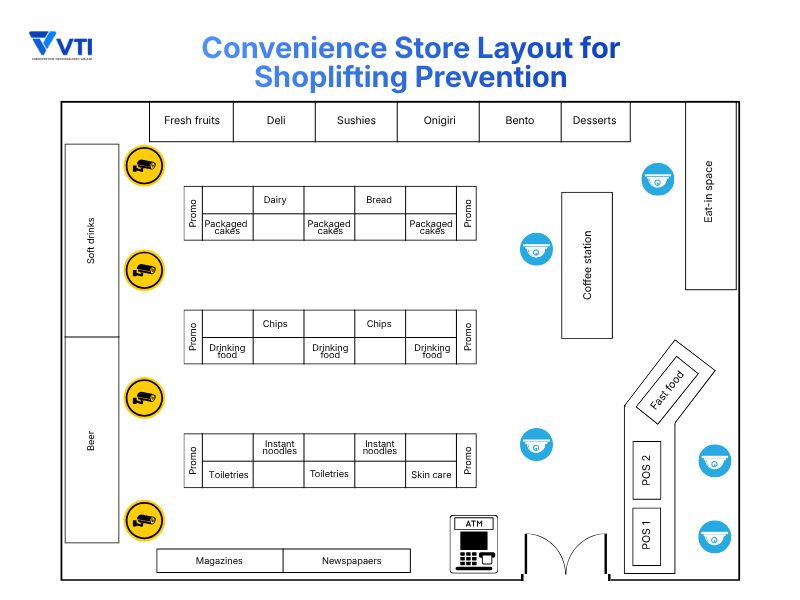
Reducing blind spots is a basic requirement. Stores with lower shelves and clear sightlines make it easier for staff to monitor customer movement. Areas such as corners, back aisles, and around fixtures should be reviewed regularly.
In addition, camera placement should be aligned with these high-risk areas. Without proper coverage, even well-designed layouts may still leave gaps in monitoring.
Optimize product placement
Product placement should also be reviewed. High-value and easy-to-carry items are better placed near the register or within clear view of staff.
In stores with higher risk levels, some retailers also combine product placement strategies with item-level controls such as security tags or monitored zones to reduce loss.
Maintain shelf condition
Shelf condition is another important factor. In stores where displays are kept organized, missing items are easier to notice. In contrast, when shelves are disordered or not regularly checked, small losses may go unnoticed. This is particularly relevant in stores with self-checkout for shoplifting.
Staff awareness and daily operations
Staff behavior plays a key role in preventing shoplifting during daily operations.
Proactive staff presence
Basic actions such as greeting customers and maintaining visibility on the shop floor help create awareness that the store is being monitored. Stores where staff remain active and visible tend to experience fewer opportunistic incidents.
Identify suspicious behavior
It is important for staff to recognize common behavior patterns, such as extended browsing in one area or repeated handling of items.
In practice, these patterns can be difficult to track consistently during busy periods, especially when staff are responsible for multiple tasks.
Standardize response procedures
Clear procedures should be in place for handling suspicious situations.
At the same time, consistent execution across shifts is often difficult to maintain, which may lead to variations in response quality between staff members.
Visual deterrence and store presence
Shoplifting prevention is also influenced by how the store is perceived.
Increase staff visibility
Visible staff presence, regular movement on the floor, and consistent customer interaction increase the sense that the store is being monitored. This can reduce opportunistic theft.
Use visible security measures
Cameras, mirrors, and signage indicating surveillance should be clearly visible to customers. In addition to deterrence, these measures also support monitoring when integrated with recording or alert systems.
System support and monitoring
Operational control alone may not be sufficient, especially in stores with high customer volume or self-checkout systems.
Optimize camera coverage
Security cameras should be positioned to cover entrances, checkout areas, and known high-risk locations. Their effectiveness depends not only on placement but also on how actively the footage is monitored.
Manage self-checkout risks
Self-checkout systems introduce new challenges. Issues such as scanning omissions or unpaid items may not be easily visible in real time. These cash register fraud methods require both operational controls and system-level monitoring.
Leverage AI-based monitoring
To support detection, some stores use AI-based security cameras. These systems can help identify unusual behavior, such as repeated scanning inconsistencies or extended handling of items, which may not be easily noticed during busy periods.
Advanced Technologies for Convenience Store Shoplifting Prevention
As shoplifting methods become more sophisticated, many retailers are extending their convenience store shoplifting prevention measures beyond manual operations.
Rather than relying only on staff observation or basic surveillance, stores are increasingly using technology to improve visibility and consistency in monitoring.
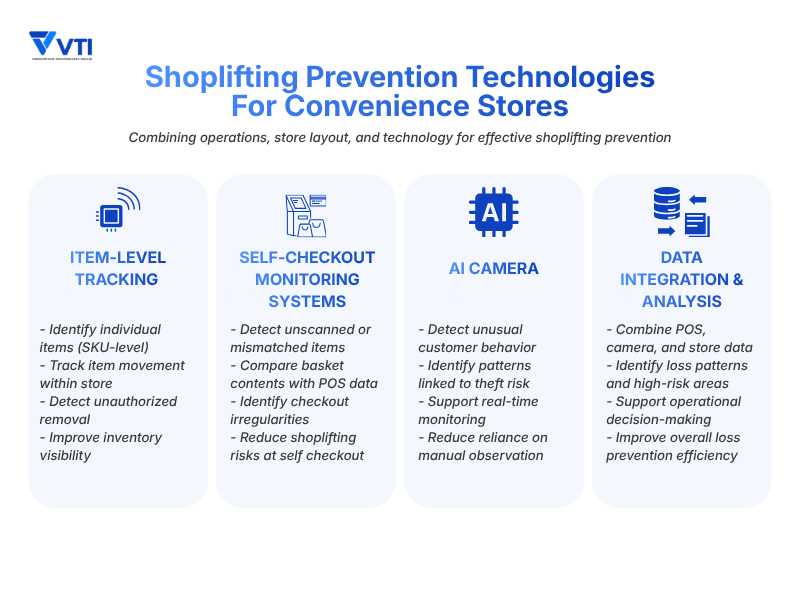
Item-level intelligence: RFID and IoT tracking
Technologies such as RFID and electronic security tags allow stores to track items more accurately.
These systems help identify:
– Which items are missing
– When they left the store
– And where risks are concentrated
This provides better visibility into inventory loss compared to manual checks alone.
Self-checkout monitoring systems
With the increase in self-checkout shoplifting, some stores are introducing systems that combine cameras, sensors, and POS data.
These systems can detect:
– Unscanned items
– Mismatches between basket contents and scanned items
This makes it easier to identify cash register fraud that may not be visible to staff during busy periods.
AI camera
AI cameras are used to support real-time monitoring by identifying unusual patterns, such as:
– Repeated handling of items
– Irregular checkout behavior
These systems do not replace staff, but help maintain consistent monitoring in environments where manual observation is difficult.
Data integration and monitoring efficiency
Many retailers are also focusing on connecting POS systems, camera data, and store operations.
By integrating these data sources, stores can:
– Improve visibility into loss patterns
– Identify high-risk products or time periods
– Support more consistent shoplifting prevention
Choosing the right shoplifting prevention measures for convenience stores
Not all stores require the same level of system support. When evaluating convenience store shoplifting prevention measures, it is important to balance operational practices with system-based support.
In practice, the goal is not to apply every available measure, but to choose the appropriate level of control based on store conditions and risk factors.
Operational vs. system-based approaches
Different approaches to shoplifting prevention serve different roles in store operations.
| Category | Operational measures (staff/layout) | System-based measures |
| Detection | Depends on staff visibility and timing | Supports continuous monitoring |
| Deterrence | Based on staff presence and interaction | Reinforced through visible monitoring |
| Labor impact | Requires ongoing staff attention | Reduces monitoring burden |
| Coverage | Limited to observable areas | Extends coverage across store areas |
| Checkout risk | Difficult to identify subtle issues | Supports detection of cash register fraud methods |
Operational measures are flexible and cost-effective, but their effectiveness depends on consistency. System-based measures provide additional support, particularly in situations where continuous monitoring is difficult.
Select measures based on store conditions
The appropriate combination of measures depends on the store environment and operational constraints.
In smaller stores with lower risk, maintaining strong operational discipline, such as clear visibility, organized shelves, and active staff presence, may be sufficient.
Stores with higher customer volume or limited staffing may find it more difficult to maintain monitoring consistently. In these cases, adding camera coverage or structured monitoring processes can improve visibility.
In high-traffic stores or environments with frequent self-checkout shoplifting, system-based support may be necessary to detect subtle issues that are not easily visible during daily operations.
Implement measures in stages
For many stores, a phased approach allows for more practical implementation.
Phase 1: Strengthen operational basics
Focus on reducing blind spots, optimizing product placement, and reinforcing staff awareness. This establishes a foundation for shoplifting prevention.
Phase 2: Improve monitoring coverage
Ensure that key areas like entrances, checkout zones, and self-checkout areas are clearly visible through camera placement and operational monitoring.
Phase 3: Introduce system-based detection
In stores with ongoing losses or more complex risks, additional tools such as AI-based monitoring can be introduced to support detection and improve consistency.
Consider cost and operational impact
When selecting shoplifting prevention measures, it is important to consider both cost and operational impact.
Even small improvements in loss rate can have a measurable effect on store performance. At the same time, increasing monitoring requirements may affect staff workload and daily operations.
Balancing these factors helps ensure that prevention measures are both effective and sustainable.
Conclusion
As retail technology evolves, convenience store shoplifting prevention measures are becoming more complex. In particular, issues such as self-checkout shoplifting and cash register fraud are often difficult to detect through manual operations alone.
While store operations and basic surveillance provide an important foundation, maintaining consistent monitoring in high-traffic or understaffed environments remains a challenge. In practice, effective shoplifting prevention increasingly requires a combination of operational control and system-based support.
At VTI, we support retail businesses in improving shoplifting prevention by connecting store operations with technology. This includes integrating POS data with video monitoring and applying AI-based analysis to support detection and reduce loss rate.
If you are looking for a retail solutions partner or exploring ways to strengthen store monitoring with technology, we would be happy to discuss your situation.