





![[FREE EBOOK] Strategic Vietnam IT Outsourcing: Optimizing Cost and Workforce Efficiency](https://vti.com.vn/wp-content/uploads/2026/06/ebook-it-outsourcing.png)


Your sales team updates a customer record, but an hour later your support team still sees the old version. This is the core problem cloud data synchronization solves. It keeps data consistent and current across every system your business relies on.
As companies expand across regions, they add cloud platforms and layer in AI-driven automation. Consequently, consistency gets harder to maintain and more critical to get right. This guide breaks down what cloud data synchronization actually means, how it differs from traditional backup, and which methods work best for modern enterprises. You’ll find practical synchronization strategies, real-world use cases across industries, and best practices for keeping your data accurate — the foundation for reliable AI deployment and confident decision-making.
What Is Cloud Data Synchronization?
Cloud data synchronization is the continuous process of connecting data from multiple sources. These include on-premise systems, SaaS platforms, and multi-cloud environments. The goal is to create a single, reliable source of truth in the cloud. Rather than each system holding its own version of the truth, every connected application draws from the same dataset in real time or near real time.
Traditional synchronization, built around internal networks and scheduled batch updates, worked when data volumes were smaller and delays were tolerable. That model breaks down in the AI era, where models and analytics platforms need continuous, high-volume data rather than periodic snapshots. Unlike traditional backup solutions, which capture point-in-time snapshots, cloud sync prioritizes active data consistency over archival storage. Backups preserve historical states for recovery. Database synchronization, by contrast, maintains live parity across production systems.
This approach also operates independently of physical location: a record updated in Hanoi reflects instantly in Tokyo, regardless of time zone or distance. This is what global data synchronization enables – a single, consistent version of enterprise data across every system and region a company operates in.
The result is real-time data integration that removes the data silos fragmenting organizational knowledge management systems. For engineering leaders managing distributed operations, this means strategic decisions and automated workflows run on complete, trustworthy information – the data foundation AI and advanced analytics systems depend on to function reliably.
Types and Timing Models of Cloud Data Synchronization
Cloud data synchronization can be classified in two dimensions: direction, which determines how data moves between systems, and timing, which determines when updates are exchanged. The right combination depends on your architecture, operational requirements, and acceptable latency.
| Category | Synchronization Type | Key Characteristic | Typical Use Cases |
| By Direction | One-way | Single source → target; no return updates | Reporting dashboards, data warehouses, BI platforms, analytics |
| Two-way | Bidirectional ↔ updates between two systems | CRM–ERP synchronization, customer records, operational databases | |
| Multi-way | Multiple systems exchange updates and stay aligned | Multi-region deployments, distributed cloud applications, global operations | |
| Hybrid | Synchronizes data across on-premise and cloud environments | Legacy ERP modernization, phased cloud migration, AI-ready data integration | |
| By Timing | Real-time | Instant synchronization as changes occur | Financial transactions, inventory management, live AI applications, mission-critical systems |
| Batch | Scheduled synchronization at defined intervals | Reporting, backups, archival, overnight processing | |
| Event-driven | Synchronization triggered only by specific events | Microservices, distributed systems, high-volume transactional workloads |
There is no one-size-fits-all synchronization strategy. Many organizations combine multiple approaches, for example, using real-time synchronization for customer-facing applications while relying on batch or event-driven synchronization for analytics and back-office processes. Selecting the right model means balancing consistency, performance, scalability, and business priorities.
Why AI-Ready Enterprises Depend on Data Synchronization
Cloud data synchronization does more than keep systems tidy; it determines whether your AI investments actually work.
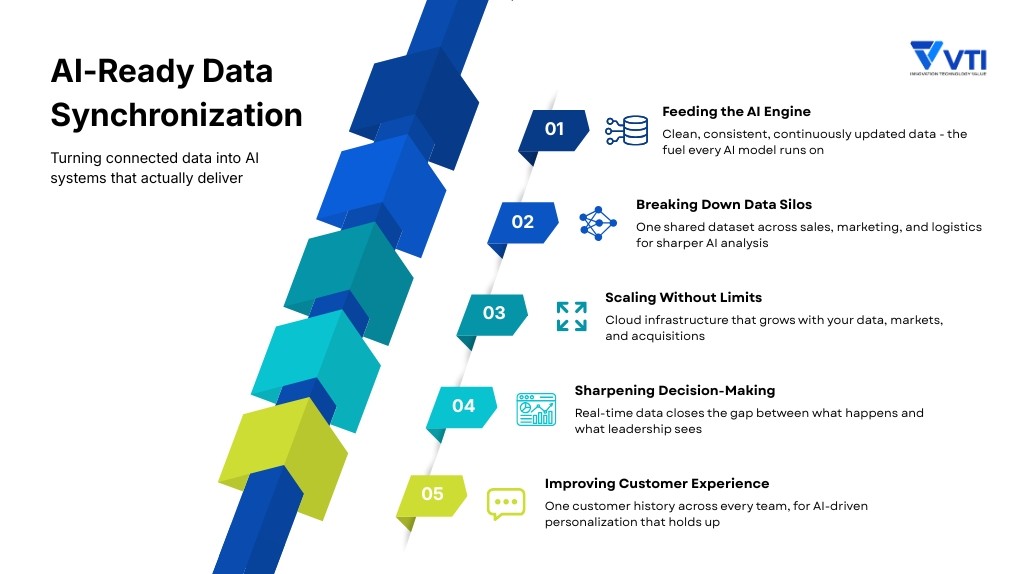
– Feeding the AI engine. AI models, including LLMs and machine learning systems, require clean, consistent, and continuously updated data. Cloud synchronization acts as the core pipeline. Without it, even the most advanced model works from an outdated picture.
– Breaking down data silos. When sales, marketing, and logistics operate from the same synchronized dataset, AI can analyze customer behavior and operational patterns with far greater accuracy. Fragmented data forces AI to work with partial information, and in AI, that’s a classic case of garbage in, garbage out.
– Scaling without limits. Cloud infrastructure scales in ways on-premise systems can’t match. This matters as enterprises generate more data across more regions. Organizations can expand into new markets or handle growing data volumes without rebuilding their data architecture each time.
– Sharpening decision-making. Executives need current data, not last week’s snapshot. Synchronized architectures close the lag between business events and leadership visibility. This reduces the risk of making critical decisions based on outdated information.
– Improving customer experience. When support, sales, and service teams draw from the same customer history, interactions become more consistent and better informed, which matters as much for AI-driven personalization as it does for human-led service.
Use Cases for Cloud Data Synchronization in the AI Era
Cloud data synchronization becomes especially powerful when paired with AI, turning consistent data into real-time, automated decisions across industries.
– E-commerce and dynamic pricing. Real-time data synchronization feeds AI live inventory visibility and demand signals. This enables instant price adjustments that respond to actual market conditions. Without it, pricing engines work from outdated stock counts and miss sudden shifts.
– Omnichannel customer experience. When a customer messages through a company’s Fanpage or website, that interaction syncs instantly to the cloud CRM. This seamless omnichannel integration allows AI to surface relevant context and suggest consultation scenarios for staff in real time, instead of leaving agents to piece together history manually.
– Predictive maintenance. Data from IoT sensors on factory equipment synchronizes continuously to the cloud, where AI analyzes it for early signs of wear or failure — allowing maintenance before a breakdown occurs, not after.
– Healthcare data consistency. Patient records and treatment histories must stay synchronized across hospitals and clinics while meeting strict compliance requirements. AI-driven diagnostics are only as reliable as the synchronized, de-identified data feeding them; inconsistent records compromise clinical accuracy, not just administrative efficiency.
– Fraud detection in financial services. Real-time data integration synchronizes transactions across payment gateways and fraud detection systems with minimal latency. AI depends on this immediacy to flag suspicious activity as it happens – delays can let fraud slip through or trigger false positives that disrupt legitimate customers.
3 Common Data Synchronization Challenges
Cloud data synchronization introduces real complexities enterprises must manage to protect integrity, security, and performance.
– Data conflict and consistency management. When users in different locations update the same record simultaneously, systems need a method to resolve conflicts. Most enterprises use timestamp-based detection or predefined business rules to determine precedence, combined with eventual-consistency models when instant consistency isn’t feasible. Without clear policies, real-time sync can create the same discrepancies it’s meant to prevent.
– Data security and compliance. Synchronizing across jurisdictions with different regulations creates compliance risk – Japan’s APPI and Singapore’s PDPA both restrict where data can be stored and processed. Encryption in transit and at rest, plus built-in audit trails, are essential for handling sensitive data across borders.
– Network latency and bandwidth costs. Moving data between distant regions strains network capacity, and high-volume synchronization can degrade performance. Change Data Capture (CDC) reduces this load by syncing only what’s changed, keeping real-time integration efficient across multi-cloud and on-premises environments.
Best Practices for AI-Ready Data Sync Success
Effective cloud data synchronization requires strategic implementation practices that ensure data quality, reliability, and compliance for AI and machine learning workloads.
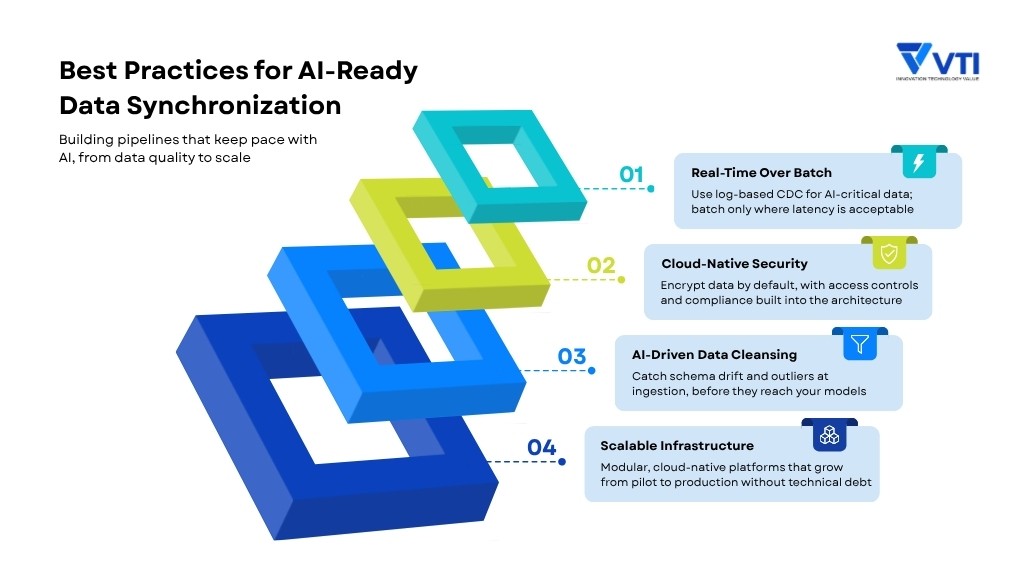
– Prioritize real-time over batch for AI-critical data. Use log-based Change Data Capture (CDC) for datasets that feed live inference, such as fraud detection or recommendations. Reserve batch processing for lower-priority workloads where some latency is acceptable.
– Implement cloud-native security by default. Encrypt data in transit and at rest, with role-based access controls mapped to data sensitivity. Build compliance requirements like Japan’s APPI or Singapore’s PDPA into the architecture itself, not as an afterthought.
– Leverage AI-driven data cleansing before data reaches your models. Automated anomaly detection can catch schema drift, duplicates, and outliers at ingestion. This stops flawed data from degrading model accuracy downstream.
– Choose infrastructure that scales without technical debt. Favor cloud-native platforms with modular pipelines and support for schema evolution without downtime. This lets your architecture grow from pilot to production as AI initiatives mature.
Final words
Cloud data synchronization has moved from a background IT function to a decision that shapes how fast your organization can act. It determines how quickly your teams see accurate information, how reliably your AI systems perform, and how well your business responds when conditions change.
For CXOs and technology leaders, the payoff is measurable: fewer silos, faster decisions, and greater confidence in the data behind every AI initiative. Building this foundation takes deliberate choices around governance, resilience, and infrastructure, but the return shows up in every system that depends on accurate, current data.
Ready to make your data AI-ready? Connect with VTI’s experts to design a synchronization strategy built for your systems, your regions, and your growth.
FAQ
What is cloud data synchronization in simple words?
It’s the process of keeping your data the same across every system you use, updated automatically as changes happen. Instead of checking multiple places for the right answer, everyone works from one current version.
How does cloud data synchronization work?
It works by detecting changes in one system and propagating them to connected systems, using methods like Change Data Capture, APIs, or event triggers. Conflicts are resolved through timestamp rules or predefined business logic.
Is real-time synchronization always better than batch synchronization?
Not always — real-time sync suits AI-critical data like fraud detection, while batch sync is more resource-efficient for lower-priority workloads like reporting. The right choice depends on how quickly your business needs the data to be current.
How long does it take to implement cloud data synchronization?
Timelines vary based on system complexity, but most enterprises move from pilot to production in a few weeks to a few months. Establishing governance and data contracts upfront typically shortens this timeline.