






![[FREE EBOOK] Strategic Vietnam IT Outsourcing: Optimizing Cost and Workforce Efficiency](https://vti.com.vn/wp-content/uploads/2026/06/ebook-it-outsourcing.png)


Multi-store expansion has become a widely adopted growth strategy among retail businesses looking to scale. However, as businesses expand to multiple locations, store operations become increasingly complex.
Shifts in consumer behavior and rising operational costs are putting increased pressure on traditional store management. Without standardized workflows and centralized oversight, expanding businesses often face localized inefficiencies, inconsistent service quality, and a lack of clear visibility across branches.
To map out a sustainable growth path, this overview outlines the core operational challenges associated with multi-store expansion. It explores practical approaches to stabilizing store operations through store DX and scalable IT infrastructure.
What is multi-store expansion?
Multi-location expansion definition
Multi-store expansion is a business model in which a company operates multiple locations under a unified brand and operational structure. Rather than relying on a single flagship store, businesses expand into targeted regions to increase customer access, strengthen local brand presence, and improve operational efficiency across locations. In Asia, this approach has traditionally been associated with “Dominant Area” strategies that concentrate store openings within specific regions to block competitors.
This approach is particularly common among convenience stores, restaurant chains, drugstores, and specialty retailers.
Benefits of multi-store expansion
Whether operating a retail network or a restaurant chain with multiple locations, scaling a business across targeted regions offers several operational advantages:
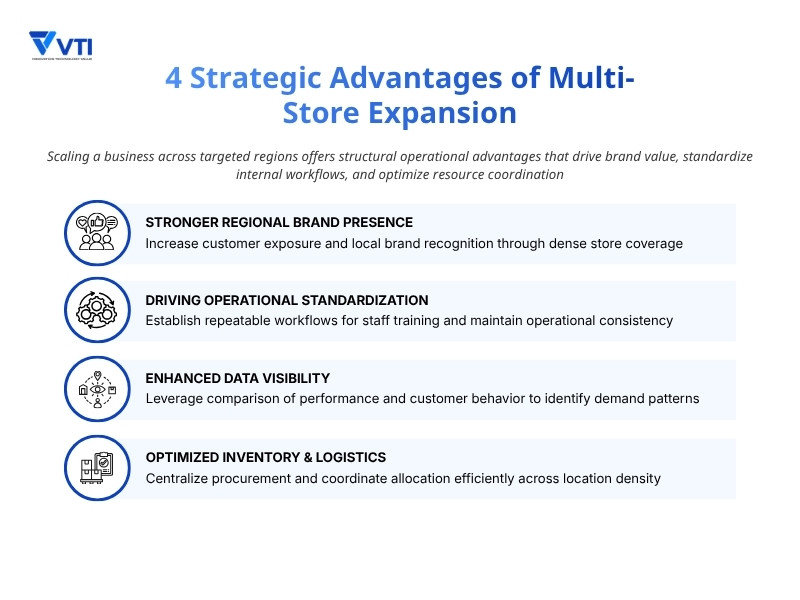
Stronger regional brand presence
Opening multiple stores within the same area increases customer exposure and strengthens local brand recognition. This approach is widely seen across convenience store and restaurant sectors, where dense store coverage helps brands become a seamless part of customers’ daily routines.
Driving operational standardization
Expansion often requires businesses to standardize workflows that were previously managed individually at each store. Establishing repeatable workflows for staff training and daily reporting helps maintain operational consistency and reduces heavy dependence on individual veteran managers.
Enhanced cross-store data visibility
Operating a multi-store network generates operational data across locations. Comparing sales performance, inventory turnover, and customer behavior between locations allows headquarters to identify regional demand patterns and operational friction points more objectively.
Optimized logistics and inventory coordination
Multi-store networks also make it easier to centralize procurement and coordinate inventory allocation across locations. Instead of managing stock separately at each branch, businesses can optimize replenishment and inventory transfers more efficiently, particularly in regions with high store density.
Disadvantages of multi-store expansion
Despite the benefits, expanding your footprint without the right management tools creates severe operational strains, often leading to the failure of multi-store expansion.
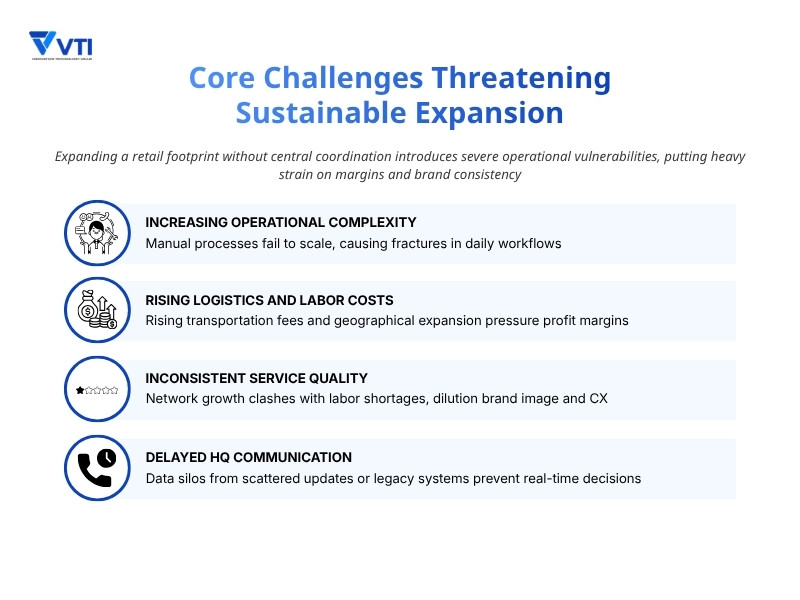
Increasing operational complexity
Processes that work seamlessly for a single store often fracture when scaled. As new stores are added, management overhead increases rapidly. Without structured systems, handling day-to-day tasks such as consolidated sales reporting, multi-site inventory control, and cross-store staff allocation becomes highly inefficient.
Rising logistics and labor costs
Escalating transportation fees and rising labor costs continue to put pressure on profit margins across the retail sector. As store networks expand geographically, businesses often face growing operational costs related to staffing, logistics, and inventory coordination, making efficient resource management increasingly important.
Inconsistent service quality
Maintaining unified operational standards becomes a constant struggle as the network grows. Recent data from Teikoku Databank reveals that approximately 70% of food and beverage businesses and over 50% of retailers report ongoing labor shortages. This labor gap often leads to rushed staff onboarding, fragmented workflows, and inconsistent customer experiences that risk diluting the brand image.
Communication delays between headquarters and stores
Multi-store operations depend on structured communication between headquarters and individual branches. When businesses rely on manual updates, scattered emails, or disconnected legacy systems, operational silos are inevitable. This data lag restricts operational visibility, delaying critical decision-making and limiting headquarters’ ability to respond efficiently to frontline disruptions.
Common system challenges in multi-location expansion
Managing a single storefront manually is heavily dependent on individual effort, but expanding across multiple locations requires a unified IT architecture. Without an integrated platform, fragmented system gaps can destabilize operations and trigger the failure of multi-store expansion through five critical technical bottlenecks:
Disconnected POS systems across stores
Many expanding retail businesses still operate legacy POS terminals that function as isolated silos. To compile company-wide reports, headquarters is forced to manually extract, export, and merge multiple spreadsheets every single night. This lack of centralized sales management creates an administrative bottleneck and increases the risk of human errors, leaving executives without real-time revenue trends.
Fragmented inventory management
As store networks grow, managing stock without a unified ledger leads to operational friction. Headquarters frequently suffers from inventory imbalances, where one branch carries excess deadstock while another faces constant stockouts, driving potential customers to competitors. Without automated data synchronization, efficient cross-store stock transfers are difficult to execute.
Siloed customer data across locations
When customer profiles are locked inside individual store databases or separated between offline POS systems and e-commerce platforms, customer visibility drops significantly. A VIP customer from your flagship store may not be recognized when visiting a newly opened branch. This fragmentation limits the effectiveness of unified loyalty programs and data-driven marketing campaigns.
Inconsistent operational workflows between stores
Without a centralized operating system, individual store managers naturally develop self-styled workflows based on local intuition. Reporting formats, inventory audits, and staff onboarding methods become fragmented. This lack of operational standardization increases retraining costs whenever employees are cross-assigned to cover shifts at different locations.
Security and governance risks across multiple locations
Every new location added to your network represents a new digital endpoint that must be secured. Allowing remote branches to deploy unmanaged local routers, share weak passwords, or use personal devices for sensitive payment data creates compliance liabilities. Without a centralized IT infrastructure, vulnerabilities across multiple locations increase significantly.
The core store DX infrastructure required for multi-store expansion
To overcome these challenges and establish an efficient multi-store management ecosystem, transitioning to a centralized store DX infrastructure is an essential step. An enterprise-grade multi-location network relies on four interconnected pillars:
Cloud POS systems
The core financial pipeline of your network must be cloud-based. Cloud POS platforms instantly consolidate transaction data from all locations into a unified corporate dashboard. This automates nightly data aggregation, minimizes manual errors, and allows headquarters to launch synchronized, company-wide pricing and promotional rollouts seamlessly.
Integrated inventory management systems
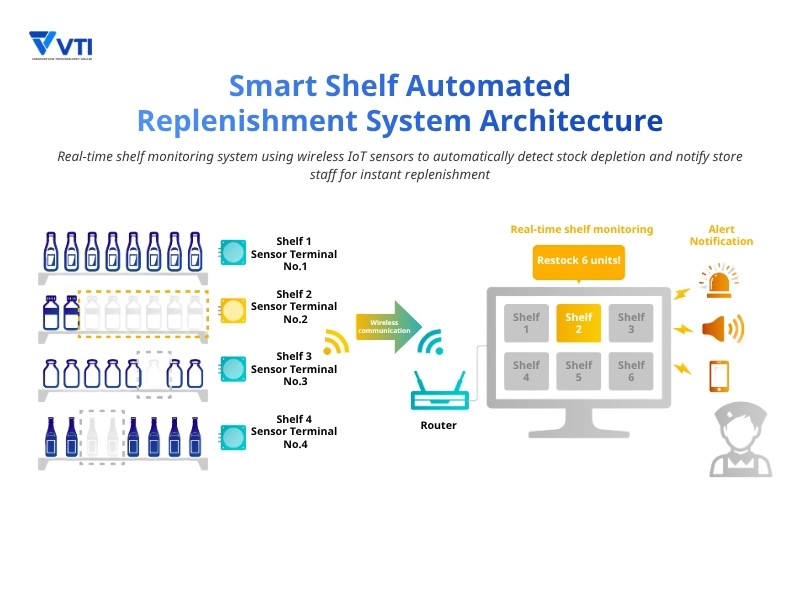
As your footprint scales, managing stock requires a single source of truth across all branches and central warehouses. Real-time inventory synchronization ensures headquarters can spot imbalances immediately, enabling agile cross-store stock transfers to protect sales and powering automated replenishment to optimize cash flow.
Unified CRM and customer management systems
To prevent valuable customer profiles from becoming fragmented across physical stores and online channels, an integrated CRM ecosystem is essential. Merging customer data ensures that purchase histories, reward points, and loyalty tiers remain seamless across all touchpoints. In the evolving OMO (Online-Merge-Offline) landscape, this integration is critical for executing personalized marketing and maximizing long-term customer retention.
AI-Powered retail analytics and smart store operations
To address ongoing workforce constraints, advanced retailers leverage practical retail AI to optimize brick-and-mortar operations. By integrating AI tools with in-store camera infrastructure, headquarters can analyze customer flow patterns and heatmaps to optimize staff allocation based on actual traffic. Furthermore, deploying smart surveillance systems directly mitigates inventory loss while reducing the administrative burden on on-site employees.
Key system design considerations for multi-location businesses
Before deploying any software to support your store expansion strategy, your IT architecture must be evaluated under a strict technical lens. A successful system designed for long-term multi-store management must prioritize these four core principles:
Cloud-native scalability
Many businesses initially adopt operational software tailored for a single location. However, as store networks expand, rigid on-premise setups cause severe performance degradation. Your architecture must be cloud-native from day one, ensuring that adding 10, 50, or 100 new stores and user accounts can be done flexibly without requiring costly code rewrites or platform migrations.
Integration-first architecture via open APIs
Disconnected systems quickly create operational bottlenecks. Your POS, inventory management, CRM, and accounting tools must share data seamlessly within the same ecosystem. Prioritizing platforms with robust, open APIs eliminates manual CSV exports, duplicated workflows, and fragmented operational visibility.
Intuitive UI/UX for front-line adoption
In retail environments facing ongoing labor shortages, on-site personnel rarely possess high-tech literacy. If a system is overly complex, it triggers high transactional errors and skyrockets training costs. The front-end interface must feature an intuitive design, allowing part-time or foreign staff to master daily operations within minutes without thick training manuals.
Centralized identity governance and endpoint security
Every new remote location added to the corporate network represents a fresh digital endpoint exposed to cyber threats. Security management must be built into the core infrastructure through centralized Mobile Device Management (MDM) and Single Sign-On (SSO). Enforcing strict, role-based access controls limits data visibility between part-time workers and headquarters, eliminating internal fraud and protecting sensitive payment data.
A step-by-step DX roadmap for expanding retailers
Transitioning a legacy retail network into an integrated, DX-driven ecosystem cannot be achieved overnight. To mitigate technical friction and avoid the operational missteps that commonly trigger the failure of multi-store expansion, corporate executives should approach infrastructure upgrades through a phased, calculated roadmap:
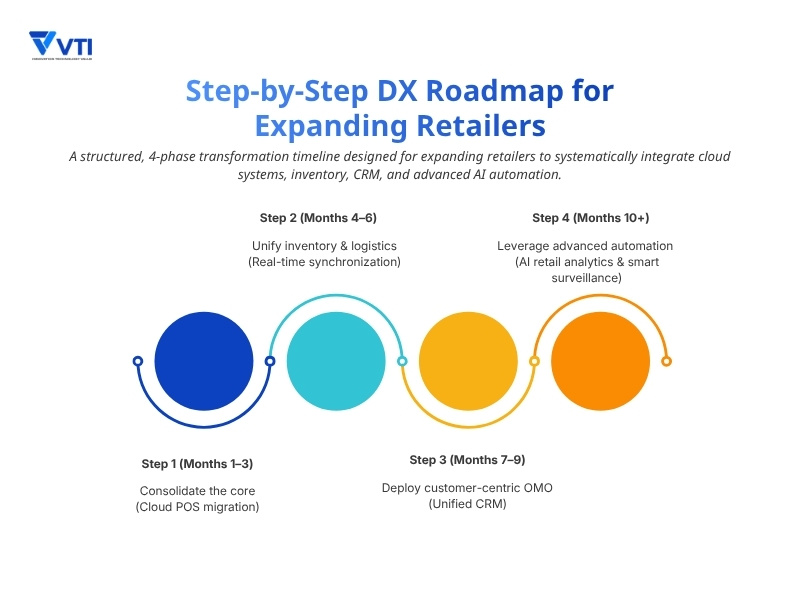
Phase 1: Consolidate the core (months 1–3)
Prioritize migrating disconnected, legacy POS terminals to a centralized cloud infrastructure. Establishing a single financial source of truth across all locations is an absolute prerequisite before launching any advanced analytics or expansion strategy.
Phase 2: Unify inventory and logistics (months 4–6)
Integrate distributed warehouse databases with real-time store ledgers. This eliminates localized stock imbalances, enables agile cross-store transfers, and lays the foundation for automated replenishment logic.
Phase 3: Deploy customer-centric OMO (months 7–9)
Merge offline storefront transactional profiles with online e-commerce data to build a unified CRM. This phase ensures data-driven marketing efforts and loyalty tiers remain seamless, regardless of which regional branch a VIP customer visits.
Phase 4: Leverage advanced automation (month 10+):
Once the data pipeline is stable, introduce smart store infrastructure. Deploying practical retail AI, customer flow heatmaps, and automated loss prevention systems allows headquarters to optimize labor allocation and directly mitigate inventory loss on the retail floor.
Case study: WORKMAN’s multi-store expansion strategy
With more than 1,000 stores across Japan, WORKMAN is widely recognized as one of the strongest examples of data-driven multi-store management.
Originally known as a workwear retailer, the company later expanded aggressively into the outdoor and sports apparel market through WORKMAN Plus. However, rapid scaling also exposed growing operational bottlenecks—challenges that, if left unaddressed, commonly drive the failure of multi-store expansion across traditional retail networks.
The challenge
As the store network expanded toward a scale of 1,000 locations, several system bottlenecks became critical:
– Dependency on intuition: Ordering and replenishment processes were heavily dependent on individual store managers’ experience rather than standardized metrics.
– SKU complexity: Extensive variations in product sizes and colors led to significant inventory imbalances. This fragmentation caused slow-moving accumulation at certain locations while generating frequent stockouts at others.
– Data lag: A lack of centralized system architecture meant headquarters had limited real-time visibility across stores, slowing down regional inventory adjustments.
The solution
WORKMAN shifted from experience-based store operations to a centralized, cloud-native architecture powered by automated data logic:
– AI-powered automated replenishment: By combining historical transaction data, inventory turnover rates, and meteorological (weather) forecasts, the system automatically calculates optimal inventory levels for each store.
– Frontline-focused system design: Instead of forcing complex analytics platforms onto store workers, WORKMAN routed the backend data into intuitive, automated Excel-based dashboards. Store employees could execute optimized orders with a single click without advanced technical training.
The result
| Metric | Pre-DX | Post-DX |
| Ordering operations | Heavy reliance on manager intuition | AI-powered automated replenishment |
| Inventory conditions | Frequent stock shortages & deadstock | Imbalances eliminated; minimized holding costs |
| Headquarters visibility | Delayed operational monitoring | Real-time visibility across 1,000+ stores |
| Store operations | Heavy manual administrative workloads | Staff focus shifted 100% toward visual merchandising & CX |
Conclusion
Managing a small number of stores through manual workflows is often sustainable. However, as multi-store expansion accelerates, maintaining operational consistency, inventory accuracy, and cross-store coordination requires a structural shift. Relying on disconnected legacy systems only increases administrative overhead and limits a business’s ability to respond to changing market demands.
To support long-term, sustainable growth, establishing a scalable IT infrastructure and centralized store DX is the foundation of modern retail operations. At VTI, we specialize in building scalable IT infrastructure, seamless system integrations, and tailored retail solutions that transform distributed operational challenges into a structured, highly profitable ecosystem.