





![[FREE EBOOK] Strategic Vietnam IT Outsourcing: Optimizing Cost and Workforce Efficiency](https://vti.com.vn/wp-content/uploads/2026/06/ebook-it-outsourcing.png)



Even when a store has high foot traffic, it does not always lead to higher conversion rates. In many cases, the underlying issue lies in how customers move within the store. Without understanding where customers go, where they stop, and which areas they skip, store improvements tend to rely on intuition. Flow analysis provides a way to visualize these behaviors and turn them into actionable improvements.
In this article, we explain the fundamentals of flow analysis, clarify the difference between actual and designed flow, and introduce practical approaches to improving store layout and visual merchandising (VMD).
What is flow analysis?
Flow analysis refers to the process of understanding how people move within a physical space and how those movements relate to outcomes such as engagement, efficiency, and purchasing behavior.
In retail, flow analysis focuses on tracking how customers navigate the store, where they stop, which areas they skip, and how their movement patterns influence conversion rates. Rather than relying on assumptions or intuition, flow analysis provides a data-driven way to evaluate whether the store layout and product placement strategies are actually working as intended.
In addition to customer behavior, flow analysis can also include staff movement, helping to identify inefficiencies in daily operations.
What flow analysis reveals in stores
Flow analysis provides a way to understand how customer movement relates to store performance. While overall traffic is often used as a basic indicator, it does not explain how customers interact with the store environment or why certain areas perform differently.
By examining movement patterns in more detail, flow analysis makes it possible to identify structural issues that are not visible through sales data alone.
Traffic distribution
One of the fundamental insights is how customer traffic is distributed across the store. In practice, movement is rarely even. Certain areas tend to attract a high concentration of customers, while others are consistently overlooked.
This imbalance can affect product visibility and sales opportunities. Even well-placed products may underperform if they are located in areas with low foot traffic.
Dwell time
Flow analysis also provides visibility into dwell time, indicating how long customers stay in specific areas. This metric is often used to assess engagement, but it does not always reflect positive interaction.
In some cases, longer dwell time may indicate hesitation, confusion, or difficulty in navigating the space. For this reason, dwell time should be evaluated alongside other indicators rather than interpreted in isolation.
Stop rate and customer engagement
The stop rate shows where customers pause during their movement. These points often suggest areas of interest or interaction with products.
However, a high stop rate does not necessarily lead to purchasing behavior or improved conversion rates. By comparing stop patterns with actual outcomes, it becomes possible to identify gaps between engagement and purchase.
Blind spots and visibility
Flow analysis can also reveal areas that receive little or no customer attention. These blind spots are difficult to detect without visualizing movement patterns, such as through heatmaps.
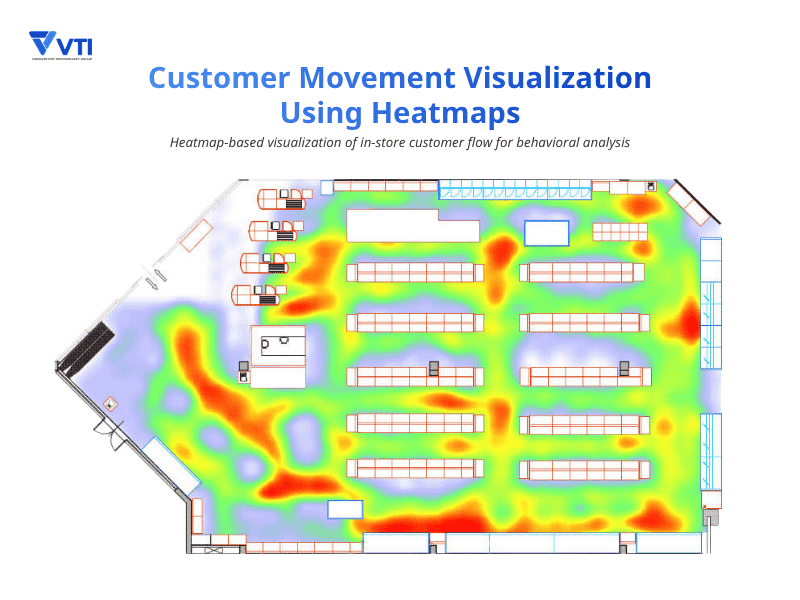
Even when products are placed strategically, they may not perform as expected if customers do not pass through those areas.
Bottlenecks in movement
Another important aspect is the identification of bottlenecks, where customer movement becomes constrained or uneven. These points can reduce accessibility and affect how customers navigate the store, particularly during peak hours.
Such constraints may also influence staff movement, potentially creating inefficiencies in daily operations.
Why flow analysis is essential for store operations today
Labor shortage and operational optimization
Labor shortage continues to affect retail operations. According to Japan’s Ministry of Economy, Trade and Industry (METI), labor constraints in the service sector are expected to intensify, making it increasingly difficult to rely on additional staffing to improve performance.
As a result, attention has shifted toward how existing resources are used. Many daily operations, like restocking, customer support, and movement within the store, are directly influenced by both customer flow and staff movement.
When these movement patterns are not visible, inefficiencies tend to remain unnoticed, even when performance issues are observed at a higher level.
Changing consumer behavior
At the same time, customer behavior has become less predictable. With the expansion of e-commerce, customers often enter stores with specific intentions rather than browsing freely.
This affects how they move within the space. They may go directly to certain areas, avoid congestion, or leave if navigation is not intuitive. As a result, store layouts that were effective in the past do not always produce the same outcomes today.
Turning customer behavior into actionable insights
Metrics such as traffic or dwell time show what is happening in the store, but they do not explain how those outcomes are formed.
Flow analysis links movement patterns with actual results, making it possible to understand how customer behavior influences store performance. This allows improvements to be based on observable patterns rather than isolated metrics.
The gap between designed flow and actual behavior
In store operations, there is often a gap between the designed flow and actual customer movement. While layouts and VMD are planned to guide customers through specific paths, actual behavior does not always follow these assumptions.
Customers may take the shortest route, skip certain areas, or concentrate in specific zones depending on their intent and the store environment. As a result, even well-designed store layouts may not function as expected in practice.
This mismatch can directly affect performance. For example, products placed in key locations may not receive sufficient exposure if customers do not pass through those areas. Similarly, high-traffic zones do not always lead to higher conversion rates.
Flow analysis makes it possible to identify this gap by comparing intended paths with actual movement patterns, for example, through heatmaps. By understanding where these differences occur, retailers can make more targeted adjustments to layout, product placement, and operations.
How flow analysis works
To address the challenges of flow analysis, it is important to consider not only what is analyzed but also how the data is collected and used. In practice, flow analysis can be approached in different ways, each with its own strengths and limitations.
Observation-based analysis
One of the most common approaches is on-site observation. This involves manually tracking how customers move within the store, identifying where they stop, and noting how they interact with products.
This method can provide useful qualitative insights, such as hesitation, confusion, or how customers physically engage with displays. It is often used in small-scale analysis or for initial assessments.
Data-driven analysis
An alternative approach is to use digital tools to capture and analyze movement data. Technologies such as AI cameras and in-store sensors can track customer flow continuously and at scale.
This makes it possible to measure metrics such as traffic, dwell time, and stop rate across different time periods and conditions.
Unlike manual observation, data-driven analysis allows for consistent and repeatable measurement. It also enables the visualization of movement patterns, for example, through heatmaps, making it easier to identify trends and anomalies.
From snapshot to continuous optimization
A key difference between these approaches is whether the analysis is conducted as a one-time activity or as part of an ongoing process.
While observation provides a limited view, continuous data collection makes it possible to track changes over time, compare performance across different periods, and evaluate the impact of specific improvements.
This shift from snapshot-based analysis to continuous optimization is essential for making flow analysis actionable in real-world store operations.
The technology behind modern flow analysis
Modern flow analysis relies on a combination of technologies to capture, process, and interpret movement data within the store. These technologies make it possible to move from observation to structured, scalable analysis.
AI and computer vision for movement detection
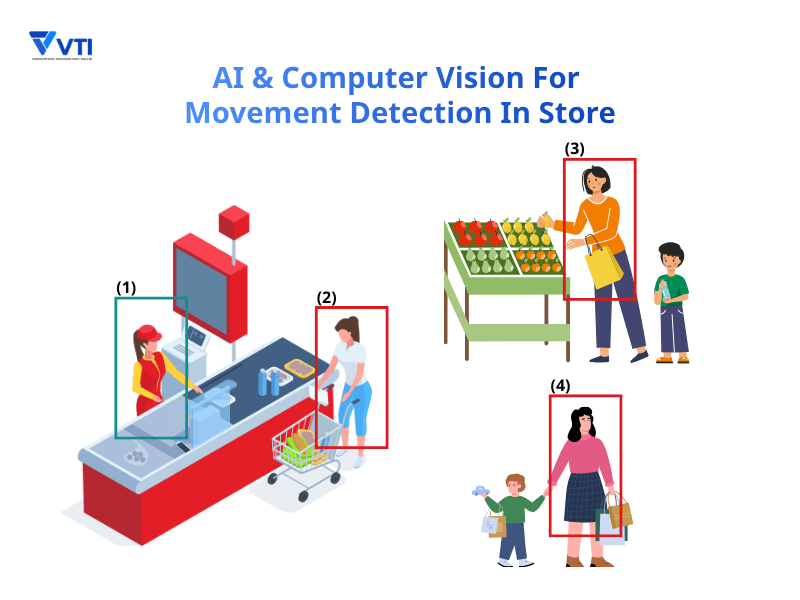
At the core of flow analysis is computer vision, supported by AI cameras. Rather than simply tracking movement, these systems interpret what is happening in the store. For example, they can distinguish between customers, staff, and other objects such as shopping carts or displays. This makes it possible to reduce noise in the data and focus only on relevant behavior.
As a result, movement data becomes more reliable and better suited for analysis, especially in busy or complex store environments.
Edge computing for data processing
To handle large volumes of visual data, processing is often performed at the edge, close to where the data is generated. Instead of transmitting all raw data to the cloud, cameras or local devices analyze key information on-site. This allows for faster processing and reduces the amount of data that needs to be transferred.
AI for behavior analysis
While computer vision captures movement, AI equipped within the store system is used to analyze patterns within that movement.
By examining how behavior changes over time, it becomes possible to identify trends such as where customers tend to stop, how congestion forms, or how movement differs depending on store conditions. These patterns are often visualized through tools like heatmaps, which provide a spatial view of customer activity across the store and help highlight high-traffic areas or zones that receive little attention.
Data integration and digital twin of the store
Movement data becomes more meaningful when it is combined with other sources of information. In many cases, this includes not only POS data but also inputs from in-store sensors, such as temperature, lighting, or occupancy levels. By integrating these data points, it becomes possible to understand how customer flow interacts with the store environment.
This integrated view is often described as a digital twin of the store, where movement, purchasing behavior, and environmental conditions can be analyzed together. This provides a more complete picture of how the store functions in practice.
How to improve store performance using flow analysis
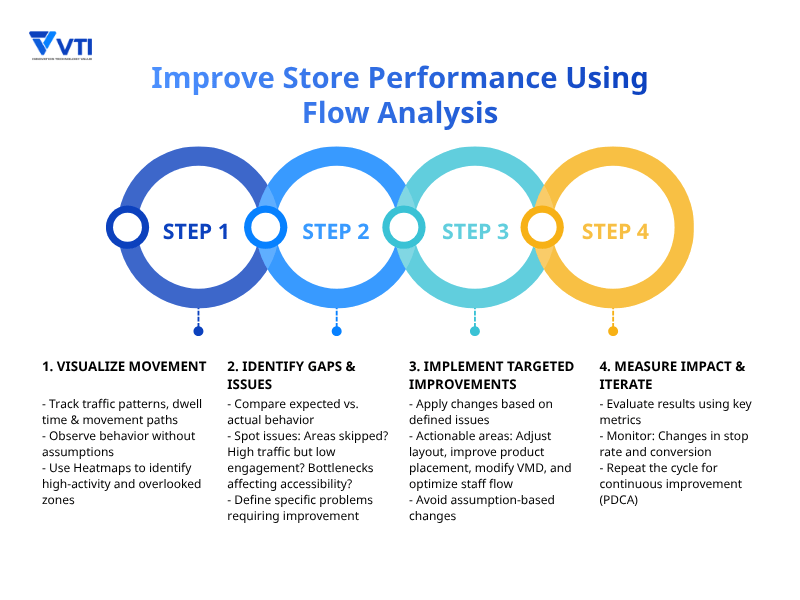
Step 1: Visualize current movement
The first step is to understand how customers actually move within the store. This can be done by analyzing traffic patterns, dwell time, and movement paths.
At this stage, the objective is not to evaluate performance, but to observe behavior without assumptions. Popular visualization tools like heatmaps can help identify areas with high activity, as well as zones that receive little attention.
Step 2: Identify gaps and issues
Once movement patterns are visible, the next step is to identify gaps between expected and actual behavior. For example:
– Are customers skipping key product areas?
– Are certain zones receiving traffic but not leading to engagement?
– Are there bottlenecks affecting accessibility?
By comparing these patterns with store objectives, it becomes possible to define specific issues that require improvement.
Step 3: Implement targeted improvements
Based on the identified issues, targeted changes can be applied to the store environment. These may include:
– Adjusting store layout
– Improving product placement
– Modifying visual merchandising (VMD)
– Optimizing staff movement
The focus should be on addressing clearly defined problems rather than making broad or assumption-based changes.
Step 4: Measure impact and iterate
After implementing changes, it is important to evaluate their impact using the same metrics. For example:
– Has dwell time changed?
– Have stop rates improved?
– Has conversion behavior been affected?
If results do not change as expected, the initial assumptions should be reviewed and adjusted.
By repeating this cycle, flow analysis can support continuous improvement rather than one-time optimization.
Conclusion
As retail environments become more complex, understanding customer movement alone is no longer sufficient. The key is how those insights are applied to improve store performance in a consistent and practical way.
While many retailers already have access to data such as traffic and dwell time, these are often not fully connected to operational decisions. Flow analysis helps bridge this gap by linking movement patterns with actual outcomes.
Applying this approach effectively requires more than one-time analysis. It depends on how data is collected, integrated, and used as part of ongoing store operations.
VTI supports retail businesses in utilizing movement data in a practical way. Our retail solutions focus on connecting insights to real improvements in store layout and operations.
If you are reviewing how customer behavior is analyzed in your store, it may be useful to start by reassessing how flow analysis is currently applied.