





![[FREE EBOOK] Strategic Vietnam IT Outsourcing: Optimizing Cost and Workforce Efficiency](https://vti.com.vn/wp-content/uploads/2026/06/ebook-it-outsourcing.png)


AI in SDLC is becoming a strategic focus for enterprises looking to improve software delivery speed and engineering efficiency. Research by McKinsey shows that generative AI tools can accelerate software development tasks such as code generation and refactoring by 20% to 45% for experienced engineers. Yet many organizations are discovering that faster coding does not automatically translate into faster software delivery.
Requirements analysis, UI/UX iterations, regression testing, and release coordination continue to create bottlenecks across the software development life cycle (SDLC). Improving engineering throughput requires more than optimizing isolated tasks. It requires integrating context-aware automation across the entire development lifecycle.
In this article, we explore how enterprises are integrating AI in SDLC, the business impact behind AI-powered software development, and the practical considerations for building scalable AI-native engineering workflows.
What is AI in SDLC?
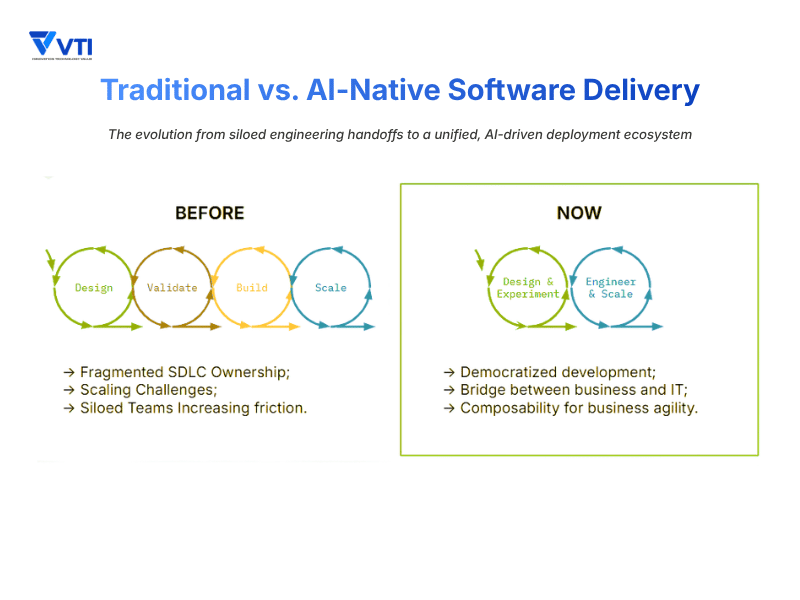
In traditional software engineering, the biggest delays rarely come from writing code itself. They usually happen during handoffs between teams, when requirements move from product teams to designers, from designers to developers, and from developers to QA and operations.
To reduce these gaps, modern enterprise software delivery is shifting toward an AI-driven SDLC. This approach uses artificial intelligence and machine learning to connect different stages of the development lifecycle, helping teams automate repetitive work, improve collaboration, and speed up software delivery. Instead of using AI as a standalone tool, organizations are gradually building more connected and intelligent engineering workflows.
The evolution of AI in SDLC
Stage 1: AI-assisted development
The first wave of AI adoption focused mainly on individual productivity. Developers used standalone tools to autocomplete code, generate boilerplate functions, or summarize documentation.
While tools like early GitHub Copilot helped speed up specific tasks, the broader software delivery process remained largely unchanged. Requirements, testing, and release workflows still depended heavily on manual coordination between teams.
Stage 2: AI-driven software development life cycle
Organizations are now moving toward more integrated AI-driven workflows, where AI supports the entire software delivery pipeline instead of isolated tasks. Requirements, design assets, source code, and testing workflows remain connected through context-aware systems.
By linking tools such as Jira, Figma, and code repositories, teams can reduce repetitive handoffs, improve collaboration, and accelerate enterprise software delivery.
Stage 3: AI-native engineering workflows
The next stage of evolution is AI-native software delivery. Instead of manually interacting with separate AI tools, engineering teams are starting to coordinate multiple AI systems across planning, development, testing, and operations.
This is driving the rise of autonomous and agentic workflows, where AI handles more routine operational tasks while engineers focus on architecture decisions, strategy, and complex problem-solving.
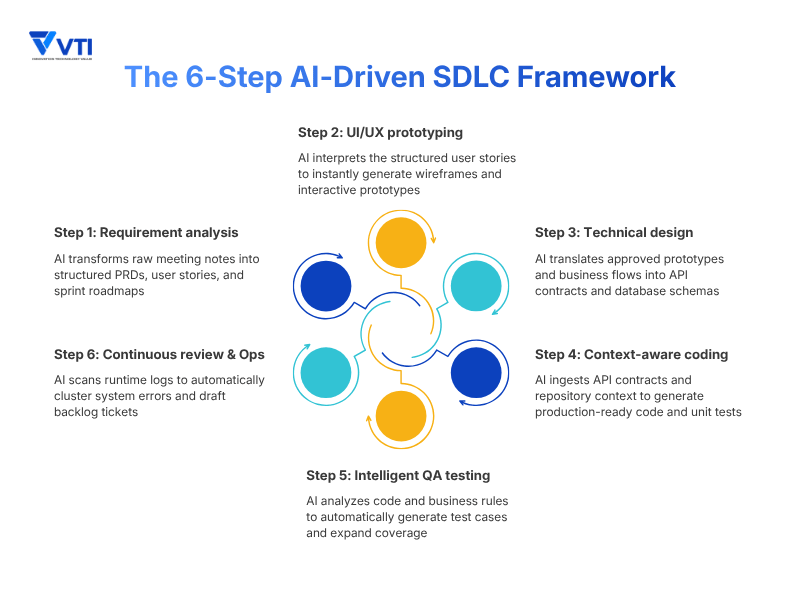
The 6-step AI-powered SDLC framework
To implement an AI in SDLC effectively, organizations need connected workflows where the output of one stage can automatically support the next.
Step 1: Automated requirement analysis and PRD generation
Traditional requirement gathering is often slow and fragmented. AI-assisted software engineering helps streamline this phase by using large language models such as Claude or GPT-4 to analyze customer briefs, meeting notes, and other unstructured inputs.
– Product requirement documents (PRDs)
– Feature lists & user stories
– Sprint roadmaps
– Business flow diagrams
By organizing business logic early, teams can improve alignment between product, design, and engineering while reducing manual documentation work.
Step 2: AI-assisted UI/UX prototyping and wireframing
Once requirements are structured, AI can speed up the design process by interpreting feature lists and user flows. Design teams use generative AI tools to quickly create wireframes, visual mockups, and interactive prototypes.
This helps shorten design iteration cycles and maintain better consistency between business requirements and user experience design.
Step 3: Technical design specifications and API contract mapping
After the design phase, AI systems can translate approved business flows into technical implementation assets. This helps bridge the gap between product design and engineering execution by automatically generating:
– API contracts and payload structures
– Database schemas and field validation rules
– Component specifications for frontend and backend teams
Step 4: Context-aware code generation
Code generation is one of the most visible applications of AI in software development lifecycle automation. Modern coding environments such as Cursor and advanced IDE copilots can understand broader repository context, including design specifications, API structures, and architectural standards.
This helps teams generate implementation-ready code that aligns more closely with existing system patterns instead of isolated code snippets.
Developers also use these tools to refactor legacy systems, create unit tests, and accelerate debugging workflows. The result is not simply faster coding, but less time spent on repetitive implementation work across large codebases.
Step 5: Intelligent QA testing and automated scenario generation
Testing traditionally requires significant manual effort. AI-powered QA platforms such as Testim and agentic testing systems can analyze business rules and source code to:
– Automatically generate test cases
– Improve regression testing coverage
– Predict high-risk failure areas
– Detect edge cases earlier
– Automate repetitive QA workflows
This allows QA teams to focus more on system reliability and complex validation scenarios instead of repetitive manual testing.
Step 6: Continuous code review and automated bug triage
Once software is deployed, AI continues supporting engineering operations. Teams can integrate automated review systems into pull requests (PRs) to detect coding standard violations before code is merged.
In production environments, platforms such as Datadog can analyze runtime logs, cluster recurring system errors, and automatically generate backlog tickets. This helps engineering and SRE teams move from reactive troubleshooting toward more proactive operational management.
Key benefits and business impact of an AI-driven SDLC
The business impact of AI in SDLC is becoming easier to measure. Beyond faster code generation, organizations are using AI to reduce workflow bottlenecks, improve software quality, and lower operational overhead across the software delivery lifecycle.
Accelerating time-to-market
A significant amount of delivery time is still lost in manual coordination and repetitive documentation work. AI-assisted SDLC workflows help reduce much of this operational friction.
Internal data from VTI’s Gen AI Center of Excellence (CoE) frameworks shows measurable improvements:
– Proposal & estimation preparation: Reduced from 3 days to 1 day.
– Project documentation & summarization: Shortened from 1 day to 2 hours.
– Legacy cCode investigation: Cut from 4 hours to 1 hour.
Engineering efficiency & rapid prototyping
The productivity impact of AI becomes even more visible during implementation and prototyping workflows. While industry research shows developers can complete coding task up to 55% faster with AI assistants, larger gains happen when AI connects multiple stages of the delivery process.
For instance, AI-assisted MVP delivery workflows can generate 30 to 50 production-ready screens within a single week for mid-sized applications. Furthermore, automated compliance checking leads to a 60% reduction in manual code review effort for senior engineers, freeing them to focus on core software architecture and optimization.
Reducing technical debt and improving software quality
Traditional QA workflows often happen too late in the release cycle, making bugs slower and more expensive to fix.
AI-powered SDLC workflows support a more shift-left approach by introducing validation earlier in development. By automatically generating regression test cases and identifying edge-case scenarios sooner, teams can improve testing coverage much earlier in the cycle.
Many organizations now achieve over 80% automated test coverage early in the cycle, helping reduce technical debt while improving release stability and long-term maintainability.
Lower operational overhead through AIOps
In traditional environments, operations teams often respond only after incidents affect production systems.
Modern AIOps platforms continuously analyze runtime logs, deployment telemetry, and infrastructure behavior to detect anomalies earlier and automate incident triage workflows.
Organizations implementing AI-assisted monitoring systems report up to a 50% reduction in Mean Time to Resolution (MTTR), cutting system downtime and manual support effort.
Governance, security, and global data compliance
As AI becomes more deeply integrated into the software development lifecycle, organizations also face new challenges around security, compliance, and operational governance.
For enterprise teams, the question is no longer whether AI can improve productivity, but how to adopt it safely and consistently at scale without introducing new business risks.
Intellectual property and source code protection
Exposing proprietary source code and internal business logic to public AI models can create serious security and compliance risks.
To reduce this exposure, many enterprises are moving toward private AI environments and enterprise-grade platforms with strict Zero Data Retention (ZDR) policies. In high-security environments, AI systems are often deployed inside isolated cloud infrastructures to ensure prompts, source code, and engineering context remain fully contained within corporate boundaries.
Maintaining engineering standards and code quality
AI-generated code can accelerate development, but faster output does not automatically guarantee maintainability or software quality.
Without proper governance, organizations can accumulate inconsistent coding standards, duplicate logic, and security vulnerabilities over time.
Mature engineering teams address this by integrating automated review pipelines and compliance checks directly into the SDLC. This ensures senior engineers remain the final human-in-the-loop validator for architecture decisions rather than routine syntax checking
Alignment with global data compliance standards
As AI adoption expands globally, software delivery pipelines must also comply with privacy regulations such as GDPR, CCPA, and PDPA.
Many organizations now introduce automated governance layers that mask Personally Identifiable Information (PII) and sensitive business data before it is processed by external AI systems. This helps maintain compliance without slowing down engineering workflows.
Financial governance and token management
As AI toolchains scale across engineering teams, operational costs can quickly become difficult to control.
Multiple copilots, API-based AI services, and overlapping subscriptions often lead to uncontrolled token usage and fragmented workflows.
To manage this, enterprises establish centralized governance models and generative AI centers to standardize tooling, monitor usage, and optimize infrastructure costs across teams.
AI capability maturity model for engineering organizations
Moving to an AI-driven SDLC is not an overnight transition. Most organizations adopt AI gradually, starting with isolated productivity tools before evolving toward more integrated and autonomous engineering workflows.
To measure this progression, many enterprises now evaluate AI maturity not by how many developers use AI tools, but by how deeply AI is integrated across the software delivery pipeline.
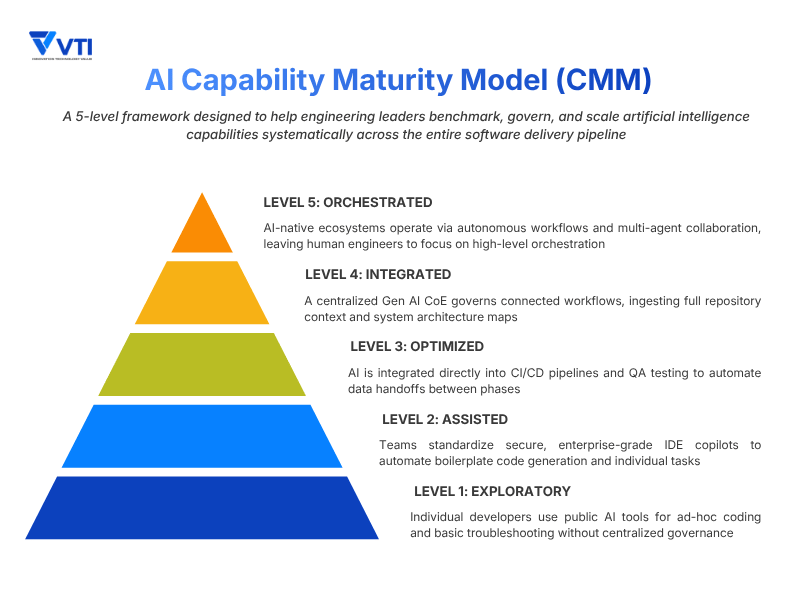
Level 1: Exploratory
At this stage, AI adoption is still fragmented and driven mostly by individual experimentation.
Developers use public AI tools or standalone assistants to generate code snippets, summarize documentation, or troubleshoot simple issues. While productivity gains exist, there are usually no shared governance standards, security guardrails, or connected workflows across teams.
Level 2: Assisted
Organizations begin standardizing AI adoption through approved enterprise tools and IDE integrations.
Engineering teams consistently use AI assistants for boilerplate generation, refactoring, documentation, and unit test creation. However, AI usage is still focused mainly on isolated development tasks rather than the broader SDLC.
Level 3: Optimized
At this stage, organizations begin connecting multiple phases of the software delivery lifecycle.
AI-assisted workflows become integrated into CI/CD pipelines, testing systems, compliance checks, and release validation processes. Outputs generated during one phase can automatically support downstream workflows, helping teams reduce repetitive manual handoffs.
Level 4: Integrated
AI evolves from a collection of productivity tools into a centralized operational framework.
Organizations establish AI governance models and generative AI centers to standardize tooling, security policies, compliance workflows, and engineering practices across departments.
At this stage, AI systems can work with broader project context, including architecture diagrams, business requirements, testing data, and operational telemetry, to support more connected software delivery pipelines.
Level 5: Orchestrated
At the highest maturity level, organizations begin operating AI-native engineering environments.
AI systems support continuous development, deployment, monitoring, incident analysis, and operational optimization through increasingly autonomous workflows. Engineering teams spend less time on repetitive implementation work and focus more on architecture strategy, governance, and system orchestration.
Organizational readiness and scaling AI adoption
Reaching higher maturity levels requires more than simply purchasing AI tools. Organizations also need standardized governance, workflow redesign, internal enablement programs, and measurable operational benchmarks.
Instead of measuring success only through lines of code written, mature engineering organizations increasingly track:
– Delivery cycle reduction
– Automated test coverage
– Incident resolution time (MTTR)
– Manual review effort saved
– Workflow automation coverage
This is why many enterprises are establishing centralized AI governance programs and CoEs to ensure tooling, security policies, compliance standards, and operational maturity evolve consistently across the organization.
Conclusion
The transition toward an AI-driven SDLC is already moving into its next phase: Agentic AI. Instead of relying on isolated tools and manual prompting, engineering organizations are beginning to adopt AI systems that can understand context, coordinate across workflows, and continuously support planning, development, testing, and operations.
As this shift accelerates, integrating AI in SDLC is becoming a competitive requirement for modern enterprises. But scaling AI successfully requires more than deploying new tools. Organizations need structured governance, standardized workflows, and a clear maturity roadmap to adopt AI safely at scale.
At VTI, we help enterprises accelerate innovation with AI through comprehensive AI consulting services and robust DevOps solutions. By providing structured governance frameworks and AI-powered global engineering teams, we help organizations accelerate software delivery while maintaining security, quality, and operational control.