






![[FREE EBOOK] Strategic Vietnam IT Outsourcing: Optimizing Cost and Workforce Efficiency](https://vti.com.vn/wp-content/uploads/2026/06/ebook-it-outsourcing.png)


Enterprise data is expanding faster than most organizations can govern its meaning – new sources, new pipelines, new teams defining the same metric in different ways. Without a system to track what each dataset means, who owns it, and how current it is, that growth doesn’t turn into insight. It turns into confusion: conflicting numbers, no way to tell which version is current, no way to trust what you’re looking at. When context is missing, compliance audits take weeks, teams duplicate existing work, and high-stakes AI initiatives stall on unvetted training inputs.
Metadata management solves this context problem by transforming raw, fragmented data into searchable, trustworthy business assets. This guide outlines how it functions, its strategic enterprise benefits, and a step-by-step approach to implementing a scalable framework.
What is metadata management?
Metadata management is the ongoing enterprise discipline of collecting, organizing, governing, and enriching metadata. It provides the essential context describing an organization’s data assets so teams can find, understand, trust, and consume data without relying on tribal knowledge.
At its simplest, if a dataset called “customer_orders” represents the underlying data, its metadata encompasses all the information that explains it. This includes who created the dataset, when it was last refreshed, what each column means, its source lineage, and access permissions. Metadata management acts as the operational framework that keeps this context accurate, automated, and universally accessible across the enterprise stack.
Why metadata management matters for enterprises
Metadata management earns its place in the modern enterprise data stack by solving four recurring business challenges.
Data discovery and trust
Systematically managed metadata helps analysts discover and evaluate data assets — recording owner, source, lineage, validation date, and quality status, with business glossaries enabling search by concept rather than technical names. Without it, analysts waste hours hunting for the right dataset, re-verifying its accuracy, or asking around because nobody documented who owns it or when it was last refreshed. Metadata doesn’t guarantee the data is good — that still requires quality controls — but it removes the guesswork of finding and evaluating what’s available.
Regulatory compliance and audits
Global privacy frameworks such as GDPR, HIPAA, and the EU AI Act mandate that organizations know exactly what data they hold, where it resides, and how it flows across systems. Metadata serves as the audit trail that makes compliance verification fast and repeatable. Instead of spending weeks manually reconstructing data flows during an audit, compliant organizations rely on automated metadata tracking to instantly map sensitive data locations, access histories, and retention schedules.
AI and machine learning readiness
Artificial intelligence models are only as reliable as the training data feeding them. According to RAND, poor data quality and lack of context are among the leading causes behind the high failure rate of enterprise AI projects. Clear metadata provides essential visibility into data lineage, freshness, and quality scores. This enables data science teams to verify whether a dataset is fit for a specific AI model before deployment, preventing flawed outputs and costly retraining cycles.
Less duplicated work and infrastructure costs
Without a centralized metadata catalog, teams frequently recreate datasets and data pipelines that already exist simply because they cannot locate the originals. This uncoordinated development creates technical debt, multiplies cloud storage costs, and leads to conflicting metrics across business units. Consistent metadata management creates a single source of truth, eliminating redundant engineering work and reducing unnecessary cloud infrastructure expenditure.
Types of metadata
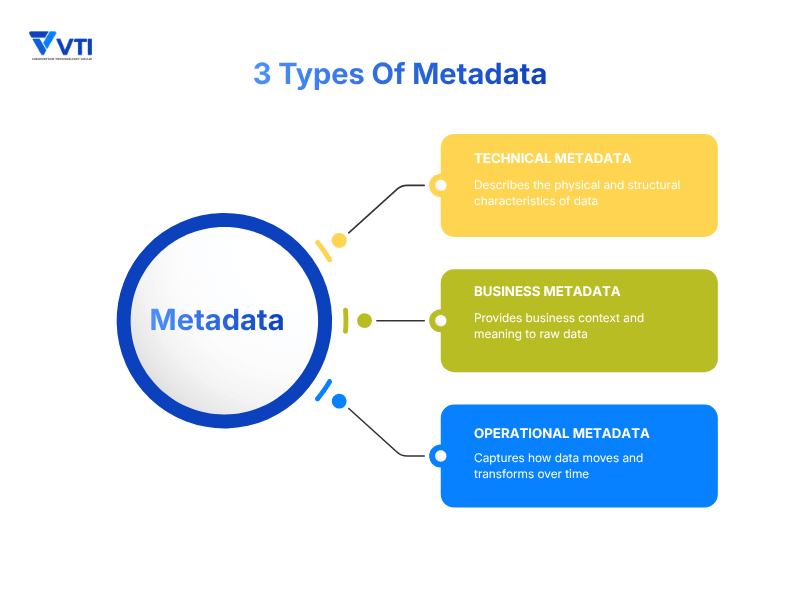
In modern enterprise data architecture and governance, metadata is categorized into three core functional pillars. For data engineers and data stewards, understanding these distinctions is the essential first step in designing a scalable framework that delivers long-term business value.
Technical metadata
Technical metadata describes the physical and structural characteristics of data assets. This includes database schemas, data types, table and column names, storage locations, indexes, and primary key relationships. Because this information resides directly within source databases, data warehouses, and data lakes, technical metadata is typically the easiest to capture through automated ingestion pipelines.
Business metadata
Business metadata provides the human context that gives raw data meaning. It encompasses business glossary terms, data classifications, governance policies, ownership assignments, and mapping rules connecting data to specific business processes. This contextual layer turns obscure technical column names like “cust_flg_03” into clearly defined, trustworthy business concepts that non-technical stakeholders can easily search for and understand.
Operational metadata
Operational metadata captures how data behaves, moves, and transforms across systems over time. It records job execution logs, refresh frequency, row counts, execution runtimes, error logs, and user access histories. Operational metadata is critical for data engineers who need to monitor system health, diagnose pipeline bottlenecks, and ensure data freshness before downstream reports are generated.
Active metadata vs. Passive metadata
Beyond these three structural types, modern enterprise architecture distinguishes between passive and active metadata.
Passive metadata sits in a centralized repository, serving as a static catalog that users must look up manually. In contrast, active metadata management creates a dynamic, continuous operational loop. It continuously analyzes technical, business, and operational metadata in real time, using those insights to automate governance actions across the enterprise data stack.
| Feature | Passive metadata | Active metadata |
| Primary focus | Static documentation and manual lookup | Real-time automation and continuous integration |
| Operational mechanism | Sits in a catalog waiting for user queries | Analyzes operational logs to trigger automated actions |
| Data health impact | Identifies errors after reports are generated | Pauses pipelines automatically when data fails |
| Enterprise value | Serves as a reference guide for analysts | Acts as an active control plane for AI and data stack |
How metadata management works: Core components & process
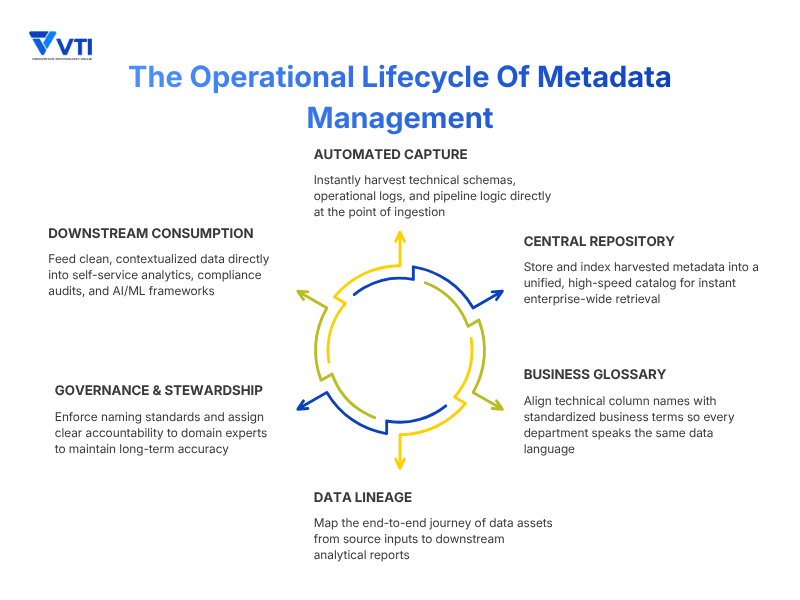
At its core, metadata management operates as a continuous operational loop rather than a one-time configuration project. Six essential building blocks work in tandem to capture, structure, and activate context across the enterprise data stack.
Automated metadata capture
The management lifecycle begins by collecting metadata directly at the point of data creation, ingestion, or transformation. Because manual documentation cannot keep pace with modern data volumes, enterprise systems rely heavily on automated connectors to harvest technical schemas, operational logs, and pipeline logic in real time.
Metadata catalog and central repository
Once harvested, metadata requires a unified home. A metadata catalog provides a searchable business index for all enterprise data assets, while the underlying repository indexes and stores structural details for high-speed retrieval across querying tools.
Business glossary
Operating alongside the catalog, a centralized business glossary aligns technical column names with standardized business terminology. This shared vocabulary ensures a core metric like churn_rate carries the exact same operational definition across finance, marketing, and executive dashboards.
Data lineage
Data lineage maps the complete journey of data assets as they flow and transform across systems, from initial source inputs to downstream analytical reports. Lineage is critical for root cause analysis, enabling engineers to trace corrupted report numbers back to faulty ingestion jobs in minutes.
Governance and stewardship
Policies, naming standards, and assigned data stewards ensure metadata maintains high accuracy over time. Stewardship assigns clear accountability to domain experts, preventing metadata quality from degrading as pipelines evolve and schemas change.
Downstream consumption and usage
The value of metadata management culminates in daily business usage. Clean metadata feeds directly into self-service analytics platforms, automated compliance reporting workflows, and AI model evaluation frameworks, turning raw documentation into an active operational asset.
Metadata management vs. Data governance vs. Master data management
These three disciplines are frequently used interchangeably, which creates confusion when planning an enterprise data strategy. While they are closely related, each serves a distinct operational purpose within the data organization.
| Metadata Management | Data Governance | Master Data Management (MDM) | |
| Focus | Describing and organizing data through context | Setting policies, roles, and standards for how data is used | Creating one trusted, consolidated version of key business entities |
| Scope | All metadata across all data assets | Organization-wide rules, accountability, and compliance | Specific master domains (customers, products, suppliers) |
| Output | A searchable, well-documented data landscape | Approved policies, defined ownership, enforced standards | A single “golden record” per entity |
| Example | Cataloging what a customer_id field means and where it’s used | Defining who can approve changes to customer data policy | Merging duplicate customer records from five systems into one accurate profile |
In practice, metadata management is the connective tissue: it gives data governance the visibility it needs to enforce policy, and it gives MDM the context needed to know which records actually represent the same real-world entity.
Building an enterprise metadata management framework
Implementing metadata management at scale is not a software purchase. It is a strategic capability that requires aligning stakeholders, processes, and technology. Organizations that succeed typically adopt a phased, business driven implementation framework.
Step 1: Align strategy with concrete business use cases
Avoid the common trap of attempting to catalog every data asset across the organization on day one. Begin by identifying high impact business pain points, such as speeding up regulatory audit preparation or fixing inconsistent revenue reporting across departments. Focusing on specific use cases ensures early wins and secures sustained executive sponsorship.
Step 2: Establish metadata standards and ownership
Technology cannot compensate for ambiguous definitions. Formulate standardized naming conventions, data classification rules, and business glossary definitions across key business domains. Assign clear data stewards who take formal operational responsibility for maintaining metadata quality within their respective business units.
Step 3: Evaluate and select the metadata tooling stack
Select metadata management platforms that integrate natively with your existing data warehouses, data lakes, and business intelligence tools. Key technical evaluation criteria should include the platform’s support for automated metadata ingestion, automated lineage mapping, granular access control, and active metadata triggers.
Step 4: Automate ingestion and map end to end lineage
Connect your metadata solution directly to source systems to begin harvesting technical schemas, pipeline code, and operational execution logs automatically. Prioritize mapping end to end data lineage for your critical business data assets so teams can immediately trace data back to its origin during operational incidents.
Step 5: Drive adoption and shift to active metadata
A catalog provides no value if teams do not actively consult it. Integrate metadata into daily workflows by embedding search capabilities inside the tools your analysts use every day. As adoption matures, transition from passive documentation to active metadata management by configuring automated quality alerts and system governance workflows.
Metadata management best practices
Extracting long term value from metadata management requires pairing technical tools with strong organizational habits. Leading data teams consistently apply three core best practices, adapting them to their specific industry requirements.
Start small with high value domains
Attempting to catalog every database table across an enterprise on day one leads to project fatigue. Successful teams begin by targeting a single business critical domain, such as customer churn or financial reporting. Mastering governance on a smaller scale proves return on investment and creates a repeatable roadmap for adjacent business units.
Embed capture into the development lifecycle
Metadata collection should never operate as a manual end of week chore. High performing organizations integrate automated harvesting directly into their software deployment pipelines. When engineers modify a database schema in production, active metadata hooks automatically update the central catalog without requiring manual documentation.
Establish clear business stewardship
While technology automates technical metadata capture, maintaining accurate business context requires human accountability. Establish formal data steward roles within each business department to oversee glossary definitions and data classification rules, ensuring metrics carry identical meanings across teams.
Real world industry applications
Metadata practices manifest differently based on regulatory pressure, data velocity, and business objectives across sectors.
| Industry | Primary business challenge | Metadata management solution |
| Manufacturing | Unifying high frequency IoT sensor data with ERP systems to predict equipment failure | Operational metadata tracks sensor data freshness and schema changes, preventing corrupted inputs from breaking predictive maintenance AI models |
| Retail & E-commerce | Conflicting definitions of metrics like Gross Merchandise Value across finance and marketing | A centralized business glossary links standardized terms to warehouse schemas, ensuring all departments rely on identical metric logic |
| Healthcare | Strict HIPAA privacy rules while processing fragmented patient data for clinical research | Automated business metadata tags identify sensitive health information and trigger dynamic data masking across the data lake |
Common metadata management challenges and how to overcome them
| Enterprise challenge | Root cause | Strategic solution |
| Cultural resistance | Engineers view manual documentation as a burdensome administrative chore | Automate metadata harvesting and demonstrate how catalogs reduce ad-hoc query requests |
| Siloed domain knowledge | Critical business context remains trapped in the minds of individual experts | Build a central business glossary with assigned data stewards for formal domain ownership |
| Complex data lineage | Legacy databases and custom SQL scripts hide end to end data flows | Deploy automated lineage engines that parse transformation code and pipeline scripts natively |
| Outdated catalogs | Static repositories become obsolete when production database schemas change | Integrate metadata ingestion directly into CI/CD pipelines to update definitions alongside code changes |
Conclusion
Metadata management has evolved from a passive cataloging exercise into an active operational engine. As enterprise data stacks grow increasingly complex, establishing an AI-ready data foundation through automated metadata workflows and real-time lineage is essential to eliminating operational friction, maintaining strict compliance, and maximizing the return on your data investments.
As a trusted technology partner, VTI empowers enterprises to build robust data management frameworks and modern active metadata architectures tailored to complex operational needs. Ready to transform your data landscape into a fully governed, self-service business asset? Contact the data engineering experts at VTI today to schedule a strategic consultation.