




![[FREE EBOOK] Strategic Vietnam IT Outsourcing: Optimizing Cost and Workforce Efficiency](https://vti.com.vn/wp-content/uploads/2026/06/ebook-it-outsourcing.png)


Ask five departments in the same company for “the number of active customers” and you may get five different answers. Not because anyone is lying, but because the data was never built to agree with itself in the first place. Sales pulls from the CRM, finance pulls from the ERP, marketing pulls from a campaign tool nobody fully trusts anymore, and every one of those numbers is technically correct within its own silo. This is the hidden cost of fragmented enterprise master data, and it is exactly the problem enterprise master data management (MDM) is designed to solve.
In this guide, we will explain what MDM is, how it helps build a single source of truth (SSOT), which architecture model fits different types of businesses, and how organizations can develop an effective MDM strategy for analytics, compliance, and AI.
The enterprise data problem and the need for master data management
Most enterprise master data management initiatives begin with the same symptoms:
– Data silos: customer, product, and supplier information scattered across disconnected systems.
– Duplicate records: the same customer appears multiple times under slightly different names.
– Inconsistent definitions: “active customer” means one thing to sales and another to finance.
– Multiple versions of the truth: leadership meetings become debates about whose report is correct.
The cost of this friction isn’t abstract. According to Gartner, poor data quality costs organizations an average of $12.9 million annually. Beyond immediate operational drag, disconnected data quietly erodes 15–25% of a company’s revenue by delaying strategic execution and destroying leadership’s confidence in their own analytical platforms. To fix this root problem, enterprises must deploy a dedicated data infrastructure to govern their core records.
What is master data management?
Master data management (MDM) is the discipline of creating and governing a consistent, trusted view of an organization’s most important business entities. In practice, MDM helps organizations decide once what “correct” means for critical data, and then ensure every system follows that definition.
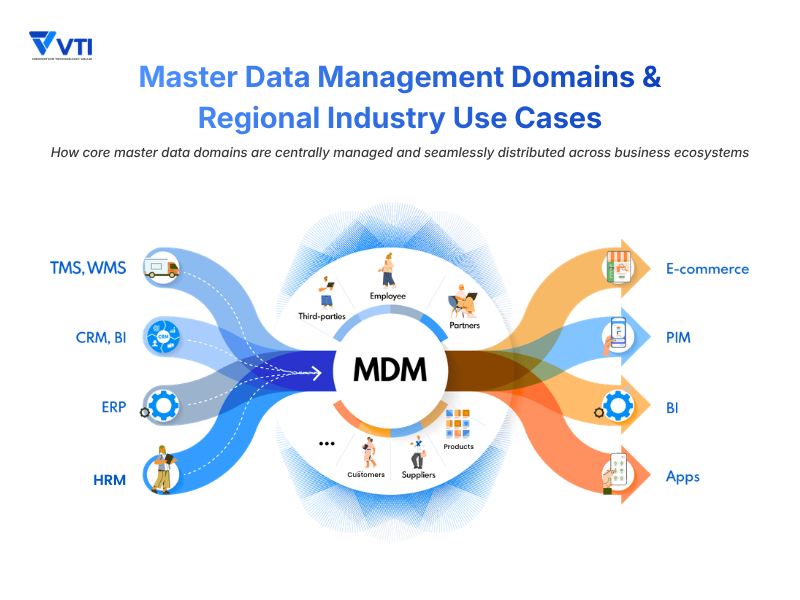
To build an effective data architecture, we must understand how enterprise master data differs from other data layers:
– Master data: the core, relatively stable entities of your business like customers, products, suppliers, employees, locations.
– Transactional data: the events that happen to those entities, such as an order, an invoice, a support ticket.
– Reference data: the shared vocabulary that gives transactional and master data meaning like country codes, currency codes, product categories.
Get your master data wrong, and every downstream transaction, report, and automation built on top of it automatically inherits the error.
Why MDM Is becoming critical for enterprises
The pressure to fix this has intensified for a very specific reason: AI. As regional enterprises push workloads into generative AI, RAG, and Agentic AI, master data governance has shifted from an IT footnote to a board-level compliance risk.
Imagine an AI assistant helping a customer service agent. If one system says a customer is a “gold member” while another still identifies them as a “standard member,” the AI cannot determine which record is correct. Instead of improving the customer experience, it may recommend the wrong promotion or provide inconsistent answers.
Master data management reduces this ambiguity by ensuring AI applications access trusted enterprise master data rather than conflicting operational records.
Business benefits of master data management
A successful MDM program is not an infrastructure integration exercise; it is a business catalyst. Organizations that successfully govern their core data unlock five competitive advantages:
– Better data accuracy
When customer, product, and supplier data is standardized across systems, teams spend less time reconciling conflicting records and more time acting on reliable information.
– Faster decision-making
Instead of debating which dashboard is correct, leaders can rely on consistent enterprise master data to make decisions more quickly.
– Improved customer experience
A unified customer profile enables more personalized interactions across sales, marketing, and customer service.
– Stronger regulatory compliance
Consistent master data improves traceability, making it easier to meet audit and regional data privacy requirements.
Modern AI applications depend on trusted data. MDM ensures AI models and analytics platforms work from consistent enterprise master data rather than fragmented operational records.
Single source of truth (SSOT): Strategic goal vs. MDM enabler
A single source of truth (SSOT) is the state in which every team and system relies on the same authoritative version of business-critical data.
It is common to confuse SSOT and MDM, but they are not the same thing. SSOT is the desired outcome. Meanwhile, MDM is the operational discipline that helps achieve it.
This distinction matters. Organizations sometimes deploy an MDM platform and assume they automatically have a single source of truth. In reality, without governance, ownership, and stewardship, the technology alone rarely delivers that outcome.
Buying an MDM software tool does not automatically give you an SSOT. As IBM has noted, implementing MDM purely as a technical matching project without changing organizational habits will fail to create a true single source of truth. For example, if you deploy an expensive MDM platform but never assign a specific team to own and update the customer data directory, your departments will go right back to arguing over mismatched numbers within six months. True data trust requires both the software tool and clear ownership rules to keep the pipeline clean.
How MDM architecture creates an SSOT
To transform data chaos into an SSOT, data must flow through a structured operational pipeline. Every mature MDM architecture moves information through these six sequential stages:
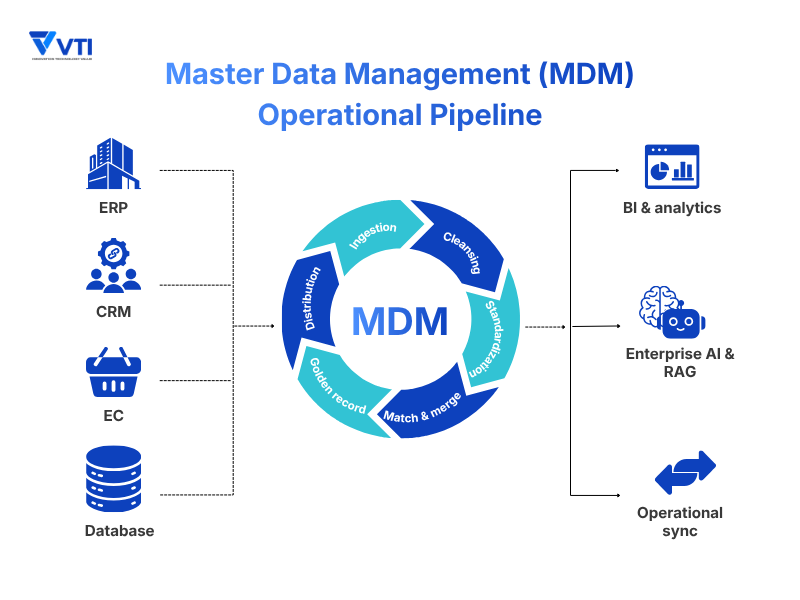
– Ingestion: pulling raw master data from disparate source systems (ERP, CRM, POS, e-commerce).
– Cleansing: correcting obvious errors like malformed emails, missing fields, or inconsistent casing.
– Standardization: Mapping every source to a unified schema so “ABC company” and “ABC Co., Ltd” map to identical attributes.
– Match & merge: employing deterministic and probabilistic algorithms to identify which records actually refer to the same real-world entity.
– Golden record management: creating the definitive, authoritative version of each entity, governed by clear survivorship rules when source systems conflict.
– Data distribution: syndicating that golden record back to all downstream operational and analytical applications, ensuring no system runs on stale data.
To keep this pipeline running smoothly over time, five foundational pillars must support it:
– Data governance: The organizational policies and decision rights determining who owns what data.
– Data quality: Continuous monitoring rules ensuring data stays clean, not just clean on day one.
Metadata management: The documentation defining what each field means to prevent definition drift.
– Data stewardship: The human-in-the-loop role responsible for resolving complex data edge cases that algorithms cannot confidently automate.
– Integration layer: The technical plumbing (APIs, webhooks, middleware) keeping the hub and sources synchronized.
MDM architecture models & leading platforms
Choosing the wrong architecture model can force an enterprise into an expensive infrastructure re-design later on. Your technical model must match your organizational structure:
| Architecture model | Operational mechanism | Leading vendor platforms | Ideal enterprise match |
| Registry | Stores only an index/ID that links related records across source systems, without physically consolidating data | IBM InfoSphere, Semarchy xDM | Multinational groups with independently operated, highly autonomous business units |
| Consolidation | Aggregates data into a central hub to produce a golden record mainly for reporting, BI, and data warehousing | Profisee, SAP MDG | Businesses that want trusted management reporting without replacing or altering legacy core systems |
| Coexistence | Builds the golden record centrally, then syncs updates back to source systems on a defined cycle | Informatica MDM, Reltio | Scale-up businesses balancing centralized master data control with local system operational autonomy |
| Transactional hub | All master data is created, edited, and deleted directly and exclusively within the MDM hub | Informatica, IBM, Reltio | Large enterprises undergoing a full legacy core-system modernization or ERP overhaul |
The enterprise tech stack: MDM vs. other data tools
A common question from business leaders is: “If we already have a CRM, a Data Warehouse, or a CDP, why do we still need MDM?”
The simplest way to understand the difference is to look at what kind of data each system owns and why they cannot replace each other:
| System | What data does it own? | The big problem it has | How it works with MDM |
| MDM | The core identity: The absolute, clean “golden record” of a customer, product, or supplier. | It doesn’t track daily sales or marketing clicks, only focuses on keeping core identities 100% accurate. | The foundation: MDM cleans the data first, then pushes this “perfect master copy” to all other systems. |
| CRM | The sales history: phone numbers, emails, pipeline deals, and support tickets for sales teams. | Siloed & messy: Sales reps often type names wrong, create duplicates, and the CRM cannot see what that same customer bought on your e-commerce app. | The input & output: CRM sends raw data to MDM to be cleaned, and receives back a verified, duplicate-free customer profile. |
| CDP | The digital behavior: Website clicks, add-to-cart events, page views, and social media interactions. | Anonymous & temporary: tracks cookies and fast-moving traffic for marketing ads, but doesn’t know if “User_982” is the exact same corporate client in your ERP. | The marketer’s lens: CDP tracks what the customer does online, but relies on MDM to know exactly who that customer is. |
| Data warehouse / Data lake | The historical analytics: Millions of past invoices, financial balances, and historical metrics stored for years. | Garbage in, garbage out: If your data warehouse ingests duplicate customer profiles from your CRM, your final charts and revenue reports will be wrong. | The clean engine: The data warehouse provides the heavy computing power, but it needs MDM’s data rules to ensure the reports are accurate. |
Industry playbook: Core master data management use cases
MDM domains rarely get prioritized in a vacuum. The right starting point often depends on your industry and operational focus:
Retail
A retailer selling through physical stores, e-commerce websites, and marketplaces often stores customer data in multiple systems. Without MDM, the same customer may receive duplicate loyalty accounts or inconsistent promotions. With MDM, customer identities are unified, giving every team access to the same trusted profile.
Manufacturing
The application is standardizing product and material master data across ERP, MES, and PLM systems. Technical specifications (BOMs, engineering specs) are genuinely complex, and every supplier encodes them differently, making a unified master model essential to prevent factory downtime.
Healthcare
The application is patient MDM, consolidating a patient’s record across registration, billing, and clinical systems into one trustworthy view. Because mismatched records impact patient safety, leading healthcare MDM programs deliberately keep human data stewards in the loop for sensitive match/merge decisions.
Master data management Implementation roadmap
MDM implementation roadmap
A successful MDM strategy rejects the “big bang” rollout approach. Instead, it focuses on delivering fast, incremental business value through 5 distinct stages:
Step 1: Assessment
Profile your current data landscape, identify the domain (customer, product, supplier) causing the most business pain right now.
Step 2: Governance setup
Assign data owners and stewards before you touch any technology. This step is skipped more often than any other, and it’s the one that determines whether the project survives its first year.
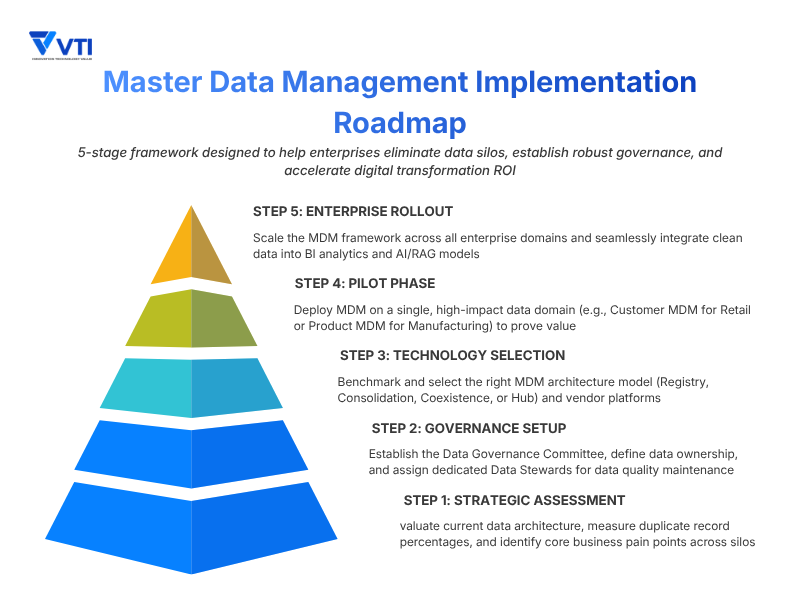
Step 3: Technology selection
Match the architecture model to your actual maturity level, not your five-year ambition.
Step 4: Pilot launch
Prove the model on one domain, with measurable KPIs (duplicate reduction rate, match accuracy), before scaling further.
Step 5: Enterprise rollout
Extend domain by domain, carrying the governance model you validated in the pilot rather than rebuilding it each time.
Common pitfalls to avoid
– IT-only ownership: An MDM program owned entirely by IT with no business stakeholders held accountable for data adoption rarely survives corporate budget cycles.
– Boiling the ocean: Trying to clean every piece of legacy operational data simultaneously. Focus exclusively on master data entities.
– Ignoring the human factor: Teams who have built complex manual workarounds around bad data for years will naturally resist new systems unless change management and operational training are prioritized from day one.
Conclusion
Master data management is not about deploying another corporate database. It is about constructing a reliable, trusted operational foundation that allows every enterprise system, analytics platform, and AI workload to operate from the same corporate truth.
At VTI, we do not view MDM as a simple software installation. We help organizations build trusted data foundations for analytics, AI, and enterprise transformation by combining practical data governance, seamless system integration, and hands-on operational rollout.
If your leadership team is still spending meetings arguing over whose numbers are right, your data foundation is telling you it’s time to adapt. Contact VTI’s data team today to benchmark your enterprise data maturity and map out a practical, step-by-step roadmap for your business.