





![[FREE EBOOK] Strategic Vietnam IT Outsourcing: Optimizing Cost and Workforce Efficiency](https://vti.com.vn/wp-content/uploads/2026/06/ebook-it-outsourcing.png)


Most enterprises have deployed generative AI, but very few have gotten it to finish a job from end to end. Agentic AI systems mark the shift from AI that suggests answers to AI that plans, decides, and executes complex workflows autonomously.
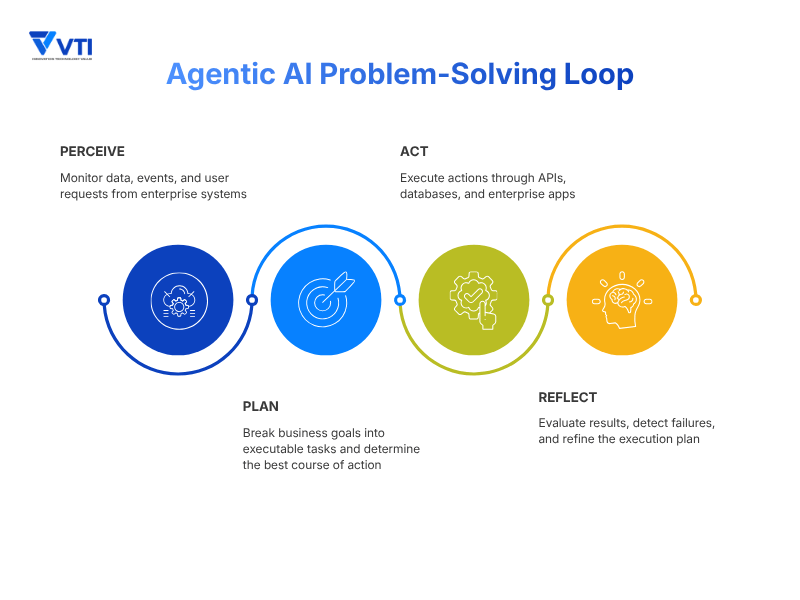
An agentic AI system is an orchestrated network of AI agents that pursues complex goals by continuously running a Perceive → Plan → Act → Reflect execution loop. Unlike traditional chatbots or static copilots, these systems autonomously integrate with enterprise tools, reason through changing conditions, and self-correct along the way.
This guide breaks down how agentic systems are architected, where they deliver measurable ROI across key industries, and how enterprises can deploy them safely at scale.
What is an agentic AI system?
An agentic AI system is an integrated framework of specialized AI agents that acts autonomously to achieve multi-step business objectives. Powered by foundational large language models (LLMs) and specialized small language models (SLMs), these systems go beyond basic text generation to independently execute complex, end-to-end operational workflows.
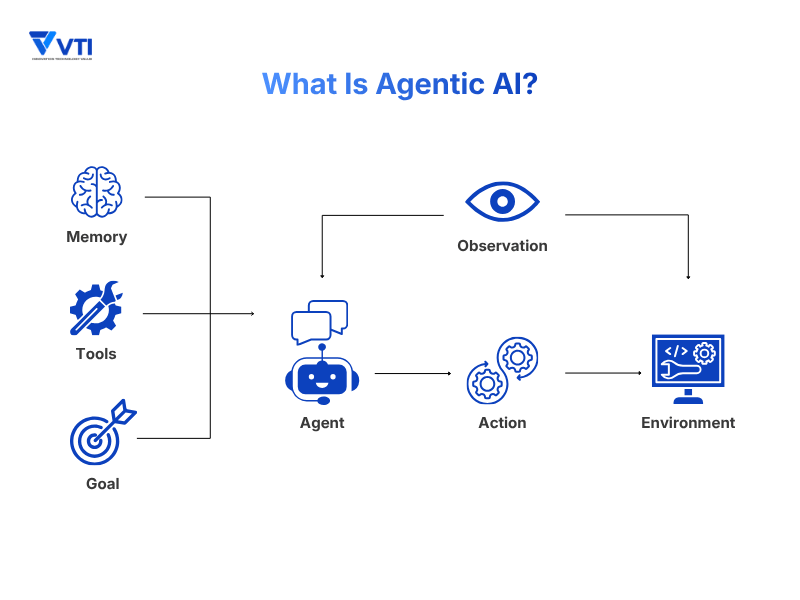
Rather than waiting for manual step-by-step prompts, an agentic AI system operates on a continuous, four-stage cognitive loop:
– Perceive: The system continuously monitors its environment by ingesting real-time data streams, enterprise database events, API webhooks, or user requests.
– Plan: The system decomposes a high-level goal into logical sub-tasks using advanced reasoning frameworks (such as Tree-of-Thought or Chain-of-Thought prompting) to plot the most efficient execution path.
– Act: The system interacts directly with external enterprise software—calling REST APIs, querying databases, or executing code via standardized protocols.
– Reflect: The system evaluates the output of its actions against the intended goal, identifies errors or dynamic environmental changes, and adjusts its remaining execution plan without requiring human intervention.
Agentic AI vs. AI Agents vs. Generative AI vs. RPA
While RPA automates rigid rules and Generative AI produces content on demand, an agentic AI system coordinates multiple autonomous agents to reason, use tools, and complete dynamic enterprise workflows with minimal human oversight.
Understanding how agentic systems differ from earlier automation paradigms is critical for enterprise technology leaders evaluating software architecture, integration complexity, and security requirements.
The table below breaks down the key architectural and operational differences across the four dominant automation technologies:
| Criteria | Robotic Process Automation (RPA) | Generative AI (Assistive) | AI Agent | Agentic AI System |
| Level of autonomy | None: Strictly follows pre-scripted, deterministic rules | Low: Reactive execution triggered per prompt | Moderate: Completes a single bounded task independently | High: Pursues multi-step, dynamic enterprise goals with minimal oversight |
| Input requirement | Structured, predictable, and fixed data inputs | Natural language prompts or unstructured context | Task goal accompanied by explicit tool access permissions | High-level business objectives and dynamic environmental streams |
| Workflow complexity | Simple, linear, highly repetitive tasks | Single-turn or short multi-turn content generation | Single-domain tasks (e.g., retrieving specific database records) | Complex, cross-system workflows requiring continuous adaptive planning |
| Tool execution | Scripted UI clicks or strict API macro execution | Text/code generation (typically no direct tool execution) | Direct function calls to specific pre-defined APIs | Coordinates multiple APIs, databases, and agents dynamically |
| Typical use case | Invoice data entry, rule-based record matching | Drafting emails, summarizing documents, code autocompletion | Resolving a simple tier-1 support ticket | End-to-end claims processing, autonomous supply chain re-routing |
While 79% of enterprises report experimenting with AI agents, only 11% have scaled them into production – a 68-percentage-point gap primarily driven by legacy integration bottlenecks and governance concerns (Gartner). Mastering agentic architecture is what enables engineering teams to bridge this exact gap.
Agentic AI System Architecture: The 5 Core Layers
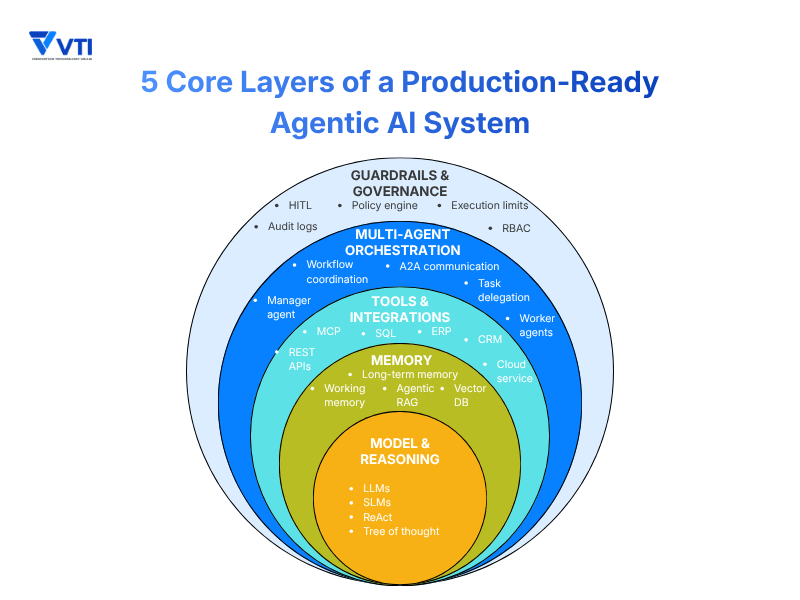
A production-grade agentic AI system is built from five interconnected layers. Understanding each one is the difference between a working pilot and a system that breaks the moment a workflow gets complicated.
Model & reasoning layer
The foundation of any agentic system is its reasoning engine – a combination of large language models (LLMs) and fine-tuned small language models (SLMs). Rather than relying on simple prompt-completion, this layer employs cognitive reasoning patterns:
– React framework (reasoning + acting): The model alternates between “thinking” through a problem out loud and executing an action, allowing it to reassess its strategy at each step.
-Tree-of-Thought (ToT): The engine evaluates multiple execution paths simultaneously, scoring potential outcomes before committing to a specific action.
– SLM delegation: Enterprise systems frequently route low-complexity sub-tasks to specialized SLMs to drastically reduce latency and inference costs while reserving frontier LLMs for high-level reasoning.
Memory layer
To execute multi-step workflows across time, agentic systems maintain two distinct forms of state management:
– Short-term working memory: Maintains immediate conversational context, recent tool execution outputs, and the active task state within the model’s context window.
– Long-term & episodic memory (agentic RAG): Unlike traditional static RAG which simply pulls matching documents based on semantic similarity, agentic RAG empowers the agent to dynamically refine search queries, query multiple vector databases, validate retrieved context for accuracy, and synthesize historical knowledge across past enterprise sessions.
Tools & integration layer
The tools layer serves as the system’s hands, allowing agents to read from and write to external enterprise applications via REST APIs, SQL queries, and code execution environments.
A critical breakthrough in this layer is the Model Context Protocol (MCP) — an open, standardized interface that acts as a universal adapter between AI agents and external data systems. Instead of writing custom point-to-point integration code for every CRM, ERP, or database, developers expose enterprise tools as MCP endpoints. Agents can dynamically discover available MCP tools, inspect their schemas, and execute function calls securely.
Multi-agent orchestration layer
When enterprise goals exceed the scope or context window of a single agent, the orchestration layer coordinates a network of specialized agents. This typically uses one of two design patterns:
– Hierarchical (conductor-worker pattern): A central manager agent receives the primary goal, decomposes it into discrete sub-tasks, delegates them to domain-specific worker agents (e.g., Data Parser Agent, Inventory Agent), and aggregates the final result.
– Peer-to-peer (agent-to-agent/A2A mesh): Specialized agents communicate directly with one another using standardized inter-agent communication protocols. Agents hand off task control dynamically based on domain expertise without a single central bottleneck.
Guardrails & governance layer
The governance layer enforces safety, security, and compliance boundaries around autonomous agent actions:
– Deterministic bounds: Hard-coded rule limits that an agent cannot bypass through reasoning.
– Human-in-the-loop (HITL): Strategic checkpoints that pause automated execution and require explicit human approval before executing irreversible or high-stakes actions.
– Execution caps & rate limits: Guardrails that monitor step counts and token consumption to prevent agents from falling into infinite execution loops or incurring runaway API bills.
Benefits of agentic AI systems for enterprises
Unlike traditional AI assistants that primarily improve individual productivity, agentic AI systems create value by autonomously completing entire business workflows. Instead of helping employees perform tasks faster, they reduce manual intervention across processes, enabling organizations to improve operational efficiency, scalability, and decision quality. As a result, enterprises measure the success of agentic AI not only by productivity gains, but also by tangible business outcomes such as cycle time reduction, straight-through processing (STP), and cost savings.
Key enterprise impact metrics
The table below outlines the core KPIs enterprises use to measure the business value of agentic AI deployments:
| Business impact area | Traditional metric (GenAI Copilot) | Agentic AI target metric | Realized business outcome |
| Operational velocity | Time spent drafting text/code (-20% time) | End-to-End Cycle Time (MTTR) reduced by 60%–80% | Workflows that took days resolve in minutes |
| Labor efficiency | Manual task assistance per employee | Full autonomous resolution rate (STP) of 40%–70% | Shift human talent from repetitive execution to high-value exception handling |
| Process accuracy | User-rated helpfulness score | First-contact error rate reduced by 30%–50% | Elimination of human data entry mistakes across ERP/CRM syncs |
| System scalability | Fixed head-count needed for volume spikes | Elastic processing throughput (10x volume scale with zero headcount addition) | Operational capacity scales instantly during peak seasonal demand |
Quantifying ROI: Straight-through processing (STP)
The primary driver of ROI in an agentic deployment is straight-through processing (STP) — the percentage of workflows completed end-to-end without any human intervention.
| STP rate (%) = (Workflows executed autonomously/Total workflow volume) x 100 |
– Level 1 (assisted – low ROI): Agents perform data lookups and present recommendations, while human operators execute the final actions.
– Level 2 (semi-autonomous – moderate ROI): Agents execute standard routine requests automatically, routing complex or ambiguous edge cases to humans.
– Level 3 (high-autonomy – maximum ROI): Agents complete routine and complex workflows end-to-end, invoking Human-in-the-Loop approval strictly for high-cost exceptions or policy boundaries.
Real-world applications of agentic AI systems by industry
Across retail, manufacturing, healthcare, and financial services, agentic AI systems are replacing fragmented automation by coordinating specialized agents to autonomously manage supply chain disruptions, predictive maintenance, clinical trial matching, and real-time fraud prevention.
While general-purpose copilots offer generic text assistance, industry-specific agentic deployments deliver direct financial ROI by automating complex, domain-regulated operations.
Retail & e-commerce
– Demand sensing agent: Ingests POS data, social sentiment, and weather forecasts to detect micro-demand spikes.
– Inventory agent: Queries vector databases across regional distribution centers to assess current safety stock.
– Supplier negotiation agent: Connects to vendor APIs via MCP, calculates wholesale price thresholds, and places automated re-orders within pre-approved budget boundaries.
– Logistics routing agent: Calculates optimal transport routes and dispatches freight carriers to prevent stockouts.
Manufacturing
– The IoT sensor agent flags subtle vibration anomalies on a assembly-line robot.
– The diagnostic agent analyzes historic maintenance logs using Agentic RAG and identifies a bearing failure risk.
– The parts inventory agent queries ERP stock levels and issues an automated purchase order for replacement components.
– The work scheduler agent automatically adjusts plant shift timetables and dispatches field technicians before catastrophic equipment failure occurs.
Healthcare
– Clinical data mining agent: Scans unstructured electronic health records (EHR) to identify patients meeting precise clinical trial criteria.
– Compliance & HIPAA audit agent: Validates data anonymization and regulatory eligibility against local medical board frameworks.
– Patient outreach agent: Conducts personalized outbound voice or text communications to schedule screening appointments, automatically escalating medical questions to human nurses.
Risks, governance, and security in agentic AI deployment
Deploying agentic AI systems introduces novel cybersecurity and compliance attack vectors that traditional IT security controls are ill-equipped to handle.
Because agentic systems possess tool-execution capabilities, security strategies must shift from basic prompt filtering to robust system-level governance and deterministic control boundaries.
Enterprise agentic risk matrix
The table below details the primary operational and security vulnerabilities inherent in autonomous agentic deployments, along with required enterprise mitigations:
| Risk category | Threat vector | Real-world impact | Technical mitigation strategy |
| Security | Indirect prompt injection | Malicious text in PDFs or emails tricks the agent into exfiltrating sensitive data | Dual-LLM architecture (separate parsing from decision-making); strict input sanitization |
| Reliability | Infinite execution loops | Agent gets stuck in reasoning loops, consuming runaway API tokens | Hard-coded iteration limits, timeout caps, and automated token-spend alerts |
| Data privacy | Privilege escalation | Agent inherits broader API access than the user, leaking cross-department data | Role-Based Access Control (RBAC) at the API Gateway; OAuth 2.0 user-identity propagation |
| Control | Unintended execution | Agent misinterprets ambiguous data and executes unwanted financial transactions | Human-in-the-Loop (HITL) approval gates for high-cost or destructive actions |
Core security & governance guardrails
To meet NIST AI RMF and OWASP LLM Top 10 standards, enterprise agentic systems must enforce three structural layers:
– Privilege segregation: Apply the principle of least privilege. An agent that reads emails must never share context or permissions with an agent authorized to write to an ERP database.
– Policy-as-code engines: Use external rule engines to validate function calls before execution. If an agent attempts a transaction over $10,000, the policy engine blocks the API call automatically.
– Immutable audit telemetry: Log every reasoning step, tool call payload, and API response. Engineering teams must be able to replay execution traces offline to debug edge cases and satisfy compliance audits.
How to deploy agentic AI systems: A practical framework
Step 1: High-impact pilot identification
Identify a high-value operational process characterized by clear rules, structured inputs, and existing manual hand-offs (e.g., tier-2 support ticket resolution or invoice discrepancy reconciliation). Avoid starting with broad, open-ended workflows.
Step 2. Integration & data readiness assessment
Audit your enterprise data stack and legacy software architecture to ensure an AI-ready data foundation – exposing structured vector databases, real-time event streams, and reliable REST APIs or webhooks. Agents require predictable integration layers to execute read/write actions effectively.
Step 3. Architecture & protocol design
Choose between a single-agent or multi-agent design pattern (Hierarchical vs. Peer-to-Peer). Standardize tool integrations using the Model Context Protocol (MCP) to prevent brittle point-to-point code integrations.
Step 4. Sandboxed staging & human-in-the-loop testing
Deploy the agent system in a sandboxed staging environment with HITL controls active. Require explicit human authorization for all write operations, gradually expanding agent autonomy as failure rates drop.
Step 5. Production scaling & continuous monitoring
Roll out production deployment gradually. Enforce deterministic policy-as-code guardrails, hard token-spend caps, and full execution trace logging to track model drift, cost efficiency, and operational throughput in real time.
Conclusion
The shift from Generative AI copilots to agentic AI systems marks the transition from software that suggests to software that executes. Bridging the gap between a promising pilot and a secure, scaled production system requires robust data infrastructure, standardized protocols like MCP, and deterministic governance from day one.
Transforming legacy workflows into autonomous agentic systems requires deep expertise across cloud infrastructure, enterprise APIs, and AI engineering. VTI provides end-to-end consulting, multi-agent orchestration, and seamless integration with core enterprise systems. Ready to automate end-to-end enterprise workflows? Contact VTI’s AI experts to evaluate your technical readiness and scale agentic systems in production safely.