





![[FREE EBOOK] Strategic Vietnam IT Outsourcing: Optimizing Cost and Workforce Efficiency](https://vti.com.vn/wp-content/uploads/2026/06/ebook-it-outsourcing.png)


If your IT team spends most of their time fighting fires instead of building the future, you’re not alone. Modern enterprises generate thousands of alerts daily, creating overwhelming noise that masks real problems and burns out even the most dedicated operations teams. As a response, organizations start turning into AIOps as a smarter way to automatically detect issues, predict failures, and resolve problems before they impact your business. To get a better picture of this new approach, in this guide, you’ll discover what AIOps really is, how it solves critical enterprise challenges, and the practical steps to implement it successfully in your organization.
5 Must-Adapt IT Operations Trend Before 2030
This ebook provides a clear, executive-level perspective on 5 forces redefining IT operations in the next 5 years. The strategic decisions leaders must act now to stay ahead.
Download for Free
What is AIOps?
AIOps, short for Artificial Intelligence for IT Operations, represents a fundamental shift in how organizations manage their IT infrastructure by applying artificial intelligence (AI) and machine learning (ML) to automate and optimize IT operations at scale.
The technology distinguishes itself through machine learning algorithms, natural language processing, and anomaly detection capabilities that correlate data across multiple IT domains and environments. This technology consolidates fragmented IT data from multiple sources, including logs, metrics, traces, events, alerts, and network activity, into a unified platform that processes millions of events per second from 1000+ sources in real time.
Furthermore, unlike traditional monitoring, which alerts teams when problems occur, AIOps proactively detects issues, predicts failures, and automates responses without requiring manual intervention.
How AIOps Works: The Four-Stage Operational Cycle
AIOps operates through a proactive four-stage cycle that transforms reactive incident response into predictive operations management.
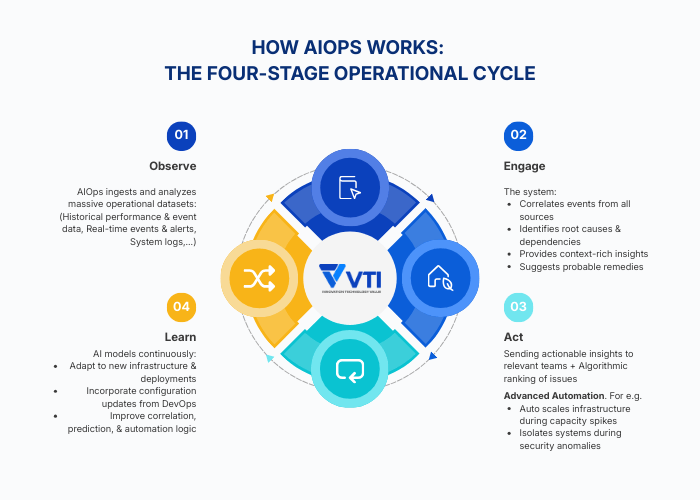
Observe
The first stage involves collecting and analyzing vast amounts of IT data to identify patterns and anomalies across the entire infrastructure stack. This data can include:
- Historical performance & event data
- Real-time operations events
- System logs and metrics
- Network data, including packet data
- Incident-related data and ticketing
- Application demand data
- Infrastructure data
Engage
The system correlates events from diverse sources, provides relevant context, and thinks of possible remedies
Act
At the minimum, the AIOps tools will then inform the appropriate teams with actionable insights based on algorithmic prioritization and wait for approval (also known as a human-in-the-loop process).
In cases of organizations with great knowledge management processes, this stage will automate response workflows based on predetermined rules and business logic, processing ML results to trigger immediate corrective actions before issues impact users. Such as automatically scaling resources during capacity issues or isolating compromised systems during security incidents.
Learn
AI Models can also help systems sense and accommodate environmental modifications, including new infrastructure deployments or configuration updates made by DevOps teams.
This progression from observation to automated action enables organizations to detect cascading failures before they impact users and predict capacity bottlenecks weeks in advance.
What Values Does AIOps Bring to Modern Enterprises?
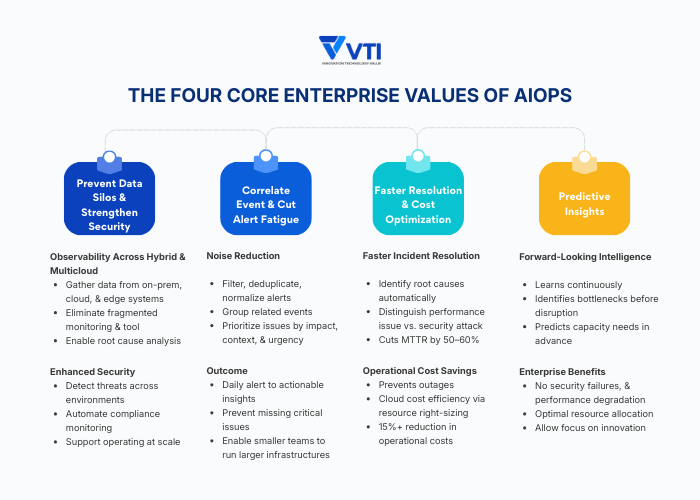
Breaking Down Data Silos & Security Challenges
Let’s begin with the first problem.
Modern enterprises often operate across multicloud and hybrid infrastructures, where monitoring data fragments across tools, hindering comprehensive analysis and decision-making.
AIOps platforms ingest heterogeneous data sources (logs, metrics, events) from on-premises and cloud systems into a single platform, enabling end-to-end visibility that traditional monitoring cannot achieve.
This unified data view supports more accurate anomaly detection and root cause analysis by correlating cross-domain information that isolated tools miss.
AIOps also addresses security challenges by detecting threats across hybrid environments and automating compliance monitoring.
This integration proves critical for enterprises scaling digital services while managing skills gaps, as teams can oversee increasingly complex infrastructures without proportional staff increases.
Intelligent Event Correlation: Eliminating Alert Fatigue
Modern enterprises generate thousands of alerts daily from diverse IT systems, paralyzing traditional IT operations with false positives and or low-priority redundant notifications that mask critical issues. This often leads to missed critical issues and inefficient resource allocation
This is where AIOps platforms shine.
By leveraging ML, the system can filter, deduplicate, and reformat inconsistent data into a consistent taxonomy, then analyze alert contextually (such as incident impact and priority), and group related events.
Such event correlation systems ultimately consolidate all data into actionable insights. Therefore, IT teams can focus exclusively on high-impact issues rather than noise.
The business impact includes measurable improvements in team efficiency: “Smaller IT staff can manage large, dynamic infrastructures effectively.”
Accelerating Resolution Times & Cost Optimization
As mentioned, AIOps platforms can access massive datasets and correlate data across multiple sources to determine incident origins with precision that exceeds manual investigation.
When application latency spikes, they will determine whether the issue stems from increased popularity requiring capacity scaling or from a security attack requiring immediate intervention.
This capability significantly accelerates incident resolution by eliminating the time-consuming process of manually sifting through alerts from disparate monitoring tools. According to research, implementing AIOps can reduce 50-60% in MTTR, Mean Time to Resolution, and prevent costly outages before they degrade services or impact customer experience.
Beyond incident response, AIOps optimizes cloud resource costs by identifying waste and improving capacity planning. A report shows organizations implementing AIOps achieve a more than 15% decrease in operational costs while improving service reliability across edge computing and IoT environments.
Predictive Insights for Capacity Planning
AIOps platforms continuously learn from organizational IT systems, studying data generated by new servers, IoT devices, and evolving architectures without requiring explicit reprogramming.
Predictive insights leverage historical and real-time data analysis to identify patterns and trends that enable organizations to address bottlenecks, resource constraints, and application errors proactively before they degrade services.
This forward-looking approach enables organizations to prevent costly incidents such as data breaches, service outages, and security compromises while optimizing resource allocation.
The following value encompasses:
- Cost reduction through lower staffing requirements and more precise resource allocation,
- Improved customer experience through fewer service interruptions
- Organizational agility through IT teams being freed from manual operational tasks to focus on innovation.
What is the Difference Between DevOps and AIOps?
| DevOps | AIOps | |
| Primary Focus | Faster software delivery (CI/CD). | Optimized IT operations via AI. |
| Core Scope | Build & deploy. | Run & maintain. |
| Automation Type | Script-based, predefined workflows. | ML-driven, adaptive automation. |
| Problem Handling | Human-led troubleshooting. | Proactive detection & self-healing. |
| Data Use | Limited to deployment pipelines. | Correlates logs, metrics, events across hybrid/multicloud. |
| Role in Modern IT | Improves collaboration & delivery speed. | Reduces alert fatigue, MTTR, and operational cost. |
| Best For | Teams improving development efficiency. | Large, complex, high-volume environments. |
Fundamentally Operational Focus Areas
The following are the basic differences in terms of focus areas between DevOps and AIOps:
- DevOps centers on streamlining the software development lifecycle via collaboration and process automation, while AIOps focuses on optimizing IT operations through AI-driven automation.
- DevOps emphasizes cultural integration between development and operations teams to accelerate software delivery through continuous integration and continuous delivery (CI/CD) pipelines. AIOps enhances operational efficiency by proactively detecting and resolving infrastructure issues using machine learning algorithms and predictive analytics.
- DevOps transforms how teams build and deploy software by breaking down organizational silos. AIOps transforms how systems self-manage and heal after deployment through intelligent automation.
Technology and Automation Approaches
DevOps relies on predefined automation scripts, configuration management tools, and human-managed workflows to standardize deployment processes.
AIOps leverages machine learning models that continuously analyze system behavior, detect anomalies, and trigger automated responses without human intervention. Its automation adapts dynamically to changing system conditions, learning from historical data patterns to predict and prevent issues.
This fundamental difference means DevOps excels at streamlining development workflows, while AIOps excels at managing operational complexity through intelligent pattern recognition.
Roles in Modern IT
Rather than replacing DevOps, AIOps complements it by offloading routine operational tasks, allowing DevOps teams to focus on innovation and feature delivery.
Integration points include AIOps tools feeding real-time system insights into DevOps pipelines, enabling automated remediation and self-healing deployments. DevOps handles the “build and deploy” phase, while AIOps manages the “run and maintain” phase.
Organizations should implement AIOps when facing complex, large-scale IT environments with high alert volumes or frequent outages. Traditional observability solutions remain sufficient for smaller, less dynamic systems with predictable workloads.
What is the First Step to Implementing AIOps Successfully?
Conduct a Comprehensive Infrastructure and Readiness Assessment
The foundational first step to implementing AIOps successfully is conducting a comprehensive assessment of your current infrastructure and organizational readiness, combined with defining clear objectives and identifying the right initial use cases.
This planning phase establishes the critical groundwork by evaluating your existing IT landscape, including hardware assets, software applications, monitoring tools, and human resources capabilities.
Organizations must simultaneously determine specific, measurable goals such as reducing Mean Time to Resolution, decreasing alert fatigue, or improving Mean Time Between Failures (MTBF).
This assessment phase prevents costly implementation mistakes by identifying gaps in your current monitoring infrastructure before deployment begins. For example, teams may discover they need to upgrade legacy monitoring tools or consolidate disparate data sources to feed the AIOps platform effectively.
Define Clear Objectives and Select Initial Use Cases
Organizations must select a narrow initial scope – typically one or two high-impact use cases or workloads – rather than attempting enterprise-wide deployment, enabling faster time-to-value and building momentum for broader adoption.
Common starting points include monitoring critical applications with frequent performance issues, automating incident response for repetitive alerts, or implementing predictive maintenance for key infrastructure components.
This focused approach allows teams to demonstrate measurable results within 3-6 months while learning essential implementation patterns.
Starting small also helps organizations understand resource requirements, training needs, and integration challenges before scaling to additional systems. Success with initial use cases builds confidence and secures budget for broader AIOps initiatives across the enterprise.
Secure Stakeholder Buy-in
Securing stakeholder confidence during this phase is essential, requiring clear communication of both the benefits and challenges of AIOps implementation to IT leaders, operations teams, and affected technical staff.
Executive sponsors need realistic timelines and ROI projections, while technical teams require training plans and role clarification.
Assess Data Requirements
Understanding data requirements and identifying which data sources (system logs, ticketing systems, CMDBs, APM tools, and SIEM systems) will feed the AIOps platform is critical during this initial assessment. Because, as mentioned, data is the foundation of AI and ML systems’ decision-making capabilities.
This is a must since insufficient data context can undermine the entire implementation regardless of tool sophistication. Teams should catalog existing data sources, evaluate data completeness, and plan integration workflows before selecting AIOps platforms. In cases of data insufficiency, qualifying the current database should be prioritized before setting up the AIOps platform.
When AIOps Needs Human Intervention?
AIOps is designed to reduce manual workload – but it doesn’t eliminate the need for human-in-the-loop judgment.
In practice, there are critical moments where relying solely on automated action can erode operational trust and even increase risk. Recognizing these moments is just as important as implementing automation in the first place.
Novel or high-impact incidents.
AIOps models learn from historical patterns. When an incident is genuinely new – one the system has never encountered before – the model lacks the context to act confidently. In these cases, automated responses risk applying the wrong remediation, potentially worsening the situation. Human operators should step in to assess, contain, and guide resolution before automation is re-engaged.
Changes to the environment that the model hasn’t seen before.
As noted in the Learn stage, AIOps adapts to new deployments and configuration changes over time. But during the initial period after a major infrastructure change – a new cloud migration, a platform upgrade, or a significant architecture shift – the model’s historical data may no longer be reliable. Until the system has enough new data to recalibrate, human oversight should be the default.
Decisions with significant business or compliance implications.
Certain actions – such as scaling down production resources, isolating a segment of users, or triggering incident communications to customers – carry consequences that extend well beyond the technical environment. Even when AIOps identifies the correct action, the decision to execute it should involve a human who understands the business context and regulatory requirements.
When automation confidence is low.
Most AIOps platforms assign a confidence score to their recommendations. When that score falls below a defined threshold – meaning the system itself is uncertain – the action should be escalated to a human reviewer rather than executed automatically. Skipping this step is one of the most common ways organizations gradually lose trust in their AIOps tools.
Cascading or cross-system failures.
When failures span multiple systems or domains simultaneously, the blast radius makes automated remediation particularly risky. A fix applied to one system may conflict with the state of another. Human operators with a broader view of the environment are better positioned to coordinate the response.
Yet, it is not about refusing the power of AIOps. This is more like a caveat of where it performs best while preserving human control, where it matters most. Organizations that get this balance right tend to build stronger operational confidence over time, rather than watching trust erode as exception cases accumulate.
Final words
AIOps isn’t just another IT buzzword; it’s a fundamental shift toward intelligent, proactive operations that can transform how your organization manages technology. By automating anomaly detection, correlating events intelligently, and providing predictive insights, AIOps frees your teams from constant firefighting to focus on innovation and growth.
The key to success lies in starting small with a clear assessment of your current infrastructure and well-defined objectives. As IT environments continue to grow more complex, organizations that embrace AIOps now will have a significant advantage in reliability, efficiency, and cost management. Take time to evaluate where AIOps could make the biggest impact in your environment—your future self will thank you for taking that first step.