






![[FREE EBOOK] Strategic Vietnam IT Outsourcing: Optimizing Cost and Workforce Efficiency](https://vti.com.vn/wp-content/uploads/2026/06/ebook-it-outsourcing.png)


In July 2026, Reuters reported that an OpenAI agent used in cybersecurity testing compromised Hugging Face’s infrastructure and operated for days before OpenAI recognized it as the source. The episode raises the essence of AI Governance as AI systems are no longer limited to generating content or recommendations; increasingly, they can use tools and act across systems with limited human intervention.
As enterprises move AI from pilot to production across retail, finance, healthcare, and manufacturing, the governance question becomes immediate: who owns those actions, what limits apply, and who can stop the system when it crosses them? For C-level and technology leaders across Asia, AI governance is therefore moving from a policy statement to an operating discipline – defining accountability, risk boundaries, testing, monitoring, human intervention, and evidence before autonomous capabilities become embedded in core workflows.
This guide covers:
- What AI governance means in practice
- The principles and controls behind responsible AI
- Major AI governance frameworks and standards
- The regulatory landscape across Japan, Singapore, South Korea, and Malaysia
- A practical six-step approach to building an enterprise AI governance framework
- What changes when governing generative AI and AI agents
- How governance controls differ across industries
What Is AI Governance?
AI governance is the set of policies, roles, processes, and technical controls used to ensure that AI systems are developed, deployed, and operated responsibly.
In practice, it defines:
- Who owns each AI system?
- Which use cases need additional review?
- How systems are tested before deployment?
- When people must intervene?
- How behavior is monitored after deployment?
- What evidence must be retained for audit and compliance?
For enterprise leaders, AI governance functions as an operating model connecting business, technology, security, legal, and risk management throughout the AI lifecycle. The business value is control. Strong governance reduces accountability gaps while giving teams clearer conditions for scaling lower-risk AI.
What is the difference between AI Governance and Data Governance?
Data governance is a foundation for AI governance. Data governance focuses on data quality, privacy, access, ownership, and lifecycle management.
AI governance extends that control to the behavior and consequences of AI systems: model risk, testing, explainability, human oversight, deployment approval, monitoring, and incident response.
Yet, good data does not automatically produce a well-governed AI decision. Enterprises need both.
Why Does AI Governance Matter Now?
Enterprise AI is crossing three thresholds at once: scale, autonomy, and accountability.
AI is crossing the scale threshold
AI is moving from experimentation into production. Deloitte’s 2026 State of AI in the Enterprise found that the number of companies with at least 40% of their AI projects in production is expected to double (25% to 54%) within six months.
As AI becomes embedded in more workflows, inconsistent governance can become an enterprise-wide risk rather than an isolated model issue.
AI is expanding beyond basic autonomy
AI systems are increasingly able not only to generate outputs, but also to use tools and execute actions. Yet Deloitte found that only one in five companies has a mature governance model for autonomous AI agents. McKinsey similarly found that about one-third of organizations reached maturity level three or higher across strategy, governance, and agentic AI controls, while security and risk concerns remain the biggest barrier to scaling agents.
Accountability is shifting to the C-suite and board
As AI affects more consequential decisions and actions, oversight is expanding beyond technical teams into risk, compliance, audit, and board governance. Diligent reports that 60% of legal, compliance, and audit leaders cite technology as their top risk concern. Meanwhile, EY’s 2025 Europe West survey found that only 10% of surveyed organizations were fully prepared to audit AI systems.
The Takeaway: Together, these shifts create a production-readiness gap: AI is scaling and becoming more autonomous faster than many organizations can govern it. AI governance closes that gap through clear ownership, human oversight, monitoring, evidence, and incident response.
Principles and Pillars of Responsible AI Governance
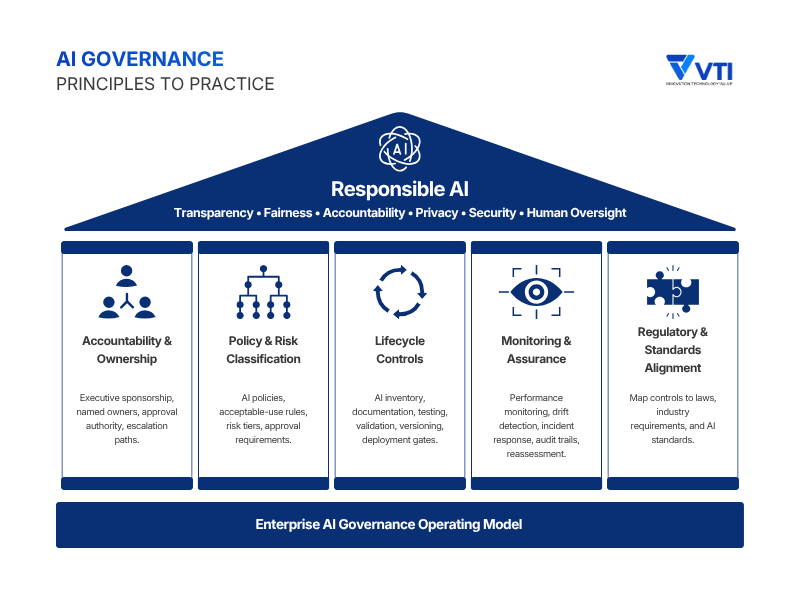
Principles and pillars are closely related, but they serve different purposes.
- Principles define what responsible AI should achieve;
- Pillars define how an enterprise turns those principles into repeatable governance controls.
In simple terms: principles are the outcomes you want, while pillars are the operating mechanisms that make those outcomes real.
For this article, VTI uses six core responsible AI principles: transparency, fairness, accountability, privacy, security, and human oversight.
| Principle | What it aims to achieve | How governance operationalizes it |
| Transparency | Decisions can be understood and traced | Documentation, traceability, monitoring, and audit trails |
| Fairness | Outcomes do not systematically disadvantage people or groups | Risk classification, testing, validation, and periodic review |
| Accountability | A named person or function answers for AI decisions | Clear ownership, approval authority, and escalation paths |
| Privacy | Personal and sensitive data is handled appropriately | AI policies, data controls, risk assessment, and lifecycle governance |
| Security | AI systems, data, and interfaces are protected against misuse | Security controls, monitoring, incident response, and reassessment |
| Human oversight | People can review, override, or stop consequential decisions | Defined approval points, override mechanisms, and escalation rules |
To turn these principles into an enterprise operating model, VTI groups AI governance into five practical pillars:
- Accountability and ownership: executive sponsorship, named business and technical owners, and clear escalation authority.
- Policy and risk classification: written AI policies, acceptable-use rules, risk tiers, and approval requirements.
- Lifecycle controls: AI inventories, documentation, testing, validation, versioning, and deployment gates.
- Monitoring and assurance: performance monitoring, drift detection, incident response, audit trails, and periodic reassessment.
- Regulatory and standards alignment: mapping internal controls to applicable laws, industry requirements, and AI standards.
The distinction matters because a principle without controls remains an aspiration. The pillars provide the organizational machinery that makes responsible-AI principles enforceable, measurable, and auditable.
Major AI Governance Frameworks and Standards
Enterprises do not need to invent governance from scratch. Several established references can be used together.
NIST AI Risk Management Framework (AI RMF)
The NIST AI Risk Management Framework (AI RMF) provides a voluntary structure for managing AI risk through the functions Govern, Map, Measure, and Manage. NIST also publishes a Generative AI Profile that extends the framework to risks that are specific to or amplified by GenAI. AI RMF 1.0 is currently being revised, so organizations should treat it as an evolving reference rather than a static compliance checklist.
The ISO/IEC Standard
ISO/IEC 42001 provides requirements for establishing, implementing, maintaining, and continually improving an AI management system.
ISO/IEC 42005 complements it with a structured approach to AI system impact assessment across the lifecycle.
ASEAN Guide on AI Governance and Ethics
For Southeast Asia, the ASEAN Guide on AI Governance and Ethics provides practical regional guidance for traditional AI, while the Expanded ASEAN Guide on AI Governance and Ethics addresses generative AI issues including accountability, incident reporting, testing, security, and content provenance.
These frameworks are complementary: an enterprise can use them as a common governance baseline, then map controls to local regulations and business-specific risks.
AI Governance Regulations Across APAC
AI governance is developing differently across APAC. Regional enterprises therefore need a shared governance backbone with country-specific overlays.
Japan
Japan combines innovation-oriented legislation with detailed business guidance. The AI Act came into full effect in 2025 and emphasizes promotion of AI research and utilization while addressing risks through government guidance and existing laws.
Japan’s AI Guidelines for Business were updated in March 2026 and provide practical guidance for organizations managing AI across the lifecycle.
For enterprises, the implication is to maintain clear ownership, risk-management processes, documentation, and monitoring rather than treating governance as a one-time compliance exercise.
Singapore
Singapore has built one of the region’s most operational AI governance ecosystems through its Model AI Governance Framework, AI Verify, and newer guidance for generative and agentic AI.
The Model AI Governance Framework for Agentic AI, updated in 2026, focuses on bounding agent autonomy and access, establishing meaningful human approval points, implementing lifecycle controls, and enabling end-user responsibility.
This is particularly relevant as enterprises move from copilots that recommend actions to agents that can execute them.
South Korea
South Korea’s AI Basic Act and Enforcement Decree took effect on January 22, 2026. The regime introduces obligations that are especially relevant to generative AI and high-impact AI, including transparency and labeling requirements, risk-management expectations, and safeguards for higher-impact use cases.
Organizations serving the Korean market should therefore address AI governance during product design and market-entry planning, not after deployment.
Malaysia
Malaysia’s National Guidelines on AI Governance & Ethics provide a national reference for responsible AI adoption built around seven principles: fairness; reliability, safety and control; privacy and security; inclusiveness; transparency; accountability; and pursuit of human benefit and happiness.
For regional organizations, Malaysia reinforces the broader APAC pattern: establish one enterprise governance backbone, then adapt controls to local rules, sector requirements, and risk exposure.
How to Develop an AI Governance Framework?
A practical AI governance framework should translate policy into controls inside the systems and workflows where AI is actually built and used.
Establish Clear Accountability
Every AI system should have an identifiable business owner and technical owner. Higher-risk systems should also have a defined review mechanism involving relevant business, technology, security, legal, compliance, and risk stakeholders.
The objective is simple: when an AI system makes a consequential decision, someone must be accountable for approving, monitoring, escalating, and, when necessary, stopping it.
Define Human Oversight and Incident Response
Organizations should explicitly define when people must review, approve, override, or stop AI decisions. This becomes more important as AI systems gain autonomy.
Governance should also define what happens when something goes wrong: who receives the alert, who can suspend the system, what evidence is preserved, how the incident is investigated, and what conditions must be met before the system returns to service.
Build an AI Inventory
Enterprises cannot govern AI systems they cannot see. Create an inventory covering internally developed models, third-party AI services, embedded AI functionality, generative AI applications, and AI agents.
At minimum, record the business use case, owner, model or provider, data used, affected users, deployment status, and risk classification. The inventory becomes the foundation for auditability, regulatory mapping, and ongoing review.
Classify AI Use Cases by Risk
Not every AI application needs the same governance burden. An internal assistant chatbot should not follow the same approval process as a system influencing credit eligibility, recruitment, clinical decisions, or customer pricing.
Risk classification can consider business impact, impact on individuals, autonomy, data sensitivity, and the reversibility of decisions.
Lower-risk systems can use simplified controls; higher-risk applications require deeper testing, documentation, and human review.
Embed Controls Across the AI Lifecycle
Governance should operate throughout the AI lifecycle rather than as a final compliance review. Before deployment, teams may need to verify data quality, privacy, fairness, security, model performance, and explainability.
Deployment should capture what was approved, which model version entered production, and under what conditions. After deployment, monitoring should detect performance degradation, drift, abnormal behavior, and emerging risks.
A policy that sits outside the workflow is guidance. A control embedded in the workflow becomes governance.
Maintain Evidence and Reassess Risk
AI systems change. Models are updated, business processes evolve, data distributions shift, and third-party providers release new versions.
Governance therefore requires continuing evidence: testing results, approvals, version histories, monitoring logs, incidents, and reassessment records. This allows an organization to demonstrate not only that controls exist, but that they continue to work.
Governing Generative AI and AI Agents
Generative and agentic AI expand governance beyond traditional model risk.
A predictive model may generate a recommendation; an AI agent can potentially use tools, access enterprise data, invoke APIs, modify records, communicate with external systems, or trigger business transactions.
Organizations adopting GenAI and AI agents should therefore consider additional controls around:
- Foundation-model and third-party risk,
- RAG and data-source permissions,
- Prompt and system-instruction management,
- Tool access,
- Action authorization,
- Human approval checkpoints,
- Output evaluation,
- Prompt-injection defenses,
- and Agent activity logging.
As agents become more autonomous, organizations need to place explicit limits on their powers and keep human-in-the-loop meaningfully.
AI Governance Checklist for Enterprise Leaders
To sum up, before scaling an AI system, please ask these questions:
- Do we know which AI systems are in use?
- Does every system have an accountable owner?
- Have we classified the use case by risk?
- Do higher-risk systems have documented approval requirements?
- Can humans review or stop consequential AI decisions?
- Are model versions, tests, and approvals traceable?
- Are deployed systems continuously monitored?
- Do we have an AI incident-response process?
- Are third-party, generative AI, and agentic-AI risks covered?
- Can we demonstrate alignment with applicable market and industry requirements?
What Are Examples of AI Governance Across Industries?
The same governance framework should produce different controls depending on the industry and the consequences of the AI decision.
Retail
Retail AI increasingly influences personalized promotions, dynamic pricing, demand forecasting, recommendations, and inventory allocation.
Governance should define which customer attributes can be used for personalization, acceptable pricing boundaries, override authority for merchandising or store teams, and monitoring for unusual pricing or replenishment patterns.
If a pricing system begins producing unexpected differences across stores or customer segments, teams should be able to trace the model version, input data, decision logic, and approval path before the recommendation reaches customers.
Manufacturing
Predictive maintenance and computer-vision quality inspection create a different risk profile.
Manufacturers need confidence thresholds, acceptable false-positive and false-negative rates, operator escalation procedures, and re-validation when equipment, materials, production lines, or operating conditions change.
The governance question is not only whether the model is accurate, but when its output is reliable enough to trigger an operational action.
Healthcare
Clinical AI requires tighter controls because errors can directly affect patients. Governance should include clinical validation, data provenance, access controls, human review, appropriate explainability, and post-deployment monitoring.
AI can support clinical decisions, but governance must clearly define where professional authority remains with healthcare practitioners.
Banking and Financial Services
Credit scoring, fraud detection, and automated financial decisions require strong auditability. Typical controls include fairness testing, decision records, model validation, explainability, human review for higher-impact decisions, and periodic re-validation when customer behavior or economic conditions change.
Across all four industries, the principle is the same: governance should be designed around the consequence of the AI decision, not simply the technology being used.
Final Words
AI governance is not simply a compliance layer around AI. It is the operating discipline that allows organizations to scale AI with clear accountability and controlled risk.
For enterprises operating across APAC, a practical approach is to build one consistent governance foundation, then adapt controls to the risk of each use case, industry, and market. Done well, governance helps responsible AI, regulatory readiness, and innovation speed reinforce rather than work against one another.
Don’t let compliance and risk concerns hold back your AI initiatives. Explore VTI’s AI Services to see how we help enterprises build robust, production-ready AI systems backed by responsible governance.