






![[FREE EBOOK] Strategic Vietnam IT Outsourcing: Optimizing Cost and Workforce Efficiency](https://vti.com.vn/wp-content/uploads/2026/06/ebook-it-outsourcing.png)


Software outsourcing has been around for roughly 40 years. Especially in recent times, outsourcing software development has witnessed tremendous growth: the market size amounted to over $700 billion in 2025, and about 64% of businesses are now outsourcing their entire development process. There must be a reason for this business model to last so long and to grow so exponentially. Is software outsourcing, then, something not worth your attention, or is it a great opportunity that you are missing out on?
Let’s take an overall look at this technology trend.
What is a software outsourcing service?
Outsourcing is the process of selecting a third-party service vendor to take over technology-related projects. In other words, software outsourcing transfers the project control from in-house resources to a qualified external team that has relevant experience and capabilities to meet the required business needs.
This practice opens opportunities in which project managers can optimize team resources while ensuring satisfying project deliveries.
Got it! So we’ll use the checklist section as the main addition, and drop “When Hiring Stops Being the Answer” entirely. Here’s the clean structure:
Why use a software outsourcing service?
Software outsourcing is the first and most potential choice from the viewpoint of meeting three major demands of an IT project: cost & time reduction, product quality assurance, and human resources optimization.
Significant cost savings
According to Deloitte, about 59% of companies take advantage of software outsourcing to cut down on costs.
Outsourced teams do not require such hiring expenses as scouting, training, onboarding, etc. Furthermore, if project managers go for offshore outsourcing models, in which the project is outsourced overseas, labor costs are usually lower. This explains why software outsourcing cuts down a great deal on money, as IT labor costs usually account for the largest percentage of a software development project. In some cases, the introduction of software outsourcing services can reduce costs by 30 to 50% compared to using in-house resources.

Access to top-notch human resources
IT talents do not normally travel from one state/country to another, and thus are limited to a specific geographical area only. This makes access to world-class talents sometimes implausible – this is where a software outsourcing service enters the fray. Project managers can now have some of the highest-skilled developers from the other side of the world at a click on an outsourced basis.
High-quality deliveries
For the most part, outsourced teams only take up projects in certain fields in which they have strong expertise. Offshore resources can therefore better assure qualified project deliveries for these three competencies:
- They have accumulated thorough niche know-how in their specialized industry field, therefore able to deeply understand customers’ problems. In some cases, an outsourced team can even accommodate customers with market insights and consult the best solution to given requirements
- They are IT specialists; there is hence no question of familiarity or knowledge of technology. This is undoubtedly a key competency when it comes to committing to delivered project qualities
- After years of experience in providing software development services, they have developed an implementation roadmap that optimizes resources while minimizing risks and errors
Faster time to market
Since the outsourced team is already experienced and highly skilled, it stands to reason that they need little to no time for onboarding, training or learning. Furthermore, software outsourcing more often than not applies a lean process that sets the whole development process in high gear and thereby considerably decreases delivery time.
Easy scalability
During project development, even when project managers try to put everything into the calculation, the scope of work may still either grow or decrease. This leads to the development team either scaling up or down, which poses a headache when it comes to in-house resources. Software outsourcing will be the potential solution in case the team size needs adjustment, since they usually run more than one project at a time.
Focus on core business
Software outsourcing is a great approach to make up for a lack of internal resources. Instead of forcing in-house teams to take care of the work they are not equipped to deal with, outsourced teams can take over what they are good at. This way, full-time employees can better focus on strategic goals that directly contribute to core business growth.
A Checklist: When Outsourcing Becomes Strategic
Not every operational challenge calls for outsourcing, but certain patterns signal that it’s time to consider it seriously. Use this checklist to assess whether your organization has reached the point where outsourcing becomes the smarter path forward.
Build: Development & Delivery Challenges
☑ Your team is consistently behind schedule, despite no major scope changes
If delivery timelines keep slipping even when requirements haven’t significantly changed, the issue is often capacity or capability – not planning. This is one of the clearest signs that your current team structure isn’t sustainable.
☑ Onboarding new hires takes longer than it used to
If it now takes 3-6 months (or more) for a new team member to become productive, your internal systems and processes have grown too complex for traditional hiring to scale efficiently. Outsourced teams with pre-existing specialization bypass this ramp-up entirely.
☑ You need specific technical expertise that’s hard to find or develop locally
Whether it’s a niche cloud platform, a specialized programming language (COBOL, Rust, etc.), modern frameworks, or deep domain knowledge in a regulated industry, some skills simply aren’t available in your hiring market – or would take too long to develop internally. In 2026, 56% of decision-makers cite “access to unavailable skills” (particularly in AI, Machine Learning, and Cybersecurity) as their top reason for outsourcing.
☑ Feature development has stalled while the team focuses on firefighting
When planned roadmap work keeps getting pushed back because the team is constantly pulled into urgent fixes, escalations, or unplanned work, you’ve lost the capacity to build. Outsourcing can take over defined workstreams so internal teams can return to strategic development.
☑ You’re spending more budget on recruitment and retention than on delivery
High turnover, competitive salary pressures, and constant hiring cycles drain resources that could be invested in actual product development. Outsourcing shifts this dynamic by giving you predictable costs and immediate capability.
Run: Operations & Maintenance Challenges
☑ Critical expertise is locked in one or two individuals
When a few senior engineers become bottlenecks – pulled into every major decision, every escalation, every troubleshooting session – your organization has a knowledge concentration problem. Adding junior hires won’t solve this. You need parallel expertise that can operate independently.
☑ Maintenance work is crowding out innovation
When your team spends the majority of its time keeping systems running rather than building new features or improving architecture, you’ve hit an operational ceiling. Outsourcing maintenance workloads frees internal resources to focus on strategic initiatives.
☑ Your infrastructure or platform has recently been modernized, but operational demands haven’t decreased
Post-migration or post-modernization, many organizations expect workloads to get easier. Instead, they find that while the technology is better, the operational complexity has shifted – not reduced. Outsourcing helps manage this new operational reality without overloading your existing team.
☑ Incident resolution is taking longer, even for familiar issues
When your team’s mean time to resolution (MTTR) is increasing despite no major changes in infrastructure, it’s often a sign of capacity erosion – too much operational load with too few resources. Outsourced operational support can restore response times.
☑ Leadership expects broader coverage without increasing headcount
If you’re being asked to do more with the same team size – or even fewer people – outsourcing is one of the few ways to actually deliver on that expectation without burning out your staff.
If you checked three or more boxes across both categories, software outsourcing is likely the right next step. And the question now isn’t whether to consider it – it’s which model fits your needs and how quickly you can start.
Software outsourcing models
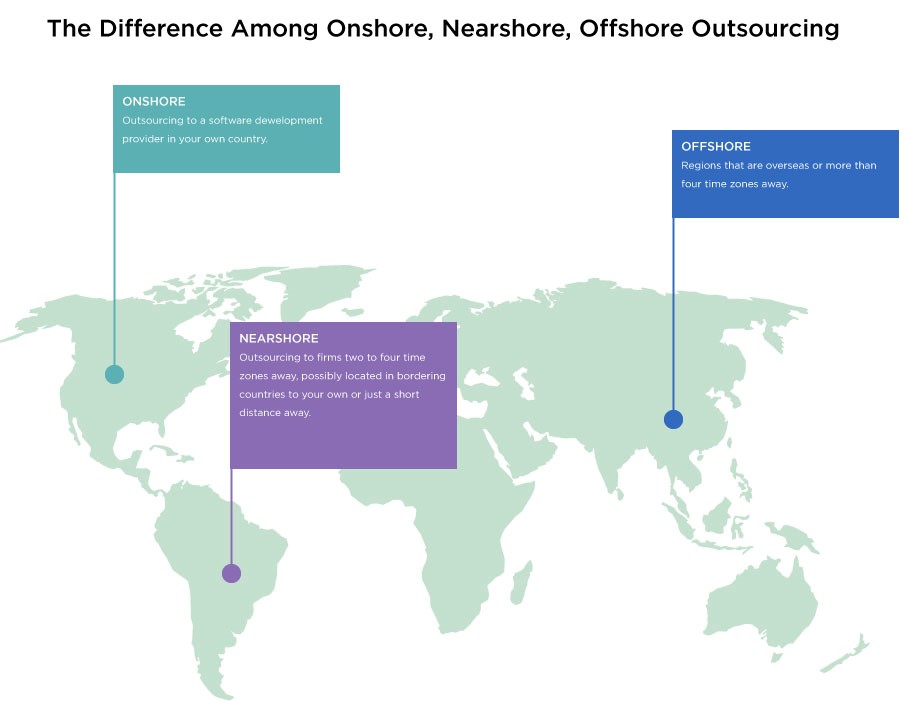
1. Based on geographical location, software outsourcing is categorized into 05 models:
- On-site outsourcing:
An outsourcing vendor sends their high-level personnel to the client’s location.
- Onshore outsourcing:
Client contracts with any other software development provider within the country, but not within the company
- Nearshore outsourcing:
An outsourced team is from the same or neighboring countries, suitable for those cases when geographic proximity needs to be taken into account
- Offshore outsourcing:
The task is transferred to a possible country worldwide
- Multi-shore outsourcing:
The client works with multiple software outsourcing vendors on the same project
2. Based on responsibility share, software outsourcing is categorized into 03 models:
- Staff Augmentation:
The client takes the majority of the responsibility, hiring technology specialists from an outsourcing vendor to strengthen the development team
- Managed team:
Responsibility is shared by the client, the outsourcing vendor, and the managed team, which works separately from an in-house team
- Project-based:
Software outsourcing vendor takes most of the responsibility, executing the project according to the client’s requirements
Choose VTI as your business’s outsourcing partner
VTI is an outsourcing vendor in Vietnam, providing software development, automation implementation, digital transformation, and high-tech services for companies of all sizes across diverse industries: manufacturing, retail, finance, construction, transportation, and Internet services.
With 8 years of experience, VTI has a track record of over 1200 projects and is working on reforms every day. Certified as an AWS Advanced Consulting Partner, CMMI Level 3, we provide IT services as a partner to more than 300 companies in Japan, South Korea, and Vietnam. We utilize our niche industry knowledge and experience to offer the most suitable solutions. We, 1800 VTI employees, will work together as one.
If you have any further questions, please feel free to contact us.