






![[FREE EBOOK] Strategic Vietnam IT Outsourcing: Optimizing Cost and Workforce Efficiency](https://vti.com.vn/wp-content/uploads/2023/08/cover-mockup_ebook-it-outsourcing-20230331111004-ynxdn-1.png)


What separates a successful investor from someone drowning in debt? It’s rarely the amount they owe – it’s how they think about it. The same principle applies to technical debt management.
Most organizations treat it as a liability to be ashamed of, something to hide from the business side and quietly apologize for during every delayed sprint. But the most competitive technology teams in the world carry technical debt too – they just manage it with the same discipline a seasoned investor brings to a portfolio.
In an era where AI adoption is accelerating, and legacy architecture can make or break a transformation initiative, that mindset shift is the difference between teams that lead and teams that just keep paying interest. And this guide will show you how to make that shift.
TL;DR – In this guide:
- What it is: Technical debt is the compounding cost of shortcuts taken during development – across code, architecture, infrastructure, security, and process
- How it’s classified: Martin Fowler’s quadrant separates strategic debt (prudent & deliberate) from governance failures (reckless & deliberate) – knowing which you have determines your response
- How to measure it: Each domain has its own signal – from cyclomatic complexity and TDR for code, to DORA metrics for infrastructure, to patch latency for security
- How to manage it: Prioritize by business impact, embed remediation into development rhythms, modernize strategically, leverage AI at both the creation and operations stage, and build a prevention culture
- When to bring in outside help: When the skill set is genuinely scarce, internal bandwidth is maxed out, deadlines are non-negotiable, or blind spots are blocking progress
What Is Technical Debt? And How It’s Changing in the Modern Era
Technical debt is the future cost your organization pays for the shortcuts taken today – the hastily written code pushed to meet a launch deadline, the infrastructure decisions made for convenience rather than scalability, or the legacy system still kept running because migration felt too risky.
First coined by Ward Cunningham, the term describes the trade-off that development teams face when choosing a faster solution over a better one – and the accumulated interest that follows when those trade-offs go unaddressed.
Think of it like a business loan: taken deliberately, it funds growth. Left unmanaged, the interest compounds until it costs more than the original shortcut ever saved. But like in finance, the actual risk isn’t carrying debt. It’s not knowing what you’re carrying.
Modern technical debt management exists to change that – to turn an uncontrolled liability into a strategic lever your organization can actually use.
What is modern technical debt management?
Modern technical debt management is a continuous, strategic discipline that treats debt as a portfolio to be governed, not a backlog to be occasionally groomed – a significant shift from the traditional break-fix approach.
In today’s landscape, this takes on new urgency. AI initiatives, cloud migrations, and platform modernization efforts don’t just add new layers on top of existing architecture – they expose every weak joint underneath it. Organizations that want to move fast on AI adoption need a foundation clean enough to build on, and the strategic clarity to know where debt will slow them down most.
That makes technical debt management not just an engineering concern, but a boardroom one.
Debt can be leveraged, not just managed
The organizations managing technical debt well treat it as a recurring discipline, not a one-time cleanup. That means knowing exactly what debt exists, where it lives, and what it’s costing – so leadership can make informed decisions about when to carry it and when to pay it down.
Managed well, technical debt isn’t a liability on your balance sheet. It’s a lever – one that, pulled at the right time, lets your organization move faster than competitors who are too afraid to borrow at all.
Where Your Technical Debt Comes From – And Where It’s Been Hiding?
To manage debt effectively, you first need to know where it comes from. The organizations that struggle most with technical debt aren’t necessarily the ones carrying the most of it – they’re the ones that can’t tell the difference between a calculated trade-off and an accumulating problem.
There are two lenses worth applying here: one strategic, one structural.
Lens 1: The Decision Matrix – How Debt Is Born
The most useful framework for understanding technical debt origins comes from Martin Fowler’s Technical Debt Quadrant, which classifies debt across two dimensions:
- Reckless vs. Prudent: Was the debt incurred through poor decision-making, or was it a deliberate, informed trade-off?
- Deliberate vs. Inadvertent: Did the team knowingly take on debt, or did it accumulate without awareness?
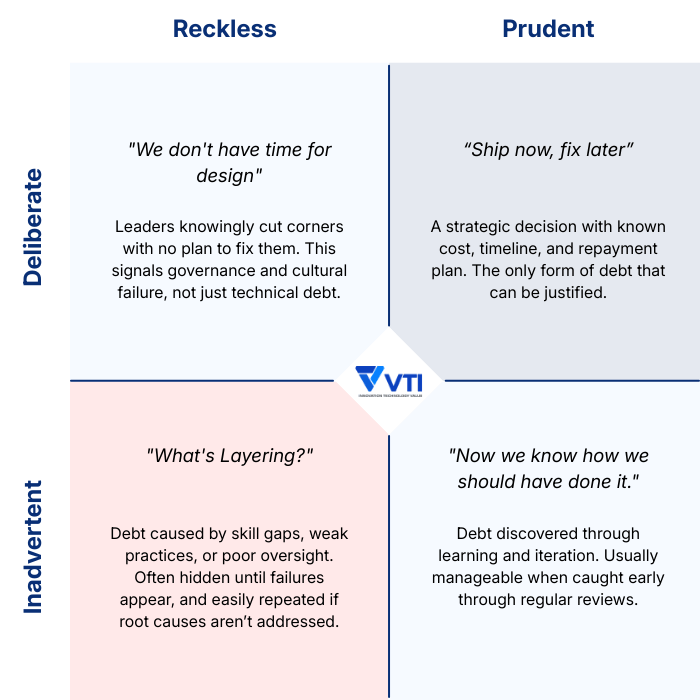
These two axes produce four distinct debt profiles:
Reckless & Deliberate – “We don’t have time for design.” The most damaging category. Leadership knowingly cuts corners without a plan to address consequences. This is not a trade-off – it’s a governance failure. If this quadrant describes your organization, no amount of refactoring will fix the underlying problem. The issue is cultural, and it starts at the top.
Reckless & Inadvertent – “What’s Layering?” Debt that emerges from skill gaps, poor practices, or a lack of oversight. Often invisible until systems start breaking. The danger here is misdiagnosis – teams treat the symptoms without addressing the root cause, and the same debt re-accumulates in a different form.
Prudent & Deliberate – “We must ship now and deal with consequences later.” The only genuinely strategic form of debt. A conscious decision with a known cost and a repayment plan. This is the quadrant every CTO should be aiming for – debt taken on your terms, with a clear exit. Acceptable when the business case is clear and the timeline is defined.
Prudent & Inadvertent – “Now we know how we should have done it.” Debt discovered in hindsight – not from negligence, but from learning. Manageable when caught early. The key is building review cadences that surface this debt before it migrates into the Reckless quadrants.
For technology leaders, the goal isn’t to eliminate all debt – it’s to ensure the vast majority sits in the Prudent & Deliberate quadrant, where it can be governed and repaid on your terms.
Lens 2: The Structural Taxonomy – Where Debt Lives
Once you understand how debt originates, the next question is where it accumulates. Debt manifests across five primary domains in modern organizations:
- Code debt results from rushed development, inconsistent practices, and poor documentation. Left unaddressed, it becomes the silent tax on every future feature – each new addition takes longer, breaks more, and costs more to maintain than it should.
- Architectural debt emerges when a system’s foundation lacks scalability or flexibility. This is the category most likely to become a hard blocker on AI adoption and platform modernization – you cannot build a modern data pipeline on top of a monolith that was never designed to be opened up.
- Infrastructure & DevOps debt accumulates through outdated deployment processes and inefficient CI/CD pipelines. The business impact is direct: slower releases, higher operational costs, and engineering teams spending cycles maintaining infrastructure instead of shipping value.
- Security debt arises when encryption, authentication, or vulnerability patching is deferred. In a compliance-heavy environment, this carries the highest asymmetric risk – the cost of a single breach or regulatory failure vastly outweighs years of remediation investment. This is the debt category that turns into board-level conversations.
- Process debt stems from poor collaboration, unclear workflows, and missing documentation. Often the hardest to quantify, and frequently misdiagnosed as a people problem rather than a structural one. When onboarding takes three months, and institutional knowledge lives in one engineer’s head, you have process debt – and it compounds every time someone leaves.
Key takeaway: Together, these two lenses give technology leaders a complete diagnostic picture – not just a list of problems, but a way to understand their origin and their organizational impact. Knowing that a debt is reckless and inadvertent sitting inside your core infrastructure tells you something very different than prudent and deliberate debt in your codebase. The classification shapes the response.
But classification alone isn’t enough. The next challenge is quantification – being aware of not just what kind of debt you have, but also being more detailed. How much, where exactly it lives, and what it’s costing your organization right now. This answers: “How bad is it and where exactly should you take action now?
How to Quantify Technical Debt?
Without quantification, even the most experienced technology leaders are making prioritization decisions based on instinct rather than evidence. The challenge is that technical debt doesn’t live in one place or show up in one metric. It surfaces differently across each of the five domains.
Code Debt – Complexity and Decay
The primary metric is cyclomatic complexity – the number of independent execution paths through a piece of code. Higher complexity means higher maintenance burden and slower future development. Scores above 10 per module are widely considered to signal refactoring priority.
Defect density – confirmed defects per unit of code – reveals where quality has degraded over time. Together, these feed into the Technical Debt Ratio (TDR): the ratio of remediation cost to total development cost.
Architectural Debt – Structural Risk
Key indicators include component coupling (how dependent system parts are on each other), modularity scores (how cleanly a system can be decomposed), and dependency age (how outdated underlying frameworks have become).
The SEI recommends evaluating change absorption capacity – the effort required to implement a meaningful system change. When that effort grows disproportionate to the scope of the change, architectural debt is compounding.
Infrastructure & DevOps Debt – Delivery Friction
The DORA metrics – developed by Google’s DevOps Research and Assessment team – are the industry standard here. covering four key indicators:
- Deployment frequency – how often code is successfully released
- Lead time for changes – how long it takes to go from commit to production
- Change failure rate – the percentage of deployments causing incidents
- Time to restore service – how quickly teams recover from failures
Elite organizations deploy multiple times daily with lead times under an hour. Deployments measured in weeks and recovery times measured in days are reliable signals of accumulated infrastructure debt.
Security Debt – Exposure and Latency
Measured through vulnerability exposure (known unpatched vulnerabilities) and patch latency (time between identification and remediation). IBM’s Cost of a Data Breach Report benchmarks the average breach cost at $4.88 million globally, with unpatched vulnerabilities and misconfigured infrastructure among the leading contributors.
In regulated industries, security debt also manifests compliance gaps – areas where current architecture fails to meet regulatory requirements, carrying both financial and reputational risk.
Process Debt – The Human Cost
Process debt is the hardest domain to quantify, but its impact is visible in operational data. Key indicators include:
- Onboarding time – how long it takes a new engineer to become productive
- Incident recurrence rate – how often the same class of problem reappears
- Documentation coverage – the proportion of systems and processes with current, accurate documentation
- Unplanned work ratio – the percentage of engineering capacity consumed by reactive work rather than planned development
Key takeaway: No single metric tells the full story. The goal is a clear enough picture to make informed trade-offs – combining quantitative signals across domains with qualitative input from architectural reviews, developer surveys, and post-incident analyses. When multiple domains score poorly simultaneously, those intersections are where the highest-priority decisions live.
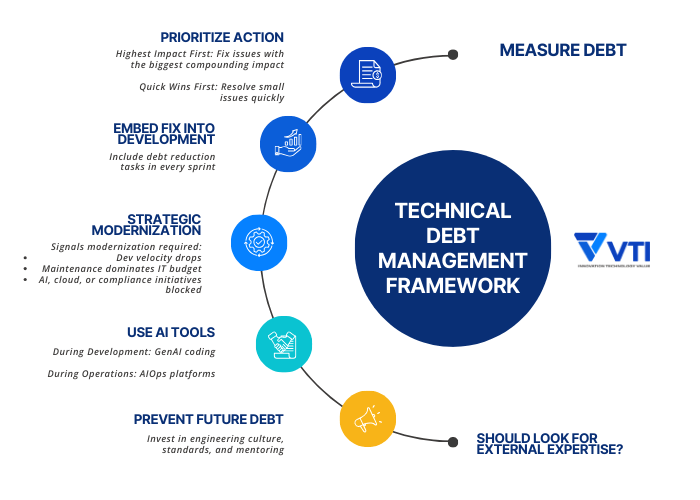
How to Manage Technical Debt? 5 Best Practices in the AI Era
There are five strategic levers worth applying, each mapping back to the debt types and causes covered earlier.
1. Prioritizing is Key
The first strategic decision after measurement is where to act first. Two prioritization approaches work well in practice – both borrowed from financial debt management:
Highest interest first – tackle the debt with the biggest compounding impact: the architectural bottleneck blocking your AI initiative, the security vulnerability in a regulated system, the infrastructure debt slowing every release. This is where remediation delivers the most immediate business return.
Lowest balance first – resolve smaller, faster wins to build organizational momentum and demonstrate tangible progress to stakeholders. Particularly effective when securing executive buy-in for larger remediation programs.
The choice between these approaches depends on your organization’s urgency and culture – but the key is that prioritization is a deliberate, business-aligned decision, not a reactive one.
2. Embed Remediation Into the Development Rhythm
Sadly, there is no such one-time cleanup, but it goes along with your system development.
Therefore, it is good to include debt reduction activities alongside regular user stories – a few per development cycle. This allows teams to balance remediation with new development without halting delivery.
This approach is particularly effective for code debt and process debt – domains where incremental improvement compounds over time and doesn’t require large-scale architectural decisions.
3. Modernize Strategically for Architectural and Infrastructure Debt
When incremental fixes are no longer sufficient – particularly for architectural and infrastructure debt – a structured modernization program becomes necessary. The signals are recognizable: development velocity has declined significantly, maintenance costs are consuming a disproportionate share of the IT budget, or critical initiatives like AI adoption, cloud migration, and compliance upgrades are blocked by the existing architecture.
At that point, modernization isn’t a cost – it’s a prerequisite for growth. IBM Institute for Business Value research makes the business case concrete: enterprises that fully account for technical debt in their advanced tech business cases (AI, cloud, etc) project up to 29% higher ROI than those that don’t, while organizations that ignore it risk losing 18% to 29% of expected returns. The debt was always costing something. Modernization simply makes that cost visible – and recoverable.
4. Leverage AI – From Code Generation to Operations
AI is reshaping technical debt management across the entire development lifecycle – but its role looks different depending on where you are in that cycle.
At the development stage, GenAI coding assistants accelerate delivery and can actively reduce debt by suggesting cleaner implementations, flagging code smells, and surfacing refactoring opportunities in real time.
At the operations stage, AIOps platforms shift technical debt management from periodic assessment to continuous visibility. By applying machine learning across infrastructure, code health, and system performance, these platforms surface anomalies before they become incidents and identify debt accumulation patterns across all five domains – automatically and at scale. For CxOs, the strategic value isn’t just operational efficiency. It’s the shift from reactive debt discovery to proactive debt governance.
Together, these two layers – AI at creation, AIOps at operation – give technology leaders something traditional approaches never could: end-to-end visibility over where debt is being introduced and where it is silently compounding. More prudent and Deliberate.
5. Build Prevention Into the Culture
Finally, the most sustainable technical debt management strategy is reducing the rate at which new debt accumulates. This means embedding quality standards into development workflows:
- Establishing architectural governance at the design stage
- Creating psychological safety for engineers to flag debt as it forms rather than after it compounds
This becomes even more important as AI-assisted development accelerates. AI code assistants can contribute to technical debt if their outputs are accepted without proper review – introducing inconsistencies or unnecessary dependencies that later require refactoring. Human-in-the-loop oversight and code review discipline become more important, not less.
But tools and processes only go so far. Ultimately, prevention comes down to the people behind them – their skills, their judgment, and the culture that shapes how they make decisions under pressure. It is most directly linked to reckless and inadvertent debt from the Fowler matrix – the category that emerges from skill gaps and poor practices. Closing those gaps through mentorship, standards, and review culture is the highest-leverage long-term investment a technology leader can make.
Should It Make Sense to Bring in External Expertise?
It depends. No technology leader chooses outsourcing as a first option. It comes with coordination overhead, knowledge transfer risk, and cultural friction that every CIO would rather avoid. But there are scenarios where the honest, strategic answer isn’t “how do we do this internally” – it’s “who is best positioned to solve this, and how quickly do we need it done?”
Those scenarios are more common than most leaders publicly acknowledge:
- The skill set simply doesn’t exist internally or anywhere nearby. Modernizing a COBOL-based core banking system, building a production-grade AI pipeline, or migrating a decades-old ERP requires genuinely scarce expertise. The talent market for these specializations is thin, hiring timelines are long, and the window for action rarely waits.
- The debt has outpaced internal bandwidth. When engineering teams are simultaneously maintaining legacy systems, delivering new features, and absorbing incident load, adding a major remediation program doesn’t stretch capacity – it breaks it. Something will be deprioritized. The question is whether that’s a deliberate choice or a slow drift.
- A compliance or security deadline is non-negotiable. Regulatory timelines don’t adjust for internal resource constraints. When the cost of missing a deadline – financial, reputational, or operational – exceeds the cost of external engagement, the calculus is straightforward.
- Organizational blind spots are blocking progress. Teams that have lived with legacy architecture for years often can’t see it clearly anymore. What looks like a manageable system from the inside can carry critical structural risk that only surfaces under an external assessment.
The outsourcing partner doesn’t replace your team – they work alongside it, transferring knowledge back rather than creating new dependency.
The strongest technology leaders aren’t the ones who solve everything internally – they’re the ones who know exactly when and whose expertise suits the situation and accelerates outcomes.
Final words
Technical debt isn’t just a developer problem – it’s a business strategy issue that directly impacts your bottom line, market agility, and competitive advantage. Managing technical debt reduces friction in software development. The organizations that treat technical debt management as a core business practice, not an afterthought, consistently outperform those that let it accumulate unchecked. By implementing systematic measurement approaches, embedding debt reduction into regular workflows, and leveraging the right tools and frameworks, you can transform technical debt from a productivity drain into a manageable aspect of technology leadership.
The key is starting now, before small issues become expensive crises. Take time to assess your current debt levels and establish the governance structures that will keep your technology assets working for you, not against you.