






![[FREE EBOOK] Strategic Vietnam IT Outsourcing: Optimizing Cost and Workforce Efficiency](https://vti.com.vn/wp-content/uploads/2023/08/cover-mockup_ebook-it-outsourcing-20230331111004-ynxdn-1.png)


Did you know that 85% of Fortune 500 financial transactions still run on COBOL programming language, which was created in 1959?
Yet 72% of experienced COBOL developers are expected to retire within the next decade, creating a critical talent gap that demands immediate attention.
This comprehensive guide explores what COBOL is, why enterprises continue to rely on it, and what strategies you should consider for the future. Our goal is to help you make informed decisions about whether to invest in retaining COBOL expertise or modernizing your systems.
What is COBOL programming language?
COBOL (Common Business-Oriented Language) is a procedural programming language developed in 1959 specifically for business, finance, and administrative systems.
Unlike modern languages designed for web or mobile applications, COBOL was engineered for processing massive volumes of transactional data with absolute precision – a requirement that remains critical for banking, insurance, and government operations today.
The language’s uniqueness lies in its verbosity. Its English-like syntax makes business logic readable for non-programmers, though it feels unfamiliar to developers trained in contemporary programming paradigms.
Consider this simple price calculation example:
| COBOL | JAVA |
| ADD PRICE TO TAX GIVING TOTAL-PRICE. | totalPrice = price + tax; |
COBOL applications typically run on mainframe systems with Job Control Language (JCL) managing batch processing and file operations. These systems handle complex calculations, data validation, and regulatory reporting that enterprises depend on for core revenue-generating functions.
What are the advantages of COBOL programming language?
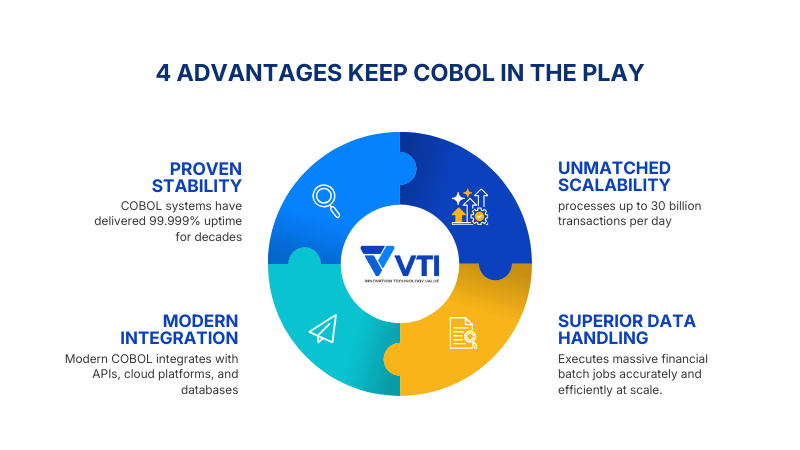
Proven Stability
COBOL systems at major banks have achieved 99.999% uptime over decades. The language’s verbose syntax and strong typing catch errors at compile-time rather than runtime, preventing the cascading failures that plague more loosely-typed languages.
Unmatched Scalability
Mainframes running COBOL, like IBM’s one, can process up to 30 billion transactions daily, making them essential for credit card processors, stock exchanges, and social security systems. The language’s design for batch processing enables efficient handling of massive data volumes.
Superior Data Handling
COBOL’s fixed-point decimal arithmetic eliminates rounding errors in financial calculations. Its comprehensive file handling supports sequential, indexed, and relative access methods optimized for different use cases. When processing millions of records nightly, these optimizations translate to hours of saved processing time.
Modern Integration Capabilities
Contemporary COBOL systems can integrate with REST APIs, consume JSON and XML, connect to SQL databases, and deploy on cloud platforms including AWS, Azure, and IBM Cloud.
Modernization tools enable COBOL programs to expose functionality as web services while preserving decades of tested business logic.
Is COBOL programming still in use?
Yes. Despite being over 60 years old, COBOL remains essential for mission-critical operations thanks to its advantages. According to Reuters, an estimated 220 billion lines of COBOL code continue to power critical daily operations across government and banking institutions globally.
Major financial institutions – JPMorgan Chase, Wells Fargo, Bank of America, Citigroup, and Deutsche Bank – depend on COBOL for core banking functions and real-time payment processing. Insurance leaders like MetLife and Prudential use COBOL for policy management and claims processing.
In Asia, Japanese megabanks like Mizuho and MUFG continue upgrading their COBOL infrastructure, while governments in Singapore, Korea, and Malaysia rely on mainframes for tax processing and citizen services.
Alarming Market Trends and Skills Shortage
Despite COBOL’s continued use, organizations face mounting pressure to address their aging workforce. The scarcity of COBOL talent has driven developer salaries to exceed $120,000 annually, yet many positions remain unfilled.
This creates a critical dilemma: Should organizations maintain their current systems by investing in retention strategies, or transform their technology entirely through modernization?
The answer depends on your organization’s specific circumstances, risk tolerance, and strategic priorities.
Transform your legacy COBOL systems with expert guidance - contact our highly experienced specialists for a comprehensive assessment today.Carry your COBOL assets into the future with VTI
How to Manage and Retain Your COBOL Developer Workforce?
Major financial institutions are investing millions in retention strategies to preserve institutional knowledge before it disappears. Here are four proven approaches:
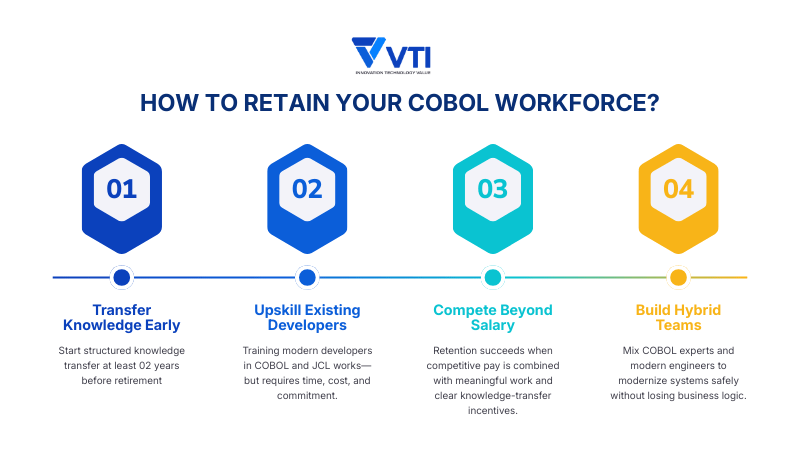
1. Transfer Knowledge Before It’s Too Late
Government agencies have found that structured knowledge transfer programs can capture 85% of critical system knowledge within 12-18 months. Successful programs include:
- Pair programming sessions where senior developers work alongside junior staff
- Documentation sprints to record business rules and system quirks
- Video recordings of senior developers explaining complex system logic
- Shadowing rotations where newer developers observe day-to-day problem-solving
Key Insight: Start this process at least two years before planned retirements. Waiting until someone gives notice is too late.
2. Train Your Existing Development Team
Most modern developers know Java, Python, or JavaScript, but COBOL programming language feels like learning a foreign language. They also need to learn JCL (Job Control Language), which controls how COBOL programs run on mainframes.
This approach works but requires significant investment. Intensive COBOL training costs $3,500-$4,000 per person for 3-5 days. For a team of 10 developers, that’s $35,000-$40,000 in direct costs, not including time away from regular work.
3. Pay Competitively and Offer Meaningful Work
The Market Reality:
- Entry to mid-level COBOL developers: $75,000-$95,000 annually
- Senior COBOL developers: $95,000-$120,000 annually
- Expert-level specialists: $120,000+ (sometimes significantly more in competitive markets)
But remember that money alone won’t retain talent. Successful retention programs combine:
- Financial incentives tied to specific knowledge transfer milestones
- Flexible work arrangements (remote work, flexible hours)
- Involvement in modernization projects bridging legacy and modern technologies
- Retention bonuses are paid when developers successfully train their replacements
4. Build Hybrid Technology Teams
Instead of isolating “COBOL people” from “modern tech people,” create integrated teams where both groups collaborate.
Why This Works? COBOL veterans understand business logic and system architecture, while modern developers bring expertise in cloud platforms, APIs, and contemporary tools. Together, they can modernize systems gradually without breaking critical functionality.
Example Structure:
- 2-3 senior COBOL developers (system knowledge experts)
- 2-3 cloud/API developers (integration specialists)
- 1 architect who understands both worlds
- 1 product manager to prioritize modernization efforts
These teams require careful management. COBOL veterans and modern developers often have different communication styles and work approaches. Clear protocols and mutual respect are essential for success.
The Limitations of the Retention Strategy
While retention strategies can work, they come with significant challenges that organizations must acknowledge:
Time and Recruitment Constraints
Knowledge transfer takes 12-18 months minimum. You’re also recruiting from a shrinking talent pool where young developers often prefer working with AI and modern cloud technologies over maintaining legacy systems.
Investment Risk
Training a developer in COBOL costs thousands of dollars. If a competitor offers them significantly higher compensation six months later, your training investment benefits your competition.
Slow System Evolution
COBOL programming language systems are monolithic – built as one giant block of code rather than modular pieces. Adding a new mobile banking feature might take months instead of weeks because changes risk breaking interconnected components.
Accumulating Technical Debt
Training teaches people to use existing code but doesn’t address underlying structural problems. Years of patches, workarounds, and undocumented changes keep accumulating, making systems increasingly fragile.
Integration Complexity
While COBOL systems can technically integrate with modern technology, it’s not seamless. Teams must build “wrapper” systems – translation layers between COBOL and modern APIs – which are fragile and increase failure risk.
Rising Compliance Costs
Cyber insurance providers charge 40-60% higher premiums for companies running legacy systems because COBOL systems struggle to support modern encryption standards and real-time security monitoring.
Is the Retention Strategy Right for Your Company?
The COBOL retention approach works well for specific types of organizations. Use this checklist to assess fit:
Financial Situation:
- ✓ Limited capital for large upfront investments
- ✓ Steady operational budget for ongoing expenses
- ✓ Fully paid-off mainframe infrastructure
System Characteristics:
- ✓ COBOL system is a massive, undocumented “black box”
- ✓ Business logic is too complex to reverse-engineer safely
- ✓ Business rules rarely change
- ✓ System has been legally proven and certified for decades
Risk Tolerance:
- ✓ Zero tolerance for system downtime
- ✓ Migration errors could be catastrophic to your business
- ✓ Operate in a heavily regulated industry requiring extensive recertification
Organizational Capacity:
- ✓ Can absorb change within the IT department only
- ✓ Don’t need to retrain the entire company on new interfaces
- ✓ Can commit to 12-18-month knowledge transfer timelines
Warning Signs Retention Won’t Work:
- ✗ Need rapid system changes to compete in your market
- ✗ Struggling to attract any IT talent due to the technology perception
- ✗ Cyber insurance costs are becoming prohibitive
- ✗ Need modern features like real-time mobile integration
- ✗ Operational costs for mainframes are eating into profits
Transform your legacy COBOL systems with expert guidance - contact our highly experienced specialists for a comprehensive assessment today.Carry your COBOL assets into the future with VTI
Should I Modernize COBOL Applications?
Modernization doesn’t mean discarding decades of proven COBOL code. It means transforming how your COBOL systems work while preserving valuable business logic. Think of it as renovating a historic building – you keep the strong foundation but update the infrastructure to meet current needs.
A 2024 survey from Kyndryl found that 77% of financial institutions in Asia are pursuing modernization as their COBOL experts retire faster than they can train replacements.
Why Companies Choose Modernization?
Talent Accessibility
Instead of competing for a shrinking pool of COBOL experts, modernization opens your systems to millions of Java, Python, and cloud developers already in the market. Insurance companies report filling developer positions 3-4x faster after modernization.
Increased Agility
Banks modernizing their core systems report 50-80% faster time-to-market for new digital features. Mobile banking features that would take months in legacy COBOL now take weeks.
Reduced Operating Costs
Organizations moving from mainframes to cloud platforms report $2-5 million in annual infrastructure savings. Modern systems also qualify for 40-60% lower cyber insurance premiums.
Seamless Integration
Government agencies report integration projects that previously took 6-12 months are now completed in 4-8 weeks. Your systems speak the same language as modern applications and APIs – no fragile “wrapper” systems needed.
For detailed implementation strategies, technical approaches, and real-world case studies, see our comprehensive guide on modernization here.
When Should You Choose Modernization for Your Company?
Modernization requires upfront investment and careful execution, but it’s the right choice for organizations facing these realities:
Business Pressure:
- ✓ Competitors launch features faster, causing market share loss
- ✓ Customers demand mobile-first, real-time digital experiences
- ✓ Need frequent integration with modern platforms and APIs
Talent Crisis:
- ✓ Can’t find or retain COBOL developers at any price
- ✓ COBOL experts are retiring within 2-5 years
- ✓ Young developers reject job offers due to your tech stack
Financial Reality:
- ✓ Have capital for strategic investment ($500K-$5M depending on system size)
- ✓ Mainframe and COBOL maintenance costs consume 30%+ of the IT budget
- ✓ Rising cyber insurance premiums are becoming a significant expense
Strategic Commitment:
- ✓ Digital transformation is a company priority with executive buy-in
- ✓ Need to add new features regularly (monthly or quarterly releases)
- ✓ Willing to invest 12-24 months in transformation for long-term gains
Warning Signs Modernization Might Not Be Necessary:
- ✗ Business rules rarely change (agility doesn’t matter)
- ✗ Lack of executive sponsorship and a dedicated modernization budget
- ✗ Mainframe infrastructure is paid off and running cost-effectively
Final Words
COBOL programming language isn’t disappearing anytime soon – it’s too embedded in the financial backbone of global commerce. The question isn’t whether COBOL will survive, but how your organization should strategically address the aging workforce challenge.
- Choose retention if: You have stable systems in a regulated industry, a low tolerance for change risk, limited capital for large investments, and can commit to long-term knowledge transfer programs.
- Choose modernization if: You need business agility, face talent shortages that retention can’t solve, have strategic capital available, and need your systems to support digital transformation.
In fact, large organizations still do both – retaining knowledge for mission-critical systems that can’t be touched while working with COBOL partners to modern systems that need to evolve.
The key is honestly assessing which systems fall into which category based on your company’s specific circumstances, not industry trends or vendor pressure.
The organizations thriving today take measured approaches: preserving decades of battle-tested business logic while gradually moving to modern architectures. Whether you choose rehosting for quick wins, refactoring for complete transformation, or hybrid approaches that bridge old and new, success depends on planning, skilled teams, and executive commitment.
The cost of inaction – talent shortages, operational risks, and competitive disadvantage – far outweighs the investment in thoughtful transformation. Start by assessing your current COBOL footprint, then choose the path that aligns with your business priorities and timeline.
FAQ
Can COBOL integrate with modern technology?
Yes. Organizations successfully encapsulate COBOL business logic behind RESTful APIs using platforms like IBM Connect, Micro Focus Enterprise Server, or AWS Mainframe Modernization. This enables mobile apps and cloud services to access mainframe functions without modifying code. Modern COBOL compilers support cloud deployment on AWS, Azure, and Google Cloud with containerization capabilities.
Is COBOL a long-term risk?
COBOL presents manageable risks that become critical without proactive action.
The primary concern is workforce demographics – 60% of experienced developers will retire within the next decade, with limited training pipelines. However, organizations implementing knowledge transfer programs and competitive compensation can maintain continuity cost-effectively. The language itself remains stable and viable for 10-15+ years through modern compilers and cloud deployment options.
The actual risk lies in failing to establish modernization strategies before workforce attrition forces reactive decisions.