





![[FREE EBOOK] Strategic Vietnam IT Outsourcing: Optimizing Cost and Workforce Efficiency](https://vti.com.vn/wp-content/uploads/2023/08/cover-mockup_ebook-it-outsourcing-20230331111004-ynxdn-1.png)


Is your organization still depending on COBOL and facing the problem of retiring COBOL human resources? Or are you looking for a partnership for a COBOL-related project? This 65-year-old programming language still processes 95% of ATM transactions globally and handles $3 trillion in daily banking operations. Yet, ironically, there are not many companies out there to meet that significant demand. So, how can you find a COBOL development company for your upcoming project? Then, the following listing of technology leaders across Asia could be a trustworthy reference. Let’s dive in.
What services do COBOL development companies typically provide?
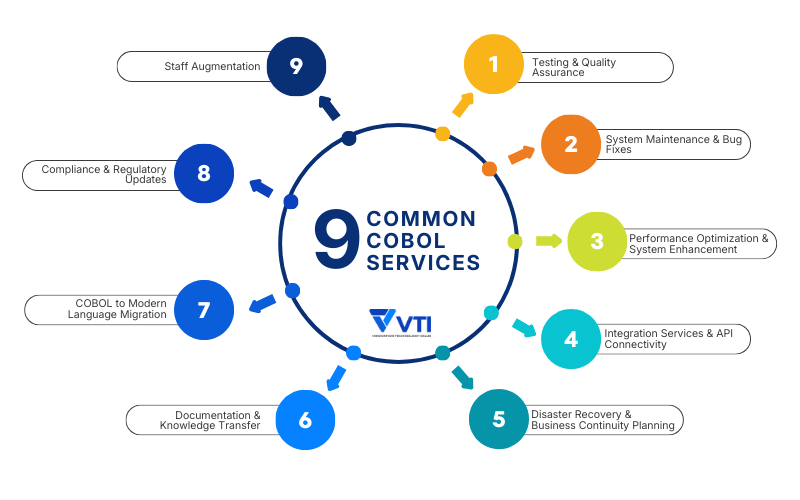
Testing and Quality Assurance
Specialized testing services ensure COBOL applications maintain reliability through regression testing, performance validation, and security assessments. Providers use both automated testing tools and manual QA processes tailored to mainframe environments.
Pre-deployment testing catches issues before they reach production, validates system changes, and identifies vulnerabilities before they impact operations. Quality assurance becomes increasingly important as COBOL systems integrate with modern architectures.
Legacy System Maintenance & Bug Fixes
A COBOL development company can provide ongoing maintenance services that keep existing COBOL applications running smoothly in high-transaction environments. These services include code refactoring, security patches, performance tuning, and resolving production issues and technical debt.
For organizations running mission-critical mainframe systems, regular maintenance prevents costly downtime and ensures regulatory compliance. This foundational service protects your technology investment while maintaining operational stability.
Performance Optimization and System Enhancement
Performance optimization services boost application efficiency and scalability for resource-constrained enterprises. Providers enhance code readability, improve processing speed, and modernize COBOL applications for compatibility with contemporary development environments like .NET and JVM.
These optimizations extend legacy system ROI by improving transaction throughput and enabling modern DevOps practices on mainframe platforms. Enhanced performance directly impacts user experience and operational capacity.
Disaster Recovery and Business Continuity Planning
Disaster recovery services establish robust backup systems, failover protocols, and recovery procedures for mission-critical COBOL applications. Providers design and implement continuity plans that ensure rapid recovery from major system failures, natural disasters, or cyberattacks.
These services include regular testing of recovery procedures to ensure reliability when needed. For organizations dependent on COBOL systems for core operations, comprehensive disaster recovery planning is non-negotiable.
Integration Services and API Connectivity
Integration services connect COBOL infrastructure with modern APIs, bridging legacy backends to microservices, cloud architectures, and contemporary business applications. Providers can expose COBOL business logic through RESTful APIs, containerization, and data virtualization layers that integrate with open-source frameworks.
These solutions reduce system silos and enable agile development practices without requiring complete system replacement. Successful integration maintains system stability while unlocking data trapped in legacy systems.
Staff Augmentation
Staff augmentation provides temporary or long-term COBOL developers to supplement internal teams without the commitment of full project outsourcing. Organizations can scale development capacity up or down based on project demands, filling skill gaps for specific initiatives or maintenance periods.
This flexible model gives you access to specialized COBOL talent while maintaining control over project direction and timelines. Augmented staff integrate with your existing teams to address immediate resource constraints.
Compliance and Regulatory Updates
Compliance services ensure COBOL systems meet evolving regulatory requirements across financial services, healthcare, and government sectors. Providers implement necessary code changes for standards like GDPR, SOX, HIPAA, and industry-specific regulations.
These updates protect organizations from legal risks and financial penalties while maintaining system functionality. Regular compliance maintenance is essential for regulated industries running legacy COBOL applications.
COBOL to Modern Language Migration
Migration services facilitate seamless transitions from COBOL to modern languages like Java, C#, or cloud-based platforms while preserving business logic and preventing data loss. Leading providers offer phased replatforming approaches that enable hybrid architectures, allowing you to modernize incrementally without disrupting operations.
These services typically include automated code conversion tools, thorough testing protocols, and API enablement for cloud integration. Migration accelerates digital transformation while reducing long-term maintenance costs.
Documentation and Knowledge Transfer
Documentation services deliver comprehensive code audits, system documentation, and structured training programs that address the growing COBOL skills shortage. Providers analyze aging codebases, create detailed technical documentation, and transfer critical knowledge to internal teams through hands-on training.
This reduces organizational dependency on scarce external expertise and builds internal capacity for long-term system maintenance. Proper documentation ensures business continuity as experienced COBOL developers retire.
How can I find a reliable COBOL modernization partner in Asia?
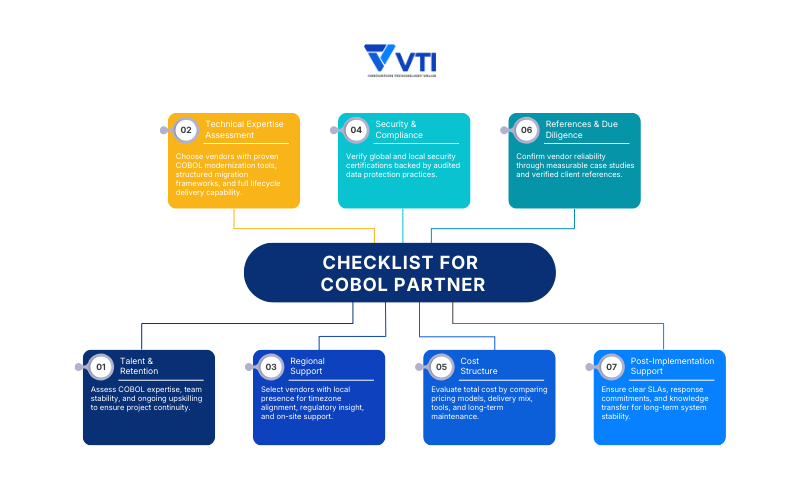
Technical Expertise Assessment Framework
Evaluate vendors based on documented experience with COBOL modernization in your specific industry sector. Look for providers with established tools for automated code analysis, phased migration approaches, and proven conversion capabilities to modern languages or cloud platforms.
Moreover, assess their disaster recovery capabilities, transition planning expertise, and structured migration methodologies such as the 4Rs framework (Rehost, Replatform, Refactor, Rearchitect).
In summary, vendors should demonstrate end-to-end capabilities from initial audits through testing, deployment, and rollback procedures.
Security and Compliance Certifications
Verify that the potential COBOL development company holds relevant certifications, including ISO 27001, SOC 2, and industry-specific standards such as PCI DSS or HIPAA. For Asian markets, confirm familiarity with local compliance frameworks like Japan’s APPI or Singapore’s PDPA.
Request documentation of security practices, including penetration testing results and data protection protocols. Third-party audit reports demonstrate a commitment to secure development practices, especially critical for systems handling sensitive data.
Due Diligence and Reference Verification
Evaluate vendors through client references and case studies with quantifiable outcomes. Contact and request detailed examples of enterprise COBOL migrations, including timelines, budget performance, and technical challenges resolved.
If possible, verify claims through direct client conversations. Review vendors’ track record for on-time, on-budget delivery and how they handled unexpected issues during previous projects.
Staff Qualifications and Retention Rates
As we are aware, the COBOL talent pool is shrinking; therefore, it is also crucial to evaluate the vendor’s human resources, including developer certifications, years of experience, and relevant platform specializations.
Inquire about employee retention rates and average tenure – high turnover disrupts project continuity and knowledge transfer. Request resumes of proposed team members and consider technical interviews with key personnel. Their training programs that develop COBOL expertise and cross-train developers in modern technologies are also a plus.
Regional Presence and Support Capabilities
Assess a COBOL development company with established local offices and support teams in your target Asian markets for timezone-aligned project management. Regional presence ensures cultural understanding, regulatory familiarity, and on-site support capability. Vendors with regional partnerships and local delivery models typically provide more reliable support throughout complex modernization initiatives.
Cost-Benefit Analysis Methodology
Compare engagement models, including fixed-price, time-and-materials, and outcome-based pricing structures. Also, the ratios between offshore and onshore should be considered to maintain a balance between cost and quality control.
Other fees include long-term maintenance costs, tool licensing fees, knowledge transfer requirements into total project economics, and so on. The clearer the resource allocation and budget, the better for your decision-making process.
Post-Implementation Support and SLA Commitments
Clarify post-implementation support arrangements, including warranty periods, support tier structures, and response time commitments. Request detailed SLAs specifying availability guarantees, incident response times, and escalation procedures.
Understand what support is included versus what requires separate maintenance contracts. Ask about knowledge transfer processes, documentation, and training programs that enable your internal teams to maintain modernized systems long-term.
Top 5 COBOL Development Companies in Asia
Note: Companies are listed in no particular order and do not reflect a formal ranking.
VTI
VTI is a COBOL development company offering enterprise-scale services, backed by established expertise in legacy system modernization across various industries, including banking, insurance, public services, retail, healthcare, and manufacturing.
With offices across Vietnam, Singapore, Japan, Thailand, and South Korea, VTI delivers cost-competitive solutions through a proven hybrid model combining offshore efficiency with on-site engineering support.
Strategic partnerships with IBM, AWS, and Microsoft Azure enable phased modernization deployments that balance cost optimization with quality control.
Interestingly, VTI has developed proprietary AI agents to accelerate COBOL modernization, including:
- VCopilot – Automated code analysis, refactoring, and quality assessment
- AuraOps – Operations intelligence, testing automation, and performance monitoring
Certifications & Standards: VTI commits to high-quality project delivery, with certifications like CMMI Maturity Level 3, ISO/IEC 27001, PrivacyMark System, ITILv4-aligned processes, and Structured SLA commitments
Service Offered: VTI provides comprehensive COBOL services across the entire system lifecycle:
- COBOL System Development & Construction
- COBOL System Migration
- COBOL System Maintenance
- COBOL Staff Augmentation
VTI’s capabilities span Z/OS, IBMi, OpenVMS, Windows, and Unix/Linux platforms, with expertise in Micro Focus COBOL, Visual COBOL, and modern cloud integration. The company maintains teams of dedicated COBOL specialists supported by continuous training programs and knowledge transfer methodologies.
Best Fit For: VTI is well-suited for mid- to large-sized enterprises facing legacy modernization deadlines. Organizations valuing regional proximity, cultural alignment, AI-enhanced capabilities, and competitive pricing will find VTI a compelling alternative to larger global vendors.
Fujitsu
Fujitsu delivers comprehensive COBOL modernization through its PROGRESSION service, automating conversions from COBOL to Java/C# with end-to-end support, including audits, migration, testing, and compliance updates for mainframes to cloud platforms like AWS and Azure.
It maintains strength in Japan’s government and high-compliance sectors, with global scalability including Australia via dedicated modernization offerings.
Services Offered: PROGRESSION-powered automated migration, legacy system maintenance, mainframe-to-cloud transitions, compliance updates
Best Fit For: Large government agencies and highly regulated enterprises willing to pay premium rates for established reliability and proven compliance expertise in mission-critical environments.
NTT Data
NTT Data leads Japan’s financial sector modernization with full-stack capabilities, including mainframe/COBOL reengineering, multi-cloud integration, core banking transformation, and disaster recovery. Regional offices enable Southeast Asia expansions for end-to-end reliability and uptime guarantees targeting premium budgets.
Services Offered: Full-stack modernization, mainframe/COBOL reengineering, multi-cloud migration, core banking system transformation, disaster recovery
Best Fit For: Tier-1 financial institutions with substantial IT budgets prioritizing maximum uptime guarantees and comprehensive enterprise support over cost efficiency.
Tata Consultancy Services (TCS)
TCS provides end-to-end COBOL solutions via global delivery and tools like MasterCraft, covering migration, hybrid cloud transitions, staff augmentation, maintenance, and testing. Strong Asia-Pacific presence includes Australia, Singapore, and a recent 2025 expansion into Bhutan for scaled, cost-effective multinational deployments.
Services Offered: MasterCraft-powered migration, hybrid cloud transitions, staff augmentation, application maintenance, testing services
Best Fit For: Large multinational enterprises with operations across multiple Asia-Pacific markets seeking global vendor scale, standardized delivery processes, and proven cost efficiency for complex, multi-site deployments.
Infosys
Infosys offers AI-powered COBOL assessment and hybrid cloud migration via the Cobalt framework, achieving high automation rates for financial and telecom code conversions. Services include analysis, automated migration, cloud transformation, and assessments for shorter timelines (4-8 months).
Services Offered: Cobalt framework-powered analysis, AI-driven automated migration, cloud transformation, and rapid system assessment
Best Fit For: Organizations in financial services and telecommunications prioritizing automation and AI-driven modernization over deep COBOL specialization, particularly those with aggressive modernization timelines (4-8 months).
Final words
COBOL isn’t going anywhere soon, and that’s actually good news for businesses that approach it strategically. While maintaining legacy systems presents real challenges – from talent shortages to integration complexities – the right modernization COBOL development company can transform these obstacles into competitive advantages.
Take time to assess, communicate with potential partners, and build a modernization roadmap that works for your specific business needs.