






![[FREE EBOOK] Strategic Vietnam IT Outsourcing: Optimizing Cost and Workforce Efficiency](https://vti.com.vn/wp-content/uploads/2026/06/ebook-it-outsourcing.png)



Retailers losing 5 to 10 percent of total inventory value to expired stock is not a fringe problem – it is a common operational reality for businesses still relying on manual shelf checks and spreadsheets. For CxOs and digital transformation leaders managing multi-outlet networks across Southeast Asia, that figure represents a direct and largely preventable margin drain. This article breaks down what modern expiry management looks like in practice. From the unique challenges of the retail environment in Southeast Asia that generic solutions fail to address, to suggestions for retail technology solutions. Here, we especially mentioned how AI and automation can be applied correctly across solution categories, infrastructure choices, and shop floor operations.
TL;DR
- SEA’s climate, fragmented cold chain, and multi-country regulations create challenges that generic solutions consistently underestimate
- The right solution depends on your scale: standalone trackers for convenience networks, ERP-integrated platforms for multi-market chains
- AI-enhanced engines outperform fixed rule-based logic when demand variability and climate conditions make static thresholds unreliable
- Automation — markdown triggers, removal alerts, compliance logging, shop floor apps — turns expiry control from reactive to proactive
- Technology alone is not enough: ownership clarity, staff training, and supplier data quality determine whether the system actually delivers
What Is Expiry Management?
Expiry management is the systematic process of tracking, monitoring, and controlling product shelf-life across retail environments – from supermarkets to neighborhood convenience stores. Unlike general inventory management, it layers a time-sensitivity dimension onto stock tracking, making it indispensable for any operation dealing in perishable or short-shelf-life goods.
The foundational concept is the distinction between FIFO (First-In, First-Out) and FEFO (First-Expired, First-Out). FIFO assumes the oldest stock arrived first and should leave first – a reasonable rule for stable products. FEFO, by contrast, prioritizes items closest to their expiry date regardless of when they arrived. For perishable-heavy retail, FEFO is the correct approach, but it is nearly impossible to execute consistently without system support. A newer shipment with an earlier expiry date will routinely be missed during a manual shelf check, and it expires before it is sold.
The modern standard is proactive expiry date management – using automated alerts and real-time data to catch near-expiry stock before markdown windows close, rather than discovering expired product during a routine audit when damage is already done.
The Cost of Getting It Wrong
Uncontrolled product expiries accumulate quietly through write-offs, missed markdown windows, and capital tied up in unsellable stock. For multi-outlet networks, the financial damage compounds across every location where manual tracking fills the gap that technology should.
The downstream consequences are consistent across operations of all sizes:
- Shrinkage from write-offs drains margin directly, with poorly managed chains losing 5 to 10 percent of inventory value annually.
- Near-expiry items that could recover partial revenue through markdowns are instead disposed of at full loss.
- Cash flow strain builds as capital stays locked in stock that can no longer be sold.
- Supplier chargebacks add another layer of cost when the product arrives at retail with insufficient remaining shelf life.
Beyond the balance sheet, poor expiry control creates regulatory exposure that technology leaders cannot afford to overlook. Singapore’s SFA guidelines, Malaysia’s FSQD standards, and Thailand’s FDA requirements each set enforceable shelf-life rules – non-compliance can trigger product recalls, operational suspensions, or legal penalties. In terms of brand reputation, a single publicized expiry incident can erode the consumer trust that retailers spend years building.
What Makes Expiry Management Harder in SEA?
Southeast Asia presents a combination of environmental, infrastructural, regulatory, and cultural conditions that make expiry date management significantly more demanding than in Western retail markets. Generic solutions built for temperate climates and consolidated supply chains routinely underperform in this context.
Climate and Humidity
Average temperatures across Thailand, Malaysia, and Singapore range from 25 to 35 degrees Celsius year-round, with relative humidity regularly exceeding 80 percent. These conditions accelerate product degradation in ways that standard shelf life management – typically calibrated for cooler, drier environments in Western countries – does not account for. A product with a printed expiry date of 30 days may effectively reach quality degradation within 20 days if cold chain handling is inconsistent or if packaging is exposed to humidity during the last mile. Expiry management systems operating in SEA need to account for real storage conditions, not just label dates.
Fragmented Cold Chain Infrastructure
Due to the overpopulation of major urban centers, cold chain infrastructure is often placed in the suburban regions, which makes the supply chain inconsistent (regarding the current levels of logistics in most SEA countries). Temperature excursions during transport – particularly for the last mile from distribution center to smaller format stores – are common. This means the effective shelf life of products entering store inventory may already be shorter than the label implies at the point of receipt. Retailers operating across both urban flagship stores and smaller provincial outlets face asymmetric expiry risk that a single system configuration cannot address without location-level customization.
Regulatory Fragmentation Across Three Markets
Thailand, Singapore, and Malaysia each operate under different food safety and labeling regulatory frameworks. Singapore’s SFA, Malaysia’s FSQD, or Thailand’s FDA impose distinct requirements on shelf-life labeling, minimum remaining shelf life at point of sale, and documentation standards for recalls or audits.
Multi-market retailers cannot apply a single compliance configuration across their store network – the system needs to support jurisdiction-specific rules, labeling formats, and audit log requirements simultaneously.
Cultural Consumption Patterns and SKU Complexity
Consumer behavior in SEA skews toward high-frequency, small-basket fresh food purchases rather than the weekly bulk shopping patterns more common in Western markets. This drives consistently high SKU turnover in fresh and chilled categories, but also creates significant demand variability tied to cultural calendars.
Not to mention, purchasing patterns shift sharply around Chinese New Year, Hari Raya, Songkran, and other regional observances – events that predictive systems trained only on Western seasonal data will miss entirely. High-volume wet markets and fresh produce sections in hypermarkets also carry products with shelf lives measured in days, not weeks, making manual expiry checks structurally unreliable at scale.
Multilingual Operations and Label Variability
Store operations across Southeast Asia are shaped by cross-border commerce and deep cultural exchange, where talent, suppliers, and retail practices move fluidly across markets. In structurally multilingual countries like Malaysia and Singapore, it is common for multiple languages to coexist within a single outlet.
As a result, staff may handle supplier labels, system inputs, and alerts across Thai, Bahasa Malaysia, Bahasa Indonesia, Mandarin, Tamil, or English—often within the same shift. Expiry management systems that surface alerts in only one language or cannot parse multi-format, multi-language labels introduce friction that reduces compliance at the point of action. For a system to work, it has to work for the person standing in front of the shelf.
How to Utilize AI & Automation Correctly For Expiry Management?
Understanding the SEA retail environment changes how technology decisions should be made. The right system is not simply the most capable one on paper. It is the one that maps cleanly to your store format, your infrastructure reality, your regulatory context, and the specific failure points that SEA conditions create. This section works through the key decision layers in sequence and consults which are the best practices for your situation.
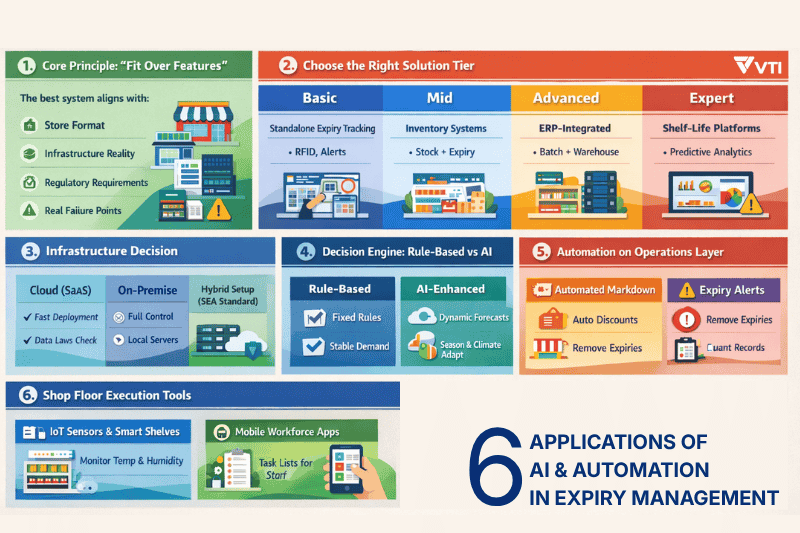
Matching Solution Category to Your Operation
Not all supermarkets or convenience stores need the most advanced technology solution. Considering your scenario before choosing the solution is sensible.
Standalone Expiry Tracking Platforms
These platforms focus narrowly on barcode and RFID scanning with automated near-expiry alerts. They deploy quickly, require minimal system disruption, and are well-suited to convenience store networks that need immediate visibility without a full inventory overhaul. They do not offer deep integration with procurement or demand forecasting, but for operations where the primary gap is shelf-level visibility, they efficiently close it.
Inventory Management Systems with Built-In Expiry Modules
Mid-sized grocery or convenience networks managing multiple outlets through a single POS-connected system typically find the most value here. Expiry date management sits alongside real-time stock tracking and low-stock alerts within one interface, reducing the data silos that form when expiry is tracked separately from inventory. The trade-off is that these systems rarely offer the depth of shelf-life analytics that larger operators need.
ERP-Integrated Solutions
Supermarket chains that need expiry control embedded into a broader operational system – covering warehouse management, procurement, and multi-outlet reporting – require ERP-integrated platforms with batch and lot tracking. These solutions scale well and support the regulatory documentation requirements of multi-market operations, but they carry longer implementation timelines and require stronger internal IT support to configure correctly. For chains operating across Thailand, Malaysia, and Singapore simultaneously, this tier is usually the minimum viable fit.
Purpose-Built Shelf-Life Management Tools
High-SKU supermarket operators with integration readiness across warehouse and store layers benefit from purpose-built platforms that offer real-time chain-wide dashboards, predictive stock rotation, and detailed expiry analytics. These tools represent the highest maturity tier and deliver the most measurable ROI for large-format retailers – but they require clean data inputs and established integration infrastructure to perform accurately.
VTI is an end-to-end retail technology partner serving Asia's leading retailers - from supermarkets, convenience stores, to food & beverage brands. With deep expertise across in-store operations, supply chain, and AI-powered retail solutions, VTI helps retailers move faster, scale smarter, and stay ahead of a rapidly shifting market. Explore retail software solutions designed for you today.Ready to eliminate expiry losses in your retail stores?
Choosing Your Infrastructure
Cloud-Based SaaS
Cloud platforms offer the fastest deployment path and lowest upfront capital commitment – practical advantages for retailers scaling across multiple SEA markets where IT resources are stretched thin. The key consideration for SEA operators is data sovereignty: Singapore and Malaysia both have data residency requirements that affect where operational data can be stored. Confirm that your chosen vendor’s cloud infrastructure complies with in-country data requirements before deployment.
On-Premise
On-premise deployment gives operators full data control and is better suited to locations with unreliable internet connectivity. This is a real constraint for provincial stores in Thailand and Malaysia. The trade-off is higher infrastructure cost and the need for strong local IT support. For chains that operate in connectivity-challenged locations but still need system-level expiry tracking, on-premise remains a practical option at the store level, even if chain-level reporting runs in the cloud.
Hybrid Models
The most common configuration for established SEA chains combines on-premise data capture and storage at the store level with cloud-based dashboards and alerting at the chain level. This approach balances data sovereignty, connectivity resilience, and management visibility – and is increasingly the default for operators who have outgrown pure SaaS but cannot justify full on-premise IT infrastructure across every outlet.
Rule-Based vs. AI-Enhanced Engines
When Rule-Based Logic Is Sufficient
Rule-based engines apply fixed thresholds – flagging any product within seven days of expiry for markdown action, for example. They are predictable, easy to audit, and sufficient for operations with stable product mixes and consistent demand. For convenience networks with low SKU complexity, rule-based systems are often the right fit: simpler to configure, easier to maintain, and reliable enough to close the gap that manual checks leave.
When AI-Enhanced Engines Are Worth the Investment
AI-enhanced engines use historical sales data and real-time demand signals to generate dynamic shelf-life recommendations and rotation priorities. For SEA retailers, this capability directly addresses two conditions that rule-based systems cannot handle: the demand variability created by cultural calendar events, and the climate-driven degradation variance that makes fixed thresholds unreliable. A system that can adjust markdown triggers based on observed sell-through rates during Hari Raya versus a standard week – or that factors in a temperature excursion logged at goods receipt – will consistently outperform one working from static rules.
The prerequisite is data quality. AI-enhanced engines require clean, consistent inputs from POS, WMS, and goods receipt systems to produce accurate outputs. If your data foundation is not there yet, investing in a more capable engine before fixing data quality will not deliver the expected gains.
Automation on the Operations Layer
Automated Markdown Triggers
When expiry thresholds are crossed, the system activates promotional pricing automatically. For SEA retailers where staff-to-SKU ratios are high and manual markdown decisions are inconsistently applied, automated triggers remove the human delay, which turns recoverable stock into disposal. The threshold should be configurable by product category, since the viable markdown window for fresh produce differs significantly from that for packaged goods.
Near-Expiry and Removal Alerts
Automated alerts flag products approaching or at expiry, prompting removal before they reach customers. In a regulatory environment where a single expired product reaching a customer can trigger an SFA or FSQD inspection, automated removal alerts function as both an operational safeguard and a compliance control. These alerts are most effective when they route directly to the responsible staff member – not to a central inbox that gets reviewed hours later.
Compliance Record Generation
Audit-ready logs of expiry events, stock rotations, markdown actions, and removal decisions are generated automatically, reducing the documentation burden during regulatory inspections across Thailand, Singapore, and Malaysia. For multi-market operators, this is particularly valuable: a system that produces jurisdiction-compliant audit records removes a significant manual overhead that typically falls on store managers.
Bringing Automation to the Shop Floor
IoT Sensors and Smart Shelving
IoT-enabled sensors and smart shelving integrations push real-time expiry intelligence directly to the shelf environment, flagging products that need attention without waiting for a scheduled audit cycle. In SEA’s high-humidity conditions, shelf-level sensors that monitor temperature and humidity alongside expiry dates can flag risk earlier than label-date logic alone. This catches the gap between printed expiry and actual product condition that SEA’s climate regularly creates.
Mobile Workforce Applications
Rather than working from a printed checklist or verbal instruction, store associates receive live, prioritized task lists on handheld devices. These show exactly which products to move, mark down, or remove, and in what sequence. For SEA operations where multilingual staff need to act on expiry alerts consistently, mobile apps that surface instructions in the associate’s working language – Thai, Bahasa, Mandarin, or others – close the execution gap that system-level automation alone cannot bridge.
The measurable impact across these automation layers is consistent:
- Shrinkage rates fall as fewer undetected products expire,
- On-shelf availability improves as fresh stock replaces expired product faster,
- Compliance audit pass rates rise as system-generated records replace manual logs prone to gaps.
Together, these gains shift expiry management from a cost center into a measurable contributor to margin protection and operational reliability.
Non-Technical Factors That Make the Technology Work
Finally, no matter how advanced technology is, they are essential but not sufficient on their own. In practice, the gap between a well-configured expiry management system and one that delivers consistent results is determined by factors that sit outside the software itself:
Assign Clear Ownership
When responsibility for expiry data quality is assumed to be shared across operations, IT, and supply chain, it typically belongs to no one. Designate a named owner for each layer: policy governance, system configuration, and upstream data quality at the receiving dock – where accurate expiry capture begins and where errors propagate through every downstream alert and report.
Train Staff on the Why, Not Just the How
Store associates who understand that their markdown response to an alert directly affects shrinkage metrics act more consistently than those who see it as an IT-mandated process. Escalation protocols – who to notify, what action to take, within what timeframe – need to be rehearsed, not just documented.
Manage Supplier Data Quality Actively
Regional suppliers across SEA vary significantly in the consistency of their labeling and the accuracy of shelf-life data provided at goods receipt. A lightweight feedback loop between store operations and procurement – even a weekly flag process – keeps the system calibrated to conditions that internal data alone does not surface.
Treat Configuration as a Living Document
Regulatory requirements shift, product mixes change, and seasonal demand patterns evolve. A system configured at go-live and left unchanged will drift out of alignment with operational reality within months in a market as dynamic as SEA retail. Schedule regular reviews – quarterly at a minimum.
Final words
Expiry management has moved well beyond a compliance checkbox. For retail leaders in Southeast Asia, it sits at the intersection of margin protection, regulatory readiness, and brand trust – and the gap between manual processes and automated systems is wide enough to show up directly on the bottom line.
Accurate shelf-life data flowing from store operations into procurement and demand forecasting systems improves replenishment decisions, reduces over-ordering in volatile demand periods, and provides the visibility needed to negotiate better intake terms with suppliers. In SEA markets where cultural demand cycles create predictable but sharp inventory challenges, that forecasting advantage is compounding.
The next step for any retail leader is an honest assessment of where current processes are failing. Whether that is at goods receipt, on the shelf, in staff execution, or in regulatory documentation, and which solution category is best matched to close that gap, given your store format, infrastructure reality, and market context. The SEA-specific conditions covered in this article are the right lens through which to make that evaluation.