





![[FREE EBOOK] Strategic Vietnam IT Outsourcing: Optimizing Cost and Workforce Efficiency](https://vti.com.vn/wp-content/uploads/2026/06/ebook-it-outsourcing.png)



With labor shortages becoming a critical issue for the retail industry, “unmanned store” is gaining significant attention. Leveraging AI and cashless payment systems, this model enables 24/7 operations and reduces operational costs, and is rapidly becoming the new standard for retail.
However, unmanned stores are not simply achieved by automating checkout. In practice, how inventory, payment, and security systems are combined has a significant impact on operational complexity and cost.
This article outlines the fundamentals of unmanned stores, key technologies, and important considerations for implementation.
What are unmanned stores?
An unmanned store is a retail environment that operates with minimal to no on-site staff, allowing customers to complete purchases via self-service technologies. These stores integrate systems for access control, product recognition, and automated payments to manage operations efficiently.
Not all unmanned stores operate in the same way. In practice, the term covers a range of store models with very different system requirements, cost structures, and operational constraints. Rather than treating it as a single concept, it is more useful to look at how far automation is applied in each case. Unmanned stores generally fall into one of three models:
Self-checkout model (Efficiency-focused)
The self-checkout model focuses on automating only the payment process. It has a relatively low entry barrier and can be introduced into existing stores without major changes.
In practice, however, most operational tasks, such as inventory restocking, fresh food handling, and in-store issue resolution, still depend on staff. As a result, while checkout friction is reduced, the overall impact on labor reduction is often limited.
This is currently the standard model across major convenience store chains such as Seven-Eleven and Lawson. Payment is handled through kiosks, but the store still relies on staff for day-to-day operations.
Semi-unmanned model (time-based operation)
This model switches between staffed and unmanned operation depending on the time of day. Stores typically operate with staff during peak hours and transition to unmanned mode during late-night or off-peak periods.
The main challenge here is maintaining stable operations when no staff is physically present. Even relatively minor issues can disrupt the store if there is no immediate fallback.
FamilyMart has been actively implementing this approach in Japan. During late-night hours (11 PM to 5 AM), stores shift to unmanned operation using app-based entry or authentication systems.
Fully automated model (System-driven)
The fully automated model handles the entire flow through system integration. Customer behavior is tracked using computer vision and sensor-based systems, enabling a checkout-free experience.
This is the most advanced, but also the most complex model. System performance directly affects the user experience. If tracking accuracy drops or latency increases, issues become immediately visible at the customer level.
Often referred to as “Just Walk Out” technology, this model is represented by startups such as Touch to Go (TTG). Commonly deployed in JR East station kiosks, these stores use a combination of shelf sensors and computer vision to track items, enabling automatic payment upon exit. This provides the highest level of efficiency but demands significant initial infrastructure investment.
How do unmanned stores work and system architecture
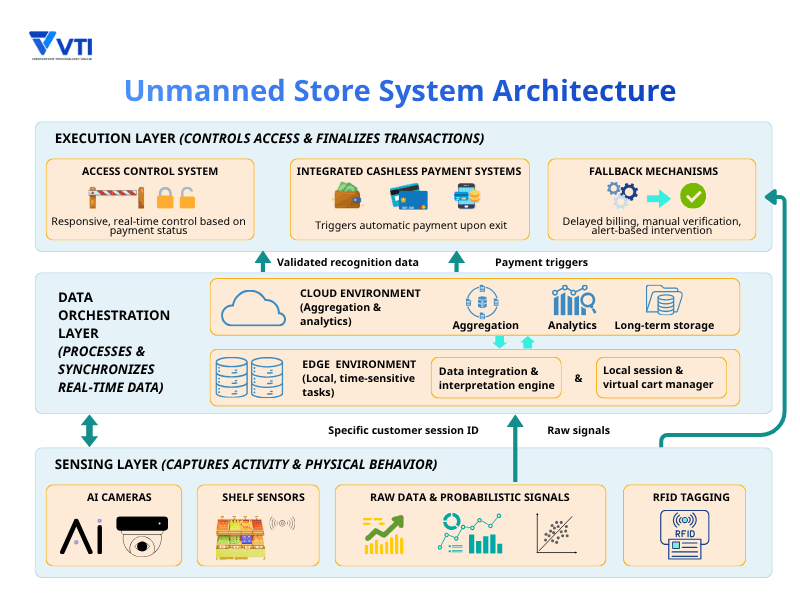
End-to-end flow of an unmanned store
A typical unmanned store operates as a continuous flow, starting from customer entry and ending with payment.
Customers begin by authenticating through a mobile app, QR code, or a facial recognition system. This step creates a unique session that links all subsequent actions to a specific user.
Once inside, customer behavior is tracked in real time. Actions such as picking up, returning, or exchanging items are recorded and translated into a virtual cart. Depending on the system design, this tracking relies on computer vision, RFID, or a combination of both.
The process is completed either through a self-checkout interface or automatically when the customer exits the store using integrated cashless payment systems.
While the flow appears simple, it depends on precise coordination between identification, tracking, and payment systems. Even small delays or recognition errors can surface directly at the checkout or exit point.
Unmanned store system architecture
The sensing layer
The sensing layer captures in-store activity and converts physical behavior into digital data. This typically includes AI cameras, shelf sensors, and in some cases RFID tagging.
These systems detect interactions such as picking up or returning items and attempt to associate them with a specific customer session. In controlled environments, detection accuracy can be high. In real stores, however, occlusion, crowding, and unpredictable movement introduce noise into the data.
Because of this, the sensing layer does not produce perfect results. Instead, it generates probabilistic signals that must be interpreted and validated downstream.
The data orchestration layer
The data orchestration layer processes and synchronizes input from multiple sensing sources in real time. This is where system responsiveness and consistency are determined.
Most deployments split processing between edge and cloud environments. Time-sensitive tasks are handled locally through edge computing to reduce latency. The cloud is used for aggregation, analytics, and long-term data storage.
The challenge lies in keeping these layers synchronized. Network instability or processing delays can cause temporary inconsistencies between edge and cloud states. When this happens, the virtual cart associated with a customer may not accurately reflect real-world actions, leading to errors at checkout or exit.
Execution layer
The execution layer finalizes transactions and controls store access.
In fully automated models, payment is triggered automatically when the customer exits, using integrated cashless payment systems. At the same time, access control systems must respond to payment status in real time.
This layer is highly sensitive to timing. If recognition data is incomplete or delayed, the system may block the exit or process incorrect charges. Both scenarios directly impact user experience and trust.
To mitigate this, most real-world implementations include fallback mechanisms such as delayed billing, manual verification, or alert-based intervention. As a result, fully autonomous operation is rarely absolute. Even advanced stores rely on controlled exceptions to maintain stability under real conditions.
Core technologies and selection criteria
While unmanned stores are often presented as a single concept, their actual implementation depends on a combination of distinct technologies. The effectiveness of the system is determined not by any individual component, but by how these technologies are selected and integrated based on operational requirements.
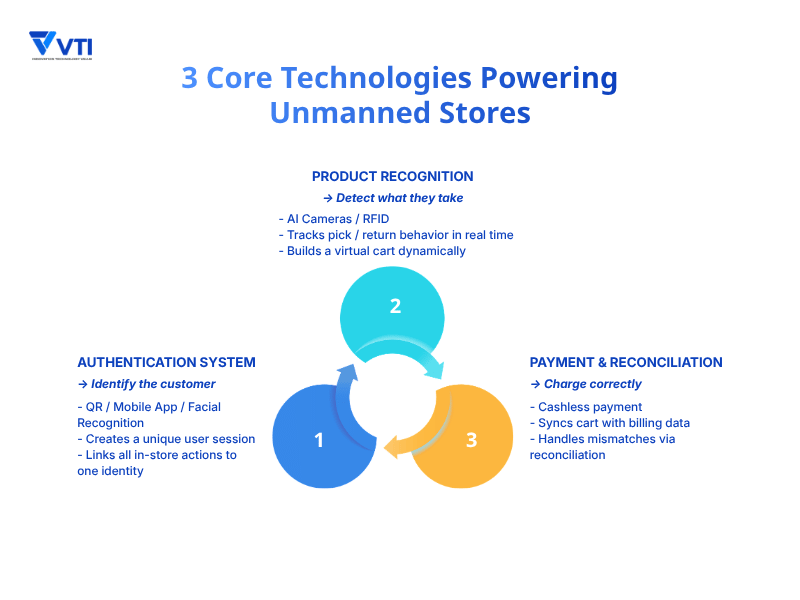
Authentication systems (entry control)
Authentication defines how customers enter the store and how their actions are linked to a digital session. Different methods are used depending on the required balance between user experience and operational complexity. Common approaches include:
QR code entry
Customers scan a QR code to enter the store. This is easy to deploy and widely used in early-stage implementations, but it requires an extra step from the user.
Mobile app authentication
Entry is linked to a registered mobile account. This improves traceability and allows integration with payment systems, but depends on app adoption and user onboarding.
Facial recognition systems
Customers enter without any physical interaction. This provides the smoothest experience, but requires higher system stability and careful handling of environmental conditions such as lighting and camera positioning.
Product recognition (AI cameras vs RFID)
Product recognition is a core design decision in unmanned store systems, as it directly impacts accuracy, cost, and operational complexity.
Instead of choosing a “better” technology, the decision is usually based on trade-offs between flexibility and precision.
| Dimension | AI Camera | RFID Tag |
| Recognition method | Infers item selection via computer vision | Direct item identification via tags |
| Setup cost | Lower initial setup (no tagging required) | Higher due to per-item tagging |
| Accuracy | Depends on the environment and crowd density | High and deterministic |
| Operational flexibility | High (no physical labeling) | Lower (requires tagging workflow) |
| Scalability | Easier to change inventory | Better for controlled inventory |
| Best use case | Dynamic retail, mixed product stores | High-value or controlled inventory environments |
AI-based systems are generally preferred when flexibility and deployment speed are priorities. RFID-based systems are selected when accuracy and traceability are more critical than operational cost. In most real-world deployments, a hybrid approach is also considered depending on product categories and store zones.
Payment systems (cashless infrastructure)
Payment in unmanned stores is typically handled through integrated cashless systems, connected to user accounts or mobile applications. Unlike authentication or product recognition, the payment layer operates as a final synchronization point between physical store activity and digital transaction records.
The main technical challenge is not the payment execution itself, but ensuring consistency between detected items and billing data in real time. Even small delays or mismatches between these systems can result in incorrect charges or confusion at the exit gate, particularly in high-traffic environments.
For this reason, many implementations rely on reconciliation mechanisms and fallback processes rather than fully synchronous real-time billing.
Required systems and implementation design
Implementing an unmanned store is not just about installing cameras. It is about building a cohesive IT ecosystem. Below is the blueprint of the essential systems and integration points required for a production-ready store.
System components
At a minimum, an unmanned store requires several core systems to function.
– Sensing system: This layer captures customer movement and product interaction inside the store. AI Cameras and IoT shelf sensors are usually used for real-time item tracking. It converts physical behavior into structured digital signals that the rest of the system can process.
– Authentication & entry system: This system manages how users enter the store and links each visit to a unique session identity. It becomes the foundation for all downstream tracking.
– Product recognition system: This is responsible for understanding what the customer picks up or returns. Depending on the design, it may rely on vision-based tracking, RFID tagging, or a hybrid approach.
– Payment system: This final layer connects customer activity with billing. It is typically integrated with external payment providers and must maintain strict consistency with in-store behavior data.
System integration
The real complexity starts when these systems need to work together. POS, inventory, and payment systems must exchange data continuously through APIs or middleware layers. The goal is simple in theory: keep all systems aligned with the same “truth” about what happened in the store.
In reality, even small delays in synchronization can create mismatches between inventory data and payment records. This is one of the most common operational issues in early-stage deployments.
Because of this, many systems are designed with reconciliation logic that continuously checks consistency across modules rather than relying on instant accuracy.
Security & surveillance design
Security in an unmanned environment shifts from “recording” to “orchestration.”
– Proactive security: Your surveillance design should include behavioral analytics to detect “tailgating” (unauthorized entry) or aggressive behavior that necessitates immediate lock-down.
– Network redundancy: Security is the first point of failure. Design the system with a “fail-safe” mode—if the network drops, the store must either restrict access or allow exit-only to prevent theft.
– Privacy-by-design: Ensure facial recognition data is anonymized or encrypted at the Edge level before it ever touches your Cloud storage to comply with data privacy standards.
Operations model
Even in highly automated environments, unmanned stores are rarely operated without human involvement. Most systems rely on a remote monitoring structure where a central team observes store status in real time. When anomalies occur, alerts are triggered for intervention.
Fallback processes are also an important part of the design. These may include manual verification, delayed processing, or temporary access restrictions depending on the situation.
In practice, unmanned store operations are closer to a “hybrid model” than a fully autonomous system, especially in real-world retail environments.
Case studies and key considerations for successful implementation
In unmanned store projects, implementation outcomes are determined by how well system design aligns with actual store conditions. While technical feasibility is the starting point, long-term success depends on stability in real-world retail environments.
Industry-proven approaches
Convenience store operators such as Seven-Eleven Japan and Lawson have introduced self-checkout and partial automation across multiple locations.
These implementations typically combine AI camera-based monitoring with simplified in-store processes. Rather than relying on perfect real-time recognition, systems are often designed to tolerate minor inconsistencies and resolve them through backend reconciliation.
Fast Retailing, like Uniqlo or GU took a radically different path that proves simplicity often beats complexity. Instead of forcing an AI to “guess” what an item is, they shifted the intelligence to the factory floor by using RFID tagging. This approach reduces ambiguity during checkout and improves inventory traceability, particularly in environments with high SKU variability.
Meanwhile, solutions developed by Touch To Go are deployed in locations such as train stations and small-format retail spaces.
These systems combine computer vision and sensor data to enable checkout-free experiences, often within controlled layouts that help reduce tracking complexity.
A similar approach can also be observed in implementation projects handled by VTI. In these cases, system design focused on integrating product tracking with existing POS and inventory systems, while maintaining stable operation under real-world conditions such as peak-hour traffic and partial system inconsistencies.
Common failure patterns
Gap between test environments and real stores
The most common mistake is the “lab-to-store disconnect.” Teams spend months tuning models in perfect lighting conditions, only to watch them fail the moment a customer in a dark coat walks through in the evening. If your system cannot handle the “messy” real world, it isn’t ready for production.
Over-dependence on real-time cloud processing
Another frequent failure is the “cloud-dependency trap.” If your gate requires a round-trip to the cloud to decide whether to open, you’ve built a network-dependent application, not a store. When the internet flickers, the store grinds to a halt. Finally, many projects fail because they lack an “exception path.” A mature design should never force a customer to solve a technical issue. If the system gets confused, it needs a “graceful fallback” to keep the line moving while the issue is patched in the background.
The blueprint for operational resilience
If you want a chain-wide model rather than a one-off PoC, your design must prioritize operational self-reliance. First, design for “graceful degradation”: if a sensor node goes offline, the store should continue to function in a limited mode rather than locking the doors. Second, ensure your backend reconciliation logic is airtight; inventory, virtual carts, and payment logs must match in real-time, or you’ll be doing manual labor to fix discrepancies forever.
Above all, build for remote-first operations. If your store requires a technician on-site every time a camera drifts, your ROI is zero. A successful unmanned store can detect its own errors, alert the remote support team, and continue serving customers without a single person physically present.
Conclusion
The future of retail is being redefined by a seamless convergence of digital innovations. As IoT, AI, cloud technology, and robotics mature, the consumer shopping experience is shifting toward a model of frictionless, anytime-anywhere accessibility. For retailers, these digital layers are no longer just enhancements. They are the essential tools required to design store concepts that are both customer-centric and economically sustainable.
At VTI, we specialize in retail AI solutions that bridge the gap between today’s experimental pilots and the autonomous stores of the future. Our focus is on architecting robust, unified systems that ensure your retail chain remains efficient, scalable, and resilient in an evolving market.
If you are currently evaluating your retail digital transformation strategy, our experts with years of experience working in the Asian market are always ready to discuss how to transition your operations in the most efficient way and get ready for the future.