






![[FREE EBOOK] Strategic Vietnam IT Outsourcing: Optimizing Cost and Workforce Efficiency](https://vti.com.vn/wp-content/uploads/2026/06/ebook-it-outsourcing.png)



API integration has become a strategic priority for enterprises worldwide, and for good reason. In a recent survey, 95% of executives said APIs are important or critically important to their organization’s digital transformation strategies.
Yet most enterprises still run on dozens of systems, CRM, ERP, e-commerce platforms, & payment gateways; these systems frequently operate in isolation. API integration solves this systemic fragmentation by programmatically connecting these independent applications, allowing data to flow seamlessly across organizational workflows without manual intervention.
This guide covers what API integration actually is, how it works across industries like finance and manufacturing, what types of APIs enterprises use and why, and the practical steps to implement it securely at scale. It also examines how AI is reshaping the integration landscape in 2026.
What Is API Integration?
API integration is the connective layer that enables different software systems to exchange data and functionality automatically. When one application sends a request through an API, that request carries authentication credentials (typically API keys or OAuth tokens) along with specific parameters targeting a defined endpoint. The receiving system validates the request, applies its business logic, and returns structured data in JSON or XML format, along with status codes that confirm success or describe any errors.
The technical challenge in enterprise system integration goes beyond establishing a connection. Fields rarely align cleanly between systems, so data almost always requires transformation before it can move reliably — reformatting dates, normalizing values, handling null fields, and applying business rules that vary by system and use case.
How API Integration Works?
A typical API call follows a predictable sequence. The calling system constructs a request with the required headers and body parameters, sends it to a specific endpoint URL, and waits for a response.
In practice, this looks something like a customer placing an order: the e-commerce platform sends an authenticated POST request to the inventory API, which checks stock levels and returns a JSON response confirming availability — triggering the next step in the workflow. Error handling runs in parallel, managing failed requests, timeouts, and invalid responses so that system reliability is maintained even when individual calls fail.
Four Common API Types in Enterprise Systems
Not all APIs work the same way or serve the same audience. Enterprises typically work with four main types, and choosing the right one depends on who needs access, what data is involved, and how tightly integrated the systems need to be.
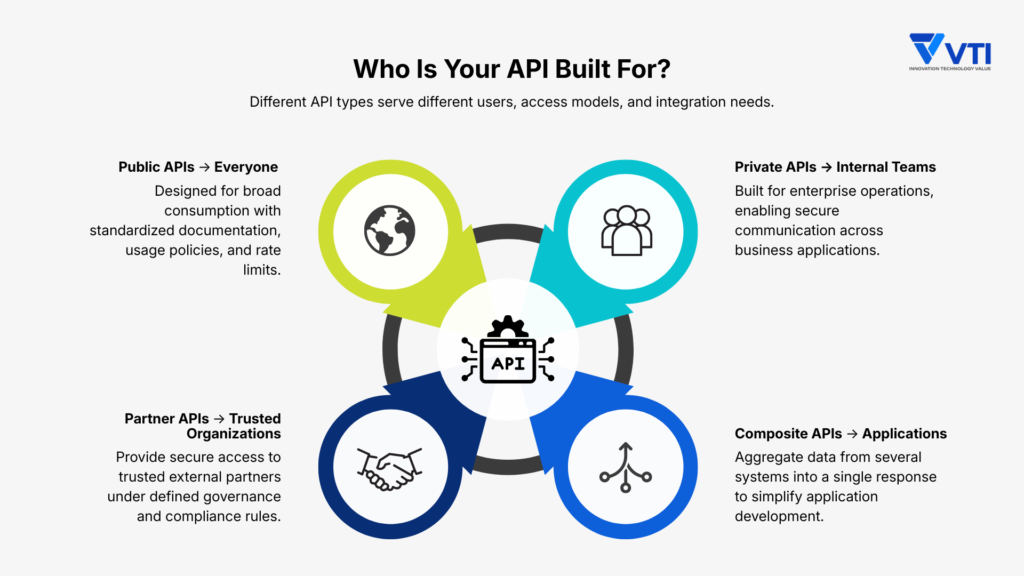
- Public (Open) APIs: Open to external developers and third parties, often requiring only basic registration and an API key. Because they serve many use cases across many users, public APIs tend to be stable and well-documented, but they impose rate limits and usage terms that internal systems do not.
- Private (Internal) APIs: Operate within a closed environment, accessible only to internal systems like a CRM, billing platform, sales tool, or reporting dashboard. They can be designed around specific use cases — though they sit in the critical path of core operations, so reliability requirements are high.
- Partner APIs: Sit between public and private. They enable controlled data exchange between two specific organizations – a payroll provider sharing records with an HR platform, or a bank authorizing a fintech app to access account data. Access is gated by compliance or audit standards, and the data shared is almost always sensitive.
- Composite APIs: Combine multiple API calls into a single request. Instead of an application making three separate calls to retrieve order data, customer records, and inventory status, a composite API returns all three in one response. This becomes increasingly valuable as enterprise API integration scales across distributed microservices environments.
Why API Integration Matters for Business Growth?
As organizations add more tools to manage operations, marketing, finance, and analytics, the systems rarely talk to each other by default. Data gets siloed, decisions slow down, and teams end up working from different versions of the same information. API integration removes these barriers — ensuring data flows accurately across systems and that everyone is working from the same picture.
The benefits extend well beyond operational cleanup. Here is what enterprises consistently gain.
Automated data flows across the organization
APIs move information between systems automatically, without manual input. This eliminates repetitive data entry, reduces human error, and ensures that every team — from sales to fulfillment — is working with current, accurate data at all times.
Real-time visibility for faster decisions
Rather than waiting for end-of-day reports, decision-makers can access live data across departments through integrated dashboards. A retail manager, for example, can monitor inventory, sales, and customer activity simultaneously — and act on what they see immediately rather than the following morning.
Stronger analytics and reporting
When APIs feed consistent, reliable data into BI tools and analytics platforms, the quality of insights improves significantly. Metrics align across systems, reports can be automated, and analysts spend less time cleaning data and more time interpreting it.
Better collaboration across teams
When systems share a common data layer, departments stop operating in isolation. Marketing, sales, and finance work from the same information — so when one team updates something, the others see it immediately. This reduces miscommunication and removes the friction that slows cross-functional work.
Scalability without disruption
As organizations grow and adopt new tools, APIs allow those tools to connect into existing infrastructure rather than requiring custom builds each time. Because APIs rely on standardized protocols, they are also compatible with future technologies — reducing the risk of costly migrations as the digital ecosystem evolves.
API Integration Use Cases Across Key Industries
API integration looks different depending on the industry — but the underlying pattern is consistent: connect systems, automate data flow, and reduce the manual work in between. The table below outlines how each sector applies it and what the business impact typically looks like.
| Industry | Common Use Cases | Example | Growth Impact |
| Financial Services | – Real-time account data access – Open banking connectivity – Treasury automation – Fraud detection – Compliance reporting | A regional bank exposes account APIs to fintech partners, enabling budgeting tools without building them in-house | – Faster partner onboarding – Reduced manual reconciliation – Stronger audit readiness |
| Manufacturing & Supply Chain | – IoT sensor integration – Inventory synchronization – Supplier data exchange – Predictive maintenance | Equipment data feeds directly into maintenance workflows, allowing teams to schedule interventions before failures occur | – Lower unplanned downtime – Real-time procurement decisions – Standardized operations across facilities |
| Healthcare | – Patient data interoperability – Cross-platform record sharing – Digital health integration | A hospital network connects EHR systems across clinics, reducing duplicate data entry and improving care coordination | – Faster information access – Reduced administrative overhead – Incremental legacy modernization |
| Retail & E-commerce | – Inventory synchronization – Omnichannel fulfillment – Personalization, payments integration | A multi-brand retailer links inventory, pricing, and customer data across stores and e-commerce platforms via a single integration layer | – Fewer stockouts – Faster fulfillment cycles – Personalization at scale |
| Logistics | – Carrier and warehouse connectivity – Real-time shipment tracking – ETA visibility – Disruption response | Logistics APIs connect carriers and customer systems, surfacing live shipment status across the supply chain | – Faster disruption response – Improved delivery accuracy – Reduced reliance on manual status updates |
5 Best Practices for Secure and Scalable API Integration
Enterprise API integration breaks down when security, governance, or performance is treated as an afterthought. These five practices work together to keep APIs secure under attack, stable under load, and maintainable as business requirements change.
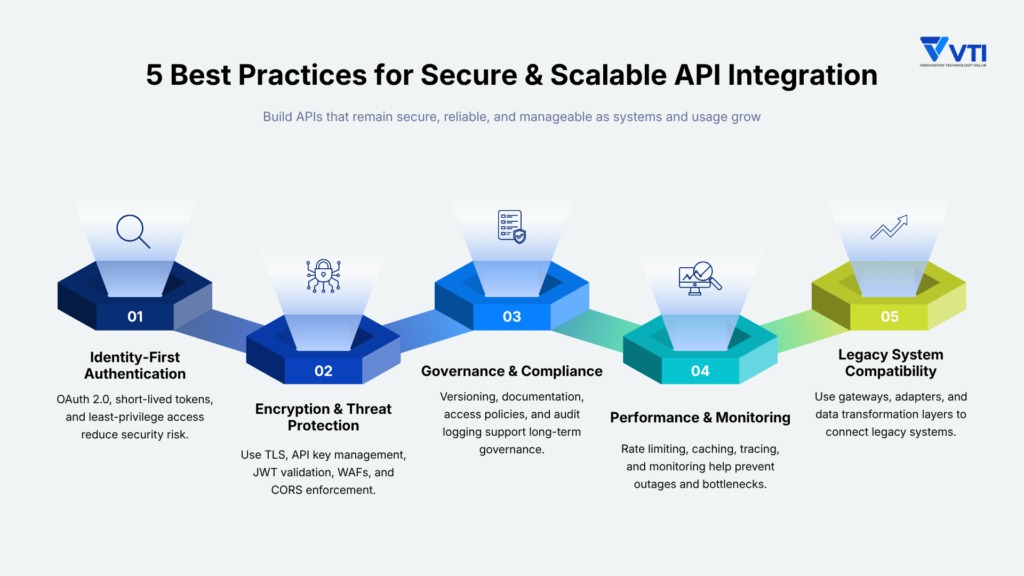
Practice 1: Implement Identity-First Authentication
Secure integration starts with controlling who and what can access your APIs. OAuth 2.0 with short-lived tokens limits credential exposure by restricting both client access and token validity. Use authorization code flow for user-facing applications and client credentials for service-to-service communication. For enterprise deployments, this approach supports partner onboarding without granting unnecessary access to core systems.
Practice 2: Enforce Encryption and Threat Protection
API keys should be treated as controlled secrets, not convenience tools. Pair them with rotation policies, least-privilege permissions, and explicit quotas so a compromised key does not escalate into a platform-wide incident. Encrypt all traffic using HTTPS/TLS, and add threat protection at the gateway level (JWT validation, WAFs, and CORS enforcement) to filter malicious traffic before it reaches core services.
Practice 3: Establish Governance and Compliance Frameworks
Clear versioning strategies (URI-based or header-based) prevent breaking existing consumers when APIs evolve. OpenAPI documentation and changelogs improve developer adoption and reduce integration errors. For regulated industries, access policies, role-based consumption plans, and logging with correlation IDs create a traceable record of who accessed what data and when.
Practice 4: Optimize Performance and Monitoring
Rate limiting protects infrastructure from abuse — set limits based on consumer tier and usage patterns. Caching and lightweight formats like JSON reduce latency, while timeout and retry policies keep dependent systems stable during traffic spikes. Combine logs, metrics, and distributed tracing to diagnose latency and failure points before they affect end users.
Practice 5: Address Legacy System Compatibility
Legacy systems often cannot handle modern protocols, and mismatched data formats add latency. Design data mapping and transformation into the integration layer from the start. Use adapter patterns or protocol translation layers to bridge capability gaps. Deploy an API gateway to normalize formats, queue heavy workloads, and isolate fragile backends so modernization can proceed incrementally without disrupting operations.
What Changes With AI in 2026 for API Integration
AI-Powered Integration Capabilities
AI is transforming API integration faster and making it less dependent on technical teams. Features such as intelligent data mapping, automated issue resolution, and natural language interfaces allow business users to connect systems with minimal coding. This speeds up digital initiatives but also increases the need for strong governance and standardized enterprise data integration platforms.
Generative AI Accelerates API Development
Generative AI is streamlining API development through automated documentation, easier discovery, and improved support. Machine-readable standards such as OpenAPI and AsyncAPI enable code generation and simplify integration across environments. While this reduces development effort and speeds delivery, organizations must strengthen contract management and security to maintain control and avoid vendor lock-in.
Strategic Priorities for CXOs
Preparing API infrastructure for AI-ready futures requires adaptive architecture and skills development rather than treating AI as a feature layer. AI agents need three capabilities from the integration layer: reliable syncs for retrieval-augmented generation, real-time triggers, and deterministic tool calling. Prioritizing data freshness, webhook-first designs, and API governance to make AI integrations scalable and auditable rather than simply more complex.
Building an API Integration Strategy That Lasts
API integration is the operational backbone of modern digital businesses. It reduces manual work, accelerates service delivery, and gives organizations the flexibility to adapt as markets shift, whether that means connecting payment systems, synchronizing inventory across channels, or enabling real-time customer experiences.
The key is treating integration as a strategic decision rather than a technical one. Prioritize security from day one, choose an architectural approach that matches your complexity level, and prepare your infrastructure for AI-driven workflows that are already reshaping how integrations are built.
A practical starting point: identify your highest-friction manual processes, map the systems involved, and evaluate whether direct API connections or a middleware platform better fits your scale and governance needs. The integration foundation you build today directly determines how fast you can move tomorrow.