





![[FREE Whitepaper] Smart Factory isn’t delivering. Is AI-Driven the answer?](https://vti.com.vn/wp-content/uploads/2026/10/angle-3.-whitepaper-ai-driven-factory-1.png)


The average enterprise runs 897 applications. Only 29% of them are integrated, and that’s where enterprise data integration becomes critical.
That gap has a direct cost: customer, operational, and financial data ends up scattered across dozens of disconnected systems, making it nearly impossible to gain a complete view of business performance. When sales teams use one platform, finance relies on another, and supply chain operations run on a third, decision-making slows down, reports become inconsistent, and operational visibility suffers.
By integrating data from disparate sources into a single, trusted foundation, organizations can improve efficiency, support DX initiatives, and prepare for AI-driven innovation. In this guide, you’ll learn what enterprise data integration is, why it matters, the most common integration approaches, and the key considerations for building a scalable & effective integration strategy. Whether you’re modernizing legacy systems or expanding cloud operations, this article will help you make more informed integration decisions.
What Is Enterprise Data Integration?
Enterprise data integration is a strategic approach that unifies data from multiple sources across an organization, creating a single version of the truth for analytics, operations, and decision-making.
It enables seamless data flow between applications, databases, and cloud platforms through patterns such as ETL, ELT, APIs, streaming, and virtualization.
Why Modern Enterprises Need Strong Data Integration
Companies adopt data integration to eliminate manual reconciliation, improve data visibility, and make faster, more informed decisions. As organizations continue to expand their technology ecosystems, data often becomes fragmented across ERP systems, cloud applications, databases, and business tools.
A strong data integration strategy connects these systems into a unified data foundation, enabling consistent reporting, better collaboration, and near-real-time to real-time access to information. By reducing data silos and manual processes, organizations can respond more quickly to changes in operations, customer demand, and market conditions while maintaining governance and compliance.
Foundation for Data Architecture and AI Initiatives
Enterprise data integration should be positioned as the foundation of modern data architecture rather than a standalone IT utility.
It feeds data warehouses, data lakes, lakehouses, BI tools, and operational workflows with standardized and timely data. This makes it a prerequisite for AI initiatives, since machine learning and generative AI depend on consistent, high-quality, and well-governed data.
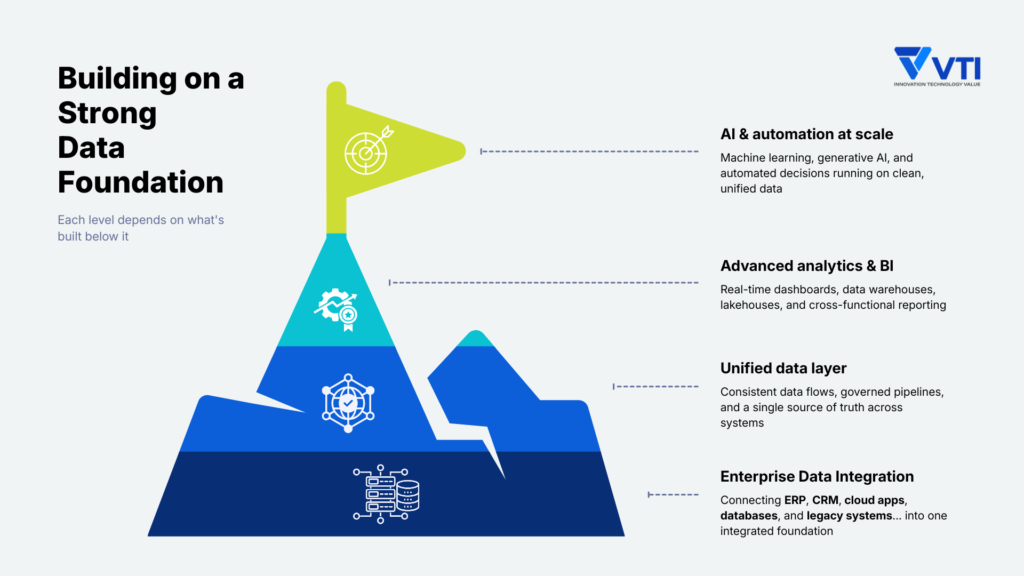
When you evaluate the data integration approach, consider how ERP data integration and other core systems will connect to your broader stack. The strategic value isn’t just cleaner reporting—it’s a durable data backbone that can absorb new systems, support enterprise-wide visibility, and create the conditions for automation and AI at scale.
Key Benefits of Enterprise Data Integration for Business Growth
Improved Data Quality and Operational Efficiency
Enterprise data integration creates a single trusted data foundation by connecting information across finance, sales, operations, and customer systems. This reduces manual reconciliation, improves data consistency, and enables teams to work from the same set of accurate information.
Faster Insights and Better Customer Experiences
By unifying data across systems, organizations gain real-time data visibility into business performance and customer activity. This enables faster decision-making, more personalized customer interactions, and quicker responses to operational issues.
Measurable ROI and Compliance Benefits
Enterprise data integration helps reduce operational costs by eliminating duplicate processes, improving automation, and streamlining reporting. It also strengthens compliance by providing auditable data flows, consistent governance, and traceable data lineage across systems.
Comparing Integration Approaches: Which Data Integration Method Fits Your Architecture
Enterprise data integration goes well beyond standard ETL. At business scale, organizations must unify many systems simultaneously, handle mixed delivery modes, and enforce governance continuously — not just build reporting pipelines.
In practice, most enterprises need a combination of methods. The right choice depends on your workload type, data latency requirements, infrastructure environment, and governance maturity.
| Approach | How it works | Best for | Key trade-off |
| ETL | Data is extracted from sources, transformed before loading, and then delivered to a target system | – Batch reporting – Compliance workloads – Legacy modernization | Transformations must be defined upfront; less flexible when data models evolve frequently |
| ELT | Raw data is loaded into a cloud data warehouse first, then transformed using warehouse compute | – Cloud analytics – Large-scale data onboarding – Flexible re-transformation | Primarily an analytics pattern — does not replace operational integration or governance-heavy pipelines |
| API-Based Integration | Systems exchange data in real time through standardized APIs | – Microservices – Real-time operational flows – Event-driven systems | Depends on reliable, well-documented APIs; less suited to high-volume historical data movement |
| iPaaS | Cloud-based platform combining connectors, orchestration, and governance across distributed systems | – Hybrid cloud environments – Multi-cloud infrastructure – Diverse integration patterns | Requires active governance to prevent uncontrolled integration sprawl over time |
| Middleware Intergration | Bridges older systems to modern architectures through adapters and translation layers | – Legacy ERP connectivity – Mainframe integration – Systems without modern APIs | Can become a maintenance burden as the system landscape grows — not built for cloud-native scale |
Enterprise Data Integration Use Cases Across Industries
Retail and E-Commerce Integration
Enterprise data integration helps retailers synchronize inventory, customer, and pricing data across stores, marketplaces, and digital channels.
Common use cases include real-time inventory visibility, customer data unification across CRM and marketing platforms, and pricing synchronization to support omnichannel operations and personalized customer experiences.
Real-time pricing and promotion management matter for cross-border commerce and multi-store operations, where wholesale, retail, and local-market pricing logic must remain consistent to avoid margin leakage.
This use case works best with event-driven or API-based integration for near-real-time updates rather than batch-only reporting.
Manufacturing and Smart Factory Use Cases
Manufacturers use data integration to connect supply chain, production, and operational systems into a unified view.
Key applications include supply chain visibility, IoT-enabled predictive maintenance, and ERP data integration with manufacturing execution systems (MES) to improve traceability, production efficiency, and process control.
Healthcare Integration Patterns
Healthcare organizations rely on data integration to connect electronic health records, diagnostic systems, billing platforms, and analytics environments.
This supports patient data interoperability, improves care coordination, strengthens regulatory compliance, and enables data-driven healthcare operations.
Key Pillars and Framework for Successful Enterprise Data Integration
Foundational Pillars for Enterprise Data Integration
Enterprise data integration succeeds when organizations treat it as a business transformation initiative rather than a standalone IT project. Five pillars consistently underpin successful programs:
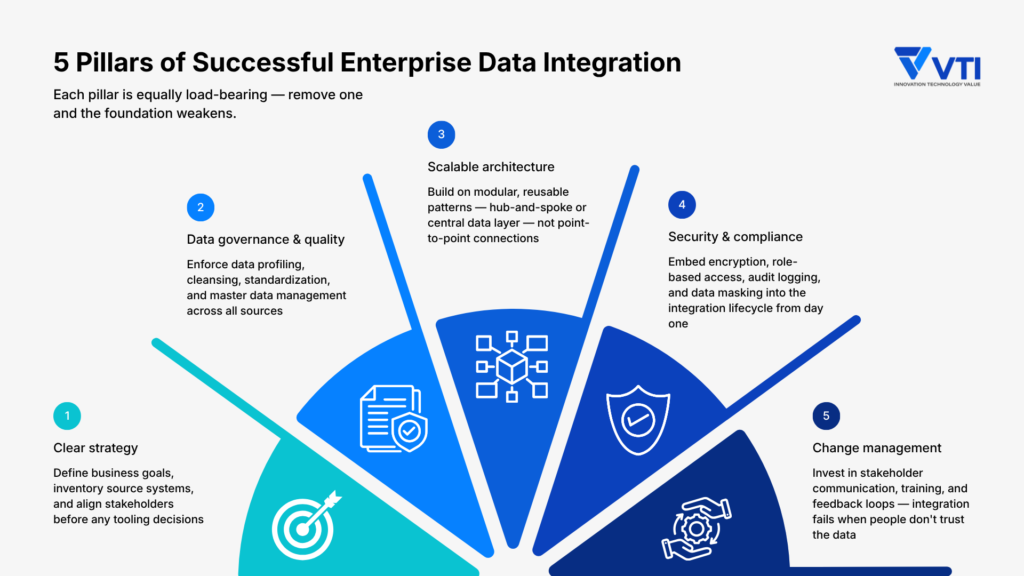
- Strategy: Align integration efforts with business objectives, priority use cases, and measurable outcomes.
- Governance and Data Quality: Establish trusted data through standardization, stewardship, and master data management.
- Scalable Architecture: Use modular, reusable integration patterns that can support growing business and technology needs.
- Security and Compliance: Embed access controls, encryption, auditability, and regulatory requirements into data flows.
- Change Management: Drive adoption through stakeholder alignment, training, and ongoing communication.
These pillars create the foundation for scalable, sustainable integration across the enterprise.
Implementation Framework
A successful enterprise data integration initiative typically progresses through four phases:
1. Assessment and Planning
Map source systems, critical data flows, and business priorities to identify the highest-value integration opportunities. This phase also defines governance requirements, success metrics, and key stakeholders.
2. Architecture Design
Select the right integration patterns, tools, and security controls based on business requirements. The architecture should support cloud, on-premises, and hybrid environments while remaining scalable over time.
3. Iterative Deployment
Start with high-impact use cases and expand incrementally using reusable components. This reduces risk, accelerates delivery, and avoids the complexity of large-scale migrations.
4. Continuous Optimization
Monitor data quality, performance, and business outcomes to ensure the integration platform continues to meet evolving requirements. Regular optimization helps maintain reliability as systems and data volumes grow.
Start with your highest-impact use cases, build reusable components, and measure outcomes against the business KPIs you defined at the outset.
Best Practices for Complex Scenarios
For cloud migration integration, prioritize platforms that connect cloud and on-premises assets during the transition. Effective patterns include cloud-based integration hubs, API gateways for legacy systems, and hybrid storage models that keep sensitive data on-premises while using cloud scalability for analytics.
For hybrid environment management, standardize connectors, enforce metadata and data-quality rules centrally, and use modular integration components so local teams maintain speed while headquarters retains visibility.
For multi-source data consolidation, use common data models, automated data cleansing, monitoring for schema drift and duplicates, and master data management where enterprise entities must be reconciled across ERP, CRM, supply chain, and analytics platforms.
Building Your Enterprise Data Integration Strategy
Enterprise data integration is no longer just an IT project – it’s a strategic foundation that determines how quickly you can make decisions, how well you understand your customers, and how ready you are for AI and automation. Organizations that get this right see faster decision cycles, higher operational efficiency, and lower risk from incomplete data visibility.
The key is to treat integration as a business transformation program, not just a technology purchase — assessing where you stand today, identifying high-impact use cases, and building your strategy around measurable outcomes.
If you’re ready to take that next step, our AI & Data experts can help you assess your data environment and map out the right integration approach for your business.