





![[FREE EBOOK] Strategic Vietnam IT Outsourcing: Optimizing Cost and Workforce Efficiency](https://vti.com.vn/wp-content/uploads/2026/06/ebook-it-outsourcing.png)


Your last AI or cloud architecture role – how long did it take to fill? Have you ended up settling, or are you still facing understaffing? Undoubtedly, you’re living inside Asia’s most pressing enterprise problem, the tech talent shortage. It’s a structural failure that’s quietly becoming your competitors’ advantage if they’re moving faster than you are.
To help you solve this, this article breaks down why the tech shortages is deeper than most hiring strategies account for, why it won’t self-correct, and what the organizations navigating it most effectively are actually doing differently.
TL;DR
- The shortage of tech workers is worse than you think – and it’s not just about headcount. 77% of APAC employers now struggle to fill key roles. The real gap is in quality: AI, cloud, and cybersecurity expertise that didn’t exist at scale five years ago.
- It won’t self-correct soon. Three structural forces – educational lag, aging demographics, and demand outpacing supply – operate on decade-long timelines. Your hiring cycle operates in quarters.
- AI partially helps, but it’s also part of the problem. Hiring tools compress timelines. They don’t create talent that doesn’t yet exist. And every organization expanding AI capabilities is accelerating demand on both sides.
- The structural solution: Buy, Build, Borrow, and Bridge. The organizations winning now have already shifted weight toward Borrow and Bridge – and they’re pulling ahead while others wait for pipelines to mature.
Tech Talent Shortage Overview in Asia
New Level of Technical Talent Shortage: Both Quantity & Quality
If you’ve been struggling to fill AI, cloud, or cybersecurity roles in the past 12–18 months, you’re not alone – and you’re not imagining it. 77% of employers across APAC now report difficulty filling key roles, a sharp jump from just 45% in 2014. But what organizations are facing today goes beyond a headcount problem to a quality problem.
Across Asia, finding professionals with the advanced technical expertise that modern transformation demands has never been harder. The bar has moved well past foundational IT skills – today’s roles require hands-on experience in AI, cloud architecture, cybersecurity, and data engineering.
The pressure is visible across every major market in the region, each shaped by its own digital agenda and investment priorities:
- Malaysia grapples with critical gaps in software engineering, semiconductor expertise, and cloud computing.
- Thailand faces a shortage of industrial digitalization specialists and engineers directly tied to its Thailand 4.0 initiative with smart manufacturing ambitions.
- 60,000+ digital professionals short in Singapore alone – with tech hiring demand growing 20% YoY
- 70%+ of Japanese organizations are understaffed in cloud roles – 52% higher than other regions
Overall, AI Model & Application Development (20%) and AI Literacy (19%) now rank as the hardest skills to source, having fully displaced traditional IT and data roles in a survey of over 39,000 employers across 41 countries.
Salary Inflation and Vacancy Duration Are the Real Operational Signals
And it’s no longer a simple HR problem; these shortage issues translate directly into compressed hiring windows and delayed transformation timelines. Financial pressure is also showing up on spreadsheets.
When cybersecurity or cloud architecture roles stay vacant, organizations face real compliance exposure and stalled modernization programs. To stay competitive, many respond by raising compensation, which leads to inflation in pay raises. Yet, the hiring competition is no longer constrained to domestic companies, but also involves multi-national companies, with a huge budget and a thirst for engineers and data scientists.
In areas like ASEAN, Singapore, as a tech hub, consistently pulls engineers and data scientists away from neighboring markets, deepening supply gaps in Malaysia and Thailand. Or in Vietnam, local companies lead the region with 7.5% tech sector salary inflation, for human resource retention.
In other words, top candidates now receive multiple offers within days. Therefore, organizations with slow approval chains consistently lose out.
Yet, even aggressive compensation strategies offer limited relief. A third of Southeast Asian professionals who received pay raises still plan to leave within 12 months, confirming that salary alone won’t stabilize retention.
This Won’t Self-Correct Anytime Soon
There’s a tempting assumption that this is a market cycle – that supply will catch up as more graduates enter the workforce and salaries normalize. However, the data suggests otherwise. The shortage is structural, driven by three compounding failures:
Education Systems Are Falling Behind Industry Needs
Tech skills now have a shelf life of roughly 2.5 years. Most university curricula still operate on 3–5-year revision cycles. So, by the time a graduate enters the workforce, a meaningful portion of what they studied is already approaching obsolescence. In Southeast Asia, underdeveloped vocational tech pathways make this worse – Malaysia and Thailand in particular face decades of underinvestment in digital education infrastructure.
Without sufficient entry-level pipelines that convert youth interest into qualified tech careers, the shortage compounds with each graduating class that enters the workforce underprepared for modern roles.
Demographic Pressure Is Shrinking the Available Talent Pool
Demographics are adding a second layer of pressure that hiring budgets alone can’t solve. Singapore, for instance, faces an aging workforce – with 1 in 4 residents projected to be aged 65 or older by 2030 – while the pace of digital transformation continues to accelerate. Older workers transitioning from traditional functions into tech-intensive roles require sustained upskilling investment that many organizations aren’t yet structured to provide.
Demand Is Accelerating Faster Than Supply Can Respond
The surge in generative AI adoption, cloud-native infrastructure, and Industry 4.0 automation since 2023 has created role specializations – AI engineering, MLOps, cloud security – that are, by definition, too new for any formal education system to have produced a deep practitioner base. This leaves organizations competing for a pool of experienced practitioners that is, by definition, still small.
Can’t We Use AI to Bridge the Tech Talent Shortage Gap?
The honest answer is No or Just partially. This is not a solution addressing the root causes.
AI is indeed increasing the speed of human resources replenishment. For example:
- AI-assisted hiring tools are indeed delivering real gains. In Singapore, 98% of HR leaders now use AI-powered screening tools that reduce recruitment time by 25–30%.
- AI-driven learning platforms are enabling faster, more personalized upskilling by adapting content to individual tech skills shortages. This has been shown to improve engagement scores and reduce total training time by up to 40%
- In production environments, developers are using AI for simple code and initial debugging. According to GitHub, 80% of new developers on their platform use AI Copilot within the first week.
But there’s an irony worth sitting with: AI adoption is both one of the tools being deployed to address it and one of the drivers of the talent shortage.
Every organization is expanding AI-driven products and capabilities, resulting in more demand. Also, due to the current AI trust gap, we might not need talent that can code simple code or debug the systems, but we need one with enough expertise to supervise what AI is doing.
And the shortage of experienced AI engineers and cloud architects is partially attributed to how recently these technologies emerged. No hiring algorithm or machine can fix that yet.
In summary, AI cannot replace the hard work of your organization in building hiring pipelines, developing internal capabilities, or forging the right external partnerships.
What Should Companies Do to Address the Tech Talent Shortage?
There is no 100% single fix. Based on McKinsey’s framework, our experts have identified four levers organizations can pull when facing a structural shortage: Buy, Build, Borrow, and Bridge – rather than betting everything on one approach. The right balance depends on your organization’s timeline, budget, and where the tech talent shortage is most critical.
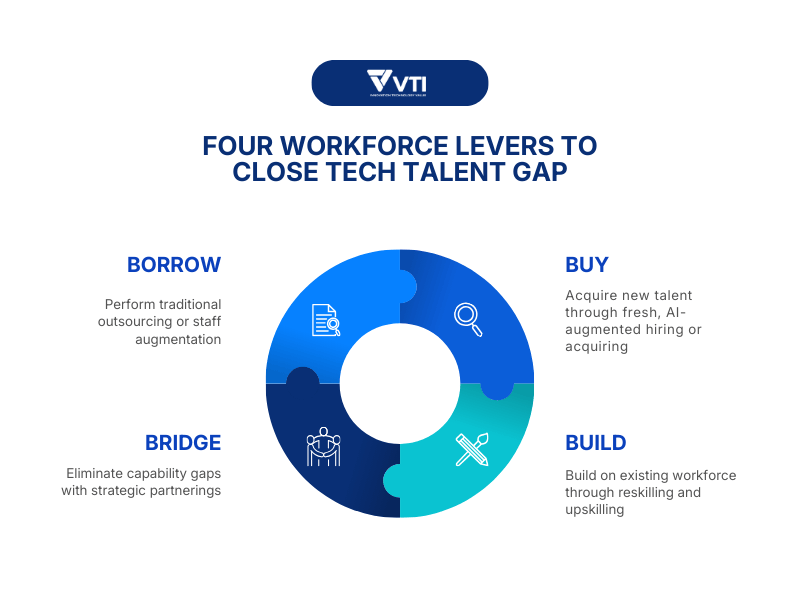
Buy – Rethinking How Talent Gets Hired
Hiring remains necessary, but a Buy-only strategy is increasingly a losing position in the current market. The most in-demand profiles – AI engineers, cloud architects, security specialists – are rarely won on compensation alone. As mentioned, a third of Southeast Asian professionals who received pay raises still plan to leave within 12 months.
Organizations that compete effectively for talent are doing three things differently:
- Using AI-assisted screening to compress time-to-offer – speed is now a competitive differentiator, not just a process metric
- Shifting to skills-based hiring that evaluates demonstrated ability over formal credentials, drawing from adjacent industries where transferable technical skills exist, 93% of talent professionals in Southeast Asia now view this as key to improving hire quality
- Recruiting continuously through technical communities rather than reactive job postings, so they’re building relationships before roles open
Buy well – but recognize its ceiling. In an undersupplied market, you will not hire your way out of this. In other words, this works well as a maintenance strategy, not a breakthrough solution.
Build – Investing in Internal Talent Pipelines
Accelerated internal upskilling has moved from an HR initiative to a core enterprise strategy. For example, organizations in Singapore are aligning training programs with government-backed schemes like SkillsFuture, focusing on machine learning, cloud infrastructure, and cybersecurity. Cybersecurity headcount in Southeast Asia grew 160% year-on-year.
The most effective Build programs share a few characteristics:
- Partnering with hyperscalers (AWS, Azure, Google Cloud) to deliver certified training tracks tied directly to open internal roles – this improves both fill rates and retention by giving engineers a visible career path
- Starting with a skills inventory to baseline current capabilities, organizations consistently find they need less reskilling than assumed. And that high-potential employees are holding in-demand skills in roles that don’t use them
Build is essential for long-term resilience. Yet, internal pipelines typically take 12–18 months to meaningfully close acute gaps. It is not a solution for roles that need to be filled this quarter.
Borrow: Immediately Solving Developers Shortage
When a cloud migration cannot wait for a six-month hiring cycle, or a cybersecurity training program cannot fix a compliance gap today, “borrowing” talent through IT outsourcing or staff augmentation offers a high-velocity solution. It comes with unignorable advantages:
- On-Demand Expertise: Beyond just headcount, augmentation allows CIOs to bring in “SME-level” (Subject Matter Expert) talent for high-stakes phases, like architectural setup or security hardening, that the internal team can then maintain.
- Risk & Compliance Offloading: By partnering with specialized firms, organizations can shift the burden of specialized regulatory compliance (e.g., MAS guidelines in Singapore) to providers who already possess the certified infrastructure and vetted talent.
- Operational Elasticity: It allows for “burst capacity” during peak project cycles (like a core banking upgrade) without the long-term liability of permanent headcount or the morale impact of post-project layoffs.
Borrowing is a high-performance solution for urgent tasks. It buys you the most valuable commodity in a digital transformation: Time. Use it to maintain momentum while your internal “Build” strategies mature.
Bridge: Building Strategic Partnerships
This is where the highest-value lever sits. Partnering with large system integrators or managed service providers offers something traditional transactional staffing cannot: stable, deep access to technical talent embedded within a structured relationship.
The differences that matter in practice:
- Talent turnover risk is significantly lower because engineers are part of a partner organization’s career structure, not project-by-project contractors
- Skill quality tends to be higher – established partners maintain talent benches, internal training programs, and specialized practice areas that individual contractors don’t
- Knowledge transfers across engagements, building institutional capability on both sides rather than resetting with every hire cycle
- For organizations with regional or global footprints, partnerships with providers in talent-rich markets like Vietnam enable access to deep technical expertise while maintaining operational continuity and cost efficiency
With the right partners, you will have a complete talent-filling structure that helps navigate through the turbulence of the software developer shortage and move faster in this DX transformation era.
Final words
Asia’s tech talent shortage isn’t a temporary headcount problem. It’s a structural challenge reshaping how organizations compete, execute transformation, and build for the future. The underlying causes – educational lag, demographic pressure, demand outpacing supply – will not resolve in the next budget cycle.
The organizations navigating this most effectively aren’t the ones with the largest recruiting budgets. They’re the ones that recognized early that hiring alone couldn’t solve the tech talent shortage – and built a portfolio strategy: upskilling internally for the long term, augmenting tactically for immediate needs, and partnering strategically for sustained capability.
The Borrow and Bridge levers, done right, become the infrastructure that keeps transformation moving while longer-term pipelines mature.
The question worth asking now: Is your current talent strategy built for the market as it actually is – or for how it was two years ago?