





![[FREE EBOOK] Strategic Vietnam IT Outsourcing: Optimizing Cost and Workforce Efficiency](https://vti.com.vn/wp-content/uploads/2026/06/ebook-it-outsourcing.png)



If you’re struggling to keep your stores fully staffed, you’re not alone. The retail labor shortage has been bugging store leaders in Asia, especially in traditional markets like Korea, Japan, and Singapore, for years.
Empty positions aren’t just inconvenient – they’re directly impacting your bottom line through reduced operating hours, declining customer satisfaction, and missed revenue opportunities.
This article breaks down exactly why the retail workforce crisis is happening; how it’s affecting different store formats, from drugstores to convenience stores; and most importantly, what you can actually do about it. You’ll discover:
- Practical retention strategies,
- A comprehensive recruiting-training-operating circle,
- Retail DX that reduce your dependency on hard-to-find staff while maintaining the service standards your customers expect.
What are the main causes of the retail labor shortage in 2026?
While comprehensive 2026 statistics continue to emerge, the labor shortage in retail has become a pressing challenge affecting thousands of retailers worldwide. Understanding the root causes helps organizations develop effective strategies to address workforce gaps and maintain competitive operations.
Demographic shifts and aging populations
Demographic shifts are fundamentally reshaping labor availability across Asia. Rapidly declining birth rates and aging populations – highlighted by South Korea’s record-low TFR of 0.78 and Japan’s shrinking workforce – are severely reducing youth labor market participation.
Similarly, Singapore’s ultra-low TFR (1.04) has created an intensely tight and competitive market for skilled workers, forcing reliance on foreign talent.
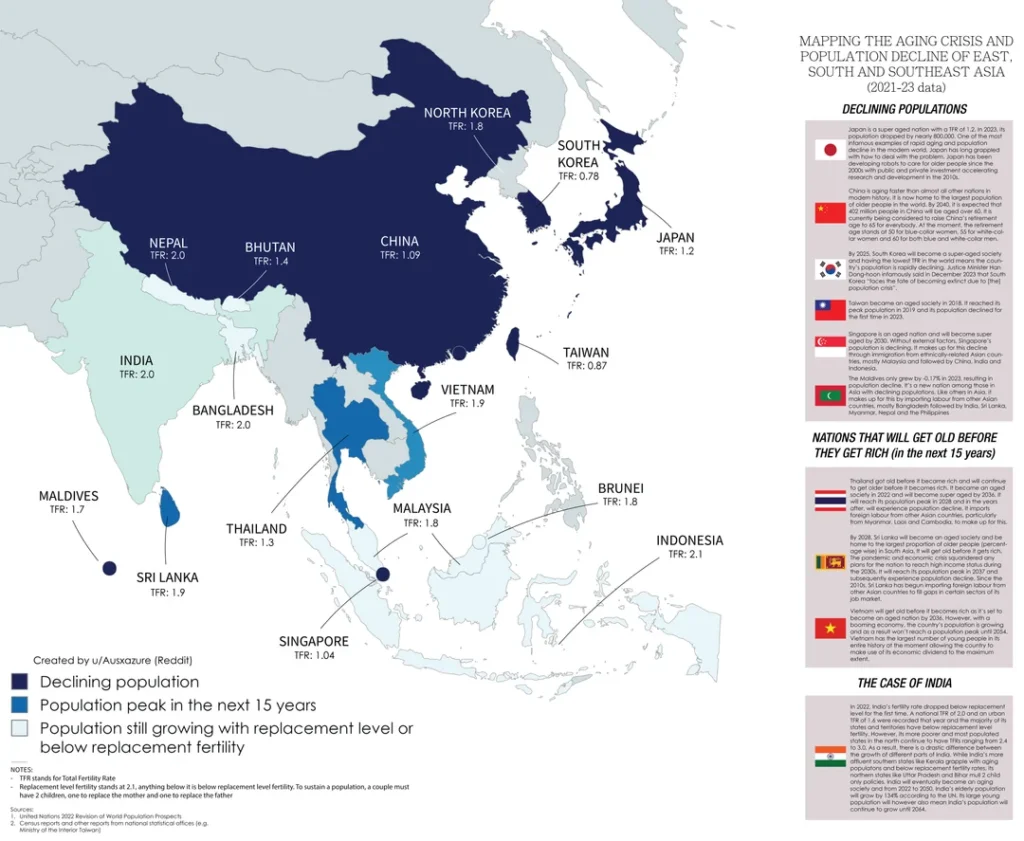
These demographic realities represent a permanent acceleration of pre-pandemic trends rather than a temporary disruption.
Retail faces particularly acute challenges due to its historical dependence on entry-level youth workers and physical presence requirements. With traditional recruitment pools shrinking each year, retailers can no longer rely on a steady influx of young talent.
As a result, companies across these rapidly aging markets must completely restructure their talent pipelines. To survive, businesses are being forced to compete more aggressively for available labor, adapt workplaces for older demographics, and heavily invest in automation.
Changing career preferences and sector competition
Younger generations increasingly view retail positions as temporary rather than career paths. The rise of e-commerce and logistics sectors has created alternative employment opportunities with competitive wages and perceived better progression.
Post-pandemic workforce mobility patterns show workers prioritizing flexibility, remote options, and work-life balance – attributes that traditional retail roles struggle to offer.
Research suggests significant worker migration from traditional retail to fulfillment operations, directly depleting the retail talent pool.
In Japan, for instance, convenience stores face particularly severe shortages as younger workers increasingly prefer warehouse roles with predictable shifts.
Economic pressures and wage competition
According to industry analyses, inflation has significantly impacted retail compensation budgets while retailers face pressure to increase wages. Many organizations find themselves caught between margin pressures and competitive pay requirements across sectors. This is a no-win competition that smaller retailers, in particular, struggle to match.
The growing skills gap further complicates hiring as inadequate training programs fail to keep pace with evolving requirements. Modern retail positions require proficiency in point-of-sale systems, inventory management software, and omnichannel customer service platforms. However, older workers often lack digital literacy, while younger candidates expect more advanced systems than many retailers provide.
High turnover and persistent vacancies
Retail sector turnover rates remain elevated compared to other industries, creating a continuous hiring cycle that strains resources. In fact, wholesale and retail trade recorded the second-highest labor turnover volume across all industries in the first half of 2025, with separations closely trailing new hires.
This instability is compounded by the sector’s structural reliance on flexible labor. Like in Japan, part-time employees account for 56.3% of the total retail headcount, creating a workforce that is inherently difficult to retain, develop, and consistently deploy.
Consequently, severe personnel allocation issues emerge when unfilled positions force existing staff to cover multiple roles, leading to burnout and attrition.
Moreover, this cycle diminishes customer service quality, disrupts training continuity, and forces reduced store operating hours. Projections through 2025 indicate these staffing challenges will persist without strategic intervention and innovative workforce solutions.
How is the retail labor shortage affecting store operations and profitability?
The labor shortage in retail is fundamentally disrupting daily operations and financial performance across the industry.
Immediate operational disruptions
Retail labor plans fall short on the front line, forcing stores to reduce operating hours and limit available services. Checkout lines lengthen as fewer cashiers manage growing customer volumes, while restocking delays leave shelves empty during peak shopping periods.
Personnel allocation issues become critical when managers cannot maintain adequate floor coverage across departments, with challenges intensifying during weekend rushes and holiday periods.
Merchandising standards deteriorate as remaining staff prioritize essential tasks over visual presentation and inventory organization. Many retailers report shortened business hours or closed departments, directly reducing revenue opportunities and customer accessibility.
Financial impact and rising costs
Industry reports indicate the retail labor shortage crisis drives double-digit percentage increases in labor costs across multiple operational areas. Overtime expenses surge as existing employees cover unfilled shifts, while recruitment and training costs escalate with higher turnover rates. Lost sales from stockouts and poor product availability compound these pressures, eroding profit margins.
Strategic growth constraints
Staffing limitations prevent retailers from executing expansion plans and innovation initiatives. New store openings face delays or cancellation when organizations cannot adequately staff existing locations. Format experiments and omnichannel integration projects stall without sufficient personnel to manage increased operational complexity.
Retail’s shifting labor landscape shows retailers prioritizing survival over growth, redirecting resources from strategic initiatives to immediate staffing needs.
Customer experience degradation
Service quality metrics reveal substantial customer satisfaction declines linked directly to understaffing through quantifiable correlations between wait times and Net Promoter Score (A metric measuring customer loyalty based on their likelihood to recommend) drops. Certainly, shoppers encountering longer wait times, unavailable assistance, and inconsistent product availability systematically rate their experiences lower.
Better-staffed competitors and automated alternatives gain market share from retailers unable to deliver expected service levels.
Unique staffing challenges across drugstores, supermarkets, and convenience stores
The retail labor shortage manifests differently across store formats, with each category facing distinct operational and regulatory constraints.
Understanding these format-specific challenges helps executives develop targeted recruitment and retention strategies that address actual workforce barriers.
Drugstore staffing complexities
Pharmacist shortage creates critical bottlenecks as drugstores require licensed professionals who meet strict regulatory standards.
Medication handling demands compliance expertise that cannot be delegated to general retail staff. Customers expect detailed product consultations and health advice that require specialized pharmaceutical knowledge.
Therefore, shift scheduling assignment becomes particularly challenging when pharmacist availability determines store prescription service hours.
Supermarket operational demands
The supermarket labor landscape reveals unique complexity around fresh food departments requiring food safety certification and handling expertise.
In addition, early morning shifts for produce and dairy create scheduling difficulties, while in-store production departments like bakeries and delis need skilled workers.
Seasonal demand fluctuations compound personnel allocation issues as holiday periods require rapid workforce scaling.
High-touch service counters for meat, seafood, and prepared foods cannot operate without trained employees, forcing departments to close or reduce hours when understaffed.
Convenience store round-the-clock challenges
Convenience store staffing challenges center on 24/7 operation requirements that create difficult overnight shift coverage.
Part-time student workers show particularly high turnover, disrupting continuity and requiring constant recruitment efforts.
Safety concerns emerge for solo late-night shifts, yet many locations cannot afford multiple employees during low-traffic hours.
Employees must handle diverse responsibilities, including food service preparation, inventory management, customer service, and cash handling. This multi-skilled requirement narrows the available talent pool significantly.
Cross-format retention barriers
All three formats share common retention obstacles that intensify the retail labor shortage:
- Unsociable hours, including nights, weekends, and holidays, deter potential applicants seeking predictable schedules.
- Physical demands from standing, lifting, and repetitive tasks create health concerns, particularly for aging workers.
- Customer-facing stress escalates as understaffing increases workload and reduces service quality, creating negative feedback loops.
- Wage constraints within these low-margin categories limit competitive compensation despite intense competition from logistics and food service sectors.
A Full-Circle Framework to Escape the Retail Labor Shortage Cycle
Understanding the scale of the problem is necessary – but it can also feel paralyzing. When demographic decline, wage competition, and structural workforce shrinkage converge simultaneously, the instinct is to treat each symptom in isolation: post another job listing, raise pay, implement a loyalty program.
What moves the needle is reducing your dependency on headcount at every stage of the workforce lifecycle – finding people faster, getting them productive sooner, running operations with leaner teams, and managing the business with greater intelligence.
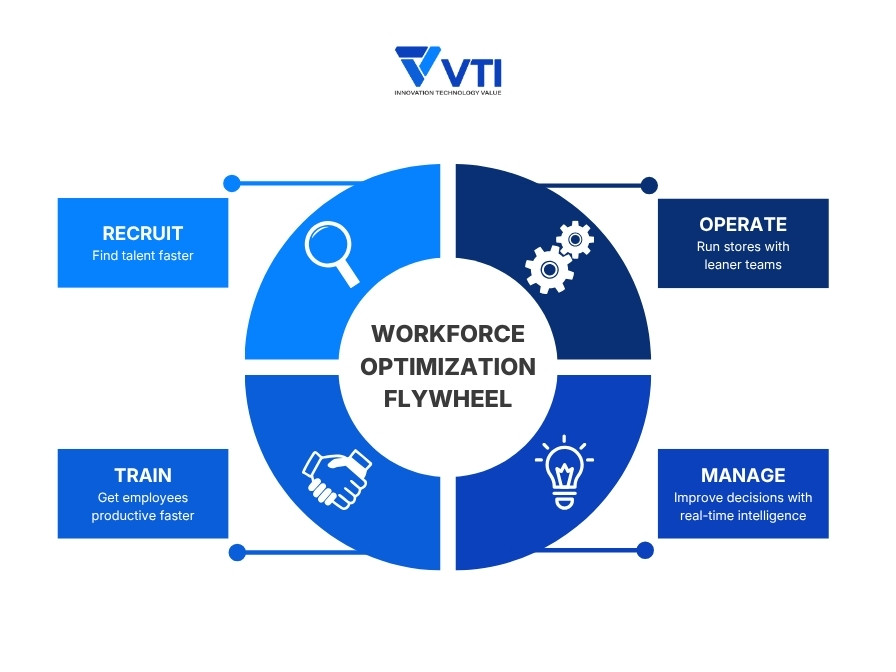
Modern technologies now exist to support every stage of the workforce lifecycle:
- Recruit – identify and screen candidates faster than your competitors can
- Train – compress onboarding timelines and build competency without tying up senior staff
- Operate – run stores efficiently with leaner teams through in-store automation
- Manage – make smarter decisions about labor, inventory, and sales with real-time intelligence
Each stage compounds on the next.
Faster recruiting reduces vacancy pressure. Shorter training cycles mean new hires contribute sooner.
Smarter operations mean fewer people can cover more ground.
Better management data means fewer costly surprises.
Together, they build a retail workforce model that is structurally more resilient – regardless of what the labor market does next.
The sections below map the key technologies available at each stage, with links to deeper implementation guides where you find the most relevant.
AI Recruiting Agents Will Be the Competitive Solution
In a tight labor market, speed and reach are everything. The retailers filling vacancies consistently are not necessarily offering the most – they are moving faster, casting wider, and filtering smarter than their competitors. Technology now makes all three achievable without scaling up your HR team.
AI-assisted CV screening and candidate matching
Retail hiring volumes are high, and time-to-offer is a genuine competitive differentiator. AI-powered screening tools analyze incoming applications against role requirements, flagging best-fit candidates within minutes rather than days.
Beyond basic keyword matching, modern systems assess behavioral indicators, availability patterns, and predicted tenure based on historical hiring data – helping managers prioritize candidates most likely to stay past the 90-day mark. For high-turnover formats like convenience stores and supermarkets, this alone can meaningfully reduce the cost-per-hire.
AI agent-supported recruiting workflows
Beyond screening, AI recruiting agents can handle the early stages of candidate engagement entirely – sending application acknowledgments, scheduling interviews, answering common role queries, and following up with candidates who go quiet.
This removes the administrative bottleneck that causes many candidates to drop off before ever speaking to a human, particularly important in logistics and F&B service sectors.
What are the best training strategies for understaffed retail stores?
In high-turnover retail environments, traditional classroom-style onboarding is too slow, too resource-intensive, and too dependent on experienced staff who are already stretched with daily operations.
Regarding that, technology-driven training reduces that gap significantly – and critically, it does so without pulling managers off the floor.
AI chatbot-based training and knowledge support
Conversational AI tools deliver onboarding content, product knowledge, and compliance training through a familiar chat interface that new hires can access on their own schedule.
Rather than shadowing a senior colleague for days, new employees query the system in real time – whether that’s asking how to handle a return, locate a product, or follow food safety procedures.
The same tool continues serving as a knowledge resource after onboarding, reducing the number of questions that escalate to supervisors and improving consistency across locations.
AI camera-based performance supervision
Computer vision systems can monitor floor activity and identify gaps in execution – whether a new hire is following checkout procedures correctly, whether restocking tasks are being completed on schedule, or whether customer queues are building unattended.
Rather than replacing human management, these systems surface specific coaching signals, allowing supervisors to give targeted feedback based on actual observed behavior rather than general impression. For multi-location operators, this creates consistent training standards without requiring a dedicated trainer at every site.
Running stores efficiently with leaner tech-driven teams
Operational coverage is where the labor shortage hits hardest – checkout lines, restocking delays, overnight shifts, and service gaps that directly affect customer experience and revenue.
The technologies for in-store operation do not replace human judgment, but keep humans in the loop. They remove the tasks that do not require it, freeing existing staff for interactions where their presence genuinely matters.
Unmanned and autonomous store systems
Computer vision and sensor fusion technology now enables cashier-free store formats that operate 24/7 without requiring staff for every transaction. Customers enter, select products, and are charged automatically upon exit.
For convenience store operators facing staffing challenges, specifically the overnight shift, fully unmanned store or hybrid models (automated during low-traffic hours, staffed during peaks) offer a practical path.
This idea maintains service standards without the safety and cost pressures of solo late-night shifts.
AI-powered shoplifting prevention
Reducing shrinkage has historically required either staff presence or visible deterrents. Modern AI camera systems detect suspicious behavioral patterns in real time – unusual dwell times, concealment gestures, barrier tailgating – and alert staff or trigger automated responses without requiring continuous human monitoring.
For understaffed stores where loss prevention coverage has effectively disappeared, these shoplifting prevention systems recover a measurable margin while operating with minimal ongoing labor input.
Self-checkout and mobile scanning systems
Self-checkout adoption consistently reaches 60–70% in stores with clear signage and basic staff support nearby. Modern systems handle age verification, weighted item detection, and coupon processing with minimal intervention, allowing a single staff member to oversee multiple lanes simultaneously. Mobile scanning apps extend this further, letting customers scan as they shop and skip the checkout queue entirely – a model that reduces peak-hour congestion without adding headcount.
Digital signage and automated promotion management
Promotional execution is one of the most labor-intensive recurring tasks in retail – printing, placing, and updating signage across a store takes hours per cycle and is prone to human error.
Digital signage systems update centrally, deploy instantly across all screens, and can be triggered dynamically based on time of day, inventory levels, or weather data. Moreover, retailers can also leverage the power of AI to customize promotions for pass-by customers.
For promotional-heavy formats like drugstores and supermarkets, this eliminates a recurring staffing burden while actually improving promotional consistency.
Making Smarter Decisions With Real-Time Operational Intelligence
The manage stage is where labor efficiency compounds. Even with the right people recruited, trained, and deployed, poor visibility into what is actually happening across store operations creates waste – overstaffed slow periods, understaffed peaks, inventory gaps that require emergency labor, and promotional decisions made on stale data. The technologies in this stage replace guesswork with real-time intelligence.
Automated shift scheduling systems
AI-driven scheduling tools analyze historical transaction volumes, foot traffic patterns, seasonal trends, and staff availability to automatically generate optimized schedules.
Rather than managers spending hours building rosters manually – and inevitably missing patterns that data would catch – these systems produce schedules aligned to actual demand, reducing both overtime costs and coverage gaps simultaneously.
Mobile-enabled platforms send instant notifications for shift changes and allow staff to swap shifts with manager approval, reducing the last-minute scramble that consumes disproportionate management time in understaffed environments.
Sales Management and Customer Data Platforms
Understanding which products are selling, to whom, at what times, and through which channels is the foundation of labor-efficient retail.
Integrated sales management platforms consolidate POS data, loyalty program behavior, and promotional performance into actionable dashboards – enabling store managers to make staffing, merchandising, and replenishment decisions based on what is actually happening rather than intuition. Reduced guesswork at the operational level translates directly into reduced waste, including labor waste.
Inventory management and automated replenishment
Manual stock counting and replenishment planning are among the highest-labor, lowest-skill tasks in retail operations.
Automated inventory systems track real-time stock levels through POS integration and sensor data, generate replenishment triggers before shelves run out of stock, and flag discrepancies that indicate shrinkage or receiving errors.
Freeing staff from repetitive counting tasks redirects their time toward customer-facing activity – and in understaffed stores, that reallocation is often the difference between acceptable and poor service levels.
Shelf-life and freshness management systems
For supermarkets and drugstores managing perishable categories, shelf-life monitoring systems track expiry dates automatically and generate markdown or removal alerts before products become a compliance issue.
This removes a significant ongoing labor requirement – manual data-checking across fresh categories is time-consuming and error-prone – while simultaneously reducing waste costs. AI-driven systems can also predict freshness-related demand patterns, improving ordering accuracy and reducing the emergency restocking that strains already lean teams.
Final words
The retail labor shortage in Asia is not a temporary disruption waiting to resolve itself. Demographic trajectories in Korea, Japan, and Singapore point to a permanently smaller workforce – one that will become more contested, not less, over the coming decade.
The retailers who navigate this successfully will not be those who simply try harder at traditional hiring and retention. They will be those who fundamentally restructure how their operations consume labor – recruiting with greater speed and precision, training new hires faster, running stores with leaner teams, and managing the business with real-time intelligence rather than intuition.
The technologies to do this exist today, are actively deployed across APAC markets, and deliver measurable ROI within 12–18 months of implementation. The question for most retail operators is no longer whether to adopt them – it is which stage of the cycle to address first.
Start where your operation is most broken. Use the linked guides above to go deeper on the solutions most relevant to your format and market. And build toward a workforce model that performs regardless of what the labor market does next.
At VTI, we specialize in building scalable IT infrastructure, seamless system integrations, and tailored retail solutions that transform distributed operational challenges into a structured, highly profitable ecosystem.